Thank you for visiting SNEWPapers!
Sign up free
Literary
March 22, 1839
Southern Christian Advocate
Charleston, Charleston County, South Carolina
What is this article about?
Theological essay from the London Christian Observer expounding St. James 1:18,21 on regeneration: its origin in God's will, instrument as the engrafted word of truth, human cooperation in receiving it meekly, and ends in man's salvation and God's glory. Emphasizes grace over works, humbling man and promoting holiness.
Clipping
OCR Quality
98%
Excellent
Full Text
CHRISTIAN DOCTRINE
From the London Christian Observer.
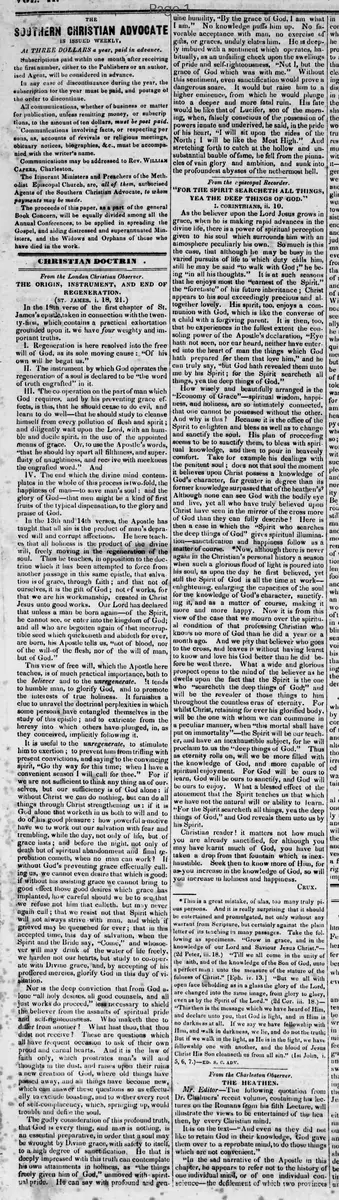
THE ORIGIN, INSTRUMENT, AND END OF REGENERATION.
(ST. JAMES, i. 18, 21.)
In the 18th verse of the first chapter of St. James's epistle, taken in connection with the twenty-first, which contains a practical exhortation grounded upon it, we have four weighty and important truths.
I. Regeneration is here resolved into the free will of God, as its sole moving cause: "Of his own will he begat us."
II. The instrument by which God operates the regeneration of a soul is declared to be "the word of truth engrafted" in it.
III. The co-operation on the part of man which God requires, and by his preventing grace effects, is this, that he should cease to do evil, and learn to do well—that he should study to cleanse himself from every pollution of flesh and spirit; and diligently wait upon the Lord, with an humble and docile spirit, in the use of the appointed means of grace. Or, to use the Apostle's words, that he should lay apart all filthiness, and superfluity of naughtiness, and receive with meekness the engrafted word."
And
IV. The end which the divine mind contemplates in the whole of this process is two-fold, the happiness of man—to save man's soul: and the glory of God—that men might be a kind of first fruits of the typical dispensation, to the glory and praise of God.
In the 13th and 14th verses, the Apostle has taught that all sin is the product of man's depraved will and corrupt affections. He here teaches that all holiness is the product of the divine will, freely moving in the regeneration of the soul. Thus he teaches, in opposition to the doctrine which it has been attempted to force from another passage in this same epistle, that salvation is of grace, through faith; and that not of ourselves, it is the gift of God; not of works, for that we are his workmanship, created in Christ Jesus unto good works. Our Lord has declared that unless a man be born again—of the Spirit, he cannot see, or enter into the kingdom of God; and all who are begotten again of that incorruptible seed which quickeneth and abideth for ever, are born, his Apostle tells us, "not of blood, nor of the will of the flesh, nor of the will of man, but of God."
This view of free will, which the Apostle here teaches, is of much practical importance, both to the believer and to the unregenerate. It tends to humble man, to glorify God, and to promote the interests of true holiness. It furnishes a clue to unravel the doctrinal perplexities in which some persons have entangled themselves in the study of this epistle; and to extricate from the heresy into which others have plunged, in, as they conceived, implicitly following it.
It is useful to the unregenerate, to stimulate him to exertion; to prevent him from trifling with present convictions, and saying to the convincing spirit, "Go thy way for this time; when I have a convenient season I will call for thee." For if we are not sufficient to think any thing as of ourselves, but our sufficiency is of God alone: if without Christ we can do nothing, but can do all things through Christ strengthening us: if it is God alone that worketh in us both to will and to do of his good pleasure: how powerful a motive have we to work out our salvation with fear and trembling, while the day, not only of life, but of grace lasts; and before the night, not only of death but of spiritual abandonment and final reprobation cometh, when no man can work? If without God's preventing grace effectually calling us, we cannot even desire that which is good: if without his assisting grace we cannot bring to good effect those good desires which grace has implanted, how careful should we be to see that we refuse not him that calleth, but may never again call; that we resist not that Spirit which will not always strive with man, and which if grieved may be quenched for ever; that in this accepted time, this day of salvation, when the Spirit and the Bride say, "Come," and whosoever will may drink of the water of life freely, we harden not our hearts, but study to co-operate with Divine grace, and, by accepting of his proffered mercies, glorify God in this day of visitation.
Nor is the deep conviction that from God alone "all holy desires, all good counsels, and all just works do proceed," less necessary to shield the believer from the assaults of spiritual pride and self-righteousness. Who maketh thee to differ from another? What hast thou, that thou didst not receive? These are questions which all have frequent occasion to ask of their own proud and carnal hearts. And it is the law of faith only, which prostrates man's will and thoughts in the dust, and raises upon their ruins a new creation of God, where old things have passed away, -and all things have become new, which can answer these questions so as effectually to exclude boasting, and to wither every root of self-complacency, which, springing up, would trouble and defile the soul.
The godly consideration of this profound truth, that God is every thing, and man is nothing, is an essential preparative, in order that a soul may be wrought by Divine grace, with safety to itself, to a high degree of sanctification. He that is deeply impressed with this truth can contemplate his own attainments in holiness, as "the things freely given him of God," unmoved with spiritual pride. He can say with profound and genuine humility, "By the grace of God, I am what I am." No knowledge puffs him up. No favorable acceptance with man, no exercise of gifts, or graces, unduly elates him. He is deeply imbued with a sentiment which operates, habitually, as an unfailing check upon the swellings of pride and self-righteousness, "Not I, but the grace of God which was with me." Without this sentiment, even sanctification would prove a dangerous snare. It would but raise him to a higher eminence, from which he would plunge into a deeper and more fatal ruin. His fate would be like that of Lucifer, son of the morning, when, falsely conscious of the possession of powers innate and underived, he said, in the pride of his heart, "I will sit upon the sides of the North; I will be like the Most High." And stretching forth to catch at the hollow and unsubstantial bauble of fame, he fell from the pinnacles of vain glory and ambition, and sunk into the profoundest abysses of the nethermost hell.
From the London Christian Observer.
THE ORIGIN, INSTRUMENT, AND END OF REGENERATION.
(ST. JAMES, i. 18, 21.)
In the 18th verse of the first chapter of St. James's epistle, taken in connection with the twenty-first, which contains a practical exhortation grounded upon it, we have four weighty and important truths.
I. Regeneration is here resolved into the free will of God, as its sole moving cause: "Of his own will he begat us."
II. The instrument by which God operates the regeneration of a soul is declared to be "the word of truth engrafted" in it.
III. The co-operation on the part of man which God requires, and by his preventing grace effects, is this, that he should cease to do evil, and learn to do well—that he should study to cleanse himself from every pollution of flesh and spirit; and diligently wait upon the Lord, with an humble and docile spirit, in the use of the appointed means of grace. Or, to use the Apostle's words, that he should lay apart all filthiness, and superfluity of naughtiness, and receive with meekness the engrafted word."
And
IV. The end which the divine mind contemplates in the whole of this process is two-fold, the happiness of man—to save man's soul: and the glory of God—that men might be a kind of first fruits of the typical dispensation, to the glory and praise of God.
In the 13th and 14th verses, the Apostle has taught that all sin is the product of man's depraved will and corrupt affections. He here teaches that all holiness is the product of the divine will, freely moving in the regeneration of the soul. Thus he teaches, in opposition to the doctrine which it has been attempted to force from another passage in this same epistle, that salvation is of grace, through faith; and that not of ourselves, it is the gift of God; not of works, for that we are his workmanship, created in Christ Jesus unto good works. Our Lord has declared that unless a man be born again—of the Spirit, he cannot see, or enter into the kingdom of God; and all who are begotten again of that incorruptible seed which quickeneth and abideth for ever, are born, his Apostle tells us, "not of blood, nor of the will of the flesh, nor of the will of man, but of God."
This view of free will, which the Apostle here teaches, is of much practical importance, both to the believer and to the unregenerate. It tends to humble man, to glorify God, and to promote the interests of true holiness. It furnishes a clue to unravel the doctrinal perplexities in which some persons have entangled themselves in the study of this epistle; and to extricate from the heresy into which others have plunged, in, as they conceived, implicitly following it.
It is useful to the unregenerate, to stimulate him to exertion; to prevent him from trifling with present convictions, and saying to the convincing spirit, "Go thy way for this time; when I have a convenient season I will call for thee." For if we are not sufficient to think any thing as of ourselves, but our sufficiency is of God alone: if without Christ we can do nothing, but can do all things through Christ strengthening us: if it is God alone that worketh in us both to will and to do of his good pleasure: how powerful a motive have we to work out our salvation with fear and trembling, while the day, not only of life, but of grace lasts; and before the night, not only of death but of spiritual abandonment and final reprobation cometh, when no man can work? If without God's preventing grace effectually calling us, we cannot even desire that which is good: if without his assisting grace we cannot bring to good effect those good desires which grace has implanted, how careful should we be to see that we refuse not him that calleth, but may never again call; that we resist not that Spirit which will not always strive with man, and which if grieved may be quenched for ever; that in this accepted time, this day of salvation, when the Spirit and the Bride say, "Come," and whosoever will may drink of the water of life freely, we harden not our hearts, but study to co-operate with Divine grace, and, by accepting of his proffered mercies, glorify God in this day of visitation.
Nor is the deep conviction that from God alone "all holy desires, all good counsels, and all just works do proceed," less necessary to shield the believer from the assaults of spiritual pride and self-righteousness. Who maketh thee to differ from another? What hast thou, that thou didst not receive? These are questions which all have frequent occasion to ask of their own proud and carnal hearts. And it is the law of faith only, which prostrates man's will and thoughts in the dust, and raises upon their ruins a new creation of God, where old things have passed away, -and all things have become new, which can answer these questions so as effectually to exclude boasting, and to wither every root of self-complacency, which, springing up, would trouble and defile the soul.
The godly consideration of this profound truth, that God is every thing, and man is nothing, is an essential preparative, in order that a soul may be wrought by Divine grace, with safety to itself, to a high degree of sanctification. He that is deeply impressed with this truth can contemplate his own attainments in holiness, as "the things freely given him of God," unmoved with spiritual pride. He can say with profound and genuine humility, "By the grace of God, I am what I am." No knowledge puffs him up. No favorable acceptance with man, no exercise of gifts, or graces, unduly elates him. He is deeply imbued with a sentiment which operates, habitually, as an unfailing check upon the swellings of pride and self-righteousness, "Not I, but the grace of God which was with me." Without this sentiment, even sanctification would prove a dangerous snare. It would but raise him to a higher eminence, from which he would plunge into a deeper and more fatal ruin. His fate would be like that of Lucifer, son of the morning, when, falsely conscious of the possession of powers innate and underived, he said, in the pride of his heart, "I will sit upon the sides of the North; I will be like the Most High." And stretching forth to catch at the hollow and unsubstantial bauble of fame, he fell from the pinnacles of vain glory and ambition, and sunk into the profoundest abysses of the nethermost hell.
What sub-type of article is it?
Essay
What themes does it cover?
Religious
Moral Virtue
What keywords are associated?
Regeneration
Divine Grace
Salvation
Holiness
Free Will
Spiritual Pride
Sanctification
What entities or persons were involved?
From The London Christian Observer.
Literary Details
Title
The Origin, Instrument, And End Of Regeneration.
Author
From The London Christian Observer.
Subject
(St. James, I. 18, 21.)
Key Lines
Of His Own Will He Begat Us.
The Word Of Truth Engrafted
Lay Apart All Filthiness, And Superfluity Of Naughtiness, And Receive With Meekness The Engrafted Word.
Salvation Is Of Grace, Through Faith; And That Not Of Ourselves, It Is The Gift Of God;
By The Grace Of God, I Am What I Am.