Thank you for visiting SNEWPapers!
Sign up free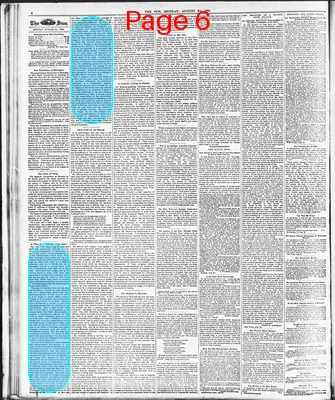
Editorial
August 31, 1896
The Sun
New York, New York County, New York
What is this article about?
In 1896, New York's presidential election lacks local or state office contests due to term changes, allowing undivided focus on the national debate over maintaining the gold standard for commercial honor versus attempts to overthrow it.
Clipping
OCR Quality
98%
Excellent
Full Text
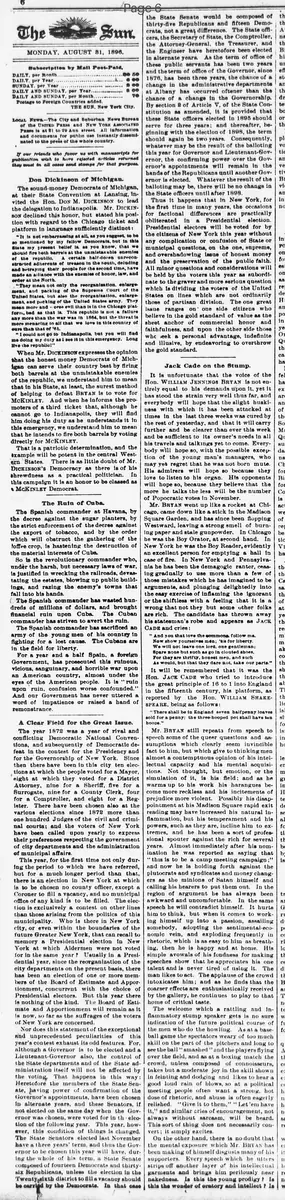
A Clear Field for the Great Issue.
The year 1872 was a year of rival and conflicting Democratic National Conventions, and subsequently of Democratic defeat in the contest for the Presidency and for the Governorship of New York. Since then there have been in this city ten elections at which the people voted for a Mayor, eight at which they voted for a District Attorney, nine for a Sheriff, five for a Surrogate, nine for a County Clerk, four for a Comptroller, and eight for a Register. There have been chosen also at the various elections since 1876 more than one hundred Judges of the civil and criminal courts; and the voters of New York have been called upon yearly to express their preferences respecting the government of city departments and the administration of municipal affairs.
This year, for the first time not only during the period to which we have referred, but for a much longer period than that, there is an election in New York at which is to be chosen no county officer, except a Coroner to fill a vacancy, and no municipal office of any kind is to be filled. The election is exclusively a contest on other lines than those arising from the politics of this municipality. Who is there in New York city, or even within the boundaries of the future Greater New York, that can recall to memory a Presidential election in New York at which Aldermen were not voted for in the same year? Usually in a Presidential year, since the reorganization of the city departments on the present basis, there has been an election of one or more members of the Board of Estimate and Apportionment, concurrent with the choice of Presidential electors. But this year there is nothing of the kind. The Board of Estimate and Apportionment will remain as it is now, so far as the suffrages of the voters of New York are concerned.
Nor does this statement of the exceptional and unprecedented peculiarities of this year's contest exhaust its odd features. For although a Governor is to be elected and a Lieutenant-Governor also, the control of the State departments and of the State administration itself will not be affected by the voting.
That happens in this way: Heretofore the members of the State Senate, having power of confirmation of the Governor's appointments, have been chosen in alternate years, and these Senators, if not elected on the same day when the Governor was chosen, were voted for in the election of the following year. This year, however, this condition of things is changed. The State Senators elected last November have a three years' term, and thus the Governor to be chosen this year will have, during the whole of his term, a State Senate composed of fourteen Democrats and thirty-six Republicans, unless the election in the Twenty-sixth district to fill a vacancy should be carried by the Democrats. In that case the State Senate would be composed of thirty-five Republicans and fifteen Democrats, not a great difference. The State officers, the Secretary of State, the Comptroller, the Attorney-General, the Treasurer, and the Engineer have heretofore been elected in alternate years. As the term of office of these public servants has been two years and the term of office of the Governor, since 1876, has been three years, the chance of a change in the administrative departments at Albany has occurred oftener than the chance of a change in the Governorship. By section 5 of Article V. of the State Constitution as amended, it is provided that these State officers elected in 1895 should serve for three years; and thereafter, beginning with the election of 1898, the term should again be two years. Consequently, whatever may be the result of the balloting this year for Governor and Lieutenant-Governor, the confirming power over the Governor's appointments will remain in the hands of the Republicans until another Governor is elected. Whatever the result of the balloting may be, there will be no change in the State officers until after 1898.
Thus it happens that in New York, for the first time in many years, the occasions for factional differences are practically obliterated in a Presidential election. Presidential electors will be voted for by the citizens of New York this year without any complication or confusion of State or municipal questions, on the one, supreme, and overshadowing issue of honest money and the preservation of the public faith. All minor questions and considerations will be held by the voters this year as subordinate to the graver and more serious question which is dividing the voters of the United States on lines which are not ordinarily those of partisan division. The one great issue ranges on one side citizens who believe in the gold standard of value as the sheet anchor of commercial honor and faithfulness, and upon the other side those who seek a personal advantage, indefinite and illusive, by endeavoring to overthrow the gold standard.
The year 1872 was a year of rival and conflicting Democratic National Conventions, and subsequently of Democratic defeat in the contest for the Presidency and for the Governorship of New York. Since then there have been in this city ten elections at which the people voted for a Mayor, eight at which they voted for a District Attorney, nine for a Sheriff, five for a Surrogate, nine for a County Clerk, four for a Comptroller, and eight for a Register. There have been chosen also at the various elections since 1876 more than one hundred Judges of the civil and criminal courts; and the voters of New York have been called upon yearly to express their preferences respecting the government of city departments and the administration of municipal affairs.
This year, for the first time not only during the period to which we have referred, but for a much longer period than that, there is an election in New York at which is to be chosen no county officer, except a Coroner to fill a vacancy, and no municipal office of any kind is to be filled. The election is exclusively a contest on other lines than those arising from the politics of this municipality. Who is there in New York city, or even within the boundaries of the future Greater New York, that can recall to memory a Presidential election in New York at which Aldermen were not voted for in the same year? Usually in a Presidential year, since the reorganization of the city departments on the present basis, there has been an election of one or more members of the Board of Estimate and Apportionment, concurrent with the choice of Presidential electors. But this year there is nothing of the kind. The Board of Estimate and Apportionment will remain as it is now, so far as the suffrages of the voters of New York are concerned.
Nor does this statement of the exceptional and unprecedented peculiarities of this year's contest exhaust its odd features. For although a Governor is to be elected and a Lieutenant-Governor also, the control of the State departments and of the State administration itself will not be affected by the voting.
That happens in this way: Heretofore the members of the State Senate, having power of confirmation of the Governor's appointments, have been chosen in alternate years, and these Senators, if not elected on the same day when the Governor was chosen, were voted for in the election of the following year. This year, however, this condition of things is changed. The State Senators elected last November have a three years' term, and thus the Governor to be chosen this year will have, during the whole of his term, a State Senate composed of fourteen Democrats and thirty-six Republicans, unless the election in the Twenty-sixth district to fill a vacancy should be carried by the Democrats. In that case the State Senate would be composed of thirty-five Republicans and fifteen Democrats, not a great difference. The State officers, the Secretary of State, the Comptroller, the Attorney-General, the Treasurer, and the Engineer have heretofore been elected in alternate years. As the term of office of these public servants has been two years and the term of office of the Governor, since 1876, has been three years, the chance of a change in the administrative departments at Albany has occurred oftener than the chance of a change in the Governorship. By section 5 of Article V. of the State Constitution as amended, it is provided that these State officers elected in 1895 should serve for three years; and thereafter, beginning with the election of 1898, the term should again be two years. Consequently, whatever may be the result of the balloting this year for Governor and Lieutenant-Governor, the confirming power over the Governor's appointments will remain in the hands of the Republicans until another Governor is elected. Whatever the result of the balloting may be, there will be no change in the State officers until after 1898.
Thus it happens that in New York, for the first time in many years, the occasions for factional differences are practically obliterated in a Presidential election. Presidential electors will be voted for by the citizens of New York this year without any complication or confusion of State or municipal questions, on the one, supreme, and overshadowing issue of honest money and the preservation of the public faith. All minor questions and considerations will be held by the voters this year as subordinate to the graver and more serious question which is dividing the voters of the United States on lines which are not ordinarily those of partisan division. The one great issue ranges on one side citizens who believe in the gold standard of value as the sheet anchor of commercial honor and faithfulness, and upon the other side those who seek a personal advantage, indefinite and illusive, by endeavoring to overthrow the gold standard.
What sub-type of article is it?
Economic Policy
Partisan Politics
What keywords are associated?
Gold Standard
Presidential Election
New York
Honest Money
Public Faith
State Senate
Municipal Elections
What entities or persons were involved?
Republicans
Democrats
State Senate
Governor
Editorial Details
Primary Topic
Clear Field For Presidential Election On Gold Standard Issue
Stance / Tone
Supportive Of Gold Standard And Public Faith
Key Figures
Republicans
Democrats
State Senate
Governor
Key Arguments
1872 Democratic Defeat And Subsequent Local Elections In New York
This Year's Election Chooses No County Or Municipal Offices Except A Coroner Vacancy
No Aldermen Or Board Of Estimate Members Elected Concurrently
State Senate Remains Republican Dominated For Three Years
State Officers' Terms Extended, No Change Until After 1898
Election Focuses Solely On Presidential Issue Of Honest Money And Gold Standard
Opposition To Overthrowing Gold Standard For Personal Advantage