Thank you for visiting SNEWPapers!
Sign up free
Weekly North Carolina Standard
Raleigh, Wake County, North Carolina
What is this article about?
Prof. E. Emmons, State Geologist, writes to the North Carolina Standard detailing the state's rich mineral resources, including coal, iron, gold, and copper in regions like Deep River and various counties. He argues that recent depreciation in mining values stems from mismanagement, poor machinery, and extravagance, not inherent deficiencies, and advocates completing internal improvements for market access.
Merged-components note: Introductory notice and full text of Prof. Emmons' letter on mineral resources.
Clipping
OCR Quality
Full Text
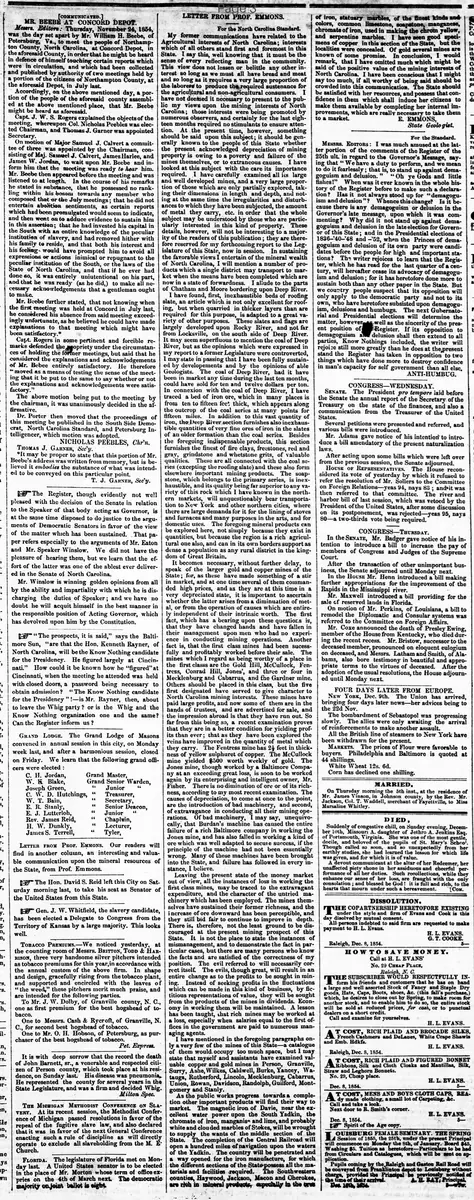
LETTER FROM PROF. EMMONS.
For the North Carolina Standard.
My former communications have related to the Agricultural interests of North Carolina; interests which of all others stand first and foremost in this State. I say this, well knowing that it must be the sense of every reflecting man in the community.
This view does not lessen or belittle any other interest so long as we must all have bread and meat and so long as it requires a very large proportion of the laborers to produce the required sustenance for the agricultural and non-agricultural consumers.
I have not deemed it necessary to present to the public my views upon the mining interests of North Carolina; those interests were being promoted by numerous observers, and certainly for the last eighteen months required no stimulants to ensure attention. At the present time, however, something should be said upon this subject; it should be generally known to the people of this State whether the present acknowledged depreciation of mining property is owing to a poverty and failure of the mines themselves, or to extraneous causes. I have looked at this subject with the care its importance required. I have carefully examined all its large and well developed mines, and a very large proportion of those which are only partially explored, taking their dimensions in length and depth, and noting at the same time the irregularities and disturbances to which they have been subjected, the amount of metal they carry, etc. in order that the whole subject may be understood by those who are particularly interested in this kind of property. These details, however, will not be interesting to a majority of the readers of this publication; they are therefore reserved for my forthcoming report to the Legislature of this State, now in session. In sustaining the favorable views I entertain of the mineral wealth of North Carolina, I will mention a number of products which a single district may transport to market when the means have been completed which are now in a state of forwardness. I allude to the parts of Chatham and Moore bordering upon Deep River.
I have found, first, inexhaustible beds of roofing slate, an article which is not only excellent for roofing, but when quarried in thicker layers than are required for this purpose, is adapted to a great variety of other purposes. These slates and flags are largely developed upon Rocky River, and not far from Locksville, on the south side of Deep River.
It may seem superfluous to mention the coal of Deep River, but as the opinions which were expressed in my report to a former Legislature were controverted, I may state in passing that I have been fully sustained by developments and by the opinions of able Geologists. The coal of Deep River, had it have been in market any time during the last ten months, could have sold for ten and twelve dollars per ton.
In connexion with the coal of Deep River, I have traced a bed of iron ore, which in many places is from ten to fifteen feet thick, which appears along the outcrop of the coal series at many points for fifteen miles. In addition to this vast quantity of iron, the Deep River section furnishes also inexhaustible quantities of very fine ores of iron in the slates of an older formation than the coal series. Besides the foregoing indispensable products, this section furnishes the finest of fire clays, freestones, red and gray, grindstone and whetstone grits, of valuable qualities. These are all connected with the coal series (excepting the roofing slate) and these also form elsewhere important mining products. The soap stone, which belongs to the primary series, is inexhaustible, and its quality being far superior to any variety of this rock which I have known in the northern markets, will unquestionably bear transportation to New York and other northern cities, where there are large demands for it for the lining of stoves and furnaces and many purposes in the arts, and for domestic uses. The foregoing mineral products can be explored here, not simply because they exist in quantities, but because the region is a rich agricultural one also, and can in its own borders support as dense a population as any rural district in the kingdom of Great Britain.
It becomes necessary, without further delay, to speak of the larger gold and copper mines of the State; for, as these have made something of a stir in market, and at one time several of them commanded high prices, and as they are at this time in a very depreciated state, it is important to ascertain whether the latter arises from a diminution of metal, or from the operation of causes which are entirely independent of their intrinsic worth. The first fact, which has a bearing upon these questions is, that they have changed hands and have fallen in their management upon men who had no experience in conducting mining operations. Another fact is, that the first class mines had been successfully and profitably worked before their sale. The mines which I regard as being worthy of a place in the first class are the Gold Hill, McCulloch, Fentress, Conrad Hill, Jones', and three or four in Mecklenburg and Cabarrus, and the Gardner mine. Others should be placed in this class, but the five first designated have served to give character to North Carolina mining interests. These mines have paid large profits, and now some of them are in the hands of trustees, and are advertised for sale, and the impression abroad is that they have run out. So far from this being so, a recent examination proves that they are in a better condition for yielding profits than ever; that as they have been explored the veins have improved in the quantity of metal which they carry. The Fentress mine has 2 feet in thickness of yellow sulphuret of copper. The McCulloch mine yielded $500 worth weekly of gold. The Jones mine, though worked by a Baltimore Company at an exceeding great loss, is soon to be worked again by its enterprising and intelligent owner, Mr. Fisher. There is no diminution of ore or of its richness, according to my most recent examination. The causes of depreciation, to come at once to the point, are the introduction of bad machinery, and second, of extravagance in conducting all their mining operations. Of bad machinery, I may say, unequivocally, that Burdan's machine has caused the entire failure of a rich Baltimore company in working the Jones mine, and has also failed in working a kind of ore which was well adapted to secure success, if the principle of the machine had not been essentially wrong. Many of these machines have been brought into the State, and failure has followed in every instance, I believe.
Leaving the present state of the money market out of view, all the instances of loss in working the first class mines, may be traced to the extravagant expenditure, and the character of the untried machinery which has been employed. The mines themselves have sustained their former richness, and the increase of ore downward has been perceptible, and they still bid fair to continue to improve in depth.
There is, therefore, not the least ground to be discouraged at the present mining prospects of this State. It is not the place to state the instances of mismanagement, and to demonstrate the fact in particular cases, but there are many persons who know the facts and are satisfied of the correctness of my position. The evil referred to will necessarily correct itself. The evils, though great, will result in an entire change as to the profits to be sought in mining. Instead of seeking profits in the fluctuations which can be made in this kind of business, by fictitious representations of value, they will be sought from the products of the mines in dividends. Economy in working them will be maintained. A lesson has been taught, that rich mines may be worked at a loss, especially when salaries equal to the first offices in the government are paid to numerous managing agents.
I have mentioned in the foregoing paragraphs only a very few of the mines of this State—a catalogue of them would occupy too much space, but I may state that myself and assistants have examined valuable copper and gold mines in Person, Granville, Surry, Ashe, Wilkes, Caldwell, Burke, Yancey, Watauga, Rutherford, Lincoln, Mecklenburg, Cabarrus, Union, Rowan, Davidson, Randolph, Guilford, Montgomery and Stanly.
As the public works progress towards a completion other important products will find their way to market. The magnetic iron of Davie, near the excellent water power upon the South Yadkin, the chromate of iron, manganese and lime, and probably white and clouded marbles of Stokes, will be wrought to supply the wants of the middle section of the State. The completion of the Central Railroad will open a hundred miles of navigation upon the waters of the Yadkin. The country will be penetrated and a way opened for the iron manufacture, for which the different sections of the State possess all the materials and facilities required. The Southwestern counties, Haywood, Jackson, Macon and Cherokee, are rich in mineral products, especially in the great variety of iron, statuary marbles of the finest kinds and colors, common limestone, soapstone, manganese, chromate of iron, used in making the chrom yellow and serpentine marbles. I have seen good specimens of copper in this section of the State, but the localities were concealed. Of gold several mines are known of some promise. In conclusion, I would remark, that I have omitted much which might be said of the positive value of the mining interests of North Carolina. I have been conscious that I might say too much, if all worthy of being said should be crowded into this communication. The State should be satisfied with her resources, and possess that confidence in them which shall induce her citizens to make them available by completing her internal improvements, which are really necessary to take them to a market.
E. EMMONS,
State Geologist.
What sub-type of article is it?
What themes does it cover?
What keywords are associated?
What entities or persons were involved?
Letter to Editor Details
Author
E. Emmons, State Geologist
Recipient
For The North Carolina Standard
Main Argument
north carolina's mineral resources, including coal, iron, gold, and copper, are abundant and promising; current depreciation in mining properties results from mismanagement, poor machinery, and extravagance, not from any failure of the mines themselves. the state should complete internal improvements to access markets and realize these resources' value.
Notable Details