Thank you for visiting SNEWPapers!
Sign up free
The Daily Herald
New Haven, New Haven County, Connecticut
What is this article about?
November edition of the Horticultural Register provides detailed gardening advice on preserving roots using sand, protecting cabbages and celery from frost, sowing seeds for spring crops, and planting/transplanting fruit trees and shrubs in orchards and nurseries.
Merged-components note: This is a continuation of the gardening advice article from the Horticultural Register across page 1 and 2; relabeled to domestic_news as it fits practical local news/advice better than literary.
Clippings
1 of 2
OCR Quality
Full Text
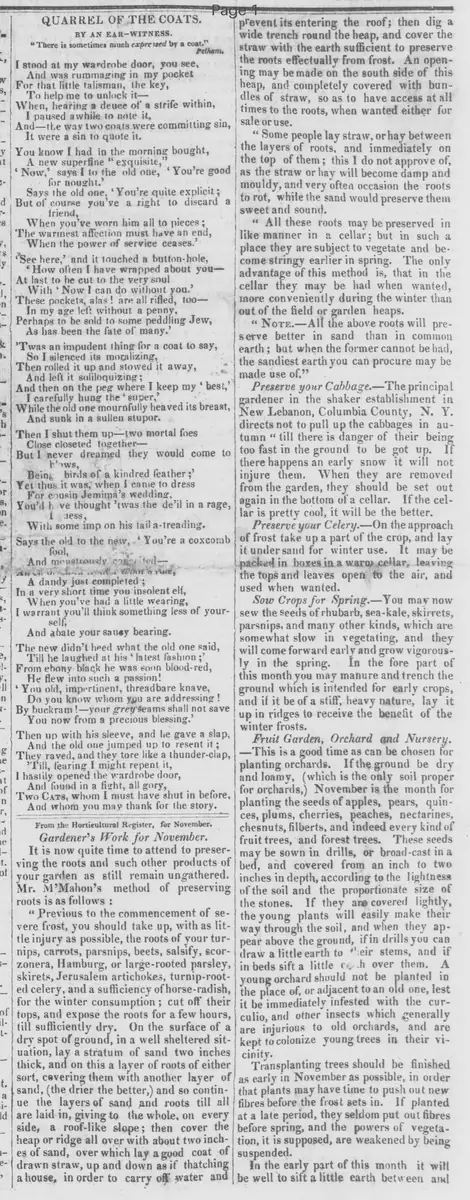
Gardener's Work for November.
It is now quite time to attend to preserving the roots and such other products of your garden as still remain ungathered.
Mr. M'Mahon's method of preserving roots is as follows:
"Previous to the commencement of severe frost, you should take up, with as little injury as possible, the roots of your turnips, carrots, parsnips, beets, salsify, scorzonera, Hamburg, or large-rooted parsley, skirets, Jerusalem artichokes, turnip-rooted celery, and a sufficiency of horse-radish, for the winter consumption; cut off their tops, and expose the roots for a few hours, till sufficiently dry. On the surface of a dry spot of ground, in a well sheltered situation, lay a stratum of sand two inches thick, and on this a layer of roots of either sort, covering them with another layer of sand, (the drier the better,) and so continue the layers of sand and roots till all are laid in, giving to the whole, on every side, a roof-like slope; then cover the heap or ridge all over with about two inches of sand, over which lay a good coat of drawn straw, up and down as if thatching a house, in order to carry off water and prevent its entering the roof; then dig a wide trench round the heap, and cover the straw with the earth sufficient to preserve the roots effectually from frost. An opening may be made on the south side of this heap, and completely covered with bundles of straw, so as to have access at all times to the roots, when wanted either for sale or use.
"Some people lay straw, or hay between the layers of roots, and immediately on the top of them; this I do not approve of, as the straw or hay will become damp and mouldy, and very often occasion the roots to rot, while the sand would preserve them sweet and sound.
"All these roots may be preserved in like manner in a cellar; but in such a place they are subject to vegetate and become stringy earlier in spring. The only advantage of this method is, that in the cellar they may be had when wanted, more conveniently during the winter than out of the field or garden heaps.
"Note.—All the above roots will preserve better in sand than in common earth; but when the former cannot be had, the sandiest earth you can procure may be made use of."
Preserve your Cabbage.—The principal gardener in the Shaker establishment in New Lebanon, Columbia County, N. Y. directs not to pull up the cabbages in autumn till there is danger of their being too fast in the ground to be got up. If there happens an early snow it will not injure them. When they are removed from the garden, they should be set out again in the bottom of a cellar. If the cellar is pretty cool, it will be the better.
Preserve your Celery.—On the approach of frost take up a part of the crop, and lay it under sand for winter use. It may be packed in boxes in a warm cellar, leaving the tops and leaves open to the air, and used when wanted.
Sow Crops for Spring.—You may now sow the seeds of rhubarb, sea-kale, skirrets, parsnips, and many other kinds, which are somewhat slow in vegetating, and they will come forward early and grow vigorously in the spring. In the fore part of this month you may manure and trench the ground which is intended for early crops, and if it be of a stiff, heavy nature, lay it up in ridges to receive the benefit of the winter frosts.
Fruit Garden, Orchard and Nursery.—This is a good time as can be chosen for planting orchards. If the ground be dry and loamy, (which is the only soil proper for orchards,) November is the month for planting the seeds of apples, pears, quinces, plums, cherries, peaches, nectarines, chestnuts, filberts, and indeed every kind of fruit trees, and forest trees. These seeds may be sown in drills, or broad-cast in a bed, and covered from an inch to two inches in depth, according to the lightness of the soil and the proportionate size of the seeds. If they are covered lightly, the young plants will easily make their way through the soil, and when they appear above the ground, if in drills you can draw a little earth to their stems, and if in beds sift a little earth over them. A young orchard should not be planted in the place of, or adjacent to an old one, lest it be immediately infested with the curculio, and other insects which generally are injurious to old orchards, and are kept to colonize young trees in their vicinity.
Transplanting trees should be finished as early in November as possible, in order that plants may have time to push out new fibres before the frost sets in. If planted at a late period, they seldom put out fibres before spring, and the powers of vegetation, it is supposed, are weakened by being suspended.
In the early part of this month it will be well to sift a little earth between and
among plants so as nearly to come up to the leaves, which will be of use in every climate and country, to every sort of seedling, tree, or shrub, which in consequence of their small size the first year's growth are liable to be thrown out of the ground by frosts, or injured by drought.
Stake and tie up all the newly planted trees, which are in open exposures, in order to prevent their being agitated by wind. Lay light litter of some kind, a good thickness, over the roots of tender and choice shrubs, to protect them from frost.
What sub-type of article is it?
What keywords are associated?
What entities or persons were involved?
Domestic News Details
Event Date
November
Key Persons
Event Details
Advice on preserving garden roots using sand layers in sheltered heaps protected from frost; preserving cabbages by storing in cool cellars; celery under sand or in boxes; sowing seeds of rhubarb, sea-kale, skirrets, parsnips for spring; manuring and trenching ground; planting orchard seeds like apples, pears in dry loamy soil; transplanting trees early in month; sifting earth around seedlings; staking trees; protecting shrubs with litter.