Thank you for visiting SNEWPapers!
Sign up free
The National Intelligencer And Washington Advertiser
Washington, District Of Columbia
What is this article about?
Extracts of diplomatic correspondence from US Consul James Simpson in Tangier, Morocco, to the Secretary of State in 1802, addressing Emperor Muley Soliman's pretensions, treaty confirmations, refusal of passports for a Tripoline ship, escaped American seamen, and ongoing negotiations to maintain peace without annual embassies or presents.
Clipping
OCR Quality
Full Text
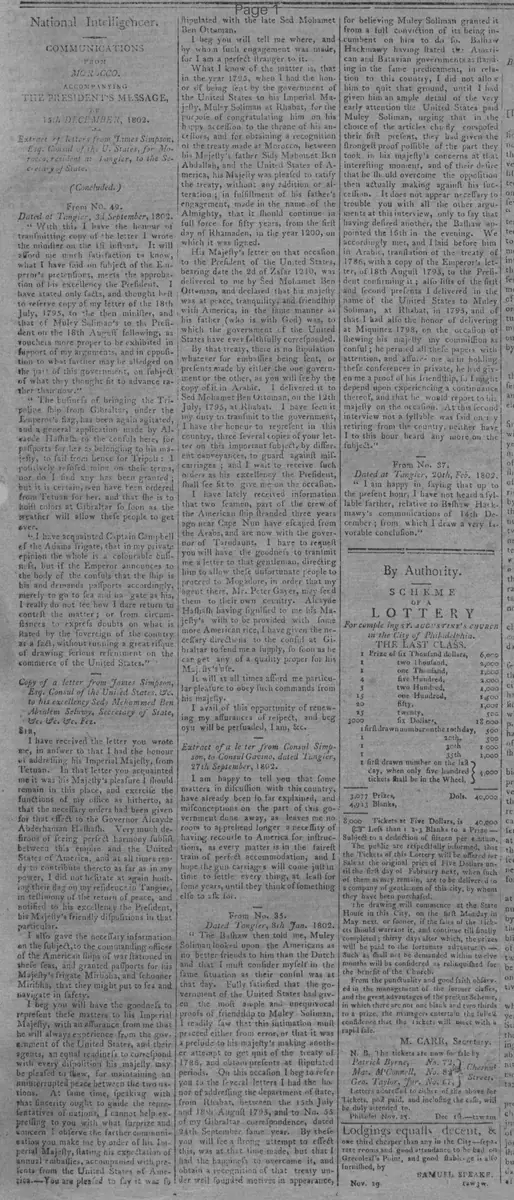
COMMUNICATIONS
FROM: MOROCCO.
ACCOMPANYING THE PRESIDENT'S MESSAGE, OF 15th DECEMBER, 1802.
Extract of letters from James Simpson, Esq. Consul of the U. States, for Morocco, resident at Tangier, to the Secretary of State.
(Concluded.)
From No. 49.
Dated at Tangier, 3d September, 1802.
"With this I have the honour of transmitting copy of the letter I wrote the minister on the 1st instant. It will afford me much satisfaction to know, what I have said on subject of the Emperor's pretensions, meets the approbation of his excellency the President. I have stated only facts, and thought best to reserve copy of my letter of the 18th July, 1795, to the then minister, and that of Muley Soliman's to the President on the 18th August following, as vouchers more proper to be exhibited in support of my arguments, and in opposition to what further may be alleged on the part of this government, on subject of what they thought fit to advance rather than now."
"The business of bringing the Tripoline ship from Gibraltar, under the Emperor's flag, has been again agitated, and a general application made by Alcayde Hashash to the consuls here, for passports for her and belonging to his majesty, to sail from hence to Tripoli. I positively refused mine on these terms, nor do I find any has been granted; but it is certain, men have been ordered from Tetuan for her, and that he is to hoist colors at Gibraltar as soon as the weather will allow these people to get over."
"I have acquainted Captain Campbell of the Adams frigate, that in my private opinion the whole is a colourable business. But if the Emperor announces to the body of the consuls that the ship is his and demands passports accordingly, merely to go to sea and navigate as his, I really do not see how I dare return to contest the matter; or from circumstances to express doubts on what is stated by the sovereign of the country as a fact, without running a great risk of drawing serious resentment on the commerce of the United States."
Copy of a letter from James Simpson, Esq. Consul of the United States, &c. to his excellency Sidy Mehammed Ben Absalem Seluwy, Secretary of State, &c. &c. Fez.
SIR,
I have received the letter you wrote me, in answer to that I had the honour of addressing his Imperial Majesty, from Tetuan. In that letter you acquainted me it was his Majesty's pleasure I should remain in this place, and exercise the functions of my office as hitherto, as that the necessary orders had been given for that effect to the Governor Alcayde Abderhaman Hashash. Very much desirous of seeing perfect harmony subsist between this empire and the United States of America, and at all times ready to contribute thereto as far as in my power, I did not hesitate at again hoisting their flag on my residence in Tangier, in testimony of the return of peace, and notified to his excellency the President, his Majesty's friendly dispositions in that particular.
I also gave the necessary information on the subject, to the commanding officer of the American ships of war stationed in these seas, and granted passports for his Majesty's frigate Mirbaha, and schooner Mirbaha, that they might put to sea and navigate in safety.
I beg you will have the goodness to represent these matters to his Imperial Majesty, with an assurance from me that he will always experience from the government of the United States, and their agents, an equal readiness to correspond with every disposition his majesty may be pleased to shew, for maintaining an uninterrupted peace between the two nations. At same time, speaking with that sincerity which ought to guide the representatives of nations, I cannot help expressing to you with what surprise and concern I observe the further communication you make me by order of his Imperial Majesty, stating his expectation of annual embassies, accompanied with presents from the United States of America.--You are pleased to say it was stipulated with the late Sidy Mohamet Ben Ottman.
I beg you will tell me where, and by whom such engagement was made, for I am a perfect stranger to it. What I know of the matter is, that in the year 1795, when I had the honour of being sent by the government of the United States to his Imperial Majesty, Muley Soliman at Rabat, for the purpose of congratulating him on his happy accession to the throne of his ancestors, and for obtaining a recognition of the treaty made at Morocco, between his Majesty's father Sidy Mohammed Ben Abdallah, and the United States of America, his Majesty was pleased to ratify the treaty, without any addition or alteration; in fulfillment of his father's engagement, made in the name of the Almighty, that it should continue in full force for fifty years, from the first day of Rhamaden, in the year 1200, on which it was signed.
His Majesty's letter on that occasion to the President of the United States, bearing date the 2d of Zafar 1210, was delivered to me by Sidy Mohamet Ben Ottman, and declared that his majesty was at peace, tranquility, and friendship with America, in the same manner as his father (who is with God) was, to which the government of the United States have ever faithfully corresponded.
By that treaty, there is no stipulation whatever for embassies being sent, or presents made by either the one government or the other, as you will see by the copy of it in Arabic. I delivered it to Sidy Mohamet Ben Ottman, on the 12th July, 1795, at Rabat. I have seen it my duty to transmit to the government, I have the honour to represent in this country, three several copies of your letter on this important subject, by different conveyances, to guard against miscarriages; and I wait to receive such orders as his excellency the President, shall see fit to give me on the occasion.
I have lately received information that two seamen, part of the crew of the American ship stranded three years ago near Cape Nun have escaped from the Arabs, and are now with the governor of Tarudant. I have to request you will have the goodness to transmit me a letter to that gentleman, directing him to allow these unfortunate people to proceed to Mogadore, in order that my agent there, Mr. Peter Gayer, may send them to their own country. Alcayde Hashash having signified to me his Majesty's wish to be provided with some more American rice, I have given the necessary directions to the consul at Gibraltar to send me a supply, so soon as he can get any of a quality proper for his Majesty's use.
It will at all times afford me particular pleasure to obey such commands from his majesty.
I avail of this opportunity of renewing my assurances of respect, and beg you will be persuaded, I am, &c.
Extract of a letter from Consul Simpson, to Consul Gavino, dated Tangier, 27th September, 1802.
I am happy to tell you that some matters in discussion with this country, have already been so far explained, and misconceptions on the part of this government done away, as leaves me no room to apprehend longer a necessity of having recourse to America for instructions, as every matter is in the fairest train of perfect accommodation, and I hope the gun carriages will come just in time to settle every thing, at least for some years, until they think of something else to ask for.
From No. 35.
Dated Tangier, 8th Jan. 1802.
"The Bashaw then told me, Muley Soliman looked upon the Americans as no better friends to him than the Dutch and that I must consider myself in the same situation as their consul was at that day. Fully satisfied that the government of the United States had given the most ample and unequivocal proofs of friendship to Muley Soliman, I readily saw that this intimation must proceed either from error, or that it was a prelude to his majesty's making another attempt to get quit of the treaty of 1786, and obtain presents at stipulated periods. On this occasion I beg to refer you to the several letters I had the honour of addressing the department of state, from Rabat, between the 15th July and 18th August 1795, and to No. 55 of my Gibraltar correspondence, dated 24th September same year. By these you will see a strong attempt to effect this, was at that time made, but that I had the happiness to overcome it, and obtain a recognition of that treaty under well founded motives in appearance, for believing Muley Soliman granted it from a full conviction of its being incumbent on him to do so. Bashaw Hackmawy having stated the American and Batavian governments as standing in the same predicament, in relation to this country, I did not allow him to quit that ground, until I had given him an ample detail of the very early attention the United States paid Muley Soliman, urging that in the choice of the articles chiefly composed their first present, they had given the strongest proof possible of the part they took in his majesty's concerns at that interesting moment, and of their desire that he should overcome the opposition then actually making against his succession. It does not appear necessary to trouble you with all the other arguments at this interview, only to say that having desired another, the Bashaw appointed the 16th in the evening. We accordingly met, and I laid before him in Arabic, translation of the treaty of 1786, with a copy of the Emperor's letter, of 18th August 1795, to the President confirming it; also lists of the first and second presents I delivered in the name of the United States to Muley Soliman, at Rabat, in 1795, and of that I had also the honor of delivering at Mekinez 1798, on the occasion of shewing his majesty my commission as consul; he perused all these papers with attention, and assured me as in holding these conferences in private, he had given me a proof of his friendship, so I might depend upon experiencing a continuance thereof, and that he would report to his majesty on the occasion. At this second interview not a syllable was said on my retiring from the country, neither have I to this hour heard any more on the subject."
From No. 37.
Dated at Tangier, 20th, Feb. 1802.
"I am happy in saying that up to the present hour, I have not heard a syllable farther, relative to Bashaw Hackmawy's communications of 14th December; from which I draw a very favorable conclusion."
What sub-type of article is it?
What keywords are associated?
What entities or persons were involved?
Where did it happen?
Foreign News Details
Primary Location
Tangier, Morocco
Event Date
1802
Key Persons
Outcome
diplomatic misconceptions resolved; treaty of 1786 reaffirmed without stipulations for annual embassies or presents; passports granted for moroccan vessels; arrangements for escaped american seamen and rice supply; favorable outlook for continued peace.
Event Details
US Consul Simpson reports on negotiations with Moroccan officials regarding Emperor Muley Soliman's expectations of annual US embassies and presents, refuting them based on the 1786 treaty ratified in 1795. He refuses passports for a Tripoline ship claimed by the Emperor, expresses concerns over potential resentment, and details past diplomatic efforts to maintain the treaty. Updates include resolution of discussions, escaped seamen from a stranded ship, and provision of American rice.