Thank you for visiting SNEWPapers!
Sign up free
Phenix Gazette
Alexandria, Virginia
What is this article about?
The annual report of the Board of Public Works was submitted to the Virginia House of Delegates on January 28, detailing the state of the internal improvement fund, investments in turnpikes, banks, canals, and companies, totaling over $2 million, with discussions on income, expenditures, deficiencies due to bank dividend reductions, and recommendations to borrow $20,000 to meet engagements.
Clipping
OCR Quality
Full Text
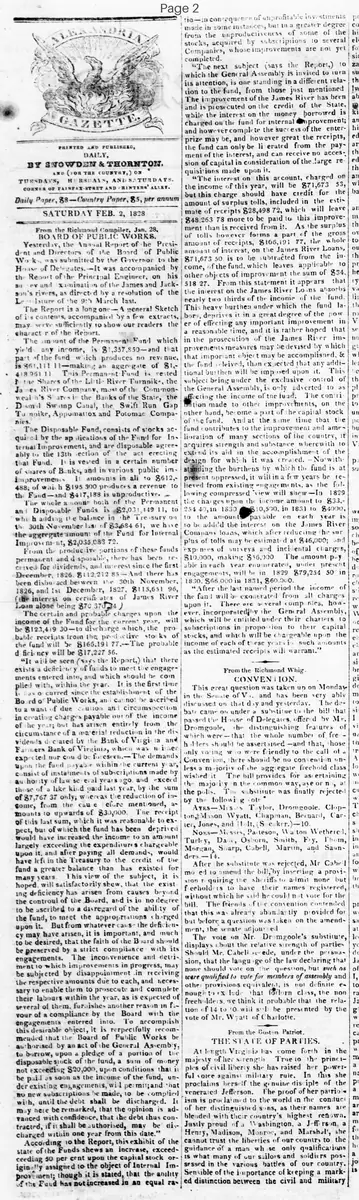
BOARD OF PUBLIC WORKS.
Yesterday, the Annual Report of the President and Directors of the Board of Public Works, was submitted by the Governor to the House of Delegates. It was accompanied by the Report of the Principal Engineer, on his survey and examination of the James and Jackson's rivers, as directed by a resolution of the Legislature of the 25th March last.
The Report is a long one. A general sketch of its contents, accompanied by a few extracts, may serve sufficiently to show our readers the character of the Report.
The amount of the Permanent Fund which yields any income, is $1,357,850—and that part of the fund which produces no revenue, is $61,111—making an aggregate of $1,418,961. This Permanent Fund is vested in Shares of the Little-River Turnpike, the James River Company, most of the Commonwealth's Shares in the Banks of the State, the Dismal Swamp Canal, the Swift Run Gap Turnpike, Appomattox and Potomac Companies.
The Disposable Fund, consists of stocks acquired by the applications of the Fund for Internal Improvement, and are disposable agreeably to the 13th section of the act erecting that Fund. It is vested in a certain number of shares of Banks, and in various public improvements. It amounts in all to $612,488; of which $195,300 produces a revenue to the Fund—and $417,188 is unproductive.
The whole amount both of the Permanent and Disposable Funds is $2,031,449 11, to which adding the balance in the Treasury on the 30th November last of $3,684 61, we have the aggregate amount of the Fund for Internal Improvement, $2,035,083 72.
From the productive portions of these funds permanent and disposable, there has been received for dividends, and interest since the first December, 1826, $112,212 85—And there has been disbursed between the 30th November, 1826, and 1st December, 1827, $115,651 96, (the interest on certificates of James River Loan alone being $70,370 34)
The certain and probable charges upon the income of the Fund for the current year, will be $123,419 30—to discharge which, the probable receipts from the productive stocks of the fund will be $166,191 77.—The probable deficiency will be $17,227 56.
"It will be seen (says the Report,) that there exists a deficiency of funds to meet the engagements entered into, and which should be complied with, within the year. It is the first time it has occurred since the establishment of the Board of Public Works, and cannot be ascribed to a want of due caution and circumspection in creating charges payable out of the income of the year; but has arisen entirely from the circumstance of a material reduction in the dividends declared by the Bank of Virginia and Farmers Bank of Virginia, which was neither expected nor could be foreseen.—The demands upon the fund payable within the current year, consist of instalments of subscriptions made by authority of law several years ago, and exceed those of a like kind paid last year, by the sum of $7,767 37 only; whereas the reduction of income, from the cause before mentioned, amounts to upwards of $30,000. The receipt of this last sum, which it was reasonable to expect, but of which the fund has been deprived, would have increased the income to an amount largely exceeding the expenditures chargeable upon it, and after paying all demands, would have left in the Treasury to the credit of the fund a greater balance than has existed for many years. This view of the subject, it is hoped, will satisfactorily show, that the existing deficiency has arisen from causes beyond the controul of the Board, and is in no degree to be ascribed to a disregard of the ability of the fund, to meet the appropriations charged upon it. But from whatever cause the deficiency may have arisen, it is important, and much to be desired, that the faith of the Board should be preserved by a strict compliance with its engagements. The inconvenience and detriment to which improvements in progress, may be subjected by disappointment in receiving the respective amounts due to each, and necessary to enable them to prosecute and complete their labours within the year, as is expected of several of them, furnishes another reason in favour of a compliance by the Board with the engagements entered into. To accomplish this desirable object, it is respectfully recommended that the Board of Public Works be authorised by an act of the General Assembly, to borrow, upon a pledge of a portion of the disposable stock of the fund, a sum of money not exceeding $20,000, upon conditions that it be paid as soon as the income of the fund, under existing engagements, will permit; and that no new subscriptions be made, to be complied with, until the debt shall be discharged. It may here be remarked, that the opinion is advanced with confidence, that the debt thus contracted, if it shall be authorised, may be discharged within one year from this date."
According to the Report, this exhibit of the state of the Funds shews an increase, exceeding 50 per cent upon the capital stock originally assigned to the object of Internal Improvement; though it is stated, that the ability of the Fund has not increased in an equal ratio—in consequence of unprofitable investments made in some instances, but in a greater degree from the unproductiveness of some of the stocks, acquired by subscriptions to several Companies, whose improvements are not yet completed.
"The next subject (says the Report,) to which the General Assembly is invited to turn its attention, is one standing in a different relation to the fund, from those just mentioned The improvement of the James River has been and is prosecuted on the credit of the State, while the interest on the money borrowed is charged on the fund for internal improvement; and however complete the success of the enterprise may be, and however great the receipts, the fund can only be liberated from the payment of the interest, and can receive no accession of capital in consideration of the large requisitions made upon it.
"The interest on this account, charged on the income of this year, will be $71,673 53, but this charge should have credit for the amount of surplus tolls, included in the estimate of receipts $28,498 72, which will leave $48,263 78 more to be paid to this improvement than is received from it. As the surplus of tolls however forms a part of the gross amount of receipts, $166,191 77, the whole amount of interest, on the James River Loans, $71,673 50 is to be subtracted from the income, of the fund. which leaves applicable to other objects of improvement the sum of $94,518 27. From this statement it appears that the interest on the James River Loans absorbs nearly two thirds of the income of the fund. This heavy burthen under which the fund labours, deprives it in a great degree of the power of effecting any important improvement in a reasonable time, and it is rather hoped that in the prosecution of the James River improvements measures may be devised by which that important object may be accomplished, & the fund relieved, than expected that any additional burthen will be imposed upon it. This subject being under the exclusive control of the General Assembly, is only adverted to as affecting the income of the fund. The contribution made to other improvements, on the other hand, become a part of the capital stock of the fund. And at the same time that the fund contributes to the improvement and amelioration of many sections of the country, it acquires strength and substance wherewith to extend its aid in the accomplishment of the design for which it was created.—Notwithstanding the burthens by which the fund is at present oppressed, it will in a few years be relieved from existing engagements. as the following compressed view will shew—In 1829 the charges upon the income amount to $79,254 40, in 1830 $66,000. in 1831 $60,000. To the amounts payable on each year is to be added the interest on the James River Company loans, which after reducing the surplus of tolls may be estimated at $46,000; and expenses of surveys and incidental charges, $10,000, making $56,000 The amount payable in each year enumerated, under present engagements, will be in 1829 $79,254 50 in 1830, $66,000 in 1831, $60,000.
"After the last named period the income of the fund will be exonerated from all charges upon it. There are several companies, however. incorporated by the General Assembly, which will be entitled under their charters to subscriptions in proportion to their capital stocks, and which will be chargeable upon the income of each of these years, in such amounts as the estimated receipts will warrant."
What sub-type of article is it?
What keywords are associated?
Where did it happen?
Domestic News Details
Primary Location
Richmond, Virginia
Event Date
Jan. 28
Outcome
fund totals $2,035,083.72; probable deficiency of $17,227.56 for current year due to reduced bank dividends; recommendation to borrow up to $20,000; future relief from engagements by 1831.
Event Details
Annual report of the Board of Public Works submitted by Governor to House of Delegates, covering Permanent and Disposable Funds invested in turnpikes, banks, canals, and companies; income receipts and disbursements from 1826-1827; charges including James River loans; survey of James and Jackson's rivers.