Thank you for visiting SNEWPapers!
Sign up free
Story
September 11, 1907
The Evening World
New York, New York County, New York
What is this article about?
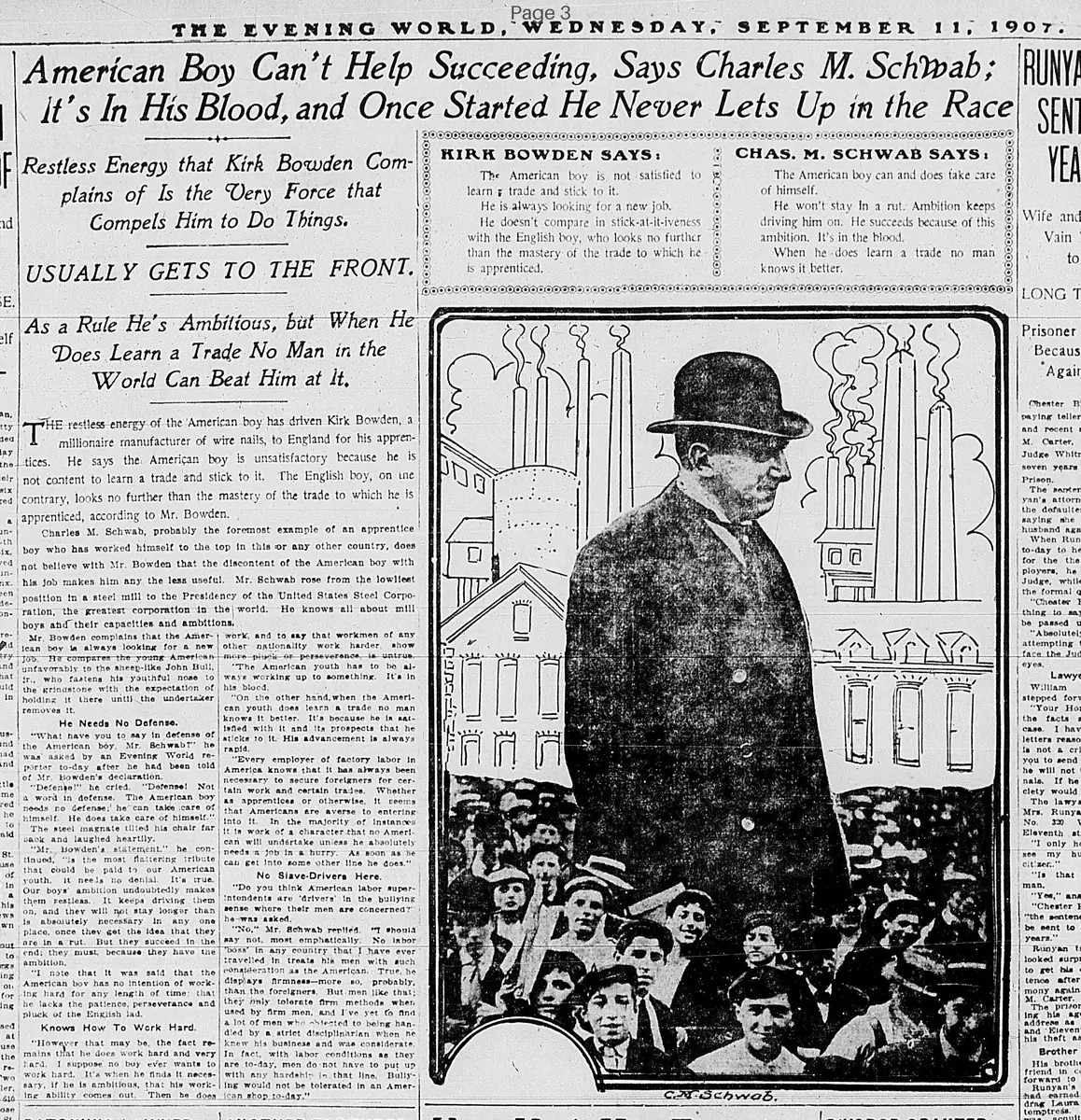
Charles M. Schwab defends the ambition and restlessness of American boys against Kirk Bowden's criticism that they lack dedication to trades. Schwab, who rose from steel mill worker to U.S. Steel president, praises their drive and rapid advancement.
Clipping
OCR Quality
98%
Excellent
Full Text
THE EVENING
WORLD, WEDNESDAY, SEPTEMBER
American Boy Can't Help Succeeding, Says Charles M. Schwab;
RUN
It's In His Blood, and Once Started He Never Lets Up in the Race
Restless Energy that Kirk Bowden Com-
plains of Is the Very Force that
Compels Him to Do Things.
USUALLY GETS TO THE FRONT.
As a Rule He's Ambitious, but When He
Does Learn a Trade No Man in the
World Can Beat Him at It.
THE restless energy of the American boy has driven Kirk Bowden, a
millionaire manufacturer of wire nails, to England for his appren-
tices.
He says the American boy is unsatisfactory because
he
is
not content to learn a trade and stick to it. The English boy, on the
contrary, looks no further than the mastery of the trade to which he is
apprenticed, according to Mr. Bowden.
Charles M. Schwab, probably the foremost example of an apprentice
boy who has worked himself to the top in this or any other country, does
not believe with Mr. Bowden that the discontent of the American boy with
his job makes him any the less useful.
Mr. Schwab rose from the lowliest
position in a steel mill to the Presidency of the United States Steel
Corporation, the greatest corporation in the world.
He
knows
all
about mill
boys and their capacities and ambitions.
Mr. Bowden complains that the American
boy is always looking for a new
Job. He compares the young American
unfavorably to the sheep-like John Bull,
who fastens
his youthful nose
to
the grindstone with the expectation
of
holding
it
there
until
the
undertaker
removes
it.
He Needs No Defense.
"What have you to say
in defense of
the
American
boy,
Mr.
Schwab?"
he
was
asked
by
an
Evening
World
reporter
to-day after he had
been
told
of Mr.
Bowden's declaration.
"Defense!" he cried.
"Defense!
Not
a
word in defense.
The American
boy
needs no defense; he can take care of
himself. He does take care of himself."
The steel magnate tilted his chair far
back and laughed heartily.
"Mr. Bowden's statement,"
he
con-
tinued, "is the most flattering tribute
that could be
paid
our
American
youth. It needs no denial.
It's true.
Our boys' ambition undoubtedly
makes
them restless. It keeps driving
them
on, and they will not stay longer
than
is absolutely necessary
in
any
one
place, once they get the idea that they
are in a rut. But they succeed in
the end; they must because
they
have
the
ambition.
"I
note
that
it
was
said
that
the
American boy has no intention of
working
hard for any length of time; that
he lacks the patience, perseverance and
pluck of the English lad.
Knows How To Work Hard.
"However that may be, the fact re-
mains that he does work hard and very
hard. I suppose no boy ever wants to
work hard. It's when he finds it neces-
sary, if he is ambitious, that his work-
ing ability comes out. Then he does
work, and to say that workmen
of
any
other nationality
work
harder
show
mere pluck or perseverance
untrue.
The American
youth
has
to
be
always working up to something.
It's in
his blood.
"On the other hand, when the American
youth
does
learn
a
trade no man
knows it better.
It's because he is sat-
isfied with it and its prospects that he
sticks to it. His advancement is always
rapid.
"Every employer
of
factory
labor
in
America knows that it has always been
necessary
to
secure
foreigners for cer-
tain work and certain trades. Whether
as
apprentices or otherwise. It
seems
that Americans are averse to entering
into
it.
In the majority of instances
it is work of a character that no American
will undertake unless he absolutely
needs a job in a hurry. As soon as he
can
get into some other line he does.
No Slave-Drivers Here.
"Do you think American labor super-
intendents are
slave-
drivers'
in the bullying
sense where their
men
are concerned?"
he was asked.
"No," Mr. Schwab replied. "I should
say not, most emphatically. No labor
boss in any country
that I have ever
travelled
in
treats
his
men
with such
consideration as the American. True, he
displays firmness—more so, probably.
than the foreigners. But men like that;
they only tolerate firm methods when
used by firm men, and I've yet to find
a lot of men who objected to being han-
dled by a strict disciplinarian when he
knew his business and was considerate.
In fact, with labor conditions as they
are to-day, men do not have to put up
with any hardship in that line. Bullying
would not be tolerated in an American shop to-day."
WORLD, WEDNESDAY, SEPTEMBER
American Boy Can't Help Succeeding, Says Charles M. Schwab;
RUN
It's In His Blood, and Once Started He Never Lets Up in the Race
Restless Energy that Kirk Bowden Com-
plains of Is the Very Force that
Compels Him to Do Things.
USUALLY GETS TO THE FRONT.
As a Rule He's Ambitious, but When He
Does Learn a Trade No Man in the
World Can Beat Him at It.
THE restless energy of the American boy has driven Kirk Bowden, a
millionaire manufacturer of wire nails, to England for his appren-
tices.
He says the American boy is unsatisfactory because
he
is
not content to learn a trade and stick to it. The English boy, on the
contrary, looks no further than the mastery of the trade to which he is
apprenticed, according to Mr. Bowden.
Charles M. Schwab, probably the foremost example of an apprentice
boy who has worked himself to the top in this or any other country, does
not believe with Mr. Bowden that the discontent of the American boy with
his job makes him any the less useful.
Mr. Schwab rose from the lowliest
position in a steel mill to the Presidency of the United States Steel
Corporation, the greatest corporation in the world.
He
knows
all
about mill
boys and their capacities and ambitions.
Mr. Bowden complains that the American
boy is always looking for a new
Job. He compares the young American
unfavorably to the sheep-like John Bull,
who fastens
his youthful nose
to
the grindstone with the expectation
of
holding
it
there
until
the
undertaker
removes
it.
He Needs No Defense.
"What have you to say
in defense of
the
American
boy,
Mr.
Schwab?"
he
was
asked
by
an
Evening
World
reporter
to-day after he had
been
told
of Mr.
Bowden's declaration.
"Defense!" he cried.
"Defense!
Not
a
word in defense.
The American
boy
needs no defense; he can take care of
himself. He does take care of himself."
The steel magnate tilted his chair far
back and laughed heartily.
"Mr. Bowden's statement,"
he
con-
tinued, "is the most flattering tribute
that could be
paid
our
American
youth. It needs no denial.
It's true.
Our boys' ambition undoubtedly
makes
them restless. It keeps driving
them
on, and they will not stay longer
than
is absolutely necessary
in
any
one
place, once they get the idea that they
are in a rut. But they succeed in
the end; they must because
they
have
the
ambition.
"I
note
that
it
was
said
that
the
American boy has no intention of
working
hard for any length of time; that
he lacks the patience, perseverance and
pluck of the English lad.
Knows How To Work Hard.
"However that may be, the fact re-
mains that he does work hard and very
hard. I suppose no boy ever wants to
work hard. It's when he finds it neces-
sary, if he is ambitious, that his work-
ing ability comes out. Then he does
work, and to say that workmen
of
any
other nationality
work
harder
show
mere pluck or perseverance
untrue.
The American
youth
has
to
be
always working up to something.
It's in
his blood.
"On the other hand, when the American
youth
does
learn
a
trade no man
knows it better.
It's because he is sat-
isfied with it and its prospects that he
sticks to it. His advancement is always
rapid.
"Every employer
of
factory
labor
in
America knows that it has always been
necessary
to
secure
foreigners for cer-
tain work and certain trades. Whether
as
apprentices or otherwise. It
seems
that Americans are averse to entering
into
it.
In the majority of instances
it is work of a character that no American
will undertake unless he absolutely
needs a job in a hurry. As soon as he
can
get into some other line he does.
No Slave-Drivers Here.
"Do you think American labor super-
intendents are
slave-
drivers'
in the bullying
sense where their
men
are concerned?"
he was asked.
"No," Mr. Schwab replied. "I should
say not, most emphatically. No labor
boss in any country
that I have ever
travelled
in
treats
his
men
with such
consideration as the American. True, he
displays firmness—more so, probably.
than the foreigners. But men like that;
they only tolerate firm methods when
used by firm men, and I've yet to find
a lot of men who objected to being han-
dled by a strict disciplinarian when he
knew his business and was considerate.
In fact, with labor conditions as they
are to-day, men do not have to put up
with any hardship in that line. Bullying
would not be tolerated in an American shop to-day."
What sub-type of article is it?
Biography
Personal Triumph
What themes does it cover?
Triumph
Moral Virtue
What keywords are associated?
American Boy
Charles Schwab
Kirk Bowden
Apprentices
Ambition
Steel Industry
Work Ethic
What entities or persons were involved?
Charles M. Schwab
Kirk Bowden
Story Details
Key Persons
Charles M. Schwab
Kirk Bowden
Event Date
Wednesday, September
Story Details
Kirk Bowden criticizes American boys for lacking dedication to trades and seeks English apprentices. Charles M. Schwab defends them, highlighting their ambition and his own rise from steel mill worker to U.S. Steel president as proof of their success.