Thank you for visiting SNEWPapers!
Sign up free
Editorial
May 23, 1804
The Enquirer
Richmond, Henrico County, Virginia
What is this article about?
This editorial extols the press's crucial role in a free government, aiding voter selection of candidates, informing officials on public measures, and facilitating national debate. It argues for press freedom while condemning licentiousness that undermines trust.
Clipping
OCR Quality
98%
Excellent
Full Text
The Enquirer
RICHMOND:
WEDNESDAY, MAY 23, 1804.
ON THE PRESS.
NO. 2.
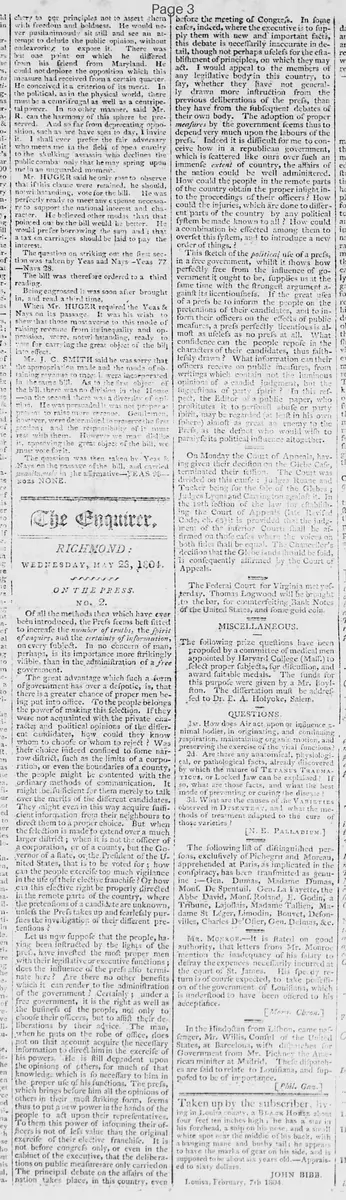
Of all the methods then which have ever been introduced, the Press seems best fitted to increase the number of truths, the spirit of enquiry, and the certainty of information, on every subject. In no concern of man, perhaps, is its importance more strikingly visible, than in the administration of a free government.
The great advantage which such a form of government has over a despotic, is, that there is a greater chance of proper men being put into office. To the people belongs the power of making this selection. If they were not acquainted with the private character and political opinions of the different candidates, how could they know whom to choose or whom to reject? Was their choice indeed confined to some narrow district, such as the limits of a corporation, or even the boundaries of a county, the people might be contented with the ordinary methods of communication. It might be sufficient for them merely to talk over the merits of the different candidates. They might even in this way acquire sufficient information from their neighbours to direct them to a proper choice. But when the selection is made to extend over a much larger district; when it is not the officer of a corporation, or of a county, but the Governor of a state, or the President of the United States, that is to be voted for; how can the people exercise too much vigilance in the use of their elective franchise? Or how can this elective right be properly directed in the remote parts of the country, where the pretensions of a candidate are unknown, unless the Press takes up and fearlessly pursues the investigation of their different pretensions?
Let us now suppose that the people, having been instructed by the lights of the press, have invested the most proper men with their legislative or executive functions; does the influence of the press also terminate here? Are there no other benefits which it can render to the administration of the government? Certainly; under a free government, it is the right as well as the business of the people, not only to choose their officers, but to assist their deliberations by their advice. The man, when he puts on the robe of office, does not on that account acquire the necessary information to direct him in the exercise of his powers. He is still dependent upon the opinions of others, for much of that knowledge which is so necessary to him in the proper use of his functions. The press, which brings before him all the opinions of others in their most striking form, seems thus to put a new power in the hands of the people to act upon their representatives. To them this power of informing their officers is not of less value than the original exercise of their elective franchise. It is not before congress only, or even in the cabinet of the executive, that the deliberations on public measures are only carried on. The principal debate on the affairs of the nation takes place, in this country, even before the meeting of Congress. In some cases, indeed, where the executive is to supply them with new and important facts, this debate is necessarily inaccurate in detail, though not perhaps useless for the establishment of principles, on which they may act. I would appeal to the members of any legislative body in this country, to say, whether they have not generally drawn more instruction from the previous deliberations of the press, than they have from the subsequent debates of their own body. The adoption of proper measures by the government seems thus to depend very much upon the labours of the press. Indeed it is difficult for me to conceive how in a republican government, which is scattered like ours over such an immense extent of country, the affairs of the nation could be well administered. How could the people in the remote parts of the country obtain the proper information into the proceedings of their officers? How could the injuries, which are done to different parts of the country by any political system be made known to all? How could a combination be effected among them to overset this system, and to introduce a new order of things?
This sketch of the political use of a press, in a free government, whilst it shows how perfectly free from the influence of government it ought to be, supplies us at the same time with the strongest argument against its licentiousness. If the great uses of a press be to inform the people on the pretensions of their candidates, and to inform their officers on the effects of public measures, a press perfectly licentious is almost as useless as no press at all. What confidence can the people repose in the characters of their candidates, thus faithlessly drawn? What information can their officers receive on public measures, from writings which contain not the luminous opinions of a candid judgment, but the suggestions of party spirit? In this respect, the Editor of a public paper, who prostitutes it to personal abuse or party spirit, may be regarded (at least in his own sphere) almost as great an enemy to the Press, as the despot who would wish to paralyse its political influence altogether.
RICHMOND:
WEDNESDAY, MAY 23, 1804.
ON THE PRESS.
NO. 2.
Of all the methods then which have ever been introduced, the Press seems best fitted to increase the number of truths, the spirit of enquiry, and the certainty of information, on every subject. In no concern of man, perhaps, is its importance more strikingly visible, than in the administration of a free government.
The great advantage which such a form of government has over a despotic, is, that there is a greater chance of proper men being put into office. To the people belongs the power of making this selection. If they were not acquainted with the private character and political opinions of the different candidates, how could they know whom to choose or whom to reject? Was their choice indeed confined to some narrow district, such as the limits of a corporation, or even the boundaries of a county, the people might be contented with the ordinary methods of communication. It might be sufficient for them merely to talk over the merits of the different candidates. They might even in this way acquire sufficient information from their neighbours to direct them to a proper choice. But when the selection is made to extend over a much larger district; when it is not the officer of a corporation, or of a county, but the Governor of a state, or the President of the United States, that is to be voted for; how can the people exercise too much vigilance in the use of their elective franchise? Or how can this elective right be properly directed in the remote parts of the country, where the pretensions of a candidate are unknown, unless the Press takes up and fearlessly pursues the investigation of their different pretensions?
Let us now suppose that the people, having been instructed by the lights of the press, have invested the most proper men with their legislative or executive functions; does the influence of the press also terminate here? Are there no other benefits which it can render to the administration of the government? Certainly; under a free government, it is the right as well as the business of the people, not only to choose their officers, but to assist their deliberations by their advice. The man, when he puts on the robe of office, does not on that account acquire the necessary information to direct him in the exercise of his powers. He is still dependent upon the opinions of others, for much of that knowledge which is so necessary to him in the proper use of his functions. The press, which brings before him all the opinions of others in their most striking form, seems thus to put a new power in the hands of the people to act upon their representatives. To them this power of informing their officers is not of less value than the original exercise of their elective franchise. It is not before congress only, or even in the cabinet of the executive, that the deliberations on public measures are only carried on. The principal debate on the affairs of the nation takes place, in this country, even before the meeting of Congress. In some cases, indeed, where the executive is to supply them with new and important facts, this debate is necessarily inaccurate in detail, though not perhaps useless for the establishment of principles, on which they may act. I would appeal to the members of any legislative body in this country, to say, whether they have not generally drawn more instruction from the previous deliberations of the press, than they have from the subsequent debates of their own body. The adoption of proper measures by the government seems thus to depend very much upon the labours of the press. Indeed it is difficult for me to conceive how in a republican government, which is scattered like ours over such an immense extent of country, the affairs of the nation could be well administered. How could the people in the remote parts of the country obtain the proper information into the proceedings of their officers? How could the injuries, which are done to different parts of the country by any political system be made known to all? How could a combination be effected among them to overset this system, and to introduce a new order of things?
This sketch of the political use of a press, in a free government, whilst it shows how perfectly free from the influence of government it ought to be, supplies us at the same time with the strongest argument against its licentiousness. If the great uses of a press be to inform the people on the pretensions of their candidates, and to inform their officers on the effects of public measures, a press perfectly licentious is almost as useless as no press at all. What confidence can the people repose in the characters of their candidates, thus faithlessly drawn? What information can their officers receive on public measures, from writings which contain not the luminous opinions of a candid judgment, but the suggestions of party spirit? In this respect, the Editor of a public paper, who prostitutes it to personal abuse or party spirit, may be regarded (at least in his own sphere) almost as great an enemy to the Press, as the despot who would wish to paralyse its political influence altogether.
What sub-type of article is it?
Press Freedom
Constitutional
What keywords are associated?
Press Freedom
Free Government
Elections
Public Information
Republican Administration
Licentiousness
Party Spirit
What entities or persons were involved?
The Press
The People
Candidates
Congress
Executive
Editorial Details
Primary Topic
Role Of The Press In Free Government
Stance / Tone
Advocacy For Free And Responsible Press
Key Figures
The Press
The People
Candidates
Congress
Executive
Key Arguments
Press Increases Truths, Enquiry, And Information Vital For Free Government.
Press Informs Voters On Candidates' Characters And Opinions, Especially In Large Districts.
People Must Vigilantly Use Elective Franchise With Press Guidance.
Press Advises Elected Officials By Providing Public Opinions And Pre Congress Debates.
In Republican Government Over Vast Country, Press Essential For Information Dissemination And Reform.
Press Must Be Free From Government Influence But Not Licentious Or Driven By Party Spirit.
Licentious Press Undermines Trust And Is As Harmful As Despotism.