Thank you for visiting SNEWPapers!
Sign up free
Rhode Island American
Providence, Providence County, Rhode Island
What is this article about?
In December 1823, a correspondent and friends visit the Georgetown Nunnery and Catholic College near Washington, D.C. Guided by Rev. Fenwick, they tour the elegant college facilities, chapel, library, and enjoy Potomac vistas; they converse with cheerful nuns about their devoted lives behind convent grates. (248 characters)
Clipping
OCR Quality
Full Text
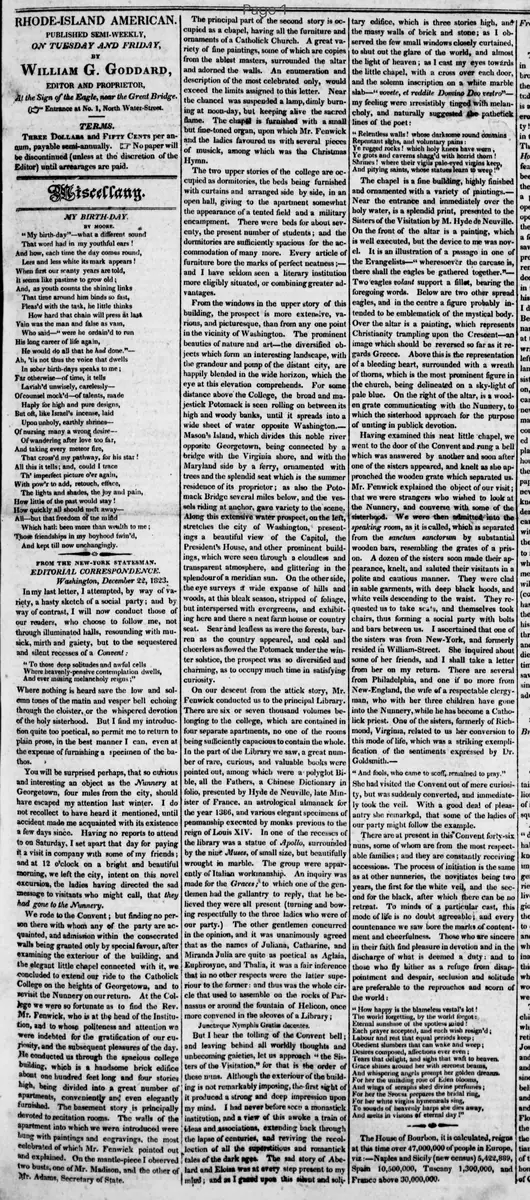
EDITORIAL CORRESPONDENCE.
Washington, December 22, 1823.
In my last letter, I attempted, by way of variety, a hasty sketch of a social party; and by way of contrast, I will now conduct those of our readers, who choose to follow me, not through illuminated halls, resounding with music, mirth and gaiety, but to the sequestered and silent recesses of a Convent:
"To those deep solitudes and awful cells
Where heavenly-pensive contemplation dwells,
And ever musing melancholy reigns;"
Where nothing is heard save the low and solemn tones of the matin and vesper bell echoing through the cloister, or the whispered devotion of the holy sisterhood. But I find my introduction quite too poetical, so permit me to return to plain prose, in the best manner I can, even at the expense of furnishing a specimen of the bathos.
You will be surprised perhaps, that so curious and interesting an object as the Nunnery at Georgetown, four miles from the city, should have escaped my attention last winter. I do not recollect to have heard it mentioned, until accident made me acquainted with its existence a few days since. Having no reports to attend to on Saturday, I set apart that day for paying it a visit in company with some of my friends; and at 12 o'clock on a bright and beautiful morning, we left the city, intent on this novel excursion, the ladies having directed the sad message to visitants who might call, that they had gone to the Nunnery.
We rode to the Convent; but finding no person there with whom any of the party are acquainted, and admission within the consecrated walls being granted only by special favour, after examining the exterior of the building, and the elegant little chapel connected with it, we concluded to extend our ride to the Catholic College on the heights of Georgetown, and to revisit the Nunnery on our return. At the College we were so fortunate as to find the Rev. Mr. Fenwick, who is at the head of the Institution, and to whose politeness and attention we were indebted for the gratification of our curiosity, and the subsequent pleasures of the day.
He conducted us through the spacious college building, which is a handsome brick edifice about one hundred feet long and four stories high, being divided into a great number of apartments, conveniently and even elegantly furnished. The basement story is principally devoted to recitation rooms. The walls of the apartment into which we were introduced were hung with paintings and engravings, the most celebrated of which Mr. Fenwick pointed out and explained. On the mantle-piece I observed two busts, one of Mr. Madison, and the other of Mr. Adams, Secretary of State.
The principal part of the second story is occupied as a chapel, having all the furniture and ornaments of a Catholic Church. A great variety of fine paintings, some of which are copies from the ablest masters, surrounded the altar and adorned the walls. An enumeration and description of the most celebrated only, would exceed the limits assigned to this letter. Near the chancel was suspended a lamp, dimly burning at noon-day, but keeping alive the sacred flame. The chapel is furnished with a small but fine-toned organ, upon which Mr. Fenwick and the ladies favoured us with several pieces of music, among which was the Christmas Hymn.
The two upper stories of the college are occupied as dormitories, the beds being furnished with curtains and arranged side by side, in an open hall, giving to the apartment somewhat the appearance of a tented field and a military encampment. There were beds for about seventy, the present number of students; and the dormitories are sufficiently spacious for the accommodation of many more. Every article of furniture bore the marks of perfect neatness; and I have seldom seen a literary institution more eligibly situated, or combining greater advantages.
From the windows in the upper story of this building, the prospect is more extensive, various, and picturesque, than from any one point in the vicinity of Washington. The prominent beauties of nature and art—the diversified objects which form an interesting landscape, with the grandeur and pomp of the distant city, are happily blended in the wide horizon, which the eye at this elevation comprehends. For some distance above the College, the broad and majestic Potomac is seen rolling on between its high and woody banks, until it spreads into a wide sheet of water opposite Washington.—
Mason's Island, which divides this noble river opposite Georgetown, being connected by a bridge with the Virginia shore, and with the Maryland side by a ferry, ornamented with trees and the splendid seat which is the summer residence of its proprietor; as also the Potomac Bridge several miles below, and the vessels riding at anchor, gave variety to the scene.
Along this extensive water prospect, on the left, stretches the city of Washington, presenting a beautiful view of the Capitol, the President's House, and other prominent buildings, which were seen through a cloudless and transparent atmosphere, and glittering in the splendour of a meridian sun. On the other side, the eye surveys a wide expanse of hills and woods, at this bleak season, stripped of foliage, but interspersed with evergreens, and exhibiting here and there a neat farm house or country seat. Sear and leafless as were the forests, barren as the country appeared, and cold and cheerless as flowed the Potomac under the winter solstice, the prospect was so diversified and charming, as to occupy much time in satisfying curiosity.
On our descent from the attic story, Mr. Fenwick conducted us to the principal Library. There are six or seven thousand volumes belonging to the college, which are contained in four separate apartments, no one of the rooms being sufficiently capacious to contain the whole. In the part of the Library we saw, a great number of rare, curious, and valuable books were pointed out, among which were a polyglot Bible, all the Fathers, a Chinese Dictionary in folio, presented by Hyde de Neuville, late Minister of France, an astrological almanack for the year 1386, and various elegant specimens of penmanship executed by monks previous to the reign of Louis XIV. In one of the recesses of the library was a statue of Apollo, surrounded by the nine Muses, of small size, but beautifully wrought in marble. The group were apparently of Italian workmanship. An inquiry was made for the Graces; to which one of the gentlemen had the gallantry to reply, that he believed they were all present (turning and bowing respectfully to the three ladies who were of our party.) The other gentlemen concurred in the opinion, and it was unanimously agreed that as the names of Juliana, Catharine, and Miranda are quite as poetical as Aglaia, Euphrosyne, and Thalia, it was a fair inference that in no other respects were the latter superior to the former: and thus was the whole circle that used to assemble on the rocks of Parnassus or around the fountain of Helicon, once more convened in the alcoves of a Library;
Junctreque Nymphis Gratiae decentes.
But I hear the tolling of the Convent bell; and leaving behind all worldly thoughts and unbecoming gaieties, let us approach "the Sisters of the Visitation," for that is the order of these nuns. Although the exterior of the building is not remarkably imposing, the first sight of it produced a strong and deep impression upon my mind. I had never before seen a monastick institution, and a view of this awoke a train of ideas and associations, extending back through the lapse of centuries, and reviving the recollection of all the superstitious and romantick tales of the dark ages. The sad story of Abelard and Eloisa was at every step present to my mind; and as I gazed upon this silent and solitary edifice, which is three stories high, and the massy walls of brick and stone; as I observed the few small windows closely curtained, to shut out the glare of the world, and almost the light of heaven; as I cast my eyes towards the little chapel, with a cross over each door, and the solemn inscription on a white marble slab—"vovete, et reddite Domino Deo vestro"— my feelings were irresistibly tinged with melancholy, and naturally suggested the pathetick lines of the poet:
"Relentless walls! whose darksome round contains
Repentant sighs, and voluntary pains:
Ye rugged rocks! which holy knees have worn,
Ye grots and caverns shagg'd with horrid thorn!
Shrines! where their vigils pale-eyed virgins keep
And pitying saints, whose statues learn to weep!"
The chapel is a fine building, highly finished and ornamented with a variety of paintings.— Near the entrance and immediately over the holy water, is a splendid print, presented to the Sisters of the Visitation by M. Hyde de Neuville. On the front of the altar is a painting, which is well executed, but the device to me was novel. It is an illustration of a passage in one of the Evangelists "wheresoever the carcase is, there shall the eagles be gathered together." Two eagles volant support a fillet, bearing the foregoing words. Below are two other spread eagles, and in the centre a figure probably intended to be emblematick of the mystical body.
Over the altar is a painting, which represents Christianity trampling upon the Crescent—an image which should be reversed so far as it regards Greece. Above this is the representation of a bleeding heart, surrounded with a wreath of thorns, which is the most prominent figure in the church, being delineated on a sky-light of pale blue. On the right of the altar, is a wooden grate communicating with the Nunnery, to which the sisterhood approach for the purpose of uniting in publick devotion.
Having examined this neat little chapel, we went to the door of the Convent and rung a bell which was answered by another and soon after one of the sisters appeared, and knelt as she approached the wooden grate which separated us. Mr. Fenwick explained the object of our visit; that we were strangers who wished to look at the Nunnery, and converse with some of the sisterhood. We were then admitted into the speaking room, as it is called, which is separated from the sanctum sanctorum by substantial wooden bars, resembling the grates of a prison. A dozen of the sisters soon made their appearance, knelt, and saluted their visitants in a polite and cautious manner. They were clad in sable garments, with deep black hoods, and white veils descending to the waist. They requested us to take seats, and themselves took chairs, thus forming a social party with bolts and bars between us.
I ascertained that one of the sisters was from New-York, and formerly resided in William-Street. She inquired about some of her friends, and I shall take a letter from her on my return. There are several from Philadelphia, and one if no more from New-England, the wife of a respectable clergyman, who with her three children have gone into the Nunnery, while he has become a Catholic priest. One of the sisters, formerly of Richmond, Virginia, related to us her conversion to this mode of life, which was a striking exemplification of the sentiments expressed by Dr. Goldsmith.—
"And fools, who came to scoff, remained to pray."
She had visited the Convent out of mere curiosity, but was suddenly converted, and immediately took the veil. With a good deal of pleasantry she remarked, that some of the ladies of our party might follow the example.
There are at present in this Convent forty-six nuns, some of whom are from the most respectable families; and they are constantly receiving accessions. The process of initiation is the same as at other nunneries, the novitiates being two years, the first for the white veil, and the second for the black, after which there can be no retreat. To minds of a particular cast, this mode of life is no doubt agreeable; and every countenance we saw bore the marks of contentment and cheerfulness. Those who are sincere in their faith find pleasure in devotion and in the discharge of what is deemed a duty: and to those who fly hither as a refuge from disappointment and despair, seclusion and solitude are preferable to the reproaches and scorn of the world:
"How happy is the blameless vestal's lot!
The world forgetting, by the world forgot:
Eternal sunshine of the spotless mind!
Each prayer accepted, and each wish resign'd;
Labour and rest that equal periods keep;
Obedient slumbers that can wake and weep;
Desires composed, affections ever even;
Tears that delight, and sighs that waft to heaven.
Grace shines around her with serenest beams,
And whispering angels prompt her golden dreams.
For her the unfading rose of Eden blooms,
And wings of seraphs shed divine perfumes;
For her the Spouse prepares the bridal ring,
For her white virgins hymenaeals sing;
To sounds of heavenly harps she dies away,
And melts in visions of eternal day!"
What sub-type of article is it?
What themes does it cover?
What keywords are associated?
What entities or persons were involved?
Where did it happen?
Story Details
Key Persons
Location
Georgetown, Near Washington
Event Date
December 1823
Story Details
A group visits the Catholic College and Nunnery in Georgetown, guided by Rev. Mr. Fenwick; they tour the college building, chapel, library, and scenic views of the Potomac and Washington; at the nunnery, they observe the chapel, interact with nuns through a grate, learn about their backgrounds and conversions.