Thank you for visiting SNEWPapers!
Sign up free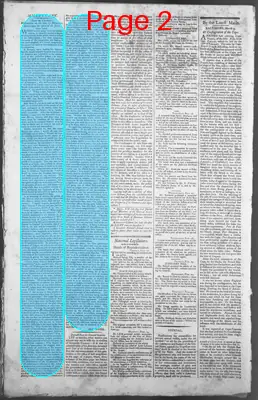
Editorial
March 16, 1802
The New Hampshire Gazette
Portsmouth, Rockingham County, New Hampshire
What is this article about?
An anonymous editorial from the Chronicle critiques Gouverneur Morris's emotional defense of the Judiciary Act of 1801, arguing its repeal restores the efficient system under Washington and Jefferson, dismisses claims of constitutional crisis, and asserts the act's creation was hasty and unnecessary by the prior administration.
Clipping
OCR Quality
95%
Excellent
Full Text
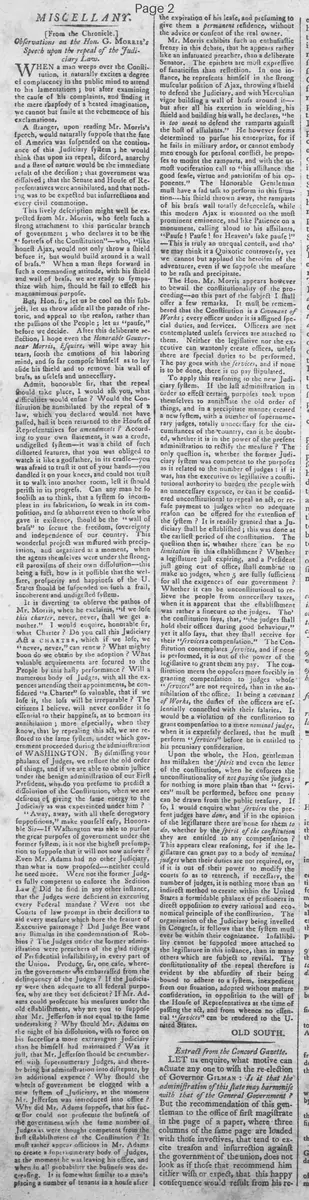
MISCELLANY
[From the Chronicle.]
Observations on the Hon. G. Morris's Speech upon the repeal of the Judiciary Law.
WHEN a man weeps over the Constitution, it naturally excites a degree of complacency in the public mind to attend to his lamentations; but after examining the cause of his complaints, and finding it the mere rhapsody of a heated imagination, we cannot but smile at the vehemence of his exclamations.
A stranger, upon reading Mr. Morris's speech, would naturally suppose that the fate of America was suspended on the continuance of this Judiciary system; he would think that upon its repeal, discord, anarchy and a state of nature would be the immediate result of the decision; that government was dissolved; that the Senate and House of Representatives were annihilated, and that nothing was to be expected but insurrections and every civil commotion.
This lively description might well be expected from Mr. Morris, who feels such a strong attachment to this particular branch of government; who declares it to be the "fortress of the Constitution"-who, "like honest Ajax, would not only throw a shield before it, but would build around it a wall of brass." When a man steps forward in such a commanding attitude, with his shield and wall of brass, we are ready to sympathize with him, should he fail to effect his magnanimous purpose.
But, Hon. Sir, let us be cool on this subject, let us throw aside all the parade of rhetoric, and appeal to the reason, rather than the passions of the People; let us "pause," before we decide. After this deliberate reflection, I hope even the Honorable Gouverneur Morris, Esquire, will wipe away his tears, soothe the emotions of his laboring mind, and so far compose himself as to lay aside his shield and to remove his wall of brass, as useless and unnecessary.
Admit, honorable Sir, that the repeal should take place, I would ask you, what difficulties would ensue? Would the Constitution be annihilated by the repeal of a law, which you declared would not have passed, had it been returned to the House of Representatives for amendments? According to your own statement, it was a crude, undigested system--it was a child of such distorted features, that you was obliged to watch it like a godfather, in its cradle-you was afraid to trust it out of your hands—you dandled it on your knees, and could not trust it to walk into another room, lest it should perish in its progress. Can any man be so foolish as to think, that a system so incomplete in its fabrication, so weak in its composition, and so abhorrent even to those who gave it existence, should be the "wall of brass" to secure the freedom, sovereignty and independence of our country. This wonderful project was matured with precipitation, and organized at a moment, when the agents themselves were under the strongest paroxysms of their own dissolution-this being a fact, how is it possible that the welfare, prosperity and happiness of the U. States should be suspended on such a frail, incoherent and undigested system.
It is diverting to observe the pathos of Mr. Morris, when he exclaims, "if we lose this charter, never, never, shall we get another." I would enquire, honorable Sir, what Charter? Do you call this Judiciary Act a CHARTER, which if we lose, we "never, never," can renew? What mighty boon do we obtain by the adoption? What valuable acquirements are secured to the People by this hasty performance? Will a numerous body of Judges, with all the expenses attending their appointments, be considered "a Charter" so valuable, that if we lose it, the loss will be irreparable? The citizens I believe, will never consider it so essential to their happiness, as to bemoan its annihilation; more especially, when they know, that by repealing this act, we are restored to the same system, under which government proceeded during the administration of WASHINGTON. By dismissing your phalanx of Judges, we restore the old order of things, and if we are able to obtain justice under the benign administration of our First President, why do you presume to predict a dissolution of the Constitution, when we are desirous of giving the same energy to the Judiciary as was experienced under him?
"Away, away, with all these derogatory suppositions,"make yourself easy, Honorable Sir-If Washington was able to pursue the great purposes of government under the former system, is it not the highest presumption to suppose that it will not now answer? Even Mr. Adams had no other Judiciary, than what is now proposed-.--neither could he need more. Were not the former Judges fully competent to enforce the Sedition Law? Did he find in any other instance, that the judges were deficient in executing every Federal mandate? Were not the Courts of law prompt in their decisions to aid every measure which bore the feature of Executive patronage? Did Judge Bee want any stimulus in the condemnation of Robbins? The Judges under the former administration were preachers of the glad tidings of Presidential infallibility, in every part of the Union, Produce, Sir, one case. wherein the government was embarrassed from the delinquency of the Judges? If the Judiciary were then adequate to all federal purposes, why are they now deficient? If Mr. Adams could prosecute his measures under the old establishment, why are you to suppose that Mr. Jefferson is not equal to the same undertaking? Why should Mr. Adams on the night of his dissolution, wish to force on his successor a more extravagant Judiciary than he himself had maintained? Was it just, that Mr. Jefferson should be encumbered with supernumerary Judges, and thereby bring his administration into disrepute, by an additional expense? Why should the wheels of government be clogged with a new system of Judiciary, at the moment Mr. Jefferson was introduced into office? Why did Mr. Adams suppose, that his successor could not prosecute the business of the government with the same number of Judges as were thought competent from the first establishment of the Constitution? It must rather appear officious in Mr. Adams to create a supernumerary body of judges, at the moment he was leaving his office, and when in all probability the business was decreasing. It is somewhat similar to a man's placing a number of tenants in a house after the expiration of his lease, and presuming to give them a permanent residence, without the advice or consent of the real owner.
Mr. Morris exhibits such an enthusiastic frenzy in this debate, that he appears rather like an infatuated preacher, than a deliberate Senator. The epithets are most expressive of fanaticism than reflection. In one instance. he represents himself in the strong muscular position of Ajax, throwing a shield to defend the Judiciary, and with Herculian vigor building a wall of brass around it-.. but after all his exertion in wielding. his shield and building his wall, he declares, "he is too weak to defend the ramparts against the host of assailants." He however seems determined to pursue his enterprize, for if he fails in military ardor, or cannot embody men enough for personal conflict, be proposes to mount the ramparts, and with the utmost vociferation call to "his assistance the good sense, virtue and patriotism of his opponents." The Honorable Gentleman must have a sad task to perform in this situation--.-his shield thrown away, the ramparts of his brass wall totally defenceless, while this modern Ajax is mounted on the most prominent eminence, and like Patience on a monument, calling aloud to his assailants, "Pause! Pause! for Heaven's sake pause!" --This is truly an unequal contest, and tho' we may think it a Quixotic controversy, yet we cannot but applaud the heroism of the adventurer, even if we suppose the measure to be rash and precipitate.
The Hon. Mr. Morris appears however to bewail the constitutionality of the proceeding--on this part of the subject I shall offer a few remarks. It must be remembered that the Constitution is a Covenant of Works ; every officer under it is assigned special duties, and services. Officers are not contemplated unless services are attached to them. Neither the legislative nor the executive can wantonly create offices, unless there are special duties to be performed. The pay goes with the services, and if none is to be done, there is no pay stipulated.
To apply this reasoning to the new Judiciary system. If the last administration in order to effect certain purposes took upon themselves to annihilate the old order of things, and in a precipitate manner created a new system, with a number of supernumerary judges, totally unnecessary for the circumstances of the country, can it be doubted, whether it is in the power of the present administration to rectify the measure? The only question is, whether the former Judiciary system was competent to the purposes as it related to the number of judges : if it was, has the executive or legislative a constitutional authority to burden the people with an unnecessary expense, or can it be considered unconstitutional to repeal an act, or refuse payment to judges when no adequate reason can be offered for the extension of the system? It is readily granted that a Judiciary shall be established ; this was done at the earliest period of the constitution. The question then is, whether there can be no limitation in this establishment? Whether a legislature just expiring, and a President just going out of office, shall combine to make 40 judges, when 5 are fully sufficient for all the exigences of our government? Whether it can be unconstitutional to relieve the people from unnecessary taxes, when it is apparent that the establishment was rather a sinecure to the judges. Tho' the constitution says, that, "the judges shall hold their offices during good behaviour," yet it also says, that they shall receive for their "services a compensation." The Constitution contemplates services, and if none is performed, it is out of the power of the legislative to grant them any pay. The constitution meets the opposers more forcibly in granting compensation to judges whose "services" are not required, than in the annihilation of the office. It being a covenant of Works, the duties of the officers are essentially connected with their salaries. It would be a violation of the constitution to grant compensation to a mere nominal judge, when it is expressly declared, that he must perform "services" before he is entitled to his pecuniary consideration.
Upon the whole, the Hon, gentleman has mistaken the' spirit and even the letter of the constitution, when he enforces the unconstitutionality of not paying the judges ; for nothing is more plain than that "services" must be performed, before one penny can be drawn from the public treasury. If so, I would enquire what services the present judges have done, and if in the opinion of the legislature there are none for them to do, whether by the spirit of the constitution they are entitled to any compensation This appears clear reasoning, for if the legislature can grant pay to a body of nominal judges when their duties are not required, or, if it is out of their power to modify the courts so as to retrench, if necessary, the number of judges, it is nothing more than an indirect method to create within the United States a formidable phalanx of pensioners in direct opposition to every rational and economical principle of the constitution. The organization of the Judiciary being invested in Congress, it follows that the system must ever be within their cognizance. Infallibility cannot be supposed more attached to the legislature in this instance, than in many others which are subject to revision. The constitutionality of the repeal therefore is evident by the absurdity of their being bound to adhere to a system, inexpedient from our situation, adopted without mature consideration, in opposition to the will of the House of Representatives at the time of passing the act, and from whence no essential "services" can be rendered to the U. nited States.
OLD SOUTH.
[From the Chronicle.]
Observations on the Hon. G. Morris's Speech upon the repeal of the Judiciary Law.
WHEN a man weeps over the Constitution, it naturally excites a degree of complacency in the public mind to attend to his lamentations; but after examining the cause of his complaints, and finding it the mere rhapsody of a heated imagination, we cannot but smile at the vehemence of his exclamations.
A stranger, upon reading Mr. Morris's speech, would naturally suppose that the fate of America was suspended on the continuance of this Judiciary system; he would think that upon its repeal, discord, anarchy and a state of nature would be the immediate result of the decision; that government was dissolved; that the Senate and House of Representatives were annihilated, and that nothing was to be expected but insurrections and every civil commotion.
This lively description might well be expected from Mr. Morris, who feels such a strong attachment to this particular branch of government; who declares it to be the "fortress of the Constitution"-who, "like honest Ajax, would not only throw a shield before it, but would build around it a wall of brass." When a man steps forward in such a commanding attitude, with his shield and wall of brass, we are ready to sympathize with him, should he fail to effect his magnanimous purpose.
But, Hon. Sir, let us be cool on this subject, let us throw aside all the parade of rhetoric, and appeal to the reason, rather than the passions of the People; let us "pause," before we decide. After this deliberate reflection, I hope even the Honorable Gouverneur Morris, Esquire, will wipe away his tears, soothe the emotions of his laboring mind, and so far compose himself as to lay aside his shield and to remove his wall of brass, as useless and unnecessary.
Admit, honorable Sir, that the repeal should take place, I would ask you, what difficulties would ensue? Would the Constitution be annihilated by the repeal of a law, which you declared would not have passed, had it been returned to the House of Representatives for amendments? According to your own statement, it was a crude, undigested system--it was a child of such distorted features, that you was obliged to watch it like a godfather, in its cradle-you was afraid to trust it out of your hands—you dandled it on your knees, and could not trust it to walk into another room, lest it should perish in its progress. Can any man be so foolish as to think, that a system so incomplete in its fabrication, so weak in its composition, and so abhorrent even to those who gave it existence, should be the "wall of brass" to secure the freedom, sovereignty and independence of our country. This wonderful project was matured with precipitation, and organized at a moment, when the agents themselves were under the strongest paroxysms of their own dissolution-this being a fact, how is it possible that the welfare, prosperity and happiness of the U. States should be suspended on such a frail, incoherent and undigested system.
It is diverting to observe the pathos of Mr. Morris, when he exclaims, "if we lose this charter, never, never, shall we get another." I would enquire, honorable Sir, what Charter? Do you call this Judiciary Act a CHARTER, which if we lose, we "never, never," can renew? What mighty boon do we obtain by the adoption? What valuable acquirements are secured to the People by this hasty performance? Will a numerous body of Judges, with all the expenses attending their appointments, be considered "a Charter" so valuable, that if we lose it, the loss will be irreparable? The citizens I believe, will never consider it so essential to their happiness, as to bemoan its annihilation; more especially, when they know, that by repealing this act, we are restored to the same system, under which government proceeded during the administration of WASHINGTON. By dismissing your phalanx of Judges, we restore the old order of things, and if we are able to obtain justice under the benign administration of our First President, why do you presume to predict a dissolution of the Constitution, when we are desirous of giving the same energy to the Judiciary as was experienced under him?
"Away, away, with all these derogatory suppositions,"make yourself easy, Honorable Sir-If Washington was able to pursue the great purposes of government under the former system, is it not the highest presumption to suppose that it will not now answer? Even Mr. Adams had no other Judiciary, than what is now proposed-.--neither could he need more. Were not the former Judges fully competent to enforce the Sedition Law? Did he find in any other instance, that the judges were deficient in executing every Federal mandate? Were not the Courts of law prompt in their decisions to aid every measure which bore the feature of Executive patronage? Did Judge Bee want any stimulus in the condemnation of Robbins? The Judges under the former administration were preachers of the glad tidings of Presidential infallibility, in every part of the Union, Produce, Sir, one case. wherein the government was embarrassed from the delinquency of the Judges? If the Judiciary were then adequate to all federal purposes, why are they now deficient? If Mr. Adams could prosecute his measures under the old establishment, why are you to suppose that Mr. Jefferson is not equal to the same undertaking? Why should Mr. Adams on the night of his dissolution, wish to force on his successor a more extravagant Judiciary than he himself had maintained? Was it just, that Mr. Jefferson should be encumbered with supernumerary Judges, and thereby bring his administration into disrepute, by an additional expense? Why should the wheels of government be clogged with a new system of Judiciary, at the moment Mr. Jefferson was introduced into office? Why did Mr. Adams suppose, that his successor could not prosecute the business of the government with the same number of Judges as were thought competent from the first establishment of the Constitution? It must rather appear officious in Mr. Adams to create a supernumerary body of judges, at the moment he was leaving his office, and when in all probability the business was decreasing. It is somewhat similar to a man's placing a number of tenants in a house after the expiration of his lease, and presuming to give them a permanent residence, without the advice or consent of the real owner.
Mr. Morris exhibits such an enthusiastic frenzy in this debate, that he appears rather like an infatuated preacher, than a deliberate Senator. The epithets are most expressive of fanaticism than reflection. In one instance. he represents himself in the strong muscular position of Ajax, throwing a shield to defend the Judiciary, and with Herculian vigor building a wall of brass around it-.. but after all his exertion in wielding. his shield and building his wall, he declares, "he is too weak to defend the ramparts against the host of assailants." He however seems determined to pursue his enterprize, for if he fails in military ardor, or cannot embody men enough for personal conflict, be proposes to mount the ramparts, and with the utmost vociferation call to "his assistance the good sense, virtue and patriotism of his opponents." The Honorable Gentleman must have a sad task to perform in this situation--.-his shield thrown away, the ramparts of his brass wall totally defenceless, while this modern Ajax is mounted on the most prominent eminence, and like Patience on a monument, calling aloud to his assailants, "Pause! Pause! for Heaven's sake pause!" --This is truly an unequal contest, and tho' we may think it a Quixotic controversy, yet we cannot but applaud the heroism of the adventurer, even if we suppose the measure to be rash and precipitate.
The Hon. Mr. Morris appears however to bewail the constitutionality of the proceeding--on this part of the subject I shall offer a few remarks. It must be remembered that the Constitution is a Covenant of Works ; every officer under it is assigned special duties, and services. Officers are not contemplated unless services are attached to them. Neither the legislative nor the executive can wantonly create offices, unless there are special duties to be performed. The pay goes with the services, and if none is to be done, there is no pay stipulated.
To apply this reasoning to the new Judiciary system. If the last administration in order to effect certain purposes took upon themselves to annihilate the old order of things, and in a precipitate manner created a new system, with a number of supernumerary judges, totally unnecessary for the circumstances of the country, can it be doubted, whether it is in the power of the present administration to rectify the measure? The only question is, whether the former Judiciary system was competent to the purposes as it related to the number of judges : if it was, has the executive or legislative a constitutional authority to burden the people with an unnecessary expense, or can it be considered unconstitutional to repeal an act, or refuse payment to judges when no adequate reason can be offered for the extension of the system? It is readily granted that a Judiciary shall be established ; this was done at the earliest period of the constitution. The question then is, whether there can be no limitation in this establishment? Whether a legislature just expiring, and a President just going out of office, shall combine to make 40 judges, when 5 are fully sufficient for all the exigences of our government? Whether it can be unconstitutional to relieve the people from unnecessary taxes, when it is apparent that the establishment was rather a sinecure to the judges. Tho' the constitution says, that, "the judges shall hold their offices during good behaviour," yet it also says, that they shall receive for their "services a compensation." The Constitution contemplates services, and if none is performed, it is out of the power of the legislative to grant them any pay. The constitution meets the opposers more forcibly in granting compensation to judges whose "services" are not required, than in the annihilation of the office. It being a covenant of Works, the duties of the officers are essentially connected with their salaries. It would be a violation of the constitution to grant compensation to a mere nominal judge, when it is expressly declared, that he must perform "services" before he is entitled to his pecuniary consideration.
Upon the whole, the Hon, gentleman has mistaken the' spirit and even the letter of the constitution, when he enforces the unconstitutionality of not paying the judges ; for nothing is more plain than that "services" must be performed, before one penny can be drawn from the public treasury. If so, I would enquire what services the present judges have done, and if in the opinion of the legislature there are none for them to do, whether by the spirit of the constitution they are entitled to any compensation This appears clear reasoning, for if the legislature can grant pay to a body of nominal judges when their duties are not required, or, if it is out of their power to modify the courts so as to retrench, if necessary, the number of judges, it is nothing more than an indirect method to create within the United States a formidable phalanx of pensioners in direct opposition to every rational and economical principle of the constitution. The organization of the Judiciary being invested in Congress, it follows that the system must ever be within their cognizance. Infallibility cannot be supposed more attached to the legislature in this instance, than in many others which are subject to revision. The constitutionality of the repeal therefore is evident by the absurdity of their being bound to adhere to a system, inexpedient from our situation, adopted without mature consideration, in opposition to the will of the House of Representatives at the time of passing the act, and from whence no essential "services" can be rendered to the U. nited States.
OLD SOUTH.
What sub-type of article is it?
Constitutional
Legal Reform
Partisan Politics
What keywords are associated?
Judiciary Repeal
Gouverneur Morris
Judiciary Act
Constitutional Services
Adams Administration
Jefferson Administration
Federal Judges
What entities or persons were involved?
Gouverneur Morris
George Washington
John Adams
Thomas Jefferson
Judge Bee
Robbins
Editorial Details
Primary Topic
Critique Of Gouverneur Morris's Opposition To Judiciary Act Repeal
Stance / Tone
Satirical Support For Repeal And Criticism Of Federalist Judiciary Expansion
Key Figures
Gouverneur Morris
George Washington
John Adams
Thomas Jefferson
Judge Bee
Robbins
Key Arguments
Repeal Restores Efficient Judiciary Under Washington
Act Was Hasty, Crude, And Unnecessary
No Constitutional Crisis From Repeal
Judges Require Services For Compensation
Adams's Creation Burdened Jefferson With Excess Judges
Morris's Rhetoric Is Emotional And Fanatical