Thank you for visiting SNEWPapers!
Sign up free
Story
September 6, 1872
The Cambria Freeman
Ebensburg, Cambria County, Pennsylvania
What is this article about?
In a political speech, Charles W. Helm recounts the anecdote of Widow Rody, a Missouri homesteader who boldly confronts guerrilla leader Jenison during the Civil War to reclaim her stolen mules, declaring opposition to all stealing as her principle.
Clipping
OCR Quality
95%
Excellent
Full Text
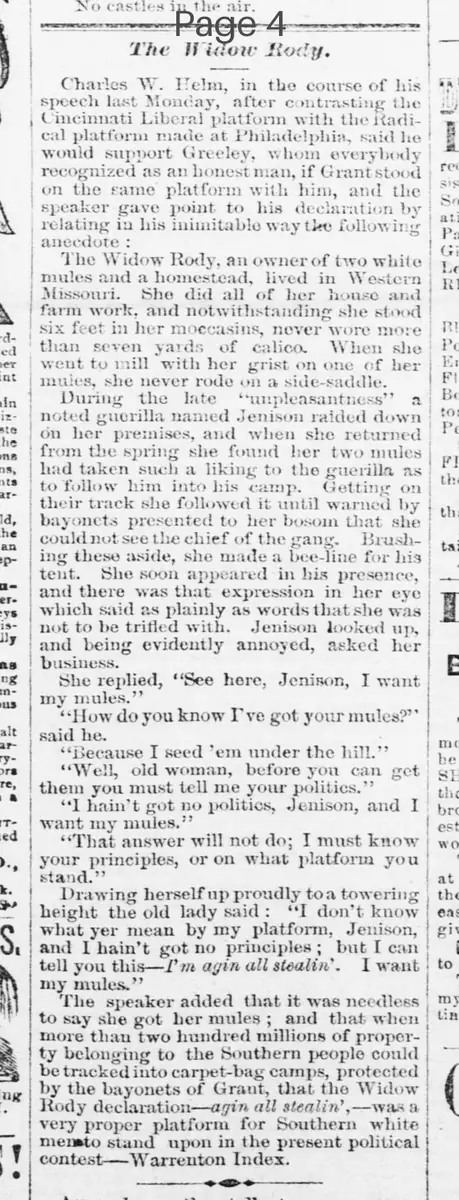
The Widow Rody.
Charles W. Helm, in the course of his speech last Monday, after contrasting the Cincinnati Liberal platform with the Radical platform made at Philadelphia, said he would support Greeley, whom everybody recognized as an honest man, if Grant stood on the same platform with him, and the speaker gave point to his declaration by relating in his inimitable way the following anecdote:
The Widow Rody, an owner of two white mules and a homestead, lived in Western Missouri. She did all of her house and farm work, and notwithstanding she stood six feet in her moccasins, never wore more than seven yards of calico. When she went to mill with her grist on one of her mules, she never rode on a side-saddle. During the late "unpleasantness" a noted guerilla named Jenison raided down on her premises, and when she returned from the spring she found her two mules had taken such a liking to the guerilla as to follow him into his camp. Getting on their track she followed it until warned by bayonets presented to her bosom that she could not see the chief of the gang. Brushing these aside, she made a bee-line for his tent. She soon appeared in his presence, and there was that expression in her eye which said as plainly as words that she was not to be trifled with. Jenison looked up, and being evidently annoyed, asked her business.
She replied, "See here, Jenison, I want my mules."
"How do you know I've got your mules?" said he.
"Because I seed 'em under the hill."
"Well, old woman, before you can get them you must tell me your politics."
"I hain't got no politics, Jenison, and I want my mules."
"That answer will not do; I must know your principles, or on what platform you stand."
Drawing herself up proudly to a towering height the old lady said: "I don't know what yer mean by my platform, Jenison, and I hain't got no principles; but I can tell you this—I'm agin all stealin'. I want my mules."
The speaker added that it was needless to say she got her mules; and that when more than two hundred millions of property belonging to the Southern people could be tracked into carpet-bag camps, protected by the bayonets of Grant, that the Widow Rody declaration—"agin all stealin',"—was a very proper platform for Southern white men to stand upon in the present political contest.—Warrenton Index
Charles W. Helm, in the course of his speech last Monday, after contrasting the Cincinnati Liberal platform with the Radical platform made at Philadelphia, said he would support Greeley, whom everybody recognized as an honest man, if Grant stood on the same platform with him, and the speaker gave point to his declaration by relating in his inimitable way the following anecdote:
The Widow Rody, an owner of two white mules and a homestead, lived in Western Missouri. She did all of her house and farm work, and notwithstanding she stood six feet in her moccasins, never wore more than seven yards of calico. When she went to mill with her grist on one of her mules, she never rode on a side-saddle. During the late "unpleasantness" a noted guerilla named Jenison raided down on her premises, and when she returned from the spring she found her two mules had taken such a liking to the guerilla as to follow him into his camp. Getting on their track she followed it until warned by bayonets presented to her bosom that she could not see the chief of the gang. Brushing these aside, she made a bee-line for his tent. She soon appeared in his presence, and there was that expression in her eye which said as plainly as words that she was not to be trifled with. Jenison looked up, and being evidently annoyed, asked her business.
She replied, "See here, Jenison, I want my mules."
"How do you know I've got your mules?" said he.
"Because I seed 'em under the hill."
"Well, old woman, before you can get them you must tell me your politics."
"I hain't got no politics, Jenison, and I want my mules."
"That answer will not do; I must know your principles, or on what platform you stand."
Drawing herself up proudly to a towering height the old lady said: "I don't know what yer mean by my platform, Jenison, and I hain't got no principles; but I can tell you this—I'm agin all stealin'. I want my mules."
The speaker added that it was needless to say she got her mules; and that when more than two hundred millions of property belonging to the Southern people could be tracked into carpet-bag camps, protected by the bayonets of Grant, that the Widow Rody declaration—"agin all stealin',"—was a very proper platform for Southern white men to stand upon in the present political contest.—Warrenton Index
What sub-type of article is it?
Biography
Historical Event
Personal Triumph
What themes does it cover?
Bravery Heroism
Justice
Moral Virtue
What keywords are associated?
Widow Rody
Stolen Mules
Guerrilla Raid
Civil War Anecdote
Political Platform
What entities or persons were involved?
Widow Rody
Jenison
Charles W. Helm
Where did it happen?
Western Missouri
Story Details
Key Persons
Widow Rody
Jenison
Charles W. Helm
Location
Western Missouri
Event Date
During The Late Unpleasantness
Story Details
Widow Rody confronts guerrilla leader Jenison in his camp to reclaim her stolen mules, brushing aside guards and declaring she is against all stealing, successfully retrieving them.