Thank you for visiting SNEWPapers!
Sign up free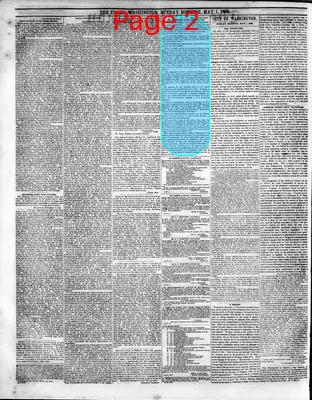
Story
May 1, 1853
The Daily Union
Washington, District Of Columbia
What is this article about?
Article from the Home Journal explores the humble origins of advertising through amusing examples of 18th-century advertisements from Norwich, England, journals, including book sales, cooking lessons, malt sales, coach travel, and a slander dispute, arguing they offer better historical insight than formal histories.
Clipping
OCR Quality
97%
Excellent
Full Text
From the Home Journal
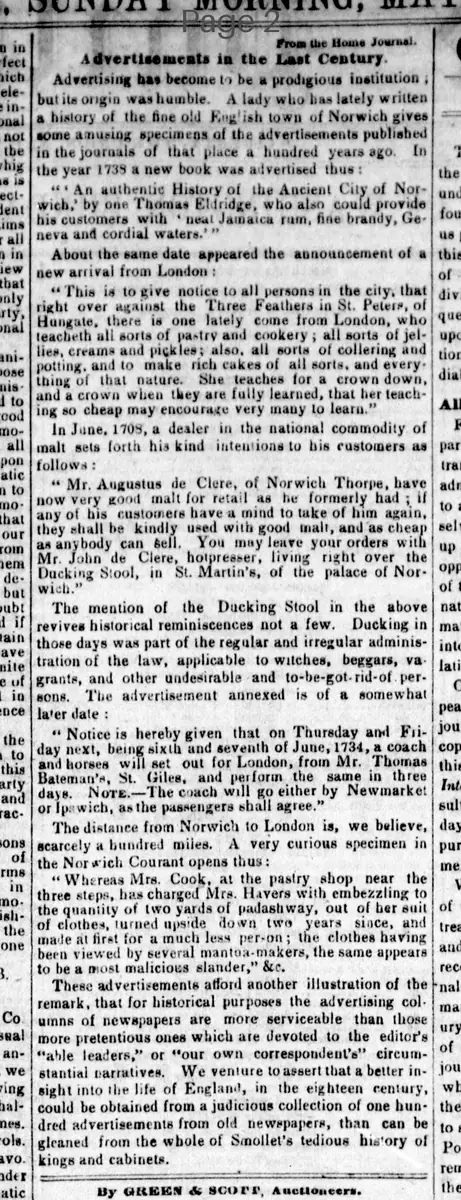
Advertisements in the Last Century.
Advertising has become to be a prodigious institution; but its origin was humble. A lady who has lately written a history of the fine old English town of Norwich gives some amusing specimens of the advertisements published in the journals of that place a hundred years ago. In the year 1738 a new book was advertised thus:
"An authentic History of the Ancient City of Norwich,' by one Thomas Eldridge, who also could provide his customers with 'neat Jamaica rum, fine brandy, Geneva and cordial waters.'"
About the same date appeared the announcement of a new arrival from London:
"This is to give notice to all persons in the city, that right over against the Three Feathers in St. Peters, of Hungate, there is one lately come from London, who teacheth all sorts of pastry and cookery; all sorts of jellies, creams and pickles; also, all sorts of collaring and potting, and to make rich cakes of all sorts, and everything of that nature. She teaches for a crown down, and a crown when they are fully learned, that her teaching so cheap may encourage very many to learn."
In June, 1758, a dealer in the national commodity of malt sets forth his kind intentions to his customers as follows:
"Mr. Augustus de Clere, of Norwich Thorpe, have now very good malt for retail as he formerly had; if any of his customers have a mind to take of him again, they shall be kindly used with good malt, and as cheap as anybody can sell. You may leave your orders with Mr. John de Clere, hotpresser, living right over the Ducking Stool, in St. Martin's, of the palace of Norwich."
The mention of the Ducking Stool in the above revives historical reminiscences not a few. Ducking in those days was part of the regular and irregular administration of the law, applicable to witches, beggars, vagrants, and other undesirable and to-be-got-rid-of persons. The advertisement annexed is of a somewhat later date:
"Notice is hereby given that on Thursday and Friday next, being sixth and seventh of June, 1734, a coach and horses will set out for London, from Mr. Thomas Bateman's, St. Giles, and perform the same in three days. Note. The coach will go either by Newmarket or Ipswich, as the passengers shall agree."
The distance from Norwich to London is, we believe, scarcely a hundred miles. A very curious specimen in the Norwich Courant opens thus:
"Whereas Mrs. Cook, at the pastry shop near the three steps, has charged Mrs. Havers with embezzling to the quantity of two yards of paduasoy, out of her suit of clothes, turned upside down two years since, and made at first for a much less person; the clothes having been viewed by several mantua-makers, the same appears to be a most malicious slander," &c.
These advertisements afford another illustration of the remark, that for historical purposes the advertising columns of newspapers are more serviceable than those more pretentious ones which are devoted to the editor's "able leaders," or "our own correspondent's" circumstantial narratives. We venture to assert that a better insight into the life of England, in the eighteenth century, could be obtained from a judicious collection of one hundred advertisements from old newspapers, than can be gleaned from the whole of Smollett's tedious history of kings and cabinets.
Advertisements in the Last Century.
Advertising has become to be a prodigious institution; but its origin was humble. A lady who has lately written a history of the fine old English town of Norwich gives some amusing specimens of the advertisements published in the journals of that place a hundred years ago. In the year 1738 a new book was advertised thus:
"An authentic History of the Ancient City of Norwich,' by one Thomas Eldridge, who also could provide his customers with 'neat Jamaica rum, fine brandy, Geneva and cordial waters.'"
About the same date appeared the announcement of a new arrival from London:
"This is to give notice to all persons in the city, that right over against the Three Feathers in St. Peters, of Hungate, there is one lately come from London, who teacheth all sorts of pastry and cookery; all sorts of jellies, creams and pickles; also, all sorts of collaring and potting, and to make rich cakes of all sorts, and everything of that nature. She teaches for a crown down, and a crown when they are fully learned, that her teaching so cheap may encourage very many to learn."
In June, 1758, a dealer in the national commodity of malt sets forth his kind intentions to his customers as follows:
"Mr. Augustus de Clere, of Norwich Thorpe, have now very good malt for retail as he formerly had; if any of his customers have a mind to take of him again, they shall be kindly used with good malt, and as cheap as anybody can sell. You may leave your orders with Mr. John de Clere, hotpresser, living right over the Ducking Stool, in St. Martin's, of the palace of Norwich."
The mention of the Ducking Stool in the above revives historical reminiscences not a few. Ducking in those days was part of the regular and irregular administration of the law, applicable to witches, beggars, vagrants, and other undesirable and to-be-got-rid-of persons. The advertisement annexed is of a somewhat later date:
"Notice is hereby given that on Thursday and Friday next, being sixth and seventh of June, 1734, a coach and horses will set out for London, from Mr. Thomas Bateman's, St. Giles, and perform the same in three days. Note. The coach will go either by Newmarket or Ipswich, as the passengers shall agree."
The distance from Norwich to London is, we believe, scarcely a hundred miles. A very curious specimen in the Norwich Courant opens thus:
"Whereas Mrs. Cook, at the pastry shop near the three steps, has charged Mrs. Havers with embezzling to the quantity of two yards of paduasoy, out of her suit of clothes, turned upside down two years since, and made at first for a much less person; the clothes having been viewed by several mantua-makers, the same appears to be a most malicious slander," &c.
These advertisements afford another illustration of the remark, that for historical purposes the advertising columns of newspapers are more serviceable than those more pretentious ones which are devoted to the editor's "able leaders," or "our own correspondent's" circumstantial narratives. We venture to assert that a better insight into the life of England, in the eighteenth century, could be obtained from a judicious collection of one hundred advertisements from old newspapers, than can be gleaned from the whole of Smollett's tedious history of kings and cabinets.
What sub-type of article is it?
Curiosity
Historical Event
What themes does it cover?
Social Manners
What keywords are associated?
Historical Advertisements
Norwich England
18th Century
Cooking Lessons
Malt Dealer
Coach Travel
Slander Dispute
What entities or persons were involved?
Thomas Eldridge
Augustus De Clere
John De Clere
Thomas Bateman
Mrs. Cook
Mrs. Havers
Where did it happen?
Norwich, England
Story Details
Key Persons
Thomas Eldridge
Augustus De Clere
John De Clere
Thomas Bateman
Mrs. Cook
Mrs. Havers
Location
Norwich, England
Event Date
Eighteenth Century (1734 1758)
Story Details
Collection of 18th-century Norwich advertisements for books, rum, cooking lessons, malt, coach travel to London, and a slander denial, illustrating everyday commerce and life; argues ads provide better historical insight than formal narratives.