Thank you for visiting SNEWPapers!
Sign up free
Gazette Of The United States, & Philadelphia Daily Advertiser
Philadelphia, Philadelphia County, Pennsylvania
What is this article about?
In the U.S. House of Representatives on May 11, debate on a bill to raise a provisional army amid fears of French invasion. Mr. Sitgreaves advocates immediate raising without contingencies; others discuss size (20,000 vs. 10,000 or 5,000 men) and presidential discretion. Amendments pass to limit to contingencies and reduce to 10,000.
Merged-components note: This is a continuation of the congressional debate story across pages 1 and 2.
Clippings
1 of 2
OCR Quality
Full Text
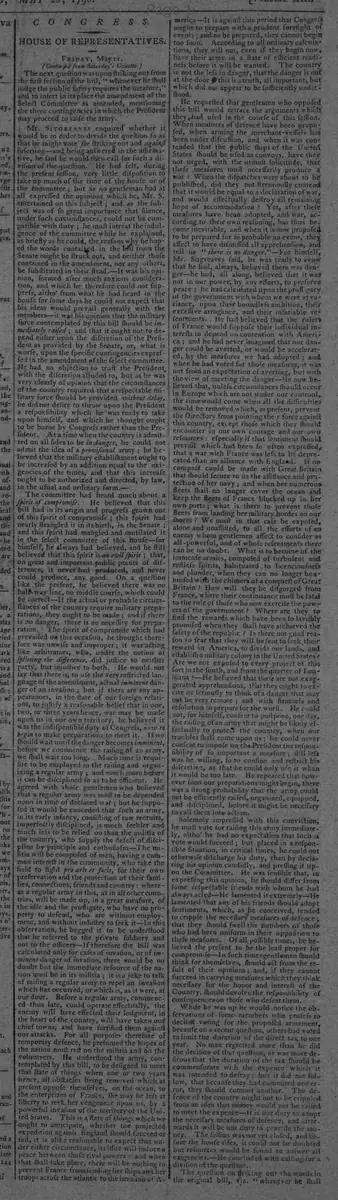
FRIDAY, May 11.
(Continued from Saturday's Gazette.)
The next question was upon striking out from the first section of the bill, "whenever he shall judge the public safety requires the measure," and to insert in its place the amendment of the Select Committee as amended, mentioning the three contingencies in which the President may proceed to raise the army.
Mr. SITGREAVES enquired whether it would be in order to divide the question so as that he might vote for striking out and against inserting—and being answered in the affirmative, he said he would then call for such a division of the question. He had felt, during the present session, very little disposition to take up much of the time of the house or of the committee; but as no gentleman had at all expressed the opinions which he, Mr. S. entertained on this subject; and as the subject was of so great importance that silence, under such circumstances, could not be compatible with duty; he must intreat the indulgence of the committee while he explained, as briefly as he could, the reasons why he hoped the words contained in the bill from the Senate might be struck out, and neither those contained in the amendment, nor any others, be substituted in their stead.—It was his opinion, formed after much anxious consideration, and which he therefore could not suppress, altho' from what he had heard in the house for some days he could not expect that his ideas would prevail generally with the members—it was his opinion that the military force contemplated by this bill should be immediately raised; and that it ought not to depend either upon the discretion of the President as provided by the Senate, or, what is worse, upon the specific contingencies expressed in the amendment of the select committee.
He had no objection to trust the President with the discretion alluded to, but as he was very clearly of opinion that the circumstances of the country required that a respectable military force should be provided without delay, he did not desire to throw upon the President a responsibility which he was ready to take upon himself, and which he thought ought to be borne by Congress rather than the President. At a time when the country is admitted on all sides to be in danger, he could not admit the idea of a provisional army; he believed that the military establishment ought to be increased by an addition equal to the exigencies of the times, and that this increase ought to be authorized and directed, by law, in the usual and ordinary form.
The committee had heard much about a spirit of compromise. He believed that this bill had in its origin and progress grown out of this spirit of compromise; this spirit had nearly strangled it in its birth, in the Senate; and this spirit had mangled and mutilated it in the select committee of this house—for himself, he always had believed, and he still believed that this spirit is an evil spirit; that, on great and important public points of difference, it never had produced, and never could produce, any good. On a question like the present, he believed there was no half-way line, no middle course, which could be correct—If the actual or probable circumstances of the country require military preparations, they ought to be made; and if there is no danger, there is no necessity for preparation. The spirit of compromise which had prevailed on this occasion, he thought therefore was unwise and improper; it was acting like arbitrators, who, under the notion of splitting the difference, did justice to neither party, but injustice to both. He would not say that there is, to use the very restricted language of the amendment, actual imminent danger of an invasion; but if there are any appearances, in the state of our foreign relations, to justify a reasonable belief that in one, two, or three years hence, war may be made upon us in our own territory, he believed it was the indispensable duty of Congress, now to begin to make preparations to meet it. If we should wait until the danger becomes imminent, before we commence the raising of an army, we shall wait too long. Much time is requisite to be employed in the raising and organizing a regular army; and much more before it can be disciplined so as to be efficient. He agreed with those gentlemen who believed that a regular army was most to be depended upon in time of declared war; but he supposed it would be conceded that such an army, in its early infancy, consisting of raw recruits, imperfectly disciplined, is much feebler and much less to be relied on than the militia of the country, who supply the defect of discipline by principle and enthusiasm—The militia will be composed of men, having a common interest in the community, who take the field to fight pro aris et focis, for their own preservation and the protection of their families, connections, friends and country: whereas a regular army in this, as in all other countries, will be made up, in a great measure, of the idle and the profligate, who have no property to defend, who are without employment, and without industry to seek it—In this observation, he begged it to be understood that he referred to the private soldiery and not to the officers—If therefore the bill was calculated only for cases of invasion, or of imminent danger of invasion, there could be no doubt but the immediate resource of the nation must be in its militia; it is a joke to talk of raising a regular army to repel an invasion which has occurred, or which is, as it were, at our door. Before a regular army, commenced thus late, could operate effectually, the enemy will have effected their lodgment, in the heart of the country, will have taken our chief towns, and have fortified them against our attacks. For all purposes therefore of temporary defence, he presumed the hopes of the nation must rest on the militia and on the volunteers. He understood the army, contemplated by this bill, to be designed to meet that state of things when one or two years hence, all obstacles being removed which at present oppose themselves, on the ocean, to the enterprizes of France, she may be left at liberty to seek her vengeance upon us, by a powerful invasion of the territory of the United States. This is a state of things which we ought to anticipate, whether the projected expedition against England should succeed or fail, it is alike reasonable to expect that under either circumstance, its issue will induce a peace between those rival powers: and when that shall take place, there will be nothing to prevent France from sending her ships and her troops across the atlantic to the invasion of America—It is against this period that Congress ought to prepare with a prudent foresight of events; and to be prepared, they cannot begin too soon. According to all ordinary calculations, they will not, even if they begin now, have their army in a state of efficient readiness before it will be wanted. The country is not the less in danger. that the danger is not at the door this is a truth, all important, but which did not appear to be sufficiently understood.
He requested that gentlemen who opposed this bill would retrace the arguments which they had used in the course of this session. When measures of defence have been proposed, when arming the merchant-vessels has been under discussion, and when it was contended that the public ships of the United States should be used as convoys, have they not urged, with the utmost solicitude, that these measures must necessarily produce a war? When the dispatches were about to be published, did they not strenuously contend that it would be equal to a declaration of war, and would effectually destroy all remaining hope of accommodation? Yet, after these measures have been adopted, and war, according to their own reasoning, has thus be-come inevitable, and when it is now proposed to be prepared for so probable an event, they affect to have dismissed all apprehension, and tell us "there is no danger." For himself, Mr. Sitgreaves said, he was ready to avow that he had, always, believed there was dan-ger—he had, all along, believed that it was not in our power, by any efforts, to preserve peace; he had calculated upon the profligacy of the government with whom we were at va-riance, upon their boundless ambition, their excessive arrogance, and their insatiable re-sentments. He had believed that the rulers of France would suppose their individual in-terests to depend on contention with Ameri-ca; and he had never imagined that our dan-ger could be averted, or would be accelerat-ed, by the measures we had adopted; and when he had voted for those measures, it was not from an expectation of averting, but with the view of meeting the danger—He now be-lieved that, unless circumstances should occur in Europe which are not under our controul, the time would come when all the difficulties would be removed which, at present, prevent the Directory from pointing their force against this country, except those which they should encounter in our own courage and our own resources: especially if that sentiment should prevail which had been so often expressed, that a war with France was less to be depre-cated than an alliance with England. If no compact could be made with Great Britain that should secure to us the assistance and pro-tection of her navy; and when her numerous fleets shall no longer cover the ocean and keep the fleets of France blocked up in her own ports; what is there to prevent those fleets rom landing her military hordes on our shores? We must in that case be exposed, alone and unassisted, to all the efforts of an enemy whom gentlemen affect to consider as all-powerful, and of whose resentments there can be no doubt. What is to become of the immense armies, composed of turbulent and restless spirits, habituated to licentiousness and plunder, when they can no longer bea-mused with the chimera of a conquest of Great Britain? How, will they be disgorged from France, where their continuance must be fatal to the rule of those who now exercise the pow—ers of the government? Where are they to find the rewards which have been so lavishly promised when they shall have atchieved the safety of the republic? Is there not good rea-son to fear that they will be sent to seek their reward in America, to divide our lands, and establish a military colony in the United States Are we not exposed to every project of this sort in the south, and from the quarter of Lou-isiana?—He believed that these are not exag-gerated apprehensions, that they ought to ex-cite us seriously to think of a danger that may not be very remote; and with firmness and resolution to prepare for the worst. He could not, for himself, consent to postpone, one day, the raising of an army that might be likely ef-fectually to protect the country, when our troubles shall come upon us; he could never consent to impose on the President the respon-sibility of so important a measure; still less was he willing, so to confine and restrict his discretion, as that he could only use it when it would be too late. He repeated that how-ever soon our preparations might begin, there was a strong probability that the army could not be efficiently raised, organized, equipped, and disciplined, before it might be necessary to call them into action.
Solemnly impressed with this conviction, he must vote for raising this army immediate-ly, altho' he had no expectation that such a vote would succeed; but placed in a respon-sible situation, in critical times, he could not otherwise discharge his duty, than by decla-ring his opinion candidly, and pressing it up-on the Committee. He was sensible that, in expressing this opinion, he should differ from some respectable friends with whom he had always acted—He lamented it extremely—He lamented that any of his friends should adopt sentiments, which, as he conceived, tended to cripple the necessary measures of defence; that they should swell the numbers of those who had been uniform in their opposition to these measures. Of all possible times, he be-lieved the present to be the least proper for compromise—In such times gentlemen should think for themselves, should act from the re-sult of their opinions; and, if they cannot succeed in carrying measures which they think necessary for the honor and interest of the Country, should devolve the responsibility of consequences on those who defeat them.
While he was up he would notice the ob-servations of some members who profess to decline voting for the proposed armament, because on a recent question, others had voted to limit the duration of the direct tax to one year. No man regretted more than he did the decision of that question, or was more de-sirous that the duration of the tax should be commensurate with the expence which it was intended to defray: but it did not fol-low, that because they had committed one er-ror, they should commit another. The de-fence of the country ought not to be crippled from an idea that money would not be raised to meet the expence—It is our duty to adopt the necessary measures of defence, and after-wards it will be our duty to provide the mo-ney. The session was not yet closed, and be-fore the house rises, it could not be doubted but resources would be found to answer all exigencies.—He concluded with calling for a division of the question.
The question on striking out the words in the original bill, viz. "whenever he shall
judge the public safety requires the measure"
was put and carried, there being 72 votes
for it.
Mr. HARPER then moved to insert the
words recommended to be inserted in their
place by the Select Committee, viz. "in the
event of a declaration of war against the United
States, or of actual invasion of their territory
by a foreign power, or of immediate danger of
such invasion, discovered, in his opinion, to ex-
ist."
The question was carried, there being 68
votes for it.
The next amendment proposed by the Se-
lect Committee was to strike out twenty thou-
sand (men) and to insert ten thousand.
Mr. GALLATIN wished this question to be
divided, as he wished to strike out twenty,
and insert five thousand. He was led to wish
this amendment from the general agreement
which there seemed to be, and agreeably to
the confession of his colleague (Mr. Sit-
greaves) that at present there exists no danger
of an invasion from Europe. If there was a-
ny danger at all, it seemed to be confined
wholly to the Southern States, and it was said
yesterday by a gentleman from that quarter
(Mr. Pinckney) that 12 or 1300 men in South
Carolina would be very useful. If that num-
ber would be sufficient for that State, Mr.
G. thought 5000 would be a number suffi-
cient to be raised for any object to which they
could be applied. As for himself he was a-
gainst the bill in toto, as he did not believe
in any danger, which the militia would not
be able to meet; but if an army must be rai-
sed, it need not be larger than gentlemen
could find a use for.
Mr. HARTLEY had some doubt whether
Congress ought not then to go further than
was intended by the bill, and vote for an ef-
ficient force to be raised immediately. No-
thing but the expense, and the strong objec-
tions made against the necessity of the mea-
sure, induced him to be in favour only of a
provisional army, to be raised on certain con-
tingencies.
The right of delegating the power intended
to be given to the President has been very
fully discussed. He thought there had been
great accommodation on the part of the ma-
jority to limit the time,
The President, Mr. H. said, will be in a
very delicate and responsible situation, The
whole world looking on, he will certainly
strive to act in the best manner. He was per-
fectly satisfied that the President should have
the power of raising the 20,000 men, or as
many of them as he thought necessary, upon
one or more of these contingencies happening.
No one ought to say that 20,000 men in case
of a war would be too many. In the year
1776, when we were contending against a na-
tion perhaps not so formidable by land as the
one now about annoying us; Congress voted
88 battalions of infantry, besides cavalry and
artillery, and afterwards 16 additional batta-
lions were voted.
Whenever armies are to be raised by re-
cruiting, you must in the first place be at con-
siderable expense in supporting officers with-
out men, but this cannot be avoided. The
officers should be selected from the several
states, and dispersed over the Union.
If we have a war, as the President might
engage men for a shorter period than three
years, he trusted that the sons of the yeoman-
ry of the country would come forth as on a
former occasion.
Mr. H. said, gentlemen might speak as
highly as they pleased in favour of militia—
The plan now in view would draw a part of
them into the standing troops, where they
would be better disciplined; and, in addition
to the knowledge of shooting, they would ac-
quire that of moving and manoeuvring to ad-
vantage.
Standing troops will be necessary in a war
of any length. You may occasionally call the
militia; but it would be immensely inconve-
nient to be constantly calling the husband-
man from the field, and the mechanic from
his labours, and to have the whole country
marching and countermarching. Short tours
of duty in the militia is a serious difficulty,
and cannot well be helped. Some attempts
have been made to retain the militia in camp
six months, but they have been distressing;
one instance he would mention. In the year
1776, a reinforcement to the Northern Army,
5000 militia, were ordered out under the
command of General Brickett. They were
very good men, they were in camp for some
months at Ticonderoga; but, from camp du-
ty, separation from their families, and impa-
tience, they became sickly and depressed, and
were daily applying for discharges.
Where the service is not of long duration,
but a drive, the militia can be useful, especi-
ally in a woody country. They may frequent-
ly act to advantage in aid of the regular troops.
They performed their duty in union when
General Burgoyne’s army was taken. A num-
ber of bold and decided men left their homes,
resolved that the invading army should be
destroyed or taken before they returned. The
army was taken. In several other places the
militia achieved reputation.
Mr. H. was not for a large standing army in
time of peace—nor in time of war for more
troops than would give security, and be a
convenience to the rest of the community.
He strongly urged the propriety in the present
state of things, of granting the power to the
President. He was confident it would be
faithfully attended to. If any intentional
wrong took place, an enlightened people
would discover it.
From the arguments of some gentlemen,
all is security—we have nothing to fear—
Those arguments have been so forcibly or
artfully used, that for the moment numbers
may be led away by them. Recollection and
thought will bring them back; and if they
do not dissent or discredit absolutely what is
said about our security, they must doubt it
and prefer their own measures.
If none of the contingencies contemplated
in the bill happen, no men are to be raised;
but if any of them should happen, the num-
ber should not be reduced from 20,000 men
to 5,000, but rather remain at 20,000.
As to providing the means, Mr. Hartley
was inclined to think that they were not obli-
ged to go to any great extent. No money
was provided to pay the militia who may be
called out; but the national character and
honour are certainly pledged to furnish what
may be necessary—so they will in this case.
He conceived; however, that it might be
prudent to appropriate 150,000 or 200,000
dollars at present, to be under the direction
of the President, in case troops were to be
raised under this bill, which might be appli-
ed towards bounty, or equipping. He was
decidedly against the motion for reduction.
Mr. HARPER did not know by what kind
of reasoning the gentleman from Pennyl-
vania could conclude that nobody apprehended
any danger from invasion, except from
the West-Indies, and that in the Southern
States. He had himself said, that there was
danger in that quarter, but by no means that
there was none any where else; so far from it
he had declared it to be his opinion that there
was as much danger in Rhode Island, as in
any other part of the Union. Another gen-
What sub-type of article is it?
What themes does it cover?
What keywords are associated?
What entities or persons were involved?
Where did it happen?
Story Details
Key Persons
Location
House Of Representatives, United States
Event Date
Friday, May 11
Story Details
Debate on amending a bill for raising a provisional army of up to 20,000 men in response to potential French invasion. Sitgreaves argues for immediate raising without presidential discretion or contingencies. Amendments pass to strike discretionary clause and insert contingencies (war, invasion, imminent danger), and reduce size to 10,000. Gallatin proposes 5,000; Hartley defends 20,000 and presidential power, citing Revolutionary War precedents and militia limitations.