Thank you for visiting SNEWPapers!
Sign up free
Editorial
December 9, 1786
Fowle's New Hampshire Gazette And General Advertiser
Portsmouth, Rockingham County, New Hampshire
What is this article about?
An editorial by ZENO argues that popularity today comes from dishonesty, exemplified by those who oppose paying public debts. These critics, often indebted themselves, stir the populace to void contracts, masking their selfish motives with feigned patriotism.
Clipping
OCR Quality
95%
Excellent
Full Text
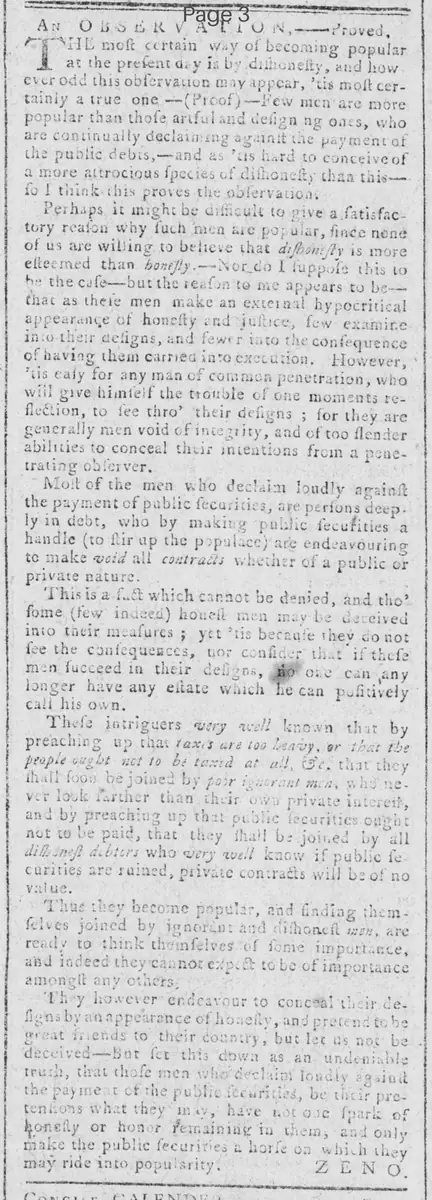
AN OBSERVATION, PROVED,
From the most certain way of becoming popular at the present day is by dishonesty, and how ever odd this observation may appear, 'tis most certainly a true one—(Proof)—Few men are more popular than those artful and designing ones, who are continually declaiming against the payment of the public debts,—and as 'tis hard to conceive of a more atrocious species of dishonesty than this—so I think this proves the observation.
Perhaps it might be difficult to give a satisfactory reason why such men are popular, since none of us are willing to believe that dishonesty is more esteemed than honesty.—Nor do I suppose this to be the case—but the reason to me appears to be—that as these men make an external hypocritical appearance of honesty and justice, few examine into their designs, and fewer into the consequence of having them carried into execution. However, tis easy for any man of common penetration, who will give himself the trouble of one moment's reflection, to see thro' their designs; for they are generally men void of integrity, and of too slender abilities to conceal their intentions from a penetrating observer.
Most of the men who declaim loudly against the payment of public securities, are persons deeply in debt, who by making public securities a handle (to stir up the populace) are endeavouring to make void all contracts whether of a public or private nature.
This is a fact which cannot be denied, and tho' some (few indeed) honest men may be deceived into their measures; yet tis because they do not see the consequences, nor consider that if these men succeed in their designs, no one can any longer have any estate which he can positively call his own.
These intriguers very well know that by preaching up that taxes are too heavy, or that the people ought not to be taxed at all, &c. that they shall soon be joined by poor ignorant men, who never look farther than their own private interest, and by preaching up that public securities ought not to be paid, that they shall be joined by all dishonest debtors who very well know if public securities are ruined, private contracts will be of no value.
Thus they become popular, and finding themselves joined by ignorant and dishonest men, are ready to think themselves of some importance, and indeed they cannot expect to be of importance amongst any others.
They however endeavour to conceal their designs by an appearance of honesty, and pretend to be great friends to their country, but let us not be deceived—For set this down as an undeniable truth, that those men who declaim loudly against the payment of the public securities, be their pretensions what they may, have not one spark of honesty or honor remaining in them, and only make the public securities a horse on which they may ride into popularity.
ZENO.
From the most certain way of becoming popular at the present day is by dishonesty, and how ever odd this observation may appear, 'tis most certainly a true one—(Proof)—Few men are more popular than those artful and designing ones, who are continually declaiming against the payment of the public debts,—and as 'tis hard to conceive of a more atrocious species of dishonesty than this—so I think this proves the observation.
Perhaps it might be difficult to give a satisfactory reason why such men are popular, since none of us are willing to believe that dishonesty is more esteemed than honesty.—Nor do I suppose this to be the case—but the reason to me appears to be—that as these men make an external hypocritical appearance of honesty and justice, few examine into their designs, and fewer into the consequence of having them carried into execution. However, tis easy for any man of common penetration, who will give himself the trouble of one moment's reflection, to see thro' their designs; for they are generally men void of integrity, and of too slender abilities to conceal their intentions from a penetrating observer.
Most of the men who declaim loudly against the payment of public securities, are persons deeply in debt, who by making public securities a handle (to stir up the populace) are endeavouring to make void all contracts whether of a public or private nature.
This is a fact which cannot be denied, and tho' some (few indeed) honest men may be deceived into their measures; yet tis because they do not see the consequences, nor consider that if these men succeed in their designs, no one can any longer have any estate which he can positively call his own.
These intriguers very well know that by preaching up that taxes are too heavy, or that the people ought not to be taxed at all, &c. that they shall soon be joined by poor ignorant men, who never look farther than their own private interest, and by preaching up that public securities ought not to be paid, that they shall be joined by all dishonest debtors who very well know if public securities are ruined, private contracts will be of no value.
Thus they become popular, and finding themselves joined by ignorant and dishonest men, are ready to think themselves of some importance, and indeed they cannot expect to be of importance amongst any others.
They however endeavour to conceal their designs by an appearance of honesty, and pretend to be great friends to their country, but let us not be deceived—For set this down as an undeniable truth, that those men who declaim loudly against the payment of the public securities, be their pretensions what they may, have not one spark of honesty or honor remaining in them, and only make the public securities a horse on which they may ride into popularity.
ZENO.
What sub-type of article is it?
Economic Policy
Moral Or Religious
Partisan Politics
What keywords are associated?
Public Debts
Dishonesty
Popularity
Securities
Debtors
Taxes
Contracts
Hypocrisy
What entities or persons were involved?
Dishonest Debtors
Public Securities Holders
Ignorant Populace
Editorial Details
Primary Topic
Opposition To Payment Of Public Debts As Dishonest Populism
Stance / Tone
Strongly Condemnatory Of Debt Opponents As Dishonest Intriguers
Key Figures
Dishonest Debtors
Public Securities Holders
Ignorant Populace
Key Arguments
Dishonesty Is The Surest Path To Popularity Today
Opponents Of Public Debt Payment Are Artful Debtors Seeking To Void All Contracts
They Hypocritically Pretend Honesty To Deceive The Public
Success Would Destroy Private Property Rights
They Attract Ignorant And Dishonest Followers By Complaining Of Taxes And Securities