Thank you for visiting SNEWPapers!
Sign up free
The Weekly Anglo African
New York, New York County, New York
What is this article about?
A letter from New Haven reports on lectures by 'The Lion of the West' on Nat Turner and the Negro race's destiny, anticipates a Masonic poem, and critiques the Episcopal Church's handling of the slave trade revival during its Richmond convention, linking it to divine judgment amid Harper's Ferry events. It urges canonical action against slavers and a day of prayer for John Brown's execution.
Clipping
OCR Quality
Full Text
New Haven, Nov. 5, 1859
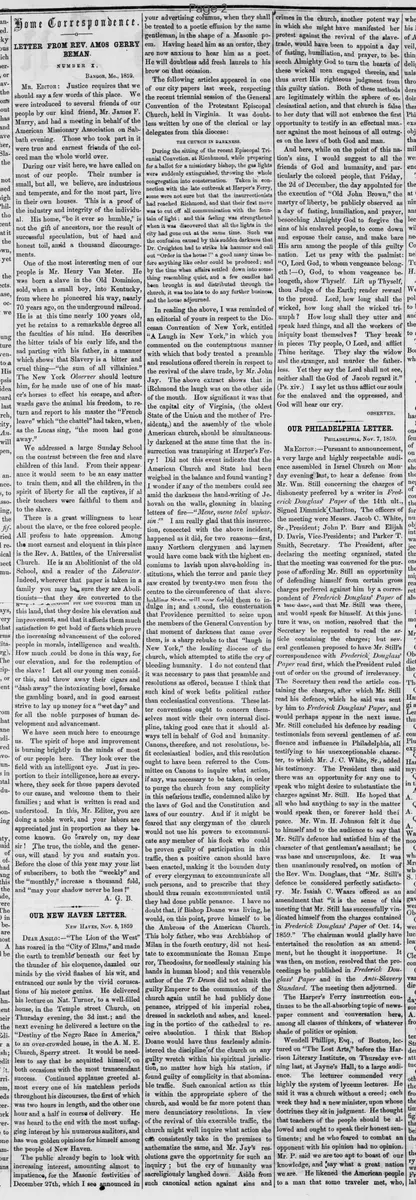
DEAR ANGLO:—"The Lion of the West" has roared in the "City of Elms," and made the earth to tremble beneath our feet by the thunder of his eloquence, dazzled our minds by the vivid flashes of his wit, and entranced our souls by the vivid coruscations of his meteor genius. He delivered his lecture on Nat. Turner, to a well-filled house, in the Temple street Church, on Thursday evening, the 3d inst.; and the next evening he delivered a lecture on the "Destiny of the Negro Race in America," to an over-crowded house, in the A. M. E. Church, Sperry street. It would be needless to say that he acquitted himself, on both occasions with the most transcendent success. Continued applause greeted almost every one of his matchless periods throughout his discourses, the first of which was two hours in length, and the other one hour and a half in course of delivery. He was heard to the end with the most unflagging interest by his numerous auditors, and has won golden opinions for himself among the people of New Haven. The public already begin to look with increasing interest, amounting almost to impatience, for the Masonic festivities of December 27th, which I see announced in your advertising columns, when they shall be treated to a poetic effusion by the same gentleman, in the shape of a Masonic poem. Having heard him as an orator, they are now anxious to hear him as a poet. He will doubtless add fresh laurels to his brow on that occasion. The following articles appeared in one of our city papers last week, respecting the recent triennial session of the General Convention of the Protestant Episcopal Church, held in Virginia. It was doubtless written by one of the clerical or lay delegates from this diocese:
THE CHURCH IN DARKNESS.
During the sitting of the recent Episcopal Triennial Convention, at Richmond, while preparing for a ballot for a missionary bishop, the gas lights were suddenly extinguished, throwing the whole congregation into consternation. Taken in connection with the late outbreak at Harper's Ferry, some were not sure but that the insurrectionists had reached Richmond, and that their first move was to cut off all communication with the fountain of light; and this feeling was strengthened when it was discovered that all the lights in the city had gone out at the same time. Such was the confusion caused by this sudden darkness that Dr. Creighton had to strike his hammer and call out "Order in the house!" a good many times before anything like order could be produced; and by the time when affairs settled down into something resembling quiet, and a few candles had been brought in and distributed through the church, it was too late to do any further business, and the house adjourned. In reading the above, I was reminded of an editorial of yours in respect to the Diocesan Convention of New York, entitled "A Laugh in New York," in which you commented on the contemptuous manner with which that body treated a preamble and resolutions offered therein in respect to the revival of the slave trade, by Mr. John Jay. The above extract shows that in Richmond the laugh was on the other side of the mouth. How significant it was that the capital city of Virginia, (the oldest State of the Union and the mother of Presidents,) and the assembly of the whole American church, should be simultaneously darkened at the same time that the insurrection was transpiring at Harper's Ferry! Did not this event indicate that the American Church and State had been weighed in the balance and found wanting? I wonder if any of the members could see amid the darkness the hand-writing of Jehovah on the walls, gleaming in blazing letters of fire—"Mene, mene tekel upharsin!" I am really glad that this insurrection, connected with the above incident, happened as it did, for two reasons—first many Northern clergymen and laymen would have come back with the highest encomiums to lavish upon slave-holding institutions, which the terror and panic they saw created by twenty-two men from the centre to the circumference of that slave holding State, will now forbid them to indulge in; and second, the consternation that Providence permitted to seize upon the members of the General Convention by that moment of darkness that came over them, is a sharp rebuke to that "laugh in New York," the leading diocese of the church, which attempted to stifle the cry of bleeding humanity. I do not contend that it was necessary to pass that preamble and resolutions as offered, because I think that such kind of work befits political rather than ecclesiastical conventions. These latter conventions ought to concern themselves most with their own internal discipline, taking good care that it should always tell in behalf of God and humanity Canons, therefore, and not resolutions, befit ecclesiastical bodies, and this resolution ought to have been referred to the Committee on Canons to inquire what action, if any, was necessary to be taken, in order to purge the church from any complicity in this nefarious traffic, condemned alike by the laws of God and the Constitution and laws of our country. And if it might be feared that any clergyman of the church would not use his powers to excommunicate any member of his flock who could be proven guilty of participation in this traffic, then a positive canon should have been enacted, making it the bounden duty of every clergyman to excommunicate all such persons, and to prescribe that they should thus remain excommunicated until they had done public penance. I have no doubt that, if Bishop Doane was living, he would, on this point, prove himself to be the Ambrose of the American Church. This holy father, who was Archbishop of Milan in the fourth century, did not hesitate to excommunicate the Roman Emperor, Theodosius, for needlessly staining his hands in human blood; and this venerable author of the Te Deum did not admit the guilty Emperor to the communion of the church again until he had publicly done penance, stripped of his imperial robes, dressed in sackcloth and ashes, and kneeling in the portico of the cathedral to receive absolution. I think that Bishop Doane would have thus fearlessly administered the discipline of the church on any guilty wretch within his spiritual jurisdiction, no matter how high his station, if found guilty of complicity in that abominable traffic. Such canonical action as this is within the appropriate sphere of the church, and would be far more potent than mere denunciatory resolutions. In view of the revival of this execrable traffic, the church might well inquire what action she can consistently take in the premises to anathematize the same, and Mr. Jay's resolutions gave the opportunity for such an inquiry; but the cry of humanity was sacreligiously laughed down. Aside from such canonical action against sins and crimes in the church, another potent way in which she might have manifested her protest against the revival of the slave-trade, would have been to appoint a day of fasting, humiliation, and prayer, to beseech Almighty God to turn the hearts of these wicked men engaged therein, and thus avert His righteous judgment from this guilty nation. Both of these methods are legitimately within the sphere of ecclesiastical action, and that church is false to her duty that will not embrace the first opportunity to testify in an effectual manner against the most heinous of all outrages on the laws of both God and man. And here, while on the point of this nation's sins, I would suggest to all the friends of God and humanity, and particularly the colored people, that Friday, the 2d of December, the day appointed for the execution of "Old John Brown," the martyr of liberty, be publicly observed as a day of fasting, humiliation, and prayer, beseeching Almighty God to forgive the sins of his enslaved people, to come down and espouse their cause, and make bare His arm among the people of this guilty nation. Let us pray with the psalmist: "O, Lord God, to whom vengeance belongeth!—O, God, to whom vengeance belongeth, show Thyself. Lift up Thyself, thou Judge of the Earth; render reward to the proud. Lord, how long shall the wicked, how long shall the wicked triumph? How long shall they utter and speak hard things, and all the workers of iniquity boast themselves? They break in pieces Thy people, O Lord, and afflict Thine heritage. They slay the widow and the stranger, and murder the fatherless. Yet they say the Lord shall not see, neither shall the God of Jacob regard it." (Ps. xiv.) I say let us thus afflict our souls for the enslaved and the oppressed, and God will hear our cry.
OBSERVER.
What sub-type of article is it?
What themes does it cover?
What keywords are associated?
What entities or persons were involved?
Letter to Editor Details
Author
Observer.
Recipient
Dear Anglo
Main Argument
the episcopal church should enact canons to excommunicate participants in the slave trade and appoint days of prayer against it, viewing the richmond convention's darkness as divine judgment linked to harper's ferry; observe december 2 as a day of fasting for john brown's execution to seek god's intervention for the enslaved.
Notable Details