Thank you for visiting SNEWPapers!
Sign up free
Story
January 15, 1952
The Daily Record
Dunn, Harnett County, North Carolina
What is this article about?
Satirical column on 1952 defense officials Charles E. Wilson and Manly Fleischmann using convoluted 'Federalese' in congressional hearings amid shortages of steel, copper, and other materials, deciding to phase out military building programs to ration resources.
Clipping
OCR Quality
98%
Excellent
Full Text
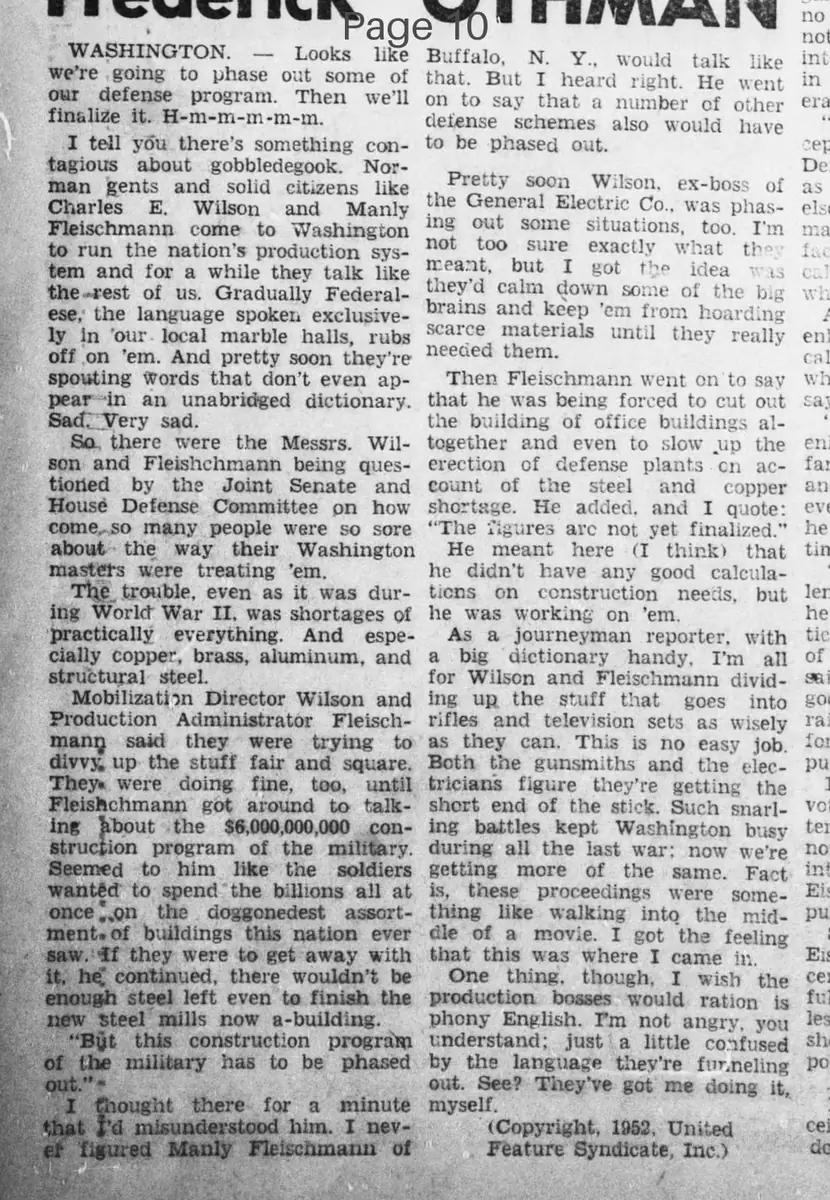
WASHINGTON.
Looks like we're going to phase out some of our defense program. Then we'll finalize it. H-m-m-m-m-m.
I tell you there's something contagious about gobbledegook. Normal gents and solid citizens like Charles E. Wilson and Manly Fleischmann come to Washington to run the nation's production system and for a while they talk like the rest of us. Gradually Federalese, the language spoken exclusively in our local marble halls, rubs off on 'em. And pretty soon they're spouting words that don't even appear in an unabridged dictionary.
Sad. Very sad.
So, there were the Messrs. Wilson and Fleischmann being questioned by the Joint Senate and House Defense Committee on how come so many people were so sore about the way their Washington masters were treating 'em.
The trouble, even as it was during World War II, was shortages of practically everything. And especially copper, brass, aluminum, and structural steel.
Mobilization Director Wilson and Production Administrator Fleischmann said they were trying to divvy up the stuff fair and square.
They were doing fine, too, until Fleischmann got around to talking about the $6,000,000,000 construction program of the military.
Seemed to him like the soldiers wanted to spend the billions all at once on the doggonedest assortment of buildings this nation ever saw. If they were to get away with it, he continued, there wouldn't be enough steel left even to finish the new steel mills now a-building.
"But this construction program of the military has to be phased out."
I thought there for a minute that I'd misunderstood him. I never figured Manly Fleischmann of Buffalo, N. Y., would talk like that. But I heard right. He went on to say that a number of other defense schemes also would have to be phased out.
Pretty soon Wilson, ex-boss of the General Electric Co., was phasing out some situations, too. I'm not too sure exactly what that meant, but I got the idea it was they'd calm down some of the big brains and keep 'em from hoarding scarce materials until they really needed them.
Then Fleischmann went on to say that he was being forced to cut out the building of office buildings altogether and even to slow up the erection of defense plants on account of the steel and copper shortage. He added, and I quote:
"The figures are not yet finalized."
He meant here (I think) that he didn't have any good calculations on construction needs, but he was working on 'em.
As a journeyman reporter, with a big dictionary handy, I'm all for Wilson and Fleischmann dividing up the stuff that goes into rifles and television sets as wisely as they can. This is no easy job.
Both the gunsmiths and the electricians figure they're getting the short end of the stick. Such snarling battles kept Washington busy during all the last war; now we're getting more of the same. Fact is, these proceedings were something like walking into the middle of a movie. I got the feeling that this was where I came in.
One thing, though, I wish the production bosses would ration is phony English. I'm not angry, you understand; just a little confused by the language they're funneling out. See? They've got me doing it, myself.
(Copyright, 1952, United Feature Syndicate, Inc.)
Looks like we're going to phase out some of our defense program. Then we'll finalize it. H-m-m-m-m-m.
I tell you there's something contagious about gobbledegook. Normal gents and solid citizens like Charles E. Wilson and Manly Fleischmann come to Washington to run the nation's production system and for a while they talk like the rest of us. Gradually Federalese, the language spoken exclusively in our local marble halls, rubs off on 'em. And pretty soon they're spouting words that don't even appear in an unabridged dictionary.
Sad. Very sad.
So, there were the Messrs. Wilson and Fleischmann being questioned by the Joint Senate and House Defense Committee on how come so many people were so sore about the way their Washington masters were treating 'em.
The trouble, even as it was during World War II, was shortages of practically everything. And especially copper, brass, aluminum, and structural steel.
Mobilization Director Wilson and Production Administrator Fleischmann said they were trying to divvy up the stuff fair and square.
They were doing fine, too, until Fleischmann got around to talking about the $6,000,000,000 construction program of the military.
Seemed to him like the soldiers wanted to spend the billions all at once on the doggonedest assortment of buildings this nation ever saw. If they were to get away with it, he continued, there wouldn't be enough steel left even to finish the new steel mills now a-building.
"But this construction program of the military has to be phased out."
I thought there for a minute that I'd misunderstood him. I never figured Manly Fleischmann of Buffalo, N. Y., would talk like that. But I heard right. He went on to say that a number of other defense schemes also would have to be phased out.
Pretty soon Wilson, ex-boss of the General Electric Co., was phasing out some situations, too. I'm not too sure exactly what that meant, but I got the idea it was they'd calm down some of the big brains and keep 'em from hoarding scarce materials until they really needed them.
Then Fleischmann went on to say that he was being forced to cut out the building of office buildings altogether and even to slow up the erection of defense plants on account of the steel and copper shortage. He added, and I quote:
"The figures are not yet finalized."
He meant here (I think) that he didn't have any good calculations on construction needs, but he was working on 'em.
As a journeyman reporter, with a big dictionary handy, I'm all for Wilson and Fleischmann dividing up the stuff that goes into rifles and television sets as wisely as they can. This is no easy job.
Both the gunsmiths and the electricians figure they're getting the short end of the stick. Such snarling battles kept Washington busy during all the last war; now we're getting more of the same. Fact is, these proceedings were something like walking into the middle of a movie. I got the feeling that this was where I came in.
One thing, though, I wish the production bosses would ration is phony English. I'm not angry, you understand; just a little confused by the language they're funneling out. See? They've got me doing it, myself.
(Copyright, 1952, United Feature Syndicate, Inc.)
What sub-type of article is it?
Historical Event
Curiosity
What themes does it cover?
Social Manners
Misfortune
What keywords are associated?
Defense Production
Material Shortages
Bureaucratic Language
Senate Committee
Military Construction
What entities or persons were involved?
Charles E. Wilson
Manly Fleischmann
Where did it happen?
Washington
Story Details
Key Persons
Charles E. Wilson
Manly Fleischmann
Location
Washington
Event Date
1952
Story Details
Columnist observes defense officials Wilson and Fleischmann adopting bureaucratic 'Federalese' during Joint Senate and House Defense Committee questioning on material shortages like steel and copper, leading to decisions to phase out military construction programs and finalize figures amid production disputes.