Thank you for visiting SNEWPapers!
Sign up free
Literary
January 1, 1886
Semi Weekly Interior Journal
Stanford, Lincoln County, Kentucky
What is this article about?
In this short story, a flamboyant new subaltern, D'Arcy de Bolingbroke, joins the Black Horse regiment after tragic deaths. Initially seen as a fool, he reforms under peers' influence, reveals honor by keeping promises despite poverty, and proves valor in a Soudan battle, losing an arm but earning the Victoria Cross.
Clipping
OCR Quality
98%
Excellent
Full Text
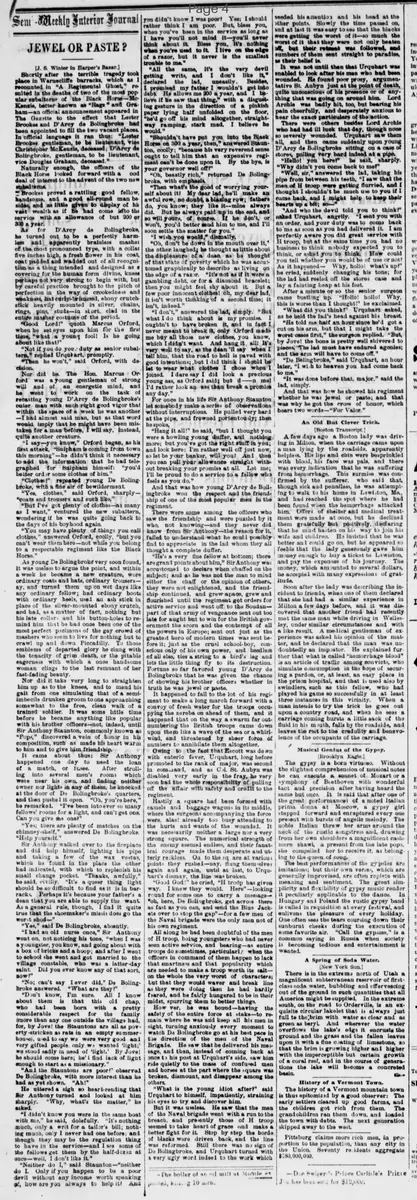
JEWEL OR PASTE?
[J. S. Winter in Harper's Bazar.]
Shortly after the terrible tragedy took place in Warnecliffe barracks, which as recounted in "A Regimental Ghost," resulted in the deaths of two of the most popular subalterns of the Black Horse—McKenzie, better known as "Rags," and Graham—an official announcement appeared in The Gazette to the effect that Lester Brookes and D'Arcy de Bolingbroke had been appointed to fill the two vacant places.
In official language it ran thus: "Lester Brookes, gentleman, to be lieutenant, vice Christopher McKenzie, deceased; D'Arcy de Bolingbroke, gentleman, to be lieutenant vice Douglas Graham, deceased."
Naturally enough, the officers of the Black Horse looked forward with a good deal of interest to the advent of the two new subalterns.
Brookes proved a rattling good fellow, handsome, and a good all-round man besides, and as little given to display of his vast wealth as if he had come into the service with an allowance of but £200 or £300 a year.
As for D'Arcy de Bolingbroke, he turned out to be a perfectly harmless and apparently brainless masher of the most pronounced type, with a collar five inches high, a fresh flower in his coat, coat padded and wadded out of all recognition as a thing intended and designed as covering for the human form divine, knees perhaps not very strong to begin with, but by careful practice brought to the pitch of perfection in the way of crookedness and weakness, hat curly-brimmed, ebony crutch stick heavily mounted in silver, chains, rings, pins, studs—in short, clad in the entire masher costume of the period.
"Good Lord!" quoth Marcus Orford when he set eyes upon him for the first time, "what a young fool! Is he going about like that?"
"Not if you do your duty as senior subaltern," replied Urquhart, promptly.
"Then he won't," said Orford, with decision.
Nor did he.
The Hon. Marcus Orford was a young gentleman of strong will and of an energetic mind, and he went to work on the task of recasting young D'Arcy de Bolingbroke's outer man with such right good vigor that within the space of a week he was another—I had almost said man, but as that word would imply that he might have been mistaken for a man before, I will say, instead, quite another creature.
"I say—you know," Orford began, as his first attack, "Snipham is coming from town this morning"—he didn't think it necessary to add the information that he had telegraphed for Snipham himself: "you'd better order some clothes of him."
"Clothes!" repeated young De Bolingbroke, with a fine air of bewilderment.
"Yes, clothes," said Orford, sharply—"coats and trousers and such like."
"But I've got plenty of clothes—as many as I want," ventured the new subaltern, wondering if he was quite going back to the days of his boyhood again.
"You may have plenty of things you call clothes," answered Orford, coolly, "but you can't wear them here—not while you belong to a respectable regiment like the Black Horse."
As young De Bolingbroke very soon found, it was useless to argue the point, and within a week he became a new creature, wore ordinary coats and hats, ordinary trousers—ay, and turned them up on wet days like any ordinary fellow; had ordinary boots with ordinary heels, used an ash stick in place of the silver-mounted ebony crutch, and had, as a matter of fact, nothing but his late collar, and his button-holes to remind him that he had once been one of the most perfect specimens of the gay crowd of mashers who seem to live for nothing but to crawl up and down Piccadilly. To those emblems of departed glory he clung with the tenacity of grim death, or the pitiable eagerness with which a once handsome woman clings to the last remnant of her fast-fading beauty.
Nor did it take very long to straighten him up as to the knees, and to mend his gait from one simulating that of a semi-imbecile drunken groom to one approaching somewhat to the free, clean walk of a trained soldier. It was some little time before he became anything like popular with his brother officers—not, indeed, until Sir Anthony Staunton, commonly known as "Pops," discovered a vein of honor in his composition, such as made his heart warm to him and to give him friendship.
It came about thus:
Sir Anthony happened one day to need the loan of a match, or fusee.
After strolling into several men's rooms which were near his own, and finding neither owner nor lights in any of them, he knocked at the door of De Bolingbroke's quarters, and then pushed it open. "Oh, you're here," he remarked. "I've been into ever so many fellows' rooms for a light, and can't get one. Can you give me one?"
"Yes; there are plenty of matches on the chimney-shelf," answered De Bolingbroke. "Help yourself."
Sir Anthony walked over to the fireplace and did help himself, lighting his pipe and taking a few of the wax vestas, which he found in the place the other had indicated, with which to replenish his small change pocket. "Thanks, awfully," he said, civilly. "It's a queer thing light should be so difficult to find as it is in barracks. Perhaps it's because your father's a dean that you are able to supply the want. As a general rule, though, I find it quite true that the shoemaker's wife does go the worst shod—"
"Yes," said De Bolingbroke, absently. "I had an old nurse once," Sir Anthony went on, not noticing his tone, "when I was a youngster, you know, and going about with a box of bricks and a hoop; and after I went to school she went and got married to the village constable, who was a latter-day saint. Did you ever know any of that sort, Bow?"
"No; can't say I ever did." De Bolingbroke answered. "What are they?"
"Don't know, I'm sure. All I know about them is that this old chap, who had been born with a pretty considerable respect for the family (more than any one outside the village had, for, by Jove! the Stauntons are all as poverty-stricken as rats in an empty summer house), used to say we were very good and very gifted people, only we wanted 'light'; we stood sadly in need of 'light.' By Jove! he should come here; he'd find lack of light enough to start as a missionary."
"And the Stauntons are poor?" observed De Bolingbroke, with more interest than he had as yet shown. "Ah!"
He uttered a sigh so heart-rending that Sir Anthony turned and looked at him sharply.
"Why, what's the matter," he asked.
"I didn't know you were in the same boat with me," he said, dolefully. "It's nothing much, only a writ for a tailor's bill; nothing much, only I never had one before; and though they may be the regulation thing to have in the service—and I see some of the fellows get them by the half-dozen at once—well, I don't like it."
"Neither do I," said Staunton—"neither do I. Only if you happen to be a poor devil without any income worth speaking of, how are you always to help it! And you didn't know I was poor? Yes; I should rather think I am poor. But, bless you, when you've been in the service as long as I have you'll not mind it—you'll never think about it. Bless you, it's nothing when you're used to it. I live on the edge of a razor, but it never is the smallest trouble to me."
"All the same, it's the very devil getting writs, and I don't like it," declared the lad, uneasily. "Besides, I promised my father I wouldn't get into debt. He allows me £300 a year, and I believe if he saw that thing," with a disgusting gesture in the direction of a pinkish paper lying half unfolded on the floor, "he'd go off his mind altogether, straightway ramping, stark mad. I believe he would."
"Shouldn't have put you into the Black Horse on £300 a year, then," answered Staunton, coolly; "because his very reverend sense ought to tell him that an expensive regiment can't be done upon it. By the bye, is your governor well off?"
"Oh, beastly rich," returned De Bolingbroke, with emphasis.
"Then what's the good of worrying yourself about it? My dear lad, he'll make an awful row, no doubt, a blazing row; fathers do, you know; they like it—mine always did. But he always paid up in the end, and so will yours, of course. If he don't, or won't, you'd better send him to me, and I'll soon settle the matter for you."
"I wish you would," dismally.
"Oh, don't be down in the mouth over it," the other laughed: he thought as little about the displeasure of a dean as he thought of that state of poverty which he was accustomed graphically to describe as living on the edge of a razor. "It's not as if it were a gambling debt, or for a diamond bracelet; then you might feel shy about it. But a few poor innocent clothes! oh, my dear lad, it isn't worth thinking of a second time; it isn't, indeed."
"I don't," answered the lad, simply. "But what I do think about is my promise. I oughtn't to have broken it, and in fact I never meant to break it, only Orford made me buy all those new clothes, you know, which I didn't want. And hang it all! It's very well to say, as the dean'll say when I tell him, that the road to hell is paved with good intentions; but I did think I should be let to wear what clothes I chose when I joined. I dare say I did look a precious young ass, as Orford said; but d—n me, I'd rather look an ass than break a promise any day."
For once in his life Sir Anthony Staunton let somebody make a series of observations without interruptions. He pulled very hard at the pipe, and frowned portentously; then he spoke.
"Hang it all!" he said, "but I thought you were a howling young duffer, and nothing more; but you've got the right stuff in you; and look here: I'm rather well off just now, so let me be your banker, will you? And then you can pull your allowance straight without breaking your promise at all. Let me; I'll be proud to do a service to a fellow who feels as you do."
And that was how young D'Arcy de Bolingbroke won the respect and the friendship of one of the most popular men in the regiment.
There were some among the officers who saw the friendship and were puzzled by it—who, not knowing—and they never did know from Sir Anthony—the reason for it, failed to understand what he could possibly find to appreciate in the lad whom they all thought a complete duffer.
"He's a very fine fellow at bottom; there are grand points about him," Sir Anthony was accustomed to declare when chaffed on the subject; and as he was not the man to mind either the chaff or the opinion of others, they were not enlightened, and the friendship continued, and grew apace, grew and flourished until the regiment got orders for active service and went off to the Soudan—part of that army of vengeance sent out too late for aught but to win for the British government the scorn and the contempt of all the powers in Europe; sent out just as the greatest hero of modern times was sent before it; just as the cruel school-boy, conscious only of his own power, and heedless of all else, ties a string to a bird's leg and lets the little thing fly to its destruction.
Fortune so far favored young D'Arcy de Bolingbroke that he was given the chance of showing his brother officers whether in truth he was jewel or paste.
It happened to fall to the lot of his regiment to make a long march forward with a convoy of fresh water for the troops occupying the zeriba on ahead of them, and it happened that on the way a swarm far outnumbering the British troops came down upon them like a wave of the sea or a whirlwind, and threatened by sheer force of numbers to annihilate them altogether.
Owing to the fact that Escott was down with enteric fever, Urquhart, long before promoted to the rank of major, was second in command, and as Col. St. Aubyn was disabled very early in the fray, he very soon had the whole responsibility of pulling off the affair with safety and credit to the regiment.
Hastily a square had been formed with camels and baggage wagons in its middle, where the surgeons accompanying the force were, alas! already too busy attending to the hurts and wants of the wounded. It was necessarily neither a large nor a very strong square. The numerical strength of the enemy seemed endless, and their fanatical courage made them desperate and utterly reckless. On to the square at various points they rushed—nay, flung themselves again and again, until at last, to Urquhart's dismay, the line was broken.
"Good God!" he cried, "H troop has given way. I knew they would. Here"—looking round for some one to carry a message—"oh, here, De Bolingbroke, get across there as fast as you can, and send the Blue Jackets over to stop the gap"—for a few men of the Naval brigade were the only men not of his own regiment.
All along he had been doubtful of the men of H troop, being youngsters who had never seen active service, and bearing—as entire troops do sometimes, particularly when the officers in command of them happen to lack that smartness and that popularity which are needed to make a troop worth its salt—on the whole the very worst of characters; but that they would waver and break line as they were doing then he had hardly feared, and he fairly hungered to be in their midst, spurring them to better things.
However, he was bound—having the safety of the entire force at stake—to remain where he was and keep all his men in sight, turning anxiously every moment to watch De Bolingbroke go at his best pace in the direction of the men of the Naval Brigade. He saw that he delivered his message, and then, instead of coming back at once to his post at Urquhart's side, saw him ride quietly to the mass of confused men and horses at the part where the square was broken, dismount, and disappear among the others.
"What is the young idiot after?" said Urquhart to himself, impatiently, straining his eyes to try and discover him.
But it was useless. He saw that the men of the Naval brigade went with a run to the breach, and presently those of H troop seemed to take heart of grace and make a better fight for it. Step by step the horde of blacks were driven back, and the line was reformed. Still there was no sign of De Bolingbroke, and Urquhart turned with a very ugly word indeed to the work which needed his attention and his head at the other points. Slowly the time passed on, and at last it was easy to see that the blacks were getting the worst of it—so much the worst of it that they were not only beaten off, but their retreat was followed, and numbers of them sent straight to paradise, as their belief is.
It was not until then that Urquhart was enabled to look after his men who had been wounded. He found poor prosy, argumentative St. Aubyn just at the point of death, quite unconscious of his presence or of anything that was going on around him. Lord Archie was badly hit, too, but bearing his pain cheerfully, and desperately anxious to hear the exact particulars of the action.
There were others besides Lord Archie who had had ill luck that day, though none so severely wounded. Urquhart saw them all, and then came suddenly upon young D'Arcy de Bolingbroke sitting on a case of stores, pulling very hard indeed at a pipe.
"Hello! you here!" he said, sharply. "Why didn't you come back to me?"
"Well, sir," answered the lad, taking his pipe from between his teeth, "I saw that the men of H troop were getting flurried, and I thought I shouldn't be much use to you if I came back, and I might help to keep their hearts up a bit."
"And who the devil told you to think?" asked Urquhart, angrily. "I sent you with an order, and your duty was to come back to me as soon as you had delivered it. I am perfectly aware you did great service with H troop, but at the same time you had no business to think; nobody expected you to think, or asked you to think. How could you tell whether you would be of use or not? As it happened— Why, hollo! what's up?" he cried, suddenly changing his tone; for the lad had reeled off the stores case and lay a fainting heap at his feet.
After a minute or so the senior surgeon came bustling up. "Hollo! hollo! Why, this is worse than I thought!" he exclaimed.
"What did you think?" Urquhart asked, as he held the lad's head against his breast.
"He told me half an hour since he'd got a cut on his arm, but that I might take the worst cases first," the surgeon replied. "But, by Jove! the bone is pretty well shivered to pieces. The lad must have endured agonies; and the arm will have to come off."
"De Bolingbroke," said Urquhart, an hour later, "I wish to heaven you had come back to me."
"It was done before that, major," said the lad, simply.
And that was how he showed his regiment whether he was jewel or paste; and that was why he got the cross of honor, which bears two words—"For Valor."
[J. S. Winter in Harper's Bazar.]
Shortly after the terrible tragedy took place in Warnecliffe barracks, which as recounted in "A Regimental Ghost," resulted in the deaths of two of the most popular subalterns of the Black Horse—McKenzie, better known as "Rags," and Graham—an official announcement appeared in The Gazette to the effect that Lester Brookes and D'Arcy de Bolingbroke had been appointed to fill the two vacant places.
In official language it ran thus: "Lester Brookes, gentleman, to be lieutenant, vice Christopher McKenzie, deceased; D'Arcy de Bolingbroke, gentleman, to be lieutenant vice Douglas Graham, deceased."
Naturally enough, the officers of the Black Horse looked forward with a good deal of interest to the advent of the two new subalterns.
Brookes proved a rattling good fellow, handsome, and a good all-round man besides, and as little given to display of his vast wealth as if he had come into the service with an allowance of but £200 or £300 a year.
As for D'Arcy de Bolingbroke, he turned out to be a perfectly harmless and apparently brainless masher of the most pronounced type, with a collar five inches high, a fresh flower in his coat, coat padded and wadded out of all recognition as a thing intended and designed as covering for the human form divine, knees perhaps not very strong to begin with, but by careful practice brought to the pitch of perfection in the way of crookedness and weakness, hat curly-brimmed, ebony crutch stick heavily mounted in silver, chains, rings, pins, studs—in short, clad in the entire masher costume of the period.
"Good Lord!" quoth Marcus Orford when he set eyes upon him for the first time, "what a young fool! Is he going about like that?"
"Not if you do your duty as senior subaltern," replied Urquhart, promptly.
"Then he won't," said Orford, with decision.
Nor did he.
The Hon. Marcus Orford was a young gentleman of strong will and of an energetic mind, and he went to work on the task of recasting young D'Arcy de Bolingbroke's outer man with such right good vigor that within the space of a week he was another—I had almost said man, but as that word would imply that he might have been mistaken for a man before, I will say, instead, quite another creature.
"I say—you know," Orford began, as his first attack, "Snipham is coming from town this morning"—he didn't think it necessary to add the information that he had telegraphed for Snipham himself: "you'd better order some clothes of him."
"Clothes!" repeated young De Bolingbroke, with a fine air of bewilderment.
"Yes, clothes," said Orford, sharply—"coats and trousers and such like."
"But I've got plenty of clothes—as many as I want," ventured the new subaltern, wondering if he was quite going back to the days of his boyhood again.
"You may have plenty of things you call clothes," answered Orford, coolly, "but you can't wear them here—not while you belong to a respectable regiment like the Black Horse."
As young De Bolingbroke very soon found, it was useless to argue the point, and within a week he became a new creature, wore ordinary coats and hats, ordinary trousers—ay, and turned them up on wet days like any ordinary fellow; had ordinary boots with ordinary heels, used an ash stick in place of the silver-mounted ebony crutch, and had, as a matter of fact, nothing but his late collar, and his button-holes to remind him that he had once been one of the most perfect specimens of the gay crowd of mashers who seem to live for nothing but to crawl up and down Piccadilly. To those emblems of departed glory he clung with the tenacity of grim death, or the pitiable eagerness with which a once handsome woman clings to the last remnant of her fast-fading beauty.
Nor did it take very long to straighten him up as to the knees, and to mend his gait from one simulating that of a semi-imbecile drunken groom to one approaching somewhat to the free, clean walk of a trained soldier. It was some little time before he became anything like popular with his brother officers—not, indeed, until Sir Anthony Staunton, commonly known as "Pops," discovered a vein of honor in his composition, such as made his heart warm to him and to give him friendship.
It came about thus:
Sir Anthony happened one day to need the loan of a match, or fusee.
After strolling into several men's rooms which were near his own, and finding neither owner nor lights in any of them, he knocked at the door of De Bolingbroke's quarters, and then pushed it open. "Oh, you're here," he remarked. "I've been into ever so many fellows' rooms for a light, and can't get one. Can you give me one?"
"Yes; there are plenty of matches on the chimney-shelf," answered De Bolingbroke. "Help yourself."
Sir Anthony walked over to the fireplace and did help himself, lighting his pipe and taking a few of the wax vestas, which he found in the place the other had indicated, with which to replenish his small change pocket. "Thanks, awfully," he said, civilly. "It's a queer thing light should be so difficult to find as it is in barracks. Perhaps it's because your father's a dean that you are able to supply the want. As a general rule, though, I find it quite true that the shoemaker's wife does go the worst shod—"
"Yes," said De Bolingbroke, absently. "I had an old nurse once," Sir Anthony went on, not noticing his tone, "when I was a youngster, you know, and going about with a box of bricks and a hoop; and after I went to school she went and got married to the village constable, who was a latter-day saint. Did you ever know any of that sort, Bow?"
"No; can't say I ever did." De Bolingbroke answered. "What are they?"
"Don't know, I'm sure. All I know about them is that this old chap, who had been born with a pretty considerable respect for the family (more than any one outside the village had, for, by Jove! the Stauntons are all as poverty-stricken as rats in an empty summer house), used to say we were very good and very gifted people, only we wanted 'light'; we stood sadly in need of 'light.' By Jove! he should come here; he'd find lack of light enough to start as a missionary."
"And the Stauntons are poor?" observed De Bolingbroke, with more interest than he had as yet shown. "Ah!"
He uttered a sigh so heart-rending that Sir Anthony turned and looked at him sharply.
"Why, what's the matter," he asked.
"I didn't know you were in the same boat with me," he said, dolefully. "It's nothing much, only a writ for a tailor's bill; nothing much, only I never had one before; and though they may be the regulation thing to have in the service—and I see some of the fellows get them by the half-dozen at once—well, I don't like it."
"Neither do I," said Staunton—"neither do I. Only if you happen to be a poor devil without any income worth speaking of, how are you always to help it! And you didn't know I was poor? Yes; I should rather think I am poor. But, bless you, when you've been in the service as long as I have you'll not mind it—you'll never think about it. Bless you, it's nothing when you're used to it. I live on the edge of a razor, but it never is the smallest trouble to me."
"All the same, it's the very devil getting writs, and I don't like it," declared the lad, uneasily. "Besides, I promised my father I wouldn't get into debt. He allows me £300 a year, and I believe if he saw that thing," with a disgusting gesture in the direction of a pinkish paper lying half unfolded on the floor, "he'd go off his mind altogether, straightway ramping, stark mad. I believe he would."
"Shouldn't have put you into the Black Horse on £300 a year, then," answered Staunton, coolly; "because his very reverend sense ought to tell him that an expensive regiment can't be done upon it. By the bye, is your governor well off?"
"Oh, beastly rich," returned De Bolingbroke, with emphasis.
"Then what's the good of worrying yourself about it? My dear lad, he'll make an awful row, no doubt, a blazing row; fathers do, you know; they like it—mine always did. But he always paid up in the end, and so will yours, of course. If he don't, or won't, you'd better send him to me, and I'll soon settle the matter for you."
"I wish you would," dismally.
"Oh, don't be down in the mouth over it," the other laughed: he thought as little about the displeasure of a dean as he thought of that state of poverty which he was accustomed graphically to describe as living on the edge of a razor. "It's not as if it were a gambling debt, or for a diamond bracelet; then you might feel shy about it. But a few poor innocent clothes! oh, my dear lad, it isn't worth thinking of a second time; it isn't, indeed."
"I don't," answered the lad, simply. "But what I do think about is my promise. I oughtn't to have broken it, and in fact I never meant to break it, only Orford made me buy all those new clothes, you know, which I didn't want. And hang it all! It's very well to say, as the dean'll say when I tell him, that the road to hell is paved with good intentions; but I did think I should be let to wear what clothes I chose when I joined. I dare say I did look a precious young ass, as Orford said; but d—n me, I'd rather look an ass than break a promise any day."
For once in his life Sir Anthony Staunton let somebody make a series of observations without interruptions. He pulled very hard at the pipe, and frowned portentously; then he spoke.
"Hang it all!" he said, "but I thought you were a howling young duffer, and nothing more; but you've got the right stuff in you; and look here: I'm rather well off just now, so let me be your banker, will you? And then you can pull your allowance straight without breaking your promise at all. Let me; I'll be proud to do a service to a fellow who feels as you do."
And that was how young D'Arcy de Bolingbroke won the respect and the friendship of one of the most popular men in the regiment.
There were some among the officers who saw the friendship and were puzzled by it—who, not knowing—and they never did know from Sir Anthony—the reason for it, failed to understand what he could possibly find to appreciate in the lad whom they all thought a complete duffer.
"He's a very fine fellow at bottom; there are grand points about him," Sir Anthony was accustomed to declare when chaffed on the subject; and as he was not the man to mind either the chaff or the opinion of others, they were not enlightened, and the friendship continued, and grew apace, grew and flourished until the regiment got orders for active service and went off to the Soudan—part of that army of vengeance sent out too late for aught but to win for the British government the scorn and the contempt of all the powers in Europe; sent out just as the greatest hero of modern times was sent before it; just as the cruel school-boy, conscious only of his own power, and heedless of all else, ties a string to a bird's leg and lets the little thing fly to its destruction.
Fortune so far favored young D'Arcy de Bolingbroke that he was given the chance of showing his brother officers whether in truth he was jewel or paste.
It happened to fall to the lot of his regiment to make a long march forward with a convoy of fresh water for the troops occupying the zeriba on ahead of them, and it happened that on the way a swarm far outnumbering the British troops came down upon them like a wave of the sea or a whirlwind, and threatened by sheer force of numbers to annihilate them altogether.
Owing to the fact that Escott was down with enteric fever, Urquhart, long before promoted to the rank of major, was second in command, and as Col. St. Aubyn was disabled very early in the fray, he very soon had the whole responsibility of pulling off the affair with safety and credit to the regiment.
Hastily a square had been formed with camels and baggage wagons in its middle, where the surgeons accompanying the force were, alas! already too busy attending to the hurts and wants of the wounded. It was necessarily neither a large nor a very strong square. The numerical strength of the enemy seemed endless, and their fanatical courage made them desperate and utterly reckless. On to the square at various points they rushed—nay, flung themselves again and again, until at last, to Urquhart's dismay, the line was broken.
"Good God!" he cried, "H troop has given way. I knew they would. Here"—looking round for some one to carry a message—"oh, here, De Bolingbroke, get across there as fast as you can, and send the Blue Jackets over to stop the gap"—for a few men of the Naval brigade were the only men not of his own regiment.
All along he had been doubtful of the men of H troop, being youngsters who had never seen active service, and bearing—as entire troops do sometimes, particularly when the officers in command of them happen to lack that smartness and that popularity which are needed to make a troop worth its salt—on the whole the very worst of characters; but that they would waver and break line as they were doing then he had hardly feared, and he fairly hungered to be in their midst, spurring them to better things.
However, he was bound—having the safety of the entire force at stake—to remain where he was and keep all his men in sight, turning anxiously every moment to watch De Bolingbroke go at his best pace in the direction of the men of the Naval Brigade. He saw that he delivered his message, and then, instead of coming back at once to his post at Urquhart's side, saw him ride quietly to the mass of confused men and horses at the part where the square was broken, dismount, and disappear among the others.
"What is the young idiot after?" said Urquhart to himself, impatiently, straining his eyes to try and discover him.
But it was useless. He saw that the men of the Naval brigade went with a run to the breach, and presently those of H troop seemed to take heart of grace and make a better fight for it. Step by step the horde of blacks were driven back, and the line was reformed. Still there was no sign of De Bolingbroke, and Urquhart turned with a very ugly word indeed to the work which needed his attention and his head at the other points. Slowly the time passed on, and at last it was easy to see that the blacks were getting the worst of it—so much the worst of it that they were not only beaten off, but their retreat was followed, and numbers of them sent straight to paradise, as their belief is.
It was not until then that Urquhart was enabled to look after his men who had been wounded. He found poor prosy, argumentative St. Aubyn just at the point of death, quite unconscious of his presence or of anything that was going on around him. Lord Archie was badly hit, too, but bearing his pain cheerfully, and desperately anxious to hear the exact particulars of the action.
There were others besides Lord Archie who had had ill luck that day, though none so severely wounded. Urquhart saw them all, and then came suddenly upon young D'Arcy de Bolingbroke sitting on a case of stores, pulling very hard indeed at a pipe.
"Hello! you here!" he said, sharply. "Why didn't you come back to me?"
"Well, sir," answered the lad, taking his pipe from between his teeth, "I saw that the men of H troop were getting flurried, and I thought I shouldn't be much use to you if I came back, and I might help to keep their hearts up a bit."
"And who the devil told you to think?" asked Urquhart, angrily. "I sent you with an order, and your duty was to come back to me as soon as you had delivered it. I am perfectly aware you did great service with H troop, but at the same time you had no business to think; nobody expected you to think, or asked you to think. How could you tell whether you would be of use or not? As it happened— Why, hollo! what's up?" he cried, suddenly changing his tone; for the lad had reeled off the stores case and lay a fainting heap at his feet.
After a minute or so the senior surgeon came bustling up. "Hollo! hollo! Why, this is worse than I thought!" he exclaimed.
"What did you think?" Urquhart asked, as he held the lad's head against his breast.
"He told me half an hour since he'd got a cut on his arm, but that I might take the worst cases first," the surgeon replied. "But, by Jove! the bone is pretty well shivered to pieces. The lad must have endured agonies; and the arm will have to come off."
"De Bolingbroke," said Urquhart, an hour later, "I wish to heaven you had come back to me."
"It was done before that, major," said the lad, simply.
And that was how he showed his regiment whether he was jewel or paste; and that was why he got the cross of honor, which bears two words—"For Valor."
What sub-type of article is it?
Prose Fiction
What themes does it cover?
Moral Virtue
War Peace
Patriotism
What keywords are associated?
Regimental Life
Proving Valor
Soudan Campaign
Honor And Debt
Dandy Transformation
Black Horse Regiment
What entities or persons were involved?
J. S. Winter
Literary Details
Title
Jewel Or Paste?
Author
J. S. Winter
Key Lines
"I'd Rather Look An Ass Than Break A Promise Any Day."
"He's A Very Fine Fellow At Bottom; There Are Grand Points About Him,"
Fortune So Far Favored Young D'arcy De Bolingbroke That He Was Given The Chance Of Showing His Brother Officers Whether In Truth He Was Jewel Or Paste.
"It Was Done Before That, Major," Said The Lad, Simply.
And That Was How He Showed His Regiment Whether He Was Jewel Or Paste; And That Was Why He Got The Cross Of Honor, Which Bears Two Words—"For Valor."