Thank you for visiting SNEWPapers!
Sign up free
Story
March 19, 1959
The Camas Hot Springs Exchange
Hot Springs, Camas, Sanders County, Montana
What is this article about?
Dennis Dellwo, secretary of the Flathead Irrigation District, argues against building Knowles or Paradise Dams, warning they would flood 13,000 acres of irrigable land, increase costs, reduce power revenues, and threaten the project's solvency, controlled by downstream interests.
Clipping
OCR Quality
98%
Excellent
Full Text
VOLUME XXXIII, NUMBER II
Dellwo Puts Up Good Argument
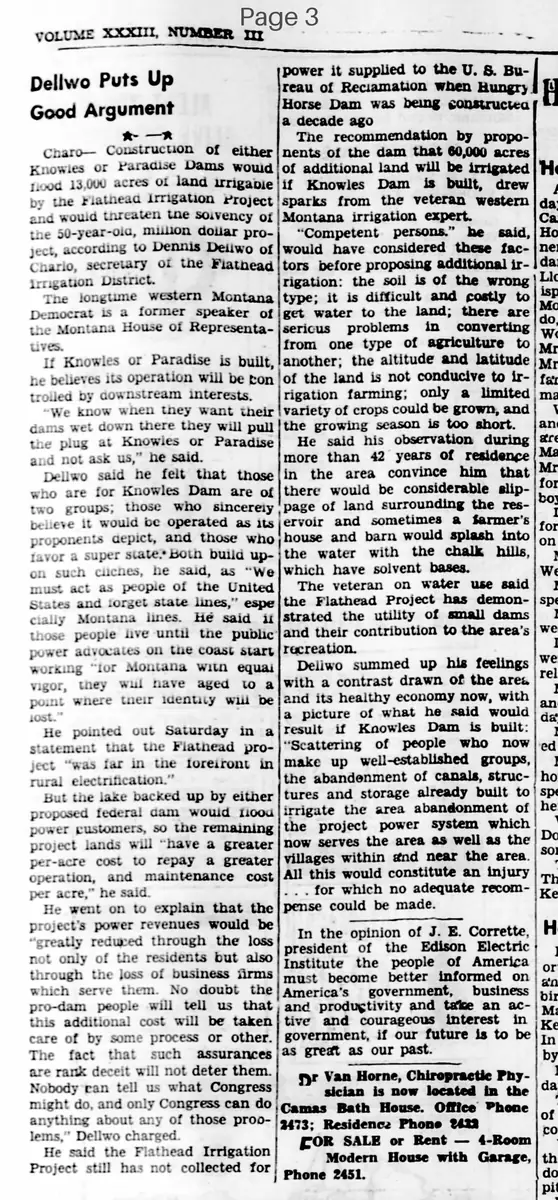
Charlo Construction of either Knowles or Paradise Dams would flood 13,000 acres of land irrigable by the Flathead Irrigation Project and would threaten the solvency of the 50-year-old, million dollar project, according to Dennis Dellwo of Charlo, secretary of the Flathead Irrigation District.
The longtime western Montana Democrat is a former speaker of the Montana House of Representatives.
If Knowles or Paradise is built, he believes its operation will be controlled by downstream interests.
"We know when they want their dams wet down there they will pull the plug at Knowles or Paradise and not ask us," he said.
Dellwo said he felt that those who are for Knowles Dam are of two groups; those who sincerely believe it would be operated as its proponents depict, and those who favor a super state. Both build upon such clichés, he said, as "We must act as people of the United States and forget state lines," especially Montana lines. He said if those people live until the public power advocates on the coast start working for Montana with equal vigor, they will have aged to a point where their identity will be lost.
He pointed out Saturday in a statement that the Flathead project "was far in the forefront in rural electrification."
But the lake backed up by either proposed federal dam would flood power customers, so the remaining project lands will "have a greater per-acre cost to repay a greater operation, and maintenance cost per acre," he said.
He went on to explain that the project's power revenues would be "greatly reduced through the loss not only of the residents but also through the loss of business firms which serve them. No doubt the pro-dam people will tell us that this additional cost will be taken care of by some process or other. The fact that such assurances are rank deceit will not deter them. Nobody can tell us what Congress might do, and only Congress can do anything about any of those problems," Dellwo charged.
He said the Flathead Irrigation Project still has not collected for power it supplied to the U. S. Bureau of Reclamation when Hungry Horse Dam was being constructed a decade ago.
The recommendation by proponents of the dam that 60,000 acres of additional land will be irrigated if Knowles Dam is built, drew sparks from the veteran western Montana irrigation expert.
"Competent persons," he said, would have considered these factors before proposing additional irrigation: the soil is of the wrong type; it is difficult and costly to get water to the land; there are serious problems in converting from one type of agriculture to another; the altitude and latitude of the land is not conducive to irrigation farming; only a limited variety of crops could be grown, and the growing season is too short.
He said his observation during more than 42 years of residence in the area convince him that there would be considerable slippage of land surrounding the reservoir and sometimes a farmer's house and barn would splash into the water with the chalk hills, which have solvent bases.
The veteran on water use said the Flathead Project has demonstrated the utility of small dams and their contribution to the area's recreation.
Dellwo summed up his feelings with a contrast drawn of the area and its healthy economy now, with a picture of what he said would result if Knowles Dam is built:
"Scattering of people who now make up well-established groups, the abandonment of canals, structures and storage already built to irrigate the area abandonment of the project power system which now serves the area as well as the villages within and near the area. All this would constitute an injury ... for which no adequate recompense could be made."
Dellwo Puts Up Good Argument
Charlo Construction of either Knowles or Paradise Dams would flood 13,000 acres of land irrigable by the Flathead Irrigation Project and would threaten the solvency of the 50-year-old, million dollar project, according to Dennis Dellwo of Charlo, secretary of the Flathead Irrigation District.
The longtime western Montana Democrat is a former speaker of the Montana House of Representatives.
If Knowles or Paradise is built, he believes its operation will be controlled by downstream interests.
"We know when they want their dams wet down there they will pull the plug at Knowles or Paradise and not ask us," he said.
Dellwo said he felt that those who are for Knowles Dam are of two groups; those who sincerely believe it would be operated as its proponents depict, and those who favor a super state. Both build upon such clichés, he said, as "We must act as people of the United States and forget state lines," especially Montana lines. He said if those people live until the public power advocates on the coast start working for Montana with equal vigor, they will have aged to a point where their identity will be lost.
He pointed out Saturday in a statement that the Flathead project "was far in the forefront in rural electrification."
But the lake backed up by either proposed federal dam would flood power customers, so the remaining project lands will "have a greater per-acre cost to repay a greater operation, and maintenance cost per acre," he said.
He went on to explain that the project's power revenues would be "greatly reduced through the loss not only of the residents but also through the loss of business firms which serve them. No doubt the pro-dam people will tell us that this additional cost will be taken care of by some process or other. The fact that such assurances are rank deceit will not deter them. Nobody can tell us what Congress might do, and only Congress can do anything about any of those problems," Dellwo charged.
He said the Flathead Irrigation Project still has not collected for power it supplied to the U. S. Bureau of Reclamation when Hungry Horse Dam was being constructed a decade ago.
The recommendation by proponents of the dam that 60,000 acres of additional land will be irrigated if Knowles Dam is built, drew sparks from the veteran western Montana irrigation expert.
"Competent persons," he said, would have considered these factors before proposing additional irrigation: the soil is of the wrong type; it is difficult and costly to get water to the land; there are serious problems in converting from one type of agriculture to another; the altitude and latitude of the land is not conducive to irrigation farming; only a limited variety of crops could be grown, and the growing season is too short.
He said his observation during more than 42 years of residence in the area convince him that there would be considerable slippage of land surrounding the reservoir and sometimes a farmer's house and barn would splash into the water with the chalk hills, which have solvent bases.
The veteran on water use said the Flathead Project has demonstrated the utility of small dams and their contribution to the area's recreation.
Dellwo summed up his feelings with a contrast drawn of the area and its healthy economy now, with a picture of what he said would result if Knowles Dam is built:
"Scattering of people who now make up well-established groups, the abandonment of canals, structures and storage already built to irrigate the area abandonment of the project power system which now serves the area as well as the villages within and near the area. All this would constitute an injury ... for which no adequate recompense could be made."
What sub-type of article is it?
Historical Event
What themes does it cover?
Misfortune
Justice
Deception
What keywords are associated?
Knowles Dam
Paradise Dam
Flathead Irrigation
Dam Opposition
Water Rights
Rural Electrification
Montana Politics
What entities or persons were involved?
Dennis Dellwo
Where did it happen?
Charlo, Western Montana, Flathead Irrigation Project
Story Details
Key Persons
Dennis Dellwo
Location
Charlo, Western Montana, Flathead Irrigation Project
Story Details
Dennis Dellwo argues that constructing Knowles or Paradise Dams would flood irrigable lands, increase costs, reduce revenues, and lead to abandonment of existing infrastructure in the Flathead Irrigation Project, accusing proponents of deceit and downstream control.