Thank you for visiting SNEWPapers!
Sign up free
Editorial
June 7, 1940
The Southern Jewish Weekly
Jacksonville, Duval County, Florida
What is this article about?
Pat Frank discusses the severe crop failures across Europe due to harsh winter, flooding, and war mobilization, predicting famine that could undermine Hitler's control. America's grain surplus positions it to influence postwar peace terms through food aid.
Merged-components note: Continuation of the 'Frankly Speaking' opinion column on European famine and its implications.
Clipping
OCR Quality
96%
Excellent
Full Text
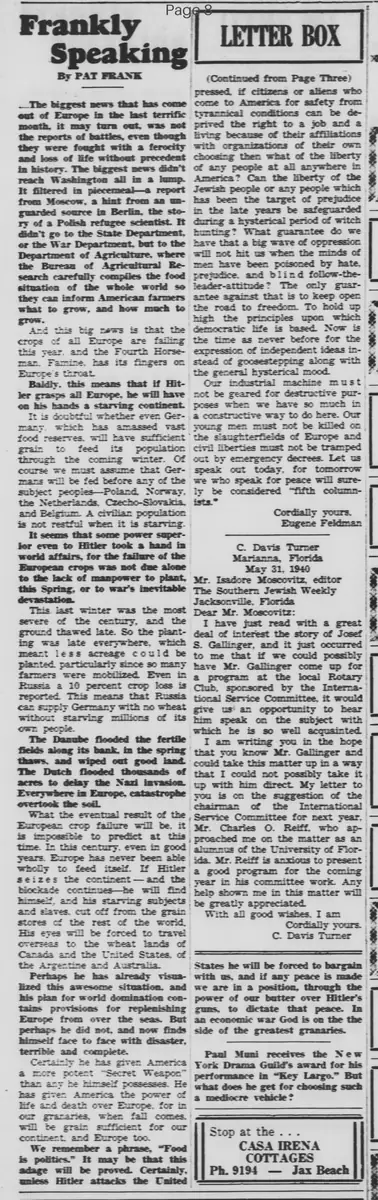
Frankly Speaking
By PAT FRANK
The biggest news that has come out of Europe in the past terrific month. It may turn out was not the reports of battles, even though they were fought with a ferocity and loss of life without precedent in history. The biggest news didn't reach Washington all in a lump. It filtered in piecemeal - a report from Moscow, a hint from an unguarded source in Berlin, the story of a Polish refugee scientist. It didn't get to the State Department, or the War Department, but to the Department of Agriculture, where the Bureau of Agricultural Research carefully compiles the food situation of the whole world so they can inform American farmers what to grow, and how much to grow.
And this big news is that the crops of all Europe are failing this year, and the Fourth Horseman, Famine, has its fingers on Europe's throat.
Baldly, this means that if Hitler grasps all Europe, he will have on his hands a starving continent. It is doubtful whether even Germany, which has amassed vast food reserves, will have sufficient grain to feed its population through the coming winter. Of course we must assume that Germans will be fed before any of the subject peoples - Poland, Norway, the Netherlands, Czecho-Slovakia, and Belgium. A civilian population is not restful when it is starving.
It seems that some power superior even to Hitler took a hand in world affairs, for the failure of the European crops was not due alone to the lack of manpower to plant, this Spring, or to war's inevitable devastation.
This last winter was the most severe of the century, and the ground thawed late. So the planting was late everywhere, which meant less acreage could be planted. Particularly since so many farmers were mobilized. Even in Russia a 10 percent crop loss is reported. This means that Russia can supply Germany with no wheat without starving millions of its own people.
The Danube flooded the fertile fields along its banks, in the spring thaws, and wiped out good land. The Dutch flooded thousands of acres to delay the Nazi invasion. Everywhere in Europe, catastrophe overtook the soil.
What the eventual result of the European crop failure will be, it is impossible to predict at this time. In this century, even in good years, Europe has never been able to wholly feed itself. If Hitler seizes the continent - and the blockade continues - he will find himself, and his starving subjects and slaves, cut off from the grain stores of the rest of the world. His envoys will be forced to travel overseas to the wheat lands of Canada and the United States, of the Argentine and Australia.
Perhaps he has already visualized this awesome situation, and his plan for world domination contains provisions for replenishing Europe from over the seas. But perhaps he did not, and now finds himself face to face with disaster, terrible and complete.
Certainly he has given America a more potent "Secret Weapon" than any he himself possesses. He has given America the power of life and death over Europe, for in our granaries, when fall comes, will be grain sufficient for our continent, and Europe too.
We remember a phrase, "Food is politics." It may be that this adage will be proved. Certainly, unless Hitler attacks the United
States he will be forced to bargain with us, and if any peace is made we are in a position, through the power of our butter over Hitler's guns, to dictate that peace. In an economic war God is on the side of the greatest granaries.
By PAT FRANK
The biggest news that has come out of Europe in the past terrific month. It may turn out was not the reports of battles, even though they were fought with a ferocity and loss of life without precedent in history. The biggest news didn't reach Washington all in a lump. It filtered in piecemeal - a report from Moscow, a hint from an unguarded source in Berlin, the story of a Polish refugee scientist. It didn't get to the State Department, or the War Department, but to the Department of Agriculture, where the Bureau of Agricultural Research carefully compiles the food situation of the whole world so they can inform American farmers what to grow, and how much to grow.
And this big news is that the crops of all Europe are failing this year, and the Fourth Horseman, Famine, has its fingers on Europe's throat.
Baldly, this means that if Hitler grasps all Europe, he will have on his hands a starving continent. It is doubtful whether even Germany, which has amassed vast food reserves, will have sufficient grain to feed its population through the coming winter. Of course we must assume that Germans will be fed before any of the subject peoples - Poland, Norway, the Netherlands, Czecho-Slovakia, and Belgium. A civilian population is not restful when it is starving.
It seems that some power superior even to Hitler took a hand in world affairs, for the failure of the European crops was not due alone to the lack of manpower to plant, this Spring, or to war's inevitable devastation.
This last winter was the most severe of the century, and the ground thawed late. So the planting was late everywhere, which meant less acreage could be planted. Particularly since so many farmers were mobilized. Even in Russia a 10 percent crop loss is reported. This means that Russia can supply Germany with no wheat without starving millions of its own people.
The Danube flooded the fertile fields along its banks, in the spring thaws, and wiped out good land. The Dutch flooded thousands of acres to delay the Nazi invasion. Everywhere in Europe, catastrophe overtook the soil.
What the eventual result of the European crop failure will be, it is impossible to predict at this time. In this century, even in good years, Europe has never been able to wholly feed itself. If Hitler seizes the continent - and the blockade continues - he will find himself, and his starving subjects and slaves, cut off from the grain stores of the rest of the world. His envoys will be forced to travel overseas to the wheat lands of Canada and the United States, of the Argentine and Australia.
Perhaps he has already visualized this awesome situation, and his plan for world domination contains provisions for replenishing Europe from over the seas. But perhaps he did not, and now finds himself face to face with disaster, terrible and complete.
Certainly he has given America a more potent "Secret Weapon" than any he himself possesses. He has given America the power of life and death over Europe, for in our granaries, when fall comes, will be grain sufficient for our continent, and Europe too.
We remember a phrase, "Food is politics." It may be that this adage will be proved. Certainly, unless Hitler attacks the United
States he will be forced to bargain with us, and if any peace is made we are in a position, through the power of our butter over Hitler's guns, to dictate that peace. In an economic war God is on the side of the greatest granaries.
What sub-type of article is it?
War Or Peace
Foreign Affairs
Economic Policy
What keywords are associated?
European Crop Failure
Famine
Hitler
World War Ii
Food Politics
American Grain Surplus
European Starvation
What entities or persons were involved?
Hitler
Germany
Europe
United States
Russia
Department Of Agriculture
Editorial Details
Primary Topic
European Crop Failure And Its Strategic Implications For World War Ii
Stance / Tone
Pro Allied, Emphasizing America's Food Leverage Against Hitler
Key Figures
Hitler
Germany
Europe
United States
Russia
Department Of Agriculture
Key Arguments
European Crops Failing Due To Severe Winter, Late Planting, Flooding, And War Mobilization
Hitler Faces A Starving Continent If He Controls Europe, Straining Even German Reserves
Russia Cannot Supply Germany Without Self Starvation
America's Grain Surplus Gives It Power Of Life And Death Over Europe
Food Is Politics; America Can Dictate Peace Terms Through Food Supplies