Thank you for visiting SNEWPapers!
Sign up free
Literary
August 23, 1809
The Rhode Island Republican
Newport, Newport County, Rhode Island
What is this article about?
In the concluding part of Letter Fifteenth, an American traveler in Europe describes how Roman emperors maintained power by entertaining the populace with spectacles, detailing the grand structures like the Circus Maximus (up to 500,000 capacity), Circus of Caracalla, Theatre of Marcellus, and the Colosseum (built by Jewish prisoners, 80,000 capacity).
Clipping
OCR Quality
95%
Excellent
Full Text
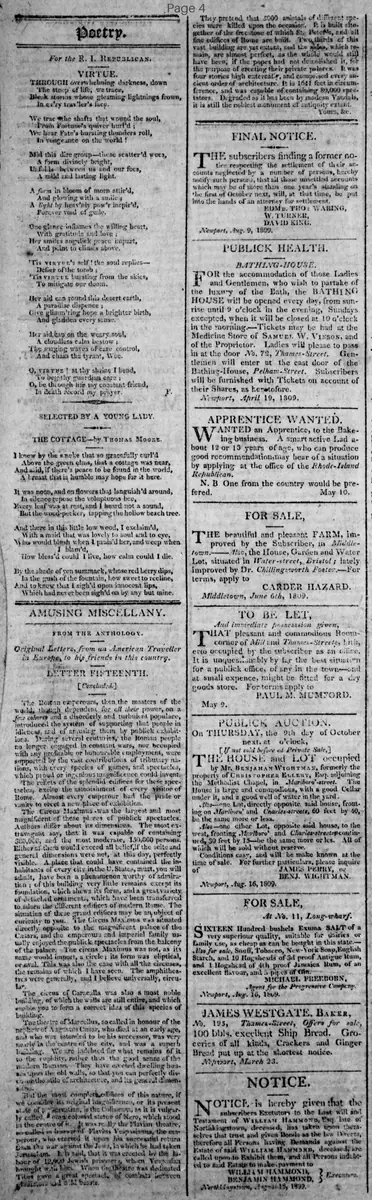
AMUSING MISCELLANY.
FROM THE ANTHOLOGY.
Original Letters, from an American Traveller
in Europe to his friends in this country.
LETTER FIFTEENTH.
[Concluded]
The Roman emperors, then the masters of the
world, though dependent for all their power, on a
few cohorts and a disorderly and turbulent populace,
introduced the system of supporting that people in
idleness, and amusing them by publick exhibitions.
During several centuries, the Roman people
no longer engaged in constant wars, nor occupied
with any profitable or honourable employment, were
supported by the vast contributions of tributary na-
tions, with every species of games, and spectacles,
which proud or ingenious magnificence could invent.
The relics of the splendid edifices for these spec-
tacles, excite the astonishment of every visitor of
Rome. Almost every emperor had the pride or
vanity to erect a new place of exhibition.
The Circus Maximus—was the largest and most
magnificent of these places of publick spectacles.
Authors differ about its dimensions. The most ex-
travagent say, that it was capable of containing
500,000, and the most moderate, 150,000 persons.
Either of them would exceed all belief, if the scite and
general dimensions were not, at this day, perfectly
visible. A place that could have contained the in-
habitants of every city in the U. States, must, you will
admit, have been a phenomenon worthy of admira-
tion; of this building very little remains except its
foundation, which shews its form, and a great variety
of detached ornaments, which have been transferred
to adorn the different edifices of modern Rome. The
situation of these grand edifices may be an object of
curiosity to you. The Circus Maximus was situated
directly opposite to the magnificent palace of the
Cæsars, and the emperors and imperial family us-
ually enjoyed the publick spectacles from the balcony
of the palace. The circus Maximus was not, as its
name would import, a circle; its form was elliptical,
or oval. This was also the case with all the circuses,
the remains of which I have seen. The amphithea-
tres were generally, and I believe universally, circu-
lar.
The circus of Caracalla was also a most noble
building, of which the walls are still entire, and which
enable you to form a correct idea of this species of
building.
The theatre of Marcellus, so called in honour of the
nephew of Augustus Cæsar, who died at an early age,
and who was intended to be his successor, was very
nearly in the centre of the city, and was a superb
building. We are indebted for what remains of it
to the cupidity, rather than the good sense of the
modern Romans. They have erected dwelling hou-
ses upon the old walls, so that you can perfectly dis-
cover the stile of architecture, and its general dimen-
sions.
But the most complete edifice of this nature, if
we consider its original magnificence, or its present
state of preservation, is the Colosseum, as it is vulgar-
ly called from a colossus statue of Nero, which stood
in the centre of it. It was really the Flavian theatre,
so-called in honour of Flavius Vespasianus, the em-
peror, who erected it upon his successful return
from the war against the Jews, in which he had taken
Jerusalem. It is said, that it was erected by the la-
bour of 12,000 Jewish prisoners, whom Vespasian
brought with him. When the theatre was dedicated
Titus gave a great spectacle of combats between
gladiators and wild beasts.
They pretend that 5000 animals of different spe-
cies were killed upon the occasion. It is built alto-
gether of the travertine stone of which St. Peter's, and all
the edifices of Rome are built. Two-thirds of this
vast building are yet extant, and the arcades, which re-
main, are almost perfect, as the whole would still
have been, if the popes had not demolished it, for
the purpose of erecting their private palaces. It was
four stories high externally, and comprised every an-
cieut order of architecture. It is 1640 feet in circum-
ference, and was capable of containing 80,000 spec-
tators. Degraded as it has been by modern Vandals,
it is still the noblest monument of antiquity extant.
Yours, &c.
FROM THE ANTHOLOGY.
Original Letters, from an American Traveller
in Europe to his friends in this country.
LETTER FIFTEENTH.
[Concluded]
The Roman emperors, then the masters of the
world, though dependent for all their power, on a
few cohorts and a disorderly and turbulent populace,
introduced the system of supporting that people in
idleness, and amusing them by publick exhibitions.
During several centuries, the Roman people
no longer engaged in constant wars, nor occupied
with any profitable or honourable employment, were
supported by the vast contributions of tributary na-
tions, with every species of games, and spectacles,
which proud or ingenious magnificence could invent.
The relics of the splendid edifices for these spec-
tacles, excite the astonishment of every visitor of
Rome. Almost every emperor had the pride or
vanity to erect a new place of exhibition.
The Circus Maximus—was the largest and most
magnificent of these places of publick spectacles.
Authors differ about its dimensions. The most ex-
travagent say, that it was capable of containing
500,000, and the most moderate, 150,000 persons.
Either of them would exceed all belief, if the scite and
general dimensions were not, at this day, perfectly
visible. A place that could have contained the in-
habitants of every city in the U. States, must, you will
admit, have been a phenomenon worthy of admira-
tion; of this building very little remains except its
foundation, which shews its form, and a great variety
of detached ornaments, which have been transferred
to adorn the different edifices of modern Rome. The
situation of these grand edifices may be an object of
curiosity to you. The Circus Maximus was situated
directly opposite to the magnificent palace of the
Cæsars, and the emperors and imperial family us-
ually enjoyed the publick spectacles from the balcony
of the palace. The circus Maximus was not, as its
name would import, a circle; its form was elliptical,
or oval. This was also the case with all the circuses,
the remains of which I have seen. The amphithea-
tres were generally, and I believe universally, circu-
lar.
The circus of Caracalla was also a most noble
building, of which the walls are still entire, and which
enable you to form a correct idea of this species of
building.
The theatre of Marcellus, so called in honour of the
nephew of Augustus Cæsar, who died at an early age,
and who was intended to be his successor, was very
nearly in the centre of the city, and was a superb
building. We are indebted for what remains of it
to the cupidity, rather than the good sense of the
modern Romans. They have erected dwelling hou-
ses upon the old walls, so that you can perfectly dis-
cover the stile of architecture, and its general dimen-
sions.
But the most complete edifice of this nature, if
we consider its original magnificence, or its present
state of preservation, is the Colosseum, as it is vulgar-
ly called from a colossus statue of Nero, which stood
in the centre of it. It was really the Flavian theatre,
so-called in honour of Flavius Vespasianus, the em-
peror, who erected it upon his successful return
from the war against the Jews, in which he had taken
Jerusalem. It is said, that it was erected by the la-
bour of 12,000 Jewish prisoners, whom Vespasian
brought with him. When the theatre was dedicated
Titus gave a great spectacle of combats between
gladiators and wild beasts.
They pretend that 5000 animals of different spe-
cies were killed upon the occasion. It is built alto-
gether of the travertine stone of which St. Peter's, and all
the edifices of Rome are built. Two-thirds of this
vast building are yet extant, and the arcades, which re-
main, are almost perfect, as the whole would still
have been, if the popes had not demolished it, for
the purpose of erecting their private palaces. It was
four stories high externally, and comprised every an-
cieut order of architecture. It is 1640 feet in circum-
ference, and was capable of containing 80,000 spec-
tators. Degraded as it has been by modern Vandals,
it is still the noblest monument of antiquity extant.
Yours, &c.
What sub-type of article is it?
Essay
Journey Narrative
What themes does it cover?
Political
What keywords are associated?
Roman Emperors
Public Spectacles
Circus Maximus
Colosseum
Flavian Theatre
What entities or persons were involved?
An American Traveller
Literary Details
Title
Letter Fifteenth.
Author
An American Traveller
Subject
Description Of Roman Public Spectacles And Edifices
Form / Style
Prose Travel Letter
Key Lines
The Roman Emperors, Then The Masters Of The World, Though Dependent For All Their Power, On A Few Cohorts And A Disorderly And Turbulent Populace, Introduced The System Of Supporting That People In Idleness, And Amusing Them By Publick Exhibitions.
The Circus Maximus—Was The Largest And Most Magnificent Of These Places Of Publick Spectacles.
But The Most Complete Edifice Of This Nature... Is The Colosseum... It Is 1640 Feet In Circumference, And Was Capable Of Containing 80,000 Spectators.