Thank you for visiting SNEWPapers!
Sign up free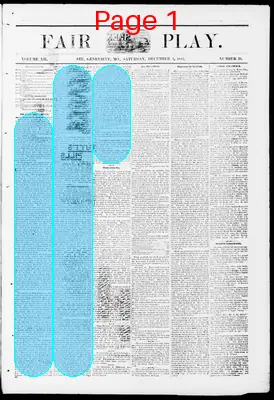
Story
December 1, 1883
Fair Play
Sainte Genevieve, Sainte Genevieve County, Missouri
What is this article about?
Historical account of the first Thanksgiving in Plymouth, 1623, where Governor Bradford, after a bountiful harvest following drought and prayer, invited Massasoit and 90 Pokanoket Indians to a feast celebrating survival and providence.
Clipping
OCR Quality
98%
Excellent
Full Text
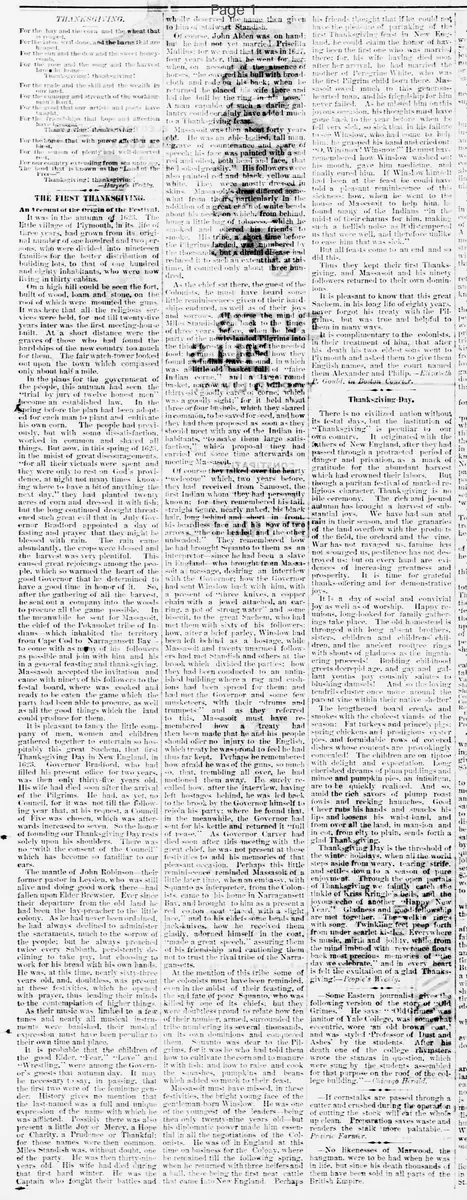
THE FIRST THANKSGIVING.
An Account of the Origin of our Festival.
It was in the autumn of 1623. The little village of Plymouth, in its life of three years, had grown from its original number of one hundred and two persons, who were divided into nineteen families for the better distribution of building lots, to that of one hundred and eighty inhabitants, who were now living in thirty cabins. On a high hill could be seen the fort, built of wood, loam and stone, on the roof of which were mounted the guns. It was here that all the religious services were held, for not till twenty-five years later was the first meeting-house built. At a short distance were the graves of those who had found the hardships of the new country too much for them. The fair watch-tower looked out upon the town which compassed only about half a mile.
In the plans for the government of the people, this autumn had seen the "trial by jury of twelve honest men" become an established law. In the spring before the plan had been adopted for each man to plant and cultivate his own corn. The people had previously, but with some dissatisfaction, worked in common and shared all things. But now, in this spring of 1623, in the midst of great discouragements, "for all their victuals were spent and they were only to rest on God's providence, at night not many times knowing where to have a bit of anything the next day," they had planted twenty acres of corn and dressed it with fish; but the long-continued drought threatened such great evil that in July Governor Bradford appointed a day of fasting and prayer that they might be blessed with rain. The rain came abundantly, the crops were blessed and the harvest was very plentiful. This caused great rejoicings among the people, which so warmed the heart of the good Governor that he determined to have a good time in honor of it. So, after the gathering of all the harvest, he sent out a company into the woods to procure all the game possible. In the meanwhile he sent for Massasoit, the chief of the Pokanoket tribe of Indians—which inhabited the territory from Cape Cod to Narragansett Bay—to come with as many of his followers as possible and join with him and his in a general feasting and thanksgiving. Massasoit accepted the invitation and came with ninety of his followers to the festal board, where was cooked and ready to be eaten the game which the party had been able to procure, as well as all the good things which the land could produce for them.
It is pleasant to fancy the little company of men, women and children gathered together to entertain so hospitably this great Sachem, that first Thanksgiving Day in New England, in 1623. Governor Bradford, who had filled his present office for two years, was then only thirty-five years old. His wife had died soon after the arrival of the Pilgrims. He had, as yet, no Council, for it was not till the following year that, at his request, a Council of Five was chosen, which was afterwards increased to seven. So the honor of founding our Thanksgiving Day rests solely upon his shoulders. There was no "with the consent of the Council" which has become so familiar to our ears.
The mantle of John Robinson—their former pastor in Leyden, who was still alive and doing good work there—had fallen upon Elder Brewster. Ever since their departure from the old land he had been the lay-preacher to the little colony. As he had never been ordained, he had always declined to administer the sacraments, much to the sorrow of the people; but he always preached twice every Sabbath, persistently declining to take pay, but choosing to work for his bread with his own hands. He was, at this time, nearly sixty-three years old, and, doubtless, was present at these festivities, which he opened with prayer, thus leading their minds to the contemplation of higher things. As their music was limited to a few tunes and nearly all musical instruments were banished, their musical expression must have been peculiar to their own time and place.
It is probable that the children of the good Elder, "Fear," "Love" and "Wrestling," were among the Governor's guests that autumn day. It may be necessary to say, in passing, that the first two were of the feminine gender. History gives no mention that the last-named was a full and unique expression of the name with which he was afflicted. Possibly there was also present a little Joy or Mercy, a Hope or Charity, a Prudence or Thankful; for those names were then common. Miles Standish was, without doubt, one of the party. He was then thirty-nine years old. His wife had died during that first hard winter. He was the Captain who fought their battles and wholly deserved the name, then given to him, of Stalwart Standish.
Of course, John Alden was on hand; but he had not yet married Priscilla Mullins; for we read that it was in 1627, four years later, that he went for her; when, on account of their absence of horses, "he covered his bull with broad cloth and rode on his back; when he returned he placed his wife thereon and led the bull by the ring in his nose."
A man capable of such a daring gallantry could certainly have added much to a Thanksgiving-feast.
Massasoit was then about forty years old. It was a well-bodied, tall man, springy; his hair was painted with a red oil that also painted red and black, yellow and white. The warrior dressed in skins. Massasoit's dress differed somewhat from that of his particular in the attention of a great chief of white but a little bit of tobacco which I smoked and offered my friends to smoke. His tribe, a short time before the Pilgrims landed, numbered 15 thousand; but an dire disease had reduced it to such an amount that, at this time, it could only about three hundred. As the chief sat there, the guest of the colonists, he must have heard some little reminiscences given of their hardships endured, as well as of their joys and sorrows. Of course the mind of Miles Standish went back to the times of three years before, when he led a party of the newly-landed Pilgrims into the thick forests in search of the needed food; he must have recalled how they found an Indian grave and mound, in which was a little old basket full of fair Indian corn," and a fair round basket, narrow at the top, with some thirty-six goodly ears of corn, which was a goodly sight;" for it held about three or four bushels, which they shared in common, to be saved for seed, and how they had then proposed as soon as they should meet with any of the Indian inhabitants, "to make them large satisfaction," which proposal they had carried out some time afterwards on meeting Massasoit.
Of course they talked over the hearty "welcome" which, two years before, they had received from Samoset, the first Indian whom they had personally known; for they remembered his tall, straight figure, nearly naked, his black hair, long behind and short in front, his beardless face and his bow of two arrows, "the one headed and the other unheaded." They remembered how he had brought Squanto to them as an interpreter—since he had been a slave in England—who brought from Massasoit a message, desiring an interview with the Governor; how the Governor had sent Winslow back with him, with a present of "three knives, a copper chain with a jewel attached, an earring, a pot of strong water" and some biscuit, to the great Sachem, who had met them with sixty of his followers; how, after a brief parley, Winslow had been left behind as a hostage, while Massasoit and twenty unarmed followers had met Standish and others at the brook which divided the parties; how they had been conducted to an unfinished building where a rag and cushions had been spread for them; and had met the Governor and some few musketeers, with their drums and trumpets; and as they referred to this, Massasoit must have remembered how a treaty had then been made that he and his people should offer no injury to the English, which treaty he was proud to feel he had thus far kept. Perhaps he remembered how afraid he was of the guns, so much so that, trembling all over, he had motioned them away. He surely recalled how, after the interview, having left hostages behind, he was led back to the brook by the Governor himself to rejoin his party; where he found that, in the meanwhile, the Governor had sent for his kettle and returned it "full of pease." As Governor Carver had died soon after this meeting with the great chief, he was not present at these festivities to add his memories of that pleasant occasion. Perhaps this little reminiscence reminded Massasoit of a little later time, when an embassy, with Squanto as interpreter, from the Colonists, came to his home in Narragansett Bay, and brought to him as a present a red cotton coat "laced with a slight lace," and to his chiefs some beads and jack-knives, how he received them gladly, adorned himself in the coat, "made a great speech," assuring them of his friendship and cautioning them not to trust the rival tribe of the Narragansetts.
At the mention of this tribe some of the colonists must have been reminded, even in the midst of their feasting, of the sad fate of poor Squanto, who was killed by one of its chiefs; but they were doubtless proud to relate how ten of their number, armed, surrounded the tribe numbering its several thousands, on its own dominions and conquered them. Squanto was dear to the Pilgrims, for it was he who had told them how to cultivate the corn and to manure it with fish; and how to raise and cook the squashes, pumpkins and beans which added so much to their feast.
Massasoit must have missed, in these festivities, the bright young face of the gentleman-born Winslow. He was one of the youngest of the leaders—being then only twenty-nine years old—but his diplomatic power made him essential in all the negotiations of the colonists. He was off in England at this time on business for the Colony, where he remained till the following spring, when he returned with three heifers and a bull, these being the first neat cattle that came to New England. Perhaps his friends thought that if he could not have the pleasure of partaking of the first Thanksgiving feast in New England, he could claim the honor of having been the first one who was married there; for, his wife having died soon after her arrival, he had married the mother of Peregrine White, who was the first Pilgrim child born there. Massasoit owed much to this generous-hearted man, and his friendship for him never failed. As he missed him on this joyous occasion, his thoughts must have gone back to the year before when he fell very sick, so sick that in his failure to see Winslow, who had come to help him, he grasped his hand and cried out "O, Winslow! Winslow!" He must have remembered how Winslow washed out his mouth, gave him medicine, and finally cured him. If Winslow himself had been at the feast he could have told a pleasant reminiscence of this sickness; how, when he went to the house of Massasoit to help him, he found many of the Indians in the mid-t of their charms for him, making such a hellish noise as it distempered us that were well, and therefore were like to ease him that was sick. But all feasts come to an end and so did this. Thus they kept their first Thanksgiving, and Massasoit and his ninety followers returned to their own dominions. It is pleasant to know that this great Sachem, in his long life of eighty years, never forgot his treaty with the Pilgrims, but was true and helpful to them in many ways. It is complimentary to the colonists, in their treatment of him, that after his death his two eldest sons went to Plymouth and asked them to give them English names, and the court named them Alexander and Philip.—Elizabeth P. Gould, in Boston Courier.
An Account of the Origin of our Festival.
It was in the autumn of 1623. The little village of Plymouth, in its life of three years, had grown from its original number of one hundred and two persons, who were divided into nineteen families for the better distribution of building lots, to that of one hundred and eighty inhabitants, who were now living in thirty cabins. On a high hill could be seen the fort, built of wood, loam and stone, on the roof of which were mounted the guns. It was here that all the religious services were held, for not till twenty-five years later was the first meeting-house built. At a short distance were the graves of those who had found the hardships of the new country too much for them. The fair watch-tower looked out upon the town which compassed only about half a mile.
In the plans for the government of the people, this autumn had seen the "trial by jury of twelve honest men" become an established law. In the spring before the plan had been adopted for each man to plant and cultivate his own corn. The people had previously, but with some dissatisfaction, worked in common and shared all things. But now, in this spring of 1623, in the midst of great discouragements, "for all their victuals were spent and they were only to rest on God's providence, at night not many times knowing where to have a bit of anything the next day," they had planted twenty acres of corn and dressed it with fish; but the long-continued drought threatened such great evil that in July Governor Bradford appointed a day of fasting and prayer that they might be blessed with rain. The rain came abundantly, the crops were blessed and the harvest was very plentiful. This caused great rejoicings among the people, which so warmed the heart of the good Governor that he determined to have a good time in honor of it. So, after the gathering of all the harvest, he sent out a company into the woods to procure all the game possible. In the meanwhile he sent for Massasoit, the chief of the Pokanoket tribe of Indians—which inhabited the territory from Cape Cod to Narragansett Bay—to come with as many of his followers as possible and join with him and his in a general feasting and thanksgiving. Massasoit accepted the invitation and came with ninety of his followers to the festal board, where was cooked and ready to be eaten the game which the party had been able to procure, as well as all the good things which the land could produce for them.
It is pleasant to fancy the little company of men, women and children gathered together to entertain so hospitably this great Sachem, that first Thanksgiving Day in New England, in 1623. Governor Bradford, who had filled his present office for two years, was then only thirty-five years old. His wife had died soon after the arrival of the Pilgrims. He had, as yet, no Council, for it was not till the following year that, at his request, a Council of Five was chosen, which was afterwards increased to seven. So the honor of founding our Thanksgiving Day rests solely upon his shoulders. There was no "with the consent of the Council" which has become so familiar to our ears.
The mantle of John Robinson—their former pastor in Leyden, who was still alive and doing good work there—had fallen upon Elder Brewster. Ever since their departure from the old land he had been the lay-preacher to the little colony. As he had never been ordained, he had always declined to administer the sacraments, much to the sorrow of the people; but he always preached twice every Sabbath, persistently declining to take pay, but choosing to work for his bread with his own hands. He was, at this time, nearly sixty-three years old, and, doubtless, was present at these festivities, which he opened with prayer, thus leading their minds to the contemplation of higher things. As their music was limited to a few tunes and nearly all musical instruments were banished, their musical expression must have been peculiar to their own time and place.
It is probable that the children of the good Elder, "Fear," "Love" and "Wrestling," were among the Governor's guests that autumn day. It may be necessary to say, in passing, that the first two were of the feminine gender. History gives no mention that the last-named was a full and unique expression of the name with which he was afflicted. Possibly there was also present a little Joy or Mercy, a Hope or Charity, a Prudence or Thankful; for those names were then common. Miles Standish was, without doubt, one of the party. He was then thirty-nine years old. His wife had died during that first hard winter. He was the Captain who fought their battles and wholly deserved the name, then given to him, of Stalwart Standish.
Of course, John Alden was on hand; but he had not yet married Priscilla Mullins; for we read that it was in 1627, four years later, that he went for her; when, on account of their absence of horses, "he covered his bull with broad cloth and rode on his back; when he returned he placed his wife thereon and led the bull by the ring in his nose."
A man capable of such a daring gallantry could certainly have added much to a Thanksgiving-feast.
Massasoit was then about forty years old. It was a well-bodied, tall man, springy; his hair was painted with a red oil that also painted red and black, yellow and white. The warrior dressed in skins. Massasoit's dress differed somewhat from that of his particular in the attention of a great chief of white but a little bit of tobacco which I smoked and offered my friends to smoke. His tribe, a short time before the Pilgrims landed, numbered 15 thousand; but an dire disease had reduced it to such an amount that, at this time, it could only about three hundred. As the chief sat there, the guest of the colonists, he must have heard some little reminiscences given of their hardships endured, as well as of their joys and sorrows. Of course the mind of Miles Standish went back to the times of three years before, when he led a party of the newly-landed Pilgrims into the thick forests in search of the needed food; he must have recalled how they found an Indian grave and mound, in which was a little old basket full of fair Indian corn," and a fair round basket, narrow at the top, with some thirty-six goodly ears of corn, which was a goodly sight;" for it held about three or four bushels, which they shared in common, to be saved for seed, and how they had then proposed as soon as they should meet with any of the Indian inhabitants, "to make them large satisfaction," which proposal they had carried out some time afterwards on meeting Massasoit.
Of course they talked over the hearty "welcome" which, two years before, they had received from Samoset, the first Indian whom they had personally known; for they remembered his tall, straight figure, nearly naked, his black hair, long behind and short in front, his beardless face and his bow of two arrows, "the one headed and the other unheaded." They remembered how he had brought Squanto to them as an interpreter—since he had been a slave in England—who brought from Massasoit a message, desiring an interview with the Governor; how the Governor had sent Winslow back with him, with a present of "three knives, a copper chain with a jewel attached, an earring, a pot of strong water" and some biscuit, to the great Sachem, who had met them with sixty of his followers; how, after a brief parley, Winslow had been left behind as a hostage, while Massasoit and twenty unarmed followers had met Standish and others at the brook which divided the parties; how they had been conducted to an unfinished building where a rag and cushions had been spread for them; and had met the Governor and some few musketeers, with their drums and trumpets; and as they referred to this, Massasoit must have remembered how a treaty had then been made that he and his people should offer no injury to the English, which treaty he was proud to feel he had thus far kept. Perhaps he remembered how afraid he was of the guns, so much so that, trembling all over, he had motioned them away. He surely recalled how, after the interview, having left hostages behind, he was led back to the brook by the Governor himself to rejoin his party; where he found that, in the meanwhile, the Governor had sent for his kettle and returned it "full of pease." As Governor Carver had died soon after this meeting with the great chief, he was not present at these festivities to add his memories of that pleasant occasion. Perhaps this little reminiscence reminded Massasoit of a little later time, when an embassy, with Squanto as interpreter, from the Colonists, came to his home in Narragansett Bay, and brought to him as a present a red cotton coat "laced with a slight lace," and to his chiefs some beads and jack-knives, how he received them gladly, adorned himself in the coat, "made a great speech," assuring them of his friendship and cautioning them not to trust the rival tribe of the Narragansetts.
At the mention of this tribe some of the colonists must have been reminded, even in the midst of their feasting, of the sad fate of poor Squanto, who was killed by one of its chiefs; but they were doubtless proud to relate how ten of their number, armed, surrounded the tribe numbering its several thousands, on its own dominions and conquered them. Squanto was dear to the Pilgrims, for it was he who had told them how to cultivate the corn and to manure it with fish; and how to raise and cook the squashes, pumpkins and beans which added so much to their feast.
Massasoit must have missed, in these festivities, the bright young face of the gentleman-born Winslow. He was one of the youngest of the leaders—being then only twenty-nine years old—but his diplomatic power made him essential in all the negotiations of the colonists. He was off in England at this time on business for the Colony, where he remained till the following spring, when he returned with three heifers and a bull, these being the first neat cattle that came to New England. Perhaps his friends thought that if he could not have the pleasure of partaking of the first Thanksgiving feast in New England, he could claim the honor of having been the first one who was married there; for, his wife having died soon after her arrival, he had married the mother of Peregrine White, who was the first Pilgrim child born there. Massasoit owed much to this generous-hearted man, and his friendship for him never failed. As he missed him on this joyous occasion, his thoughts must have gone back to the year before when he fell very sick, so sick that in his failure to see Winslow, who had come to help him, he grasped his hand and cried out "O, Winslow! Winslow!" He must have remembered how Winslow washed out his mouth, gave him medicine, and finally cured him. If Winslow himself had been at the feast he could have told a pleasant reminiscence of this sickness; how, when he went to the house of Massasoit to help him, he found many of the Indians in the mid-t of their charms for him, making such a hellish noise as it distempered us that were well, and therefore were like to ease him that was sick. But all feasts come to an end and so did this. Thus they kept their first Thanksgiving, and Massasoit and his ninety followers returned to their own dominions. It is pleasant to know that this great Sachem, in his long life of eighty years, never forgot his treaty with the Pilgrims, but was true and helpful to them in many ways. It is complimentary to the colonists, in their treatment of him, that after his death his two eldest sons went to Plymouth and asked them to give them English names, and the court named them Alexander and Philip.—Elizabeth P. Gould, in Boston Courier.
What sub-type of article is it?
Historical Event
Curiosity
What themes does it cover?
Providence Divine
Triumph
Survival
What keywords are associated?
First Thanksgiving
Plymouth Colony
Governor Bradford
Massasoit
Harvest Feast
Pilgrims
Pokanoket Indians
Providence
What entities or persons were involved?
Governor Bradford
Massasoit
Elder Brewster
Miles Standish
John Alden
Priscilla Mullins
Edward Winslow
Squanto
Samoset
Where did it happen?
Plymouth, New England
Story Details
Key Persons
Governor Bradford
Massasoit
Elder Brewster
Miles Standish
John Alden
Priscilla Mullins
Edward Winslow
Squanto
Samoset
Location
Plymouth, New England
Event Date
Autumn Of 1623
Story Details
In Plymouth, after planting corn amid shortages and a drought relieved by rain following fasting and prayer, Governor Bradford organizes a harvest feast inviting Massasoit and 90 Pokanoket Indians, establishing the first Thanksgiving with shared food, prayers, and reminiscences of hardships and alliances.