Thank you for visiting SNEWPapers!
Sign up free
Editorial
August 5, 1858
Cleveland Morning Leader
Cleveland, Cuyahoga County, Ohio
What is this article about?
The editorial argues for replacing delegate conventions with popular vote primary elections for nominating congressional and county candidates in Ohio, highlighting benefits for voter participation and party unity, with examples from Republican and Democratic counties.
Merged-components note: Sequential reading order and content continuity suggest these are parts of the same editorial on popular vote nominations; merged without label change.
Clipping
OCR Quality
85%
Good
Full Text
Popular Vote Nominations.
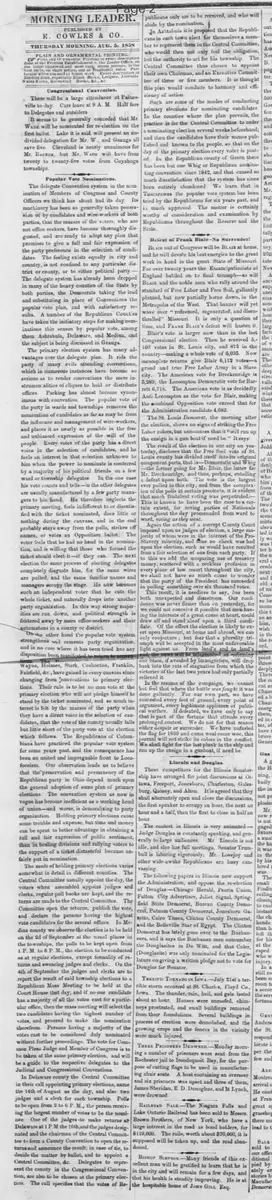
The delegate Convention system in the nomination of Members of Congress and County Officers we think has about had its day. Its machinery has been so generally taken possession of by candidates and wire-workers of both parties, that the masses of the voters, who are not office seekers, have become thoroughly disgusted, and are ready to adopt any plan that promises to give a full and fair expression of the party preference in the selection of candidates. The feeling exists equally in city and country, is not confined to any particular district or county, or to either political party—The delegate system has already been dropped in many of the heavy counties of the State by both parties, the Democrats taking the lead and substituting in place of Conventions the popular vote plan, and with satisfactory results. A number of the Republican Counties have taken the initiatory steps for making nominations this season by popular vote, among them Ashtabula, Delaware, and Medina, and the subject is being discussed in Geauga.
The primary election system has many advantages over the delegate plan. It rids the party of many evils attending conventions, which in numerous instances have become so serious as to render conventions the mere instrumentalities of cliques to hold or distribute offices. Packing has almost become synonymous with convention. The popular vote of the party in wards and townships removes the nomination of candidates as far as may be from the influence and management of wire-workers, and places it as nearly as possible in the free and unbiassed expression of the will of the people. Every voter of the party has a direct voice in the selection of candidates, and he feels an interest in that selection unknown to him when the power to nominate is conferred by a majority of his political friends on a few ward or township delegates. In the one case his vote counts and tells—in the other delegates are usually manufactured by a few party managers to his hand. He therefore neglects the primary meeting, feels indifferent to or dissatisfied with the ticket nominated, does little or nothing during the canvass, and in the end probably stays away from the polls, strikes off names, or votes an Opposition ballot. The voter feels that he had no hand in the nomination, and is willing that those who formed the ticket should elect it—if they can. The next election the same process of electing delegates completely disgusts him, for the same wires are pulled, and the same familiar names and managers occupy the stage. He now becomes such an independent voter that he cuts the whole ticket, and naturally drops into another party organization. In this way strong majorities are run down, and political strength is frittered away by mere office-seekers and their automatons in a county or district.
On the other hand the popular vote system strengthens and cements party organization, and in no case where it has been tried has any disposition been manifested Wayne, Holmes, Stark, Coshocton, Franklin, Fairfield, &c., have gained in every canvass since changing from conventions to primary elections. Their rule is to let no man vote at the primary election who will not pledge himself to stand by the ticket nominated, and so much interest is felt by the masses of the party when they have a direct voice in the selection of candidates, that the vote of the county usually falls but little short of the party vote at the election which follows. The Republicans of Columbiana have practiced the popular vote system for some years past, and the consequence has been an united and impregnable front to Locofocoism. Our observation leads us to believe that the preservation and permanency of the Republican party in Ohio depend much upon the general adoption of some plan of primary elections. The convention system as now in vogue has become inefficient as a working bond of union—and worse, is demoralizing to party organization. Holding primary elections cause some trouble and expense, but time and money can be spent to better advantage in obtaining a full and fair expression of public sentiment than in healing divisions and rallying voters to the support of a ticket distasteful because unfairly put in nomination.
The mode of holding primary elections varies somewhat in detail in different counties. The Central Committee usually appoint the day, the voters when assembled appoint judges and clerks, regular poll books are kept, and the returns are made to the Central Committee. The Committee open the returns, publish the vote, and declare the persons having the highest vote candidates for the several offices. In Medina county we observe the election is to be held on the 2d of September at the usual places in the townships, the polls to be kept open from 1 P. M. to 6 P. M., the election to be conducted as at regular elections, except formality of returns and swearing judges and clerks. On the 4th of September the judges and clerks are to report the result of said township elections to a Republican Mass Meeting to be held at the Court House that day, and if no one candidate has a majority of all the votes cast for a particular office, then the mass meeting will select the two candidates having the highest number of votes, and proceed to make the nomination therefrom. Persons having a majority of the votes cast to be considered duly nominated without further proceedings. The vote for Common Pleas Judge and Member of Congress is to be taken at the same primary election, and will be a guide to the respective delegates to the Judicial and Congressional Conventions.
In Delaware county the Central Committee in their call appointing primary elections, name the 14th of August as the day, and also two judges and a clerk for each township. Poll to be open from 2 to 6 P. M., the person receiving the largest number of votes to be the nominee. One of the judges to make returns at Delaware at 1 P. M. the 16th, and the judges designated and the chairman of the Central Committee to form a County Convention to open the returns and announce the result; in case of tie, to decide the matter by ballot, and to appoint a Central Committee, &c. Delegates to represent the county in the Congressional Convention, are also to be chosen at the primary election. The call specifies that the votes of Republicans only are to be received, and who will abide by the nomination.
In Ashtabula it is proposed that the Republicans in each town elect for themselves a member to represent them in the Central Committee, who would then not only feel the obligation, but the authority to act for his township. The Central Committee thus chosen to appoint their own Chairman, and an Executive Committee of three or five members. It is thought this plan would conduce to harmony and efficiency of action.
Such are some of the modes of conducting primary elections for nominating candidates. In the counties where the plan prevails, the practice is for the Central Committee to order a nominating election several weeks beforehand; and then the candidates have their names published and known to the people, so that on the day of the primary election every voter is posted. In the Republican county of Green there has been but one Whig or Republican nominating convention since 1842, and that caused so much dissatisfaction that the system has since been entirely abandoned. We learn that in Tuscarawas the popular vote system has been tried by the Republicans for six years past, and is much approved. The matter is certainly worthy of consideration and examination by Republicans throughout the Reserve and the State.
-ardeeituiun our State, if avoided by immigration, will drop back into the ruts of stagnation from which the victories of the last two years had only partially relieved it.
In the resume of the campaign, we cannot but feel that where the battle was fought it was done gallantly. For our own part, we have contested every foot of ground, every point of argument, every legitimate appliance of political warfare. If defeated, we have only to say that is part of the fortune that attends every prolonged contest. We do not for that reason either despair or surrender. We have unfurled the flag for 1860 and come weal come woe, this journal will not strike its colors in the conflict. We shall fight for the last plank in the chip and run up the ensign in a gunboat, if need be.
The delegate Convention system in the nomination of Members of Congress and County Officers we think has about had its day. Its machinery has been so generally taken possession of by candidates and wire-workers of both parties, that the masses of the voters, who are not office seekers, have become thoroughly disgusted, and are ready to adopt any plan that promises to give a full and fair expression of the party preference in the selection of candidates. The feeling exists equally in city and country, is not confined to any particular district or county, or to either political party—The delegate system has already been dropped in many of the heavy counties of the State by both parties, the Democrats taking the lead and substituting in place of Conventions the popular vote plan, and with satisfactory results. A number of the Republican Counties have taken the initiatory steps for making nominations this season by popular vote, among them Ashtabula, Delaware, and Medina, and the subject is being discussed in Geauga.
The primary election system has many advantages over the delegate plan. It rids the party of many evils attending conventions, which in numerous instances have become so serious as to render conventions the mere instrumentalities of cliques to hold or distribute offices. Packing has almost become synonymous with convention. The popular vote of the party in wards and townships removes the nomination of candidates as far as may be from the influence and management of wire-workers, and places it as nearly as possible in the free and unbiassed expression of the will of the people. Every voter of the party has a direct voice in the selection of candidates, and he feels an interest in that selection unknown to him when the power to nominate is conferred by a majority of his political friends on a few ward or township delegates. In the one case his vote counts and tells—in the other delegates are usually manufactured by a few party managers to his hand. He therefore neglects the primary meeting, feels indifferent to or dissatisfied with the ticket nominated, does little or nothing during the canvass, and in the end probably stays away from the polls, strikes off names, or votes an Opposition ballot. The voter feels that he had no hand in the nomination, and is willing that those who formed the ticket should elect it—if they can. The next election the same process of electing delegates completely disgusts him, for the same wires are pulled, and the same familiar names and managers occupy the stage. He now becomes such an independent voter that he cuts the whole ticket, and naturally drops into another party organization. In this way strong majorities are run down, and political strength is frittered away by mere office-seekers and their automatons in a county or district.
On the other hand the popular vote system strengthens and cements party organization, and in no case where it has been tried has any disposition been manifested Wayne, Holmes, Stark, Coshocton, Franklin, Fairfield, &c., have gained in every canvass since changing from conventions to primary elections. Their rule is to let no man vote at the primary election who will not pledge himself to stand by the ticket nominated, and so much interest is felt by the masses of the party when they have a direct voice in the selection of candidates, that the vote of the county usually falls but little short of the party vote at the election which follows. The Republicans of Columbiana have practiced the popular vote system for some years past, and the consequence has been an united and impregnable front to Locofocoism. Our observation leads us to believe that the preservation and permanency of the Republican party in Ohio depend much upon the general adoption of some plan of primary elections. The convention system as now in vogue has become inefficient as a working bond of union—and worse, is demoralizing to party organization. Holding primary elections cause some trouble and expense, but time and money can be spent to better advantage in obtaining a full and fair expression of public sentiment than in healing divisions and rallying voters to the support of a ticket distasteful because unfairly put in nomination.
The mode of holding primary elections varies somewhat in detail in different counties. The Central Committee usually appoint the day, the voters when assembled appoint judges and clerks, regular poll books are kept, and the returns are made to the Central Committee. The Committee open the returns, publish the vote, and declare the persons having the highest vote candidates for the several offices. In Medina county we observe the election is to be held on the 2d of September at the usual places in the townships, the polls to be kept open from 1 P. M. to 6 P. M., the election to be conducted as at regular elections, except formality of returns and swearing judges and clerks. On the 4th of September the judges and clerks are to report the result of said township elections to a Republican Mass Meeting to be held at the Court House that day, and if no one candidate has a majority of all the votes cast for a particular office, then the mass meeting will select the two candidates having the highest number of votes, and proceed to make the nomination therefrom. Persons having a majority of the votes cast to be considered duly nominated without further proceedings. The vote for Common Pleas Judge and Member of Congress is to be taken at the same primary election, and will be a guide to the respective delegates to the Judicial and Congressional Conventions.
In Delaware county the Central Committee in their call appointing primary elections, name the 14th of August as the day, and also two judges and a clerk for each township. Poll to be open from 2 to 6 P. M., the person receiving the largest number of votes to be the nominee. One of the judges to make returns at Delaware at 1 P. M. the 16th, and the judges designated and the chairman of the Central Committee to form a County Convention to open the returns and announce the result; in case of tie, to decide the matter by ballot, and to appoint a Central Committee, &c. Delegates to represent the county in the Congressional Convention, are also to be chosen at the primary election. The call specifies that the votes of Republicans only are to be received, and who will abide by the nomination.
In Ashtabula it is proposed that the Republicans in each town elect for themselves a member to represent them in the Central Committee, who would then not only feel the obligation, but the authority to act for his township. The Central Committee thus chosen to appoint their own Chairman, and an Executive Committee of three or five members. It is thought this plan would conduce to harmony and efficiency of action.
Such are some of the modes of conducting primary elections for nominating candidates. In the counties where the plan prevails, the practice is for the Central Committee to order a nominating election several weeks beforehand; and then the candidates have their names published and known to the people, so that on the day of the primary election every voter is posted. In the Republican county of Green there has been but one Whig or Republican nominating convention since 1842, and that caused so much dissatisfaction that the system has since been entirely abandoned. We learn that in Tuscarawas the popular vote system has been tried by the Republicans for six years past, and is much approved. The matter is certainly worthy of consideration and examination by Republicans throughout the Reserve and the State.
-ardeeituiun our State, if avoided by immigration, will drop back into the ruts of stagnation from which the victories of the last two years had only partially relieved it.
In the resume of the campaign, we cannot but feel that where the battle was fought it was done gallantly. For our own part, we have contested every foot of ground, every point of argument, every legitimate appliance of political warfare. If defeated, we have only to say that is part of the fortune that attends every prolonged contest. We do not for that reason either despair or surrender. We have unfurled the flag for 1860 and come weal come woe, this journal will not strike its colors in the conflict. We shall fight for the last plank in the chip and run up the ensign in a gunboat, if need be.
What sub-type of article is it?
Partisan Politics
What keywords are associated?
Primary Elections
Nominations
Conventions
Party Organization
Voter Engagement
Ohio Counties
Republican Party
What entities or persons were involved?
Republicans
Democrats
Ashtabula
Delaware
Medina
Geauga
Wayne
Holmes
Stark
Coshocton
Franklin
Fairfield
Columbiana
Medina County
Delaware County
Green
Tuscarawas
Editorial Details
Primary Topic
Advocacy For Primary Elections Over Delegate Conventions
Stance / Tone
Supportive Of Popular Vote System For Nominations
Key Figures
Republicans
Democrats
Ashtabula
Delaware
Medina
Geauga
Wayne
Holmes
Stark
Coshocton
Franklin
Fairfield
Columbiana
Medina County
Delaware County
Ashtabula
Green
Tuscarawas
Key Arguments
Delegate Convention System Controlled By Candidates And Wire Workers Disgusts Voters
Popular Vote Gives Direct Voice To Party Members
Primary Elections Strengthen Party Organization And Unity
Conventions Lead To Cliques And Office Seeking
Examples Of Successful Adoption In Ohio Counties
Details Of Conducting Primary Elections Vary By County
Preservation Of Republican Party Depends On Primary Elections