Thank you for visiting SNEWPapers!
Sign up free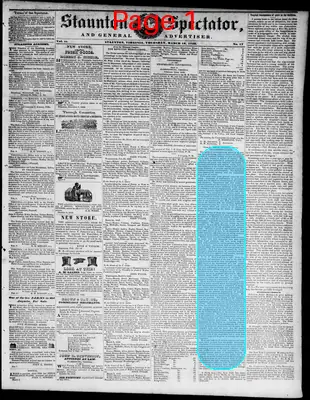
Story
March 16, 1843
Staunton Spectator, And General Advertiser
Staunton, Virginia
What is this article about?
An editorial from the Southern Patriot critiques the rising insubordination and moral decay in American society, attributing it to lax laws, weak enforcement, misplaced jury mercy, and the rise of demagoguism eroding public virtue and judicial independence.
Clipping
OCR Quality
98%
Excellent
Full Text
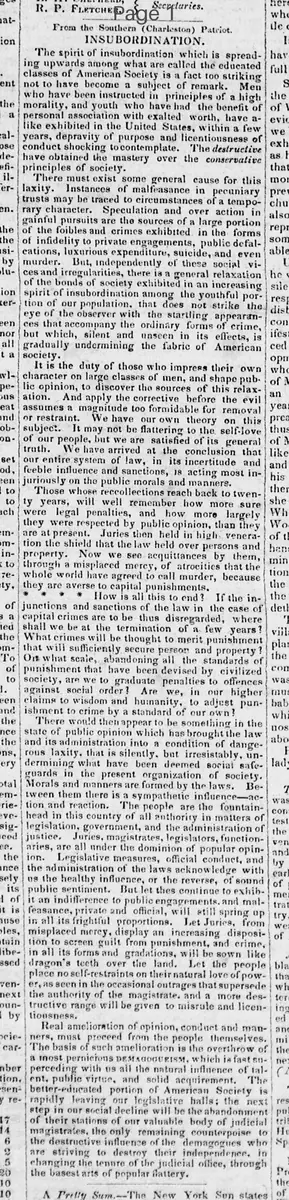
From the Southern (Charleston) Patriot.
INSUBORDINATION.
The spirit of insubordination which is spreading upwards among what are called the educated classes of American Society is a fact too striking not to have become a subject of remark. Men who have been instructed in principles of a high morality, and youth who have had the benefit of personal association with exalted worth, have alike exhibited in the United States, within a few years, depravity of purpose and licentiousness of conduct shocking to contemplate. The destructive have obtained the mastery over the conservative principles of society.
There must exist some general cause for this laxity. Instances of malfeasance in pecuniary trusts may be traced to circumstances of a temporary character. Speculation and over action in gainful pursuits are the sources of a large portion of the foibles and crimes exhibited in the forms of infidelity to private engagements, public defalcations, luxurious expenditure, suicide, and even murder. But, independently of these social vices and irregularities, there is a general relaxation of the bonds of society exhibited in an increasing spirit of insubordination among the youthful portion of our population, that does not strike the eye of the observer with the startling appearances that accompany the ordinary forms of crime, but which, silent and unseen in its effects, is gradually undermining the fabric of American society.
It is the duty of those who impress their own character on large classes of men, and shape public opinion, to discover the sources of this relaxation. And apply the corrective before the evil assumes a magnitude too formidable for removal or restraint. We have our own theory on this subject. It may not be flattering to the self-love of our people, but we are satisfied of its general truth. We have arrived at the conclusion that our entire system of law, in its incertitude and feeble influence and sanctions, is acting most injuriously on the public morals and manners.
Those whose recollections reach back to twenty years, will well remember how more sure were legal penalties, and how more largely they were respected by public opinion, than they are at present. Juries then held in high veneration the shield that the law held over persons and property. Now we see acquittances by them, through a misplaced mercy, of atrocities that the whole world have agreed to call murder, because they are averse to capital punishments.
How is all this to end? If the injunctions and sanctions of the law in the case of capital crimes are to be thus disregarded, where shall we be at the termination of a few years? What crimes will be thought to merit punishment that will sufficiently secure person and property? On what scale, abandoning all the standards of punishment that have been devised by civilized society, are we to graduate penalties to offences against social order? Are we, in our higher claims to wisdom and humanity, to adjust punishment to crime by a standard of our own?
There would then appear to be something in the state of public opinion which has brought the law and its administration into a condition of dangerous laxity, that is silently, but irresistibly, undermining what have been deemed social safe-guards in the present organization of society.
Morals and manners are formed by the laws. Between them there is a sympathetic influence--action and reaction. The people are the fountain-head in this country of all authority in matters of legislation, government, and the administration of justice. Juries, magistrates, legislators, functionaries, are all under the dominion of popular opinion. Legislative measures, official conduct, and the administration of the laws acknowledge with us the healthy influence, or the reverse, of sound public sentiment. But let these continue to exhibit an indifference to public engagements, and malfeasance, private and official, will still spring up in all its frightful proportions. Let Juries, from misplaced mercy, display an increasing disposition to screen guilt from punishment, and crime, in all its forms and gradations, will be sown like dragon's teeth over the land. Let the people place no self-restraints on their natural love of power, as seen in the occasional outrages that supersede the authority of the magistrate, and a more destructive range will be given to misrule and licentiousness.
Real amelioration of opinion, conduct and manners, must proceed from the people themselves. The basis of such amelioration is the overthrow of a most pernicious Demagoguism, which is fast superceding with us all the natural influence of talent, public virtue, and solid acquirement. The better-educated portion of American Society is rapidly leaving our legislative halls: the next step in our social decline will be the abandonment of their stations of our valuable body of judicial magistrates, the only remaining counterpoise to the destructive influence of the demagogues who are striving to destroy their independence, in changing the tenure of the judicial office, through the basest arts of popular flattery.
INSUBORDINATION.
The spirit of insubordination which is spreading upwards among what are called the educated classes of American Society is a fact too striking not to have become a subject of remark. Men who have been instructed in principles of a high morality, and youth who have had the benefit of personal association with exalted worth, have alike exhibited in the United States, within a few years, depravity of purpose and licentiousness of conduct shocking to contemplate. The destructive have obtained the mastery over the conservative principles of society.
There must exist some general cause for this laxity. Instances of malfeasance in pecuniary trusts may be traced to circumstances of a temporary character. Speculation and over action in gainful pursuits are the sources of a large portion of the foibles and crimes exhibited in the forms of infidelity to private engagements, public defalcations, luxurious expenditure, suicide, and even murder. But, independently of these social vices and irregularities, there is a general relaxation of the bonds of society exhibited in an increasing spirit of insubordination among the youthful portion of our population, that does not strike the eye of the observer with the startling appearances that accompany the ordinary forms of crime, but which, silent and unseen in its effects, is gradually undermining the fabric of American society.
It is the duty of those who impress their own character on large classes of men, and shape public opinion, to discover the sources of this relaxation. And apply the corrective before the evil assumes a magnitude too formidable for removal or restraint. We have our own theory on this subject. It may not be flattering to the self-love of our people, but we are satisfied of its general truth. We have arrived at the conclusion that our entire system of law, in its incertitude and feeble influence and sanctions, is acting most injuriously on the public morals and manners.
Those whose recollections reach back to twenty years, will well remember how more sure were legal penalties, and how more largely they were respected by public opinion, than they are at present. Juries then held in high veneration the shield that the law held over persons and property. Now we see acquittances by them, through a misplaced mercy, of atrocities that the whole world have agreed to call murder, because they are averse to capital punishments.
How is all this to end? If the injunctions and sanctions of the law in the case of capital crimes are to be thus disregarded, where shall we be at the termination of a few years? What crimes will be thought to merit punishment that will sufficiently secure person and property? On what scale, abandoning all the standards of punishment that have been devised by civilized society, are we to graduate penalties to offences against social order? Are we, in our higher claims to wisdom and humanity, to adjust punishment to crime by a standard of our own?
There would then appear to be something in the state of public opinion which has brought the law and its administration into a condition of dangerous laxity, that is silently, but irresistibly, undermining what have been deemed social safe-guards in the present organization of society.
Morals and manners are formed by the laws. Between them there is a sympathetic influence--action and reaction. The people are the fountain-head in this country of all authority in matters of legislation, government, and the administration of justice. Juries, magistrates, legislators, functionaries, are all under the dominion of popular opinion. Legislative measures, official conduct, and the administration of the laws acknowledge with us the healthy influence, or the reverse, of sound public sentiment. But let these continue to exhibit an indifference to public engagements, and malfeasance, private and official, will still spring up in all its frightful proportions. Let Juries, from misplaced mercy, display an increasing disposition to screen guilt from punishment, and crime, in all its forms and gradations, will be sown like dragon's teeth over the land. Let the people place no self-restraints on their natural love of power, as seen in the occasional outrages that supersede the authority of the magistrate, and a more destructive range will be given to misrule and licentiousness.
Real amelioration of opinion, conduct and manners, must proceed from the people themselves. The basis of such amelioration is the overthrow of a most pernicious Demagoguism, which is fast superceding with us all the natural influence of talent, public virtue, and solid acquirement. The better-educated portion of American Society is rapidly leaving our legislative halls: the next step in our social decline will be the abandonment of their stations of our valuable body of judicial magistrates, the only remaining counterpoise to the destructive influence of the demagogues who are striving to destroy their independence, in changing the tenure of the judicial office, through the basest arts of popular flattery.
What sub-type of article is it?
Curiosity
What themes does it cover?
Social Manners
Moral Virtue
Misfortune
What keywords are associated?
Insubordination
American Society
Lax Laws
Demagoguism
Moral Decay
Judicial Independence
Where did it happen?
United States
Story Details
Location
United States
Event Date
Within A Few Years
Story Details
The article argues that insubordination and moral decay in American society stem from uncertain laws, weak penalties, jury leniency toward capital crimes, and the rise of demagoguism undermining virtue and judicial independence, calling for public correction.