Thank you for visiting SNEWPapers!
Sign up free
Story
March 7, 1892
San Antonio Daily Light
San Antonio, Bexar County, Texas
What is this article about?
An improved refuse destructor in England incinerates waste using its own combustible materials, reaching high temperatures to destroy germs and utilize heat for machinery, electricity, and clinker processing into building materials. It processes 30,000 loads yearly.
Clipping
OCR Quality
98%
Excellent
Full Text
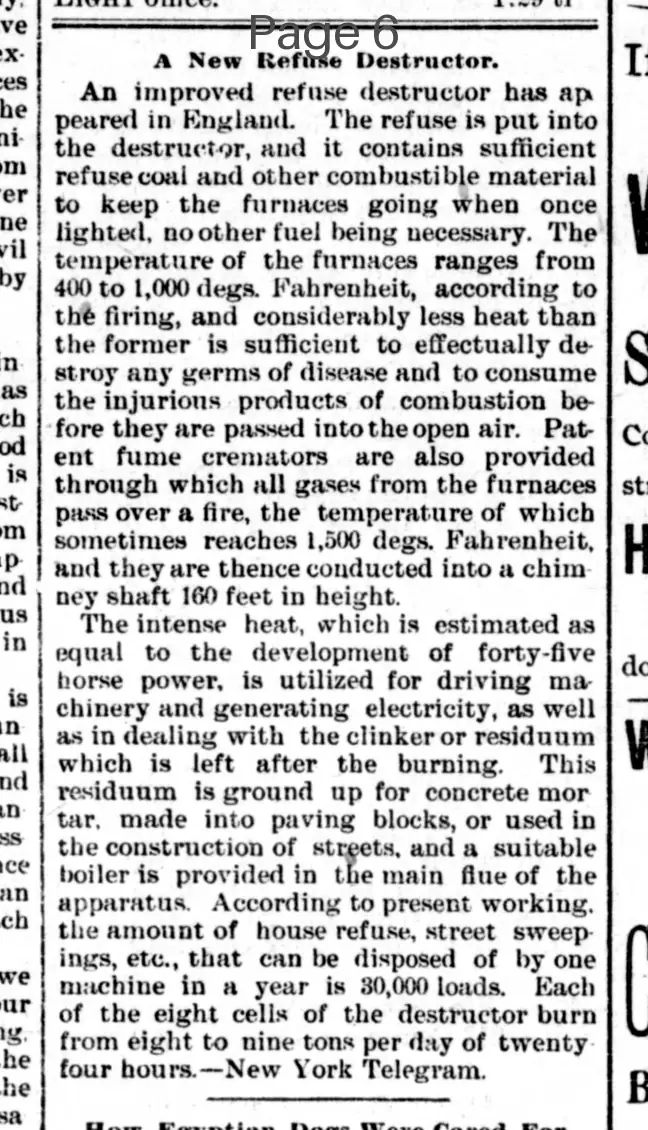
A New Refuse Destructor.
An improved refuse destructor has appeared in England. The refuse is put into the destructor, and it contains sufficient refuse coal and other combustible material to keep the furnaces going when once lighted, no other fuel being necessary. The temperature of the furnaces ranges from 400 to 1,000 degs. Fahrenheit, according to the firing, and considerably less heat than the former is sufficient to effectually destroy any germs of disease and to consume the injurious products of combustion before they are passed into the open air. Patent fume cremators are also provided through which all gases from the furnaces pass over a fire, the temperature of which sometimes reaches 1,500 degs. Fahrenheit and they are thence conducted into a chimney shaft 160 feet in height.
The intense heat, which is estimated as equal to the development of forty-five horse power, is utilized for driving machinery and generating electricity, as well as in dealing with the clinker or residuum which is left after the burning. This residuum is ground up for concrete mortar, made into paving blocks, or used in the construction of streets, and a suitable boiler is provided in the main flue of the apparatus. According to present working, the amount of house refuse, street sweepings, etc., that can be disposed of by one machine in a year is 30,000 loads. Each of the eight cells of the destructor burns from eight to nine tons per day of twenty-four hours.—New York Telegram.
An improved refuse destructor has appeared in England. The refuse is put into the destructor, and it contains sufficient refuse coal and other combustible material to keep the furnaces going when once lighted, no other fuel being necessary. The temperature of the furnaces ranges from 400 to 1,000 degs. Fahrenheit, according to the firing, and considerably less heat than the former is sufficient to effectually destroy any germs of disease and to consume the injurious products of combustion before they are passed into the open air. Patent fume cremators are also provided through which all gases from the furnaces pass over a fire, the temperature of which sometimes reaches 1,500 degs. Fahrenheit and they are thence conducted into a chimney shaft 160 feet in height.
The intense heat, which is estimated as equal to the development of forty-five horse power, is utilized for driving machinery and generating electricity, as well as in dealing with the clinker or residuum which is left after the burning. This residuum is ground up for concrete mortar, made into paving blocks, or used in the construction of streets, and a suitable boiler is provided in the main flue of the apparatus. According to present working, the amount of house refuse, street sweepings, etc., that can be disposed of by one machine in a year is 30,000 loads. Each of the eight cells of the destructor burns from eight to nine tons per day of twenty-four hours.—New York Telegram.
What sub-type of article is it?
Curiosity
What themes does it cover?
Triumph
What keywords are associated?
Refuse Destructor
Waste Incineration
Heat Utilization
Electricity Generation
Clinker Processing
Where did it happen?
England
Story Details
Location
England
Story Details
Description of an improved refuse destructor that self-sustains combustion, destroys waste efficiently, utilizes heat for power and processes residue for construction, handling 30,000 loads annually.