Thank you for visiting SNEWPapers!
Sign up free
Literary
August 25, 1921
The Jones County News
Ellisville, Jones County, Mississippi
What is this article about?
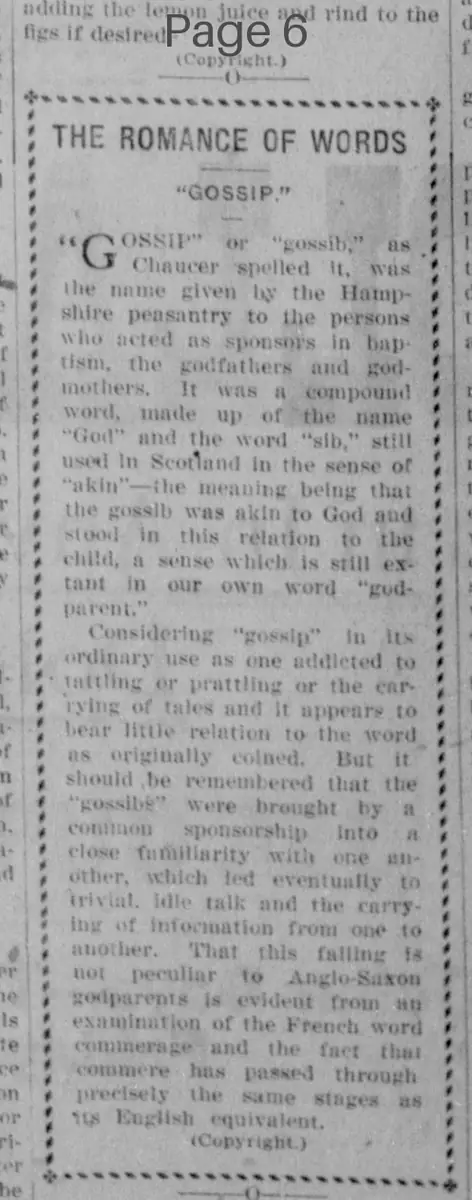
This etymological essay explains the origin of 'gossip' from Old English 'gossib,' meaning godparent or sponsor in baptism, derived from 'God' and 'sib' (akin). It evolved to denote idle talk among such familiars, paralleling the French 'commère.'
Clipping
OCR Quality
95%
Excellent
Full Text
THE ROMANCE OF WORDS
"GOSSIP"
"GOSSIP"
or
"gossib,"
as
Chaucer spelled it, was
the name given by the Hamp-
shire peasantry to the persons
who acted as sponsors in bap-
tism, the godfathers and god-
mothers. It was a compound
word, made up of the name
"God" and the word "sib," still
used in Scotland in the sense of
"akin" - the meaning being that
the gossip was akin to God and
stood in this relation to the
child, a sense which is still ex-
tant in our own word "god-
parent."
Considering "gossip" in its
ordinary use as one addicted to
tattling or prattling or the car-
rying of tales and it appears to
bear little relation to the word
as originally coined. But it
should be remembered that the
"gossips"
were brought by
sponsorship into a
close familiarity with one an-
other, which led eventually to
chit-chat, idle talk and the carry.
ing of information from one to
another. That this failing is
not peculiar to Anglo-Saxon
godparents is evident from an
examination of the French word
commere,
and the fact that
commere
has
passed through
precisely
the
same stages as
its English equivalent.
(Copyright)
"GOSSIP"
"GOSSIP"
or
"gossib,"
as
Chaucer spelled it, was
the name given by the Hamp-
shire peasantry to the persons
who acted as sponsors in bap-
tism, the godfathers and god-
mothers. It was a compound
word, made up of the name
"God" and the word "sib," still
used in Scotland in the sense of
"akin" - the meaning being that
the gossip was akin to God and
stood in this relation to the
child, a sense which is still ex-
tant in our own word "god-
parent."
Considering "gossip" in its
ordinary use as one addicted to
tattling or prattling or the car-
rying of tales and it appears to
bear little relation to the word
as originally coined. But it
should be remembered that the
"gossips"
were brought by
sponsorship into a
close familiarity with one an-
other, which led eventually to
chit-chat, idle talk and the carry.
ing of information from one to
another. That this failing is
not peculiar to Anglo-Saxon
godparents is evident from an
examination of the French word
commere,
and the fact that
commere
has
passed through
precisely
the
same stages as
its English equivalent.
(Copyright)
What sub-type of article is it?
Essay
What keywords are associated?
Gossip
Etymology
Godparent
Chaucer
Sponsorship
Commere
Literary Details
Title
The Romance Of Words "Gossip"
Subject
Etymology Of The Word Gossip
Form / Style
Etymological Essay In Prose
Key Lines
"Gossip" Or "Gossib," As Chaucer Spelled It, Was The Name Given By The Hampshire Peasantry To The Persons Who Acted As Sponsors In Baptism, The Godfathers And God Mothers.
It Was A Compound Word, Made Up Of The Name "God" And The Word "Sib," Still Used In Scotland In The Sense Of "Akin" The Meaning Being That The Gossip Was Akin To God And Stood In This Relation To The Child, A Sense Which Is Still Extant In Our Own Word "God Parent."
Considering "Gossip" In Its Ordinary Use As One Addicted To Tattling Or Prattling Or The Carrying Of Tales And It Appears To Bear Little Relation To The Word As Originally Coined.