Thank you for visiting SNEWPapers!
Sign up free
Editorial
September 14, 1803
The National Intelligencer And Washington Advertiser
Washington, District Of Columbia
What is this article about?
Letter III defends republican governments by defining them as systems where power originates from and is exercised by or accountable to the people. It outlines types (democratic, representative, mixed), argues ancient pure democracies are unsuitable for modern scales, praises their virtues, and asserts true representation ensures durability against tyranny.
Clipping
OCR Quality
95%
Excellent
Full Text
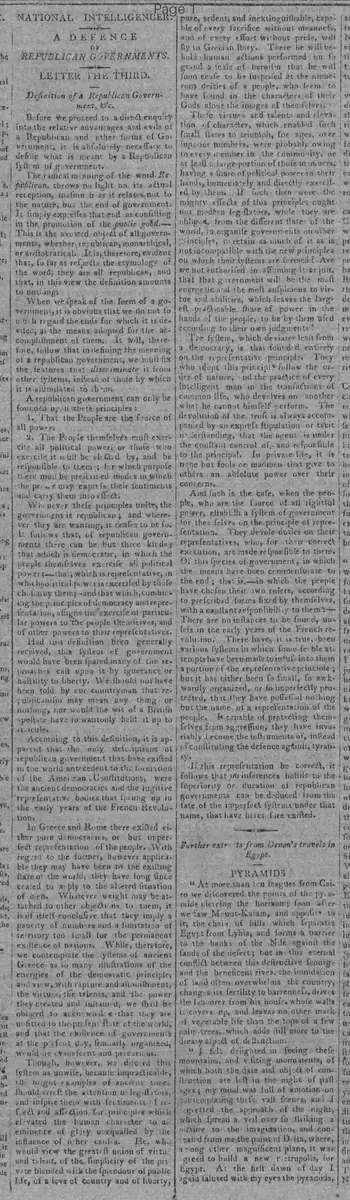
A DEFENCE
OF
REPUBLICAN GOVERNMENTS.
LETTER THE THIRD.
Definition of a Republican Govern-
ment, &c.
Before we proceed to a direct enquiry
into the relative advantages and evils of
a Republican and other forms of Go-
vernment, it is absolutely necessary to
define what is meant by a Republican
system of government.
The radical meaning of the word Re-
publican, throws no light on its actual
reception, inasmuch as it relates not to
the nature, but the end of government.
It simply expresses that end as consisting
in the promotion of the public good.-
This is the avowed object of all govern-
ments, whether republican, monarchical,
or aristocratical. It is, therefore, evident
that, so far as respects the etymology of
the word; they are all republics, and
that, in this view the definition amounts
to nothing.
When we speak of the form of a go-
vernment, it is obvious that we do not so
much regard the ends for which it is de-
signed, as the means adopted for the ac-
complishment of them. It will, there-
fore, follow that in defining the meaning
of a republican government, we must fix
the features that discriminate it from
other systems, instead of those by which
it is assimilated to them.
A republican government can only be
founded upon these principles:
1. That the People are the source of
all powers
2. The People themselves must exer-
cise all political power; or those who
exercise it must be elected by, and be
responsible to them; for which purpose
there must be preserved modes in which
the people may express, their sentiments
and carry them into effect.
Whenever these principles unite, the
government is republican; and where-
ever they are wanting, it ceases to be so.
It follows that, of republican govern-
ments there can be but three kinds:
that which is democratic, in which the
people themselves exercise all political
powers--that, which is representative, in
which political power is exercised by those
chosen by them; --and that which, combi-
ning the principles of democracy and repre-
sentation, assigns the exercise of particu-
lar powers to the people themselves, and
of other powers to their representatives.
Had this definition been generally
received, this system of government
would have been spared many of the re-
proaches cast upon it by ignorance or
hostility to liberty. We should not have
been told by our countryman that re-
publicanism may mean any thing or
nothing, nor would the wit of a British
apostate have so wantonly held it up to
ridicule.
According to this definition, it is ap-
parent that the only descriptions of
republican government that have existed
in the world antecedent to the formation
of the American, Constitutions, were
the ancient democracies and the fugitive
representative bodies that sprung up in
the early years of the French Revolu-
tion
In Greece and Rome there existed ei-
ther pure democracies, or but imper-
fect representation of the people. With
regard to the former, however applica-
ble they may have been to the existing
state of the world, they have long since
ceased to apply to the altered situation
of men. Whatever weight may be at-
tached to other objections to them, it
is of itself conclusive that they imply a
paucity of numbers and a limitation of
territory too small for the permanent
existence of nations. While, therefore,
we contemplate the systems of ancient
Greece as so many illustrations of the
energies of the democratic principle,
and view, with rapture and astonishment,
the virtues, the talents, and the power
they created and sustained, we shall be
obliged to acknowledge that they are
unsuited to the present state of the world,
and that the existence of governments
at the present day, similarly organized,
would be evanescent and precarious.
Though, however, we discard this
system as unwise, because impracticable,
the bright examples of ancient times
should arrest the attention of legislators,
and inspire them with sentiments of re-
spect and affection for principles which
elevated the human character to a
eminence of glory unequalled by the
influence of other causes. He, who
would view the greatest union of virtue
and talent, of the simplicity of the pri-
vate blended with the splendour of public
life, of a love of country and of liberty,
pure, ardent, and inextinguishable, capa-
ble of every sacrifice without meanness.
and of every effort without pride, will
fly to Grecian history. There he will be-
hold human actions performed on so
grand a scale of heroism that he will
soon cease to be surprised at the nume-
rous deities of a people. whose seem to
have found in the characters of their
Gods alone the images of themselves.
These virtue and talents and eleva-
tion of character, which enabled such
small states to triumph, for ages, over
superior numbers, were probably owing
to every member in the community, or
at least a large portion of those members,
having a share of political power in their
hands, immediately and directly exercised
by themselves. Such then were the
mighty effects of this principle, ought
not modern legislators, while they are
obliged, from the different state of the
world, to organize governments on other
principles, to retain as much of it as is
not incompatible with the new principles
on which their systems are formed? Are
we not authorized in assuming it as just.
that that government will be the most
energetic and the most auspicious to vir-
tue and abilities, which leaves the larg-
est practicable share of power in the
hands of the people, to be by them used
according to their own judgments?
The system, which deviates least from
a democracy, is that founded entirely
on the representative principle. They
who adopt this principle follow the or-
der of nature, and the practice of every
intelligent man in the transactions of
common life, who devolves on another
what he cannot himself perform. The
devolution of the trust is always accom-
panied by an express stipulation or tacit
understanding, that the agent is under
the constant control of, and responsible
to the principal. In private life, it is
none but fools or madmen that give to
others an absolute power over their
concerns.
And such is the case, when the peo-
ple, who are the source of all rightful
power, establish a system of government
for themselves on the principle of repre-
sentation. They devolve duties on their
repreentatives, who, for their correct
execution, are made responsible to them.
Of this species of government, in which
the means have been commensurate to
the end; that is,--in which the people
have chosen their own rulers, according
to prescribed forms fixed by themselves,
with a constant responsibility to them :--
There are no instances to be found, un-
less in the early years of the French re-
volution. There have, it is true, been
various systems in which some feeble at-
tempts have been made to infuse into them
a portion of the representative principle :
but it has either been so small, so awk-
wardly organized, or so imperfectly pro-
tected, that they have possessed nothing
but the name of a representation of the
people. Incapable of protecting them-
selves from aggression, they have inva-
riably become the instruments of, instead
of constituting the defence against, tyran-
ny.
If this representation be correct, it
follows that no inferences hostile to the
superiority or duration of republican
governments can be deduced from the
fate of the imperfect systems under that
name, that have heretofore existed.
OF
REPUBLICAN GOVERNMENTS.
LETTER THE THIRD.
Definition of a Republican Govern-
ment, &c.
Before we proceed to a direct enquiry
into the relative advantages and evils of
a Republican and other forms of Go-
vernment, it is absolutely necessary to
define what is meant by a Republican
system of government.
The radical meaning of the word Re-
publican, throws no light on its actual
reception, inasmuch as it relates not to
the nature, but the end of government.
It simply expresses that end as consisting
in the promotion of the public good.-
This is the avowed object of all govern-
ments, whether republican, monarchical,
or aristocratical. It is, therefore, evident
that, so far as respects the etymology of
the word; they are all republics, and
that, in this view the definition amounts
to nothing.
When we speak of the form of a go-
vernment, it is obvious that we do not so
much regard the ends for which it is de-
signed, as the means adopted for the ac-
complishment of them. It will, there-
fore, follow that in defining the meaning
of a republican government, we must fix
the features that discriminate it from
other systems, instead of those by which
it is assimilated to them.
A republican government can only be
founded upon these principles:
1. That the People are the source of
all powers
2. The People themselves must exer-
cise all political power; or those who
exercise it must be elected by, and be
responsible to them; for which purpose
there must be preserved modes in which
the people may express, their sentiments
and carry them into effect.
Whenever these principles unite, the
government is republican; and where-
ever they are wanting, it ceases to be so.
It follows that, of republican govern-
ments there can be but three kinds:
that which is democratic, in which the
people themselves exercise all political
powers--that, which is representative, in
which political power is exercised by those
chosen by them; --and that which, combi-
ning the principles of democracy and repre-
sentation, assigns the exercise of particu-
lar powers to the people themselves, and
of other powers to their representatives.
Had this definition been generally
received, this system of government
would have been spared many of the re-
proaches cast upon it by ignorance or
hostility to liberty. We should not have
been told by our countryman that re-
publicanism may mean any thing or
nothing, nor would the wit of a British
apostate have so wantonly held it up to
ridicule.
According to this definition, it is ap-
parent that the only descriptions of
republican government that have existed
in the world antecedent to the formation
of the American, Constitutions, were
the ancient democracies and the fugitive
representative bodies that sprung up in
the early years of the French Revolu-
tion
In Greece and Rome there existed ei-
ther pure democracies, or but imper-
fect representation of the people. With
regard to the former, however applica-
ble they may have been to the existing
state of the world, they have long since
ceased to apply to the altered situation
of men. Whatever weight may be at-
tached to other objections to them, it
is of itself conclusive that they imply a
paucity of numbers and a limitation of
territory too small for the permanent
existence of nations. While, therefore,
we contemplate the systems of ancient
Greece as so many illustrations of the
energies of the democratic principle,
and view, with rapture and astonishment,
the virtues, the talents, and the power
they created and sustained, we shall be
obliged to acknowledge that they are
unsuited to the present state of the world,
and that the existence of governments
at the present day, similarly organized,
would be evanescent and precarious.
Though, however, we discard this
system as unwise, because impracticable,
the bright examples of ancient times
should arrest the attention of legislators,
and inspire them with sentiments of re-
spect and affection for principles which
elevated the human character to a
eminence of glory unequalled by the
influence of other causes. He, who
would view the greatest union of virtue
and talent, of the simplicity of the pri-
vate blended with the splendour of public
life, of a love of country and of liberty,
pure, ardent, and inextinguishable, capa-
ble of every sacrifice without meanness.
and of every effort without pride, will
fly to Grecian history. There he will be-
hold human actions performed on so
grand a scale of heroism that he will
soon cease to be surprised at the nume-
rous deities of a people. whose seem to
have found in the characters of their
Gods alone the images of themselves.
These virtue and talents and eleva-
tion of character, which enabled such
small states to triumph, for ages, over
superior numbers, were probably owing
to every member in the community, or
at least a large portion of those members,
having a share of political power in their
hands, immediately and directly exercised
by themselves. Such then were the
mighty effects of this principle, ought
not modern legislators, while they are
obliged, from the different state of the
world, to organize governments on other
principles, to retain as much of it as is
not incompatible with the new principles
on which their systems are formed? Are
we not authorized in assuming it as just.
that that government will be the most
energetic and the most auspicious to vir-
tue and abilities, which leaves the larg-
est practicable share of power in the
hands of the people, to be by them used
according to their own judgments?
The system, which deviates least from
a democracy, is that founded entirely
on the representative principle. They
who adopt this principle follow the or-
der of nature, and the practice of every
intelligent man in the transactions of
common life, who devolves on another
what he cannot himself perform. The
devolution of the trust is always accom-
panied by an express stipulation or tacit
understanding, that the agent is under
the constant control of, and responsible
to the principal. In private life, it is
none but fools or madmen that give to
others an absolute power over their
concerns.
And such is the case, when the peo-
ple, who are the source of all rightful
power, establish a system of government
for themselves on the principle of repre-
sentation. They devolve duties on their
repreentatives, who, for their correct
execution, are made responsible to them.
Of this species of government, in which
the means have been commensurate to
the end; that is,--in which the people
have chosen their own rulers, according
to prescribed forms fixed by themselves,
with a constant responsibility to them :--
There are no instances to be found, un-
less in the early years of the French re-
volution. There have, it is true, been
various systems in which some feeble at-
tempts have been made to infuse into them
a portion of the representative principle :
but it has either been so small, so awk-
wardly organized, or so imperfectly pro-
tected, that they have possessed nothing
but the name of a representation of the
people. Incapable of protecting them-
selves from aggression, they have inva-
riably become the instruments of, instead
of constituting the defence against, tyran-
ny.
If this representation be correct, it
follows that no inferences hostile to the
superiority or duration of republican
governments can be deduced from the
fate of the imperfect systems under that
name, that have heretofore existed.
What sub-type of article is it?
Constitutional
What keywords are associated?
Republican Government
Democracy
Representation
Ancient Greece
French Revolution
American Constitutions
Political Power
Public Good
What entities or persons were involved?
People
Greece
Rome
French Revolution
American Constitutions
Editorial Details
Primary Topic
Definition And Defence Of Republican Government
Stance / Tone
Defensive And Explanatory Of Republican Principles
Key Figures
People
Greece
Rome
French Revolution
American Constitutions
Key Arguments
Republican Government Derives Power From The People And Promotes Public Good.
It Is Defined By Direct Exercise Of Power By The People Or Through Elected, Responsible Representatives.
Three Kinds: Pure Democracy, Representative, And Mixed.
Ancient Democracies Like Those In Greece And Rome Are Unsuitable For Modern Large Nations Due To Scale.
Modern Governments Should Retain Maximum Direct Popular Power Compatible With Practicality.
Representative Systems Follow Natural Order With Accountability To Prevent Tyranny.
Historical Imperfect Representations Do Not Discredit True Republicanism.
Grecian History Exemplifies Virtues From Democratic Principles.