Thank you for visiting SNEWPapers!
Sign up free
Editorial
October 1, 1811
The New Hampshire Gazette
Portsmouth, Rockingham County, New Hampshire
What is this article about?
A Democrat critiques Robert Smith's pamphlet, highlighting his poor writing, egotism, and suspicious character in dealings with President Madison, arguing his unsuitability as Secretary of State and defending Madison's decision to remove him.
Merged-components note: Merged continuation of the 'Political Miscellany' editorial across pages; sequential reading order and matching topic on British-American relations.
Clippings
1 of 2
OCR Quality
95%
Excellent
Full Text
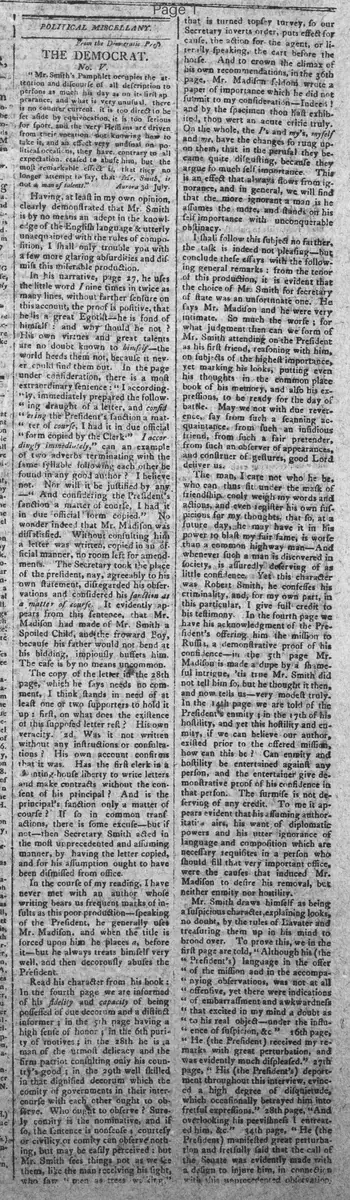
POLITICAL MISCELLANY.
from the Democratic Press
THE DEMOCRAT
No. V
"Mr. Smith's Pamphlet occupies the attention and discourse of all descriptions of persons as much this day as on its first appearance, and what is very unusual, there is no counter current. It is too direct to be set aside by equivocation. It is too serious for sport, and the very Hessians are driven from their vocation, not knowing how to take it, and an effect very unusual on political occasions, they have, contrary to all expectation, ceased to abuse him, but the most remarkable effect is, that they no longer attempt to say, that Mr. Smith is not a man of talents."
Aurora 3d July.
Having, at least in my own opinion, clearly demonstrated that Mr. Smith is by no means an adept in the knowledge of the English language & utterly unacquainted with the rules of composition, I shall only trouble you with a few more glaring absurdities and imbecilities this miserable production.
In his narrative, page 27, he uses the little word I nine times in twice as many lines. Without farther comment on this account, the proof is positive, that he is a great Egotist—he is fond of himself: and why should he not? His own virtues and great talents are no doubt known to himself—the world heeds them not, because it never could find them out. In the page under consideration, there is a most extraordinary sentence: "I accordingly, immediately prepared the following draught of a letter, and considering the President's sanction a matter of course, I had it in due official form copied by the Clerk." I accordingly immediately," can an example of two adverbs terminating with the same syllable following each other be found in any good author? I believe not. Nor will it be justified by any "And considering the President's sanction a matter of course, I had it in due official form copied." No wonder indeed that Mr. Madison was dissatisfied. Without consulting him a letter was written, copied in an official manner, no room left for amendments. The Secretary took the place of the president, nay, agreeably to his own statement, disregarded his observations and considered his sanction as a matter of course. It evidently appears from this sentence, that Mr. Madison had made of Mr. Smith a Spoiled Child, and the froward Boy, because his father would not bend at his bidding, impiously buffets him. The case is by no means uncommon.
The copy of the letter in the 28th page, which he says needs no comment, I think stands in need of at least one or two supporters to hold it up: first, on what does the existence of this supposed letter rest? His own veracity. 2d. Was it not written without any instructions or consultations? His own account confirms that it was. Has the first clerk in a counting-house liberty to write letters and make contracts without the consent of his principal? And is the principal's sanction only a matter of course? If so in common transactions, there is some excuse—but if not—then Secretary Smith acted in the most unprecedented and assuming manner, by having the letter copied, and for his assumption ought to have been dismissed from office.
In the course of my reading, I have never met with an author whose writing bears us frequent marks of insults as this poor production—speaking of the President, he generally uses Mr. Madison, and when the title is forced upon him he places a, before it—but he always treats himself very well, and then decorously abuses the President.
Read his character from his book:
In the fourth page we are informed of his fidelity and capacity of being possessed of due decorum and a distinct informer; in the 5th page having a high sense of honor; in the 6th purity of motives; in the 28th he is a man of the utmost delicacy and the firm patriot consulting only his country's good; in the 30th well skilled in that dignified decorum which the comity of governments in their intercourse with each other ought to observe. Who ought to observe? Surely comity is the nominative, and if so, the sentence is nonsense—courtesy or civility or comity can observe nothing, but may be easily perceived: but Mr. Smith sees things not as we see them, like the man receiving his sight who saw "men as trees walking."
that is turned topsy turvey, our Secretary inverts order, puts effect for cause, the action for the agent, or literally speaking, the cart before the horse. And to crown the climax of his own recommendations, in the 26th page, Mr. Madison seldom wrote a paper of importance which he did not submit to my consideration—Indeed! and by the specimen thou hast exhibited, thou wert an acute critic truly.
On the whole, the I's and my's, myself and me, have the changes so rung upon them, that in the perusal they became quite disgusting, because they argue so much self importance. This is an effect that always flows from ignorance, and in general, we will find that the more ignorant a man is he assumes the more, and stands on his self importance with unconquerable obstinacy.
I shall follow this subject no farther. the task is indeed not pleasing—but conclude these essays with the following general remarks: from the tenor of this production, it is evident that the choice of Mr. Smith for secretary of state was an unfortunate one. He says Mr. Madison and he were very intimate. So much the worse; for what judgment then can we form of Mr. Smith attending on the President as his first friend, reasoning with him, on subjects of the highest importance, yet marking his looks, putting even his thoughts in the common place book of his memory, and also his expressions, to be ready for the day of battle. May we not with due reverence, say from such a cunning acquaintance, from such an insidious friend, from such a fair pretender, from such an observer of appearances, and construe of gestures, good Lord deliver us.
The man, I care not who he be, who can thus sit under the mask of friendship cooly weigh my words and actions, and even register his own suspicions for my thoughts, that so, at a future day, he may have it in his power to blast my fair fame, is worse than a common highwayman—And whenever such a man is discovered in society, is assuredly deserving of as little confidence. Yet this character was Robert Smith, he confesses his criminality, and, for my own part, in this particular, I give full credit to his testimony. In the fourth page we have his acknowledgment of the President's offering him the mission to Russia, a demonstrative proof of his confidence—in the 7th page Mr. Madison is made a dupe by a shameful intrigue, 'tis true Mr. Smith did not tell him so, but he thought it then, and now tells us—very modest truly.
In the 18th page we are told of the President's enmity; in the 19th of his hostility, and yet this hostility and enmity, if we can believe our author, existed prior to the offered mission. how can this be? Can enmity and hostility be entertained against any person, and the entertainer give demonstrative proof of his confidence in that person. The surmise is not deserving of any credit. To me it appears evident that his assuming authoritative airs, his want of diplomatic powers and his utter ignorance of language and composition which are necessary requisites in a person who should fill that very important office, were the causes that induced Mr. Madison to desire his removal, but neither enmity nor hostility.
Mr. Smith draws himself as being a suspicious character, explaining looks, no doubt, by the rules of Lavater and treasuring them up in his mind to brood over. To prove this, we in the first page are told, "Although his (the President's) language in the offer of the mission and in the accompanying observations, was not at all offensive, yet there were indications of embarrassment and awkwardness that excited in my mind a doubt as to his real object—under the influence of suspicion, &c." 10th page, "He (the President) received my remarks with great perturbation, and was evidently much displeased." 27th page, "His (the President's) deportment throughout this interview, evinced a high degree of disquietude which occasionally betrayed him into fretful expressions." 28th page, "And overlooking his peevishness I entreated him, &c." 34th page, "He (the President) manifested great perturbation and fretfully said that the call of the Senate was evidently made with a design to injure him, in connection with this unprecedented observation."
Various indications of dissatisfaction with respect to myself, &c.
We have examined this production and have seen that its author is not qualified by his literary attainments for the important office which he filled, and we are sorry to say that his own evidence of his scanning of looks, marking gestures, searching for indications, examining what passed in the mind by his skill in physiognomy, and when no offensive expressions were used, his having recourse to motives and designs whereon to found an accusation, argue that he is not possessed of that manly ingenuousness, that heart that thinketh no evil, that honest freedom of spirit which never bends to learn from nods and winks and shrugs, but judges from finished actions. It indeed appears that he stood over the President as a spy, even of his thoughts, and in every conversation strove to weigh his soul! Happily this shrewd observer of the mind's motions is removed. We dismiss this publication by expressing our regret for its author, he has fallen from his station—by his own folly he has written himself down in the eyes of the world and literally contradicted his friend Duane, as far as it respects his claim to being a man of talents.
A DEMOCRAT.
from the Democratic Press
THE DEMOCRAT
No. V
"Mr. Smith's Pamphlet occupies the attention and discourse of all descriptions of persons as much this day as on its first appearance, and what is very unusual, there is no counter current. It is too direct to be set aside by equivocation. It is too serious for sport, and the very Hessians are driven from their vocation, not knowing how to take it, and an effect very unusual on political occasions, they have, contrary to all expectation, ceased to abuse him, but the most remarkable effect is, that they no longer attempt to say, that Mr. Smith is not a man of talents."
Aurora 3d July.
Having, at least in my own opinion, clearly demonstrated that Mr. Smith is by no means an adept in the knowledge of the English language & utterly unacquainted with the rules of composition, I shall only trouble you with a few more glaring absurdities and imbecilities this miserable production.
In his narrative, page 27, he uses the little word I nine times in twice as many lines. Without farther comment on this account, the proof is positive, that he is a great Egotist—he is fond of himself: and why should he not? His own virtues and great talents are no doubt known to himself—the world heeds them not, because it never could find them out. In the page under consideration, there is a most extraordinary sentence: "I accordingly, immediately prepared the following draught of a letter, and considering the President's sanction a matter of course, I had it in due official form copied by the Clerk." I accordingly immediately," can an example of two adverbs terminating with the same syllable following each other be found in any good author? I believe not. Nor will it be justified by any "And considering the President's sanction a matter of course, I had it in due official form copied." No wonder indeed that Mr. Madison was dissatisfied. Without consulting him a letter was written, copied in an official manner, no room left for amendments. The Secretary took the place of the president, nay, agreeably to his own statement, disregarded his observations and considered his sanction as a matter of course. It evidently appears from this sentence, that Mr. Madison had made of Mr. Smith a Spoiled Child, and the froward Boy, because his father would not bend at his bidding, impiously buffets him. The case is by no means uncommon.
The copy of the letter in the 28th page, which he says needs no comment, I think stands in need of at least one or two supporters to hold it up: first, on what does the existence of this supposed letter rest? His own veracity. 2d. Was it not written without any instructions or consultations? His own account confirms that it was. Has the first clerk in a counting-house liberty to write letters and make contracts without the consent of his principal? And is the principal's sanction only a matter of course? If so in common transactions, there is some excuse—but if not—then Secretary Smith acted in the most unprecedented and assuming manner, by having the letter copied, and for his assumption ought to have been dismissed from office.
In the course of my reading, I have never met with an author whose writing bears us frequent marks of insults as this poor production—speaking of the President, he generally uses Mr. Madison, and when the title is forced upon him he places a, before it—but he always treats himself very well, and then decorously abuses the President.
Read his character from his book:
In the fourth page we are informed of his fidelity and capacity of being possessed of due decorum and a distinct informer; in the 5th page having a high sense of honor; in the 6th purity of motives; in the 28th he is a man of the utmost delicacy and the firm patriot consulting only his country's good; in the 30th well skilled in that dignified decorum which the comity of governments in their intercourse with each other ought to observe. Who ought to observe? Surely comity is the nominative, and if so, the sentence is nonsense—courtesy or civility or comity can observe nothing, but may be easily perceived: but Mr. Smith sees things not as we see them, like the man receiving his sight who saw "men as trees walking."
that is turned topsy turvey, our Secretary inverts order, puts effect for cause, the action for the agent, or literally speaking, the cart before the horse. And to crown the climax of his own recommendations, in the 26th page, Mr. Madison seldom wrote a paper of importance which he did not submit to my consideration—Indeed! and by the specimen thou hast exhibited, thou wert an acute critic truly.
On the whole, the I's and my's, myself and me, have the changes so rung upon them, that in the perusal they became quite disgusting, because they argue so much self importance. This is an effect that always flows from ignorance, and in general, we will find that the more ignorant a man is he assumes the more, and stands on his self importance with unconquerable obstinacy.
I shall follow this subject no farther. the task is indeed not pleasing—but conclude these essays with the following general remarks: from the tenor of this production, it is evident that the choice of Mr. Smith for secretary of state was an unfortunate one. He says Mr. Madison and he were very intimate. So much the worse; for what judgment then can we form of Mr. Smith attending on the President as his first friend, reasoning with him, on subjects of the highest importance, yet marking his looks, putting even his thoughts in the common place book of his memory, and also his expressions, to be ready for the day of battle. May we not with due reverence, say from such a cunning acquaintance, from such an insidious friend, from such a fair pretender, from such an observer of appearances, and construe of gestures, good Lord deliver us.
The man, I care not who he be, who can thus sit under the mask of friendship cooly weigh my words and actions, and even register his own suspicions for my thoughts, that so, at a future day, he may have it in his power to blast my fair fame, is worse than a common highwayman—And whenever such a man is discovered in society, is assuredly deserving of as little confidence. Yet this character was Robert Smith, he confesses his criminality, and, for my own part, in this particular, I give full credit to his testimony. In the fourth page we have his acknowledgment of the President's offering him the mission to Russia, a demonstrative proof of his confidence—in the 7th page Mr. Madison is made a dupe by a shameful intrigue, 'tis true Mr. Smith did not tell him so, but he thought it then, and now tells us—very modest truly.
In the 18th page we are told of the President's enmity; in the 19th of his hostility, and yet this hostility and enmity, if we can believe our author, existed prior to the offered mission. how can this be? Can enmity and hostility be entertained against any person, and the entertainer give demonstrative proof of his confidence in that person. The surmise is not deserving of any credit. To me it appears evident that his assuming authoritative airs, his want of diplomatic powers and his utter ignorance of language and composition which are necessary requisites in a person who should fill that very important office, were the causes that induced Mr. Madison to desire his removal, but neither enmity nor hostility.
Mr. Smith draws himself as being a suspicious character, explaining looks, no doubt, by the rules of Lavater and treasuring them up in his mind to brood over. To prove this, we in the first page are told, "Although his (the President's) language in the offer of the mission and in the accompanying observations, was not at all offensive, yet there were indications of embarrassment and awkwardness that excited in my mind a doubt as to his real object—under the influence of suspicion, &c." 10th page, "He (the President) received my remarks with great perturbation, and was evidently much displeased." 27th page, "His (the President's) deportment throughout this interview, evinced a high degree of disquietude which occasionally betrayed him into fretful expressions." 28th page, "And overlooking his peevishness I entreated him, &c." 34th page, "He (the President) manifested great perturbation and fretfully said that the call of the Senate was evidently made with a design to injure him, in connection with this unprecedented observation."
Various indications of dissatisfaction with respect to myself, &c.
We have examined this production and have seen that its author is not qualified by his literary attainments for the important office which he filled, and we are sorry to say that his own evidence of his scanning of looks, marking gestures, searching for indications, examining what passed in the mind by his skill in physiognomy, and when no offensive expressions were used, his having recourse to motives and designs whereon to found an accusation, argue that he is not possessed of that manly ingenuousness, that heart that thinketh no evil, that honest freedom of spirit which never bends to learn from nods and winks and shrugs, but judges from finished actions. It indeed appears that he stood over the President as a spy, even of his thoughts, and in every conversation strove to weigh his soul! Happily this shrewd observer of the mind's motions is removed. We dismiss this publication by expressing our regret for its author, he has fallen from his station—by his own folly he has written himself down in the eyes of the world and literally contradicted his friend Duane, as far as it respects his claim to being a man of talents.
A DEMOCRAT.
What sub-type of article is it?
Partisan Politics
What keywords are associated?
Robert Smith
James Madison
Pamphlet Critique
Secretary Of State
Political Intrigue
Egotism
Diplomatic Incompetence
What entities or persons were involved?
Robert Smith
Mr. Madison
President
Duane
Aurora
Editorial Details
Primary Topic
Critique Of Robert Smith's Pamphlet And Character
Stance / Tone
Strongly Critical Of Robert Smith, Defensive Of President Madison
Key Figures
Robert Smith
Mr. Madison
President
Duane
Aurora
Key Arguments
Mr. Smith's Writing Shows Poor Command Of English And Egotism
Smith Acted Without Consulting Madison, Assuming His Sanction
Smith's Pamphlet Insults The President And Reveals Suspicious, Insidious Character
Smith's Removal From Office Was Due To Incompetence, Not Enmity
Smith's Self Praise Contradicts His Evident Ignorance And Lack Of Talents