Thank you for visiting SNEWPapers!
Sign up free
Editorial
August 6, 1798
The Gazette
Portland, Cumberland County, Maine
What is this article about?
A reprint of Marcus Brutus's editorial from the Albany Centinel critiquing the systematic aggressive foreign policy of France towards the United States, urging Americans to recognize the threat and resist rather than negotiate, highlighting failed diplomatic efforts and calling for energetic defense.
Clipping
OCR Quality
95%
Excellent
Full Text
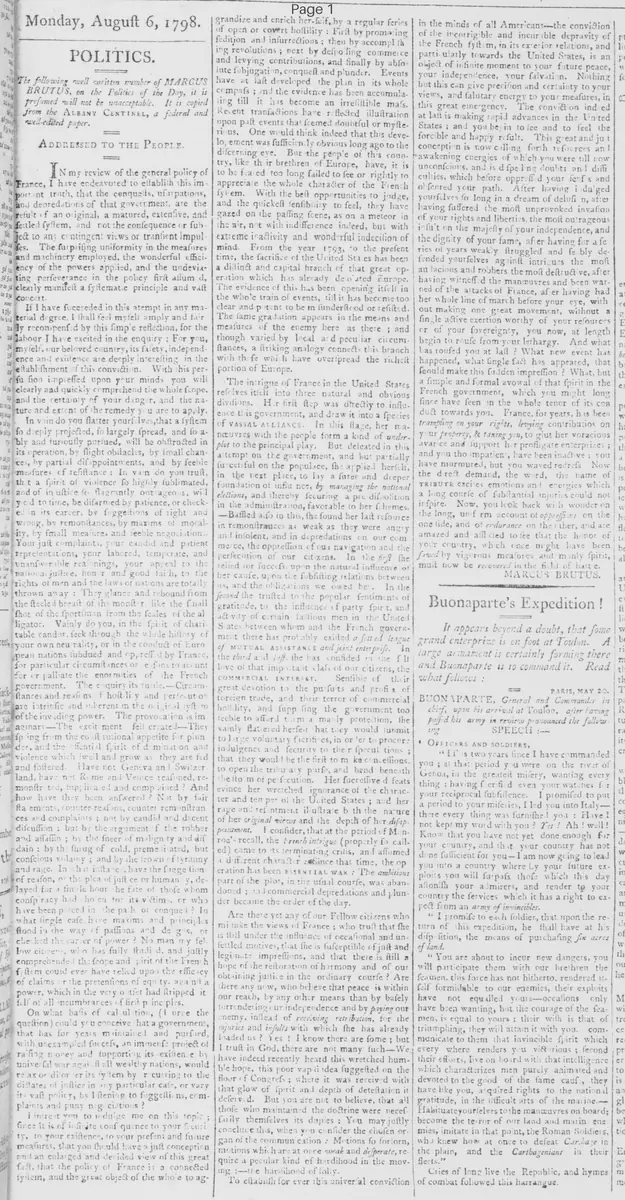
POLITICS.
The following well written number of MARCUS BRUTUS, on the Politics of the Day, it is presumed will not be unacceptable. It is copied from the ALBANY CENTINEL, a federal and well-edited paper.
Addressed to the People.
IN my review of the general policy of France, I have endeavored to establish this important truth, that the conquests, usurpations, and depredations of that government, are the result of an original, a matured, extensive, and settled system, and not the consequence of subject to any contingent views or transient impulses. The surprising uniformity in the measures and machinery employed, the wonderful efficiency of the powers applied, and the undeviating perseverance in the policy first assumed, clearly manifest a systematic principle and vast concert.
If I have succeeded in this attempt in any material degree, I shall feel myself amply and fairly recompensed by this simple reflection, for the labour I have exerted in the enquiry: For you, myself, our beloved country, its safety, independence and existence are deeply interesting in the establishment of this conviction. With this persuasion impressed upon your minds you will clearly and quickly comprehend the whole scope, and the certainty of your danger, and the nature and extent of the remedy you are to apply.
In vain do you flatter yourselves, that a system so deeply projected, so largely spread, and so ably and furiously pursued, will be obstructed in its operation, by slight obstacles, by small chance, by partial disappointments, and by feeble measures of resistance: In vain do you trust, that a spirit of violence so highly sublimated, and of injustice so flagrantly outrageous, will yield to time, be disarmed by patience, or checked in its career, by suggestions of right and wrong, by remonstrances, by maxims of morality, by small measure, and feeble negotiation.
You just complaints, your candid and patient representations, your labored, temperate, and unanswerable reasonings, your appeal to the national justice, honor and good faith, to the rights of men and the laws of nations are totally thrown away: They glance and rebound from the steeled breast of the monster like the small shot of the sportsman from the scales of the alligator. Vainly do you, in the spirit of charitable candor, seek through the whole history of your own neutrality, or in the conduct of European nations subdued and oppressed by France, for particular circumstances or reasons to account for or palliate the enormities of the French government. The enquiries are idle. Circumstances and reasons of hostility and retreat are intrinsic and inherent in the original unjust system of the invading power. The provocation is imaginary. The excitement self-created. They spring from the constitutional appetite for plunder, and the offended spirit of domination and violence which swell and grow as they are fed and fostered.
Have not Geneva and Switzerland, have not Rome and Venice reasoned, remonstrated, supplicated and complained? And how have they been answered? Not by fair statement, counter reasons, counter remonstrances and complaints; not by candid and decent discussion: but by the arguments of the robber and assassin; by the sneer of malignity and disdain: by the shrug of cold, premeditated, but conscious villainy; and by the frown of tyranny and rage. In this instance, have the suggestions of reason, or the plea of justice or humanity, delayed for a single hour the fate of those whom conspiracy had chosen for its victim, or who have been placed in the path of conquest? In what single case have maxims and principles stood in the way of passions and designs, or checked the current of power? No man, my fellow citizens, who has fully studied, and justly comprehended the scope and spirit of the French system could ever have relied upon the efficacy of claims or the pretensions of equity, against a power, which in the very outset had stripped itself of all incumbrances of first principles.
On what basis of calculation, (I urge the question) could you conceive that a government, that has for years maintained and pursued, with unexampled success, an immense project of raising money and supporting its existence by universal war against all wealthy nations, would relax or disorder its system by recurring to the dictates of justice in any particular case, or vary its vast policy, by listening to suggestions, complaints and puny negations?
I interest you to indulge me on this topic; since it is of infinite consequence to your security, to your existence, to your present and future measures, that you should have a just conception and an enlarged and decided view of this great fact, that the policy of France is a connected system, and the great object of the whole to aggrandize and enrich herself, by a regular series of open or covert hostility: First by promoting sedition and insurrections: then by accomplishing revolutions; next by destroying commerce and levying contributions, and finally by absolute subjugation, conquest and plunder. Events have at last developed the plan in its whole compass: and the evidence has been accumulating till it has become an irresistible mass.
Recent transactions have reflected illustration upon past events that seemed doubtful or mysterious. One would think indeed that this development was sufficiently obvious long ago to the discerning eye. But the people of this country, like their brethren of Europe, have, it is to be feared too long failed to see or rightly to appreciate the whole character of the French system. With the best opportunities to judge, and the quickest sensibility to feel, they have gazed on the passing scene, as on a meteor in the air, not with indifference indeed, but with extreme inactivity and wonderful indecision of mind. From the year 1793, to the present time, the sacrifice of the United States has been a distinct and capital branch of that great operation which has already desolated Europe.
The evidence of this has been opening itself in the whole train of events, till it has become too clear and patent to be misunderstood or resisted. The same gradation appears in the means and measures of the enemy here as there; and though varied by local and peculiar circumstances, a striking analogy connects this branch with those which have overspread the richest portion of Europe.
The intrigue of France in the United States resolves itself into three natural and obvious divisions. Her first step was directly to influence this government, and draw it into a species of vassal alliance. In this stage, her manoeuvres with the people form a kind of under plot to the principal play. But defeated in this attempt on the government, and but partially successful on the populace, she applied herself, in the next place, to lay a surer and deeper foundation of influence, by managing the national elections, and thereby securing a piecemeal dissolution in the administration, favorable to her schemes.
Baffled also in this, she found her last resource in remonstrances as weak as they were angry and insolent, and in depredations on our commerce, the oppression of our navigation and the persecution of our citizens. In the first she relied for success, upon the natural influence of her cause, upon the subsisting relations between us, and the obligations we owed her. In the second she trusted to the popular sentiments of gratitude, to the influence of party spirit, and activity of certain seditious men in the United States between whom and the French government there has probably existed a settled league of mutual assistance and joint enterprise. In the third and last, she has confided in the first love of that important class of our citizens, the COMMERCIAL INTEREST. Sensible of their great devotion to the pursuits and profits of foreign trade, and their terror of commercial hostility, and supposing the government too feeble to afford them a manly protection, she vainly flattered herself that they would submit to large voluntary sacrifices, in order to procure indulgence and security to their speculations; that they would be the first to make concessions, to open the tributary purse, and bend beneath the storm of persecution. Her successive defeats evince her wretched ignorance of the character and temper of the United States; and her rage and resentment illustrate both the nature of her original views and the depth of her disappointment. I consider, that at the period of Monroe's recall, the French intrigue (properly so called) came to its terminating crisis, and assumed a different character: since that time, the operation has been FUSTIAN war: The ambitious part of the plot, in the usual course, was abandoned; in commercial depredations and plunder became the order of the day.
Are there yet any of our Fellow citizens who mistake the views of France: who trust that she is still under the influence of occasional and unsettled motives, that she is susceptible of just and legitimate impressions, and that there is still a hope of the restoration of harmony and of our obtaining justice in the ordinary course? Are there any now, who believe that peace is within our reach, by any other means than by basely surrendering our independence and by paying our enemy, instead of receiving retribution, for the injuries and insults with which she has already loaded us? Yes! I know there are some; but I trust in God, there are not many such. We have indeed recently heard this wretched humble hope, this poor vapid idea suggested on the floor of Congress: where it was received with that glow of spirit and depth of detestation it deserved. But you are not to believe, that all those who maintained the doctrine were necessarily themselves its dupes: You may justly conclude this, when you consider the chosen organ of the communication: Motions so forlorn, motions which are at once weak and desperate, require a peculiar kind of hardihood in the moving; the hardihood of folly.
To establish for ever this universal conviction in the minds of all Americans--the conviction of the incorrigible and incurable depravity of the French system, in its exterior relations, and particularly towards the United States, is an object of infinite moment to your future peace, your independence, your salvation. Nothing but this can give precision and certainty to your views, and salutary energy to your measures, in this great emergency. The conviction indeed at last is making rapid advances in the United States; and you begin to see and to feel the forcible and happy result. This great and just conception is now calling forth resources and awakening energies of which you were until now unconscious, and is dispelling doubts and difficulties, which before oppressed your senses and obscured your path. After having indulged yourselves so long in a dream of delusion, after having suffered the most unprovoked invasion of your rights and liberties, the most outrageous insult on the majesty of your independence, and the dignity of your fame, after having for a series of years weakly struggled and feebly defended yourselves against intrigues the most audacious and robbers the most destructive, after having witnessed the manoeuvres and been warned of the attacks of France, after having had her whole line of march before your eye, without making one great movement, without a single active exertion worthy of your resources or of your sovereignty, you now, at length begin to rouse from your lethargy. And what has roused you at last? What new event has happened, what single fact has appeared, that should make this sudden impression? What, but a simple and formal avowal of that spirit in the French government, which you might long since have seen in the whole tenor of its conduct towards you. France, for years, has been trampling on your rights, levying contributions on your property, & taxing you, to glut her voracious avarice and support her profligate enterprises; and you though impatient, have been inactive; you have murmured, but you waived redress. Now the direct demand, the word, the name of TRIBUTE excites emotions and energies which a long course of substantial injuries could not inspire. Now, you look back with wonder on the long, uniform account of oppressions on the one side, and of endurance on the other, and are amazed and afflicted to see that the honor of your country, which once might have been saved by vigorous measures and manly spirit, must now be recovered in the field of battle.
MARCUS BRUTUS.
The following well written number of MARCUS BRUTUS, on the Politics of the Day, it is presumed will not be unacceptable. It is copied from the ALBANY CENTINEL, a federal and well-edited paper.
Addressed to the People.
IN my review of the general policy of France, I have endeavored to establish this important truth, that the conquests, usurpations, and depredations of that government, are the result of an original, a matured, extensive, and settled system, and not the consequence of subject to any contingent views or transient impulses. The surprising uniformity in the measures and machinery employed, the wonderful efficiency of the powers applied, and the undeviating perseverance in the policy first assumed, clearly manifest a systematic principle and vast concert.
If I have succeeded in this attempt in any material degree, I shall feel myself amply and fairly recompensed by this simple reflection, for the labour I have exerted in the enquiry: For you, myself, our beloved country, its safety, independence and existence are deeply interesting in the establishment of this conviction. With this persuasion impressed upon your minds you will clearly and quickly comprehend the whole scope, and the certainty of your danger, and the nature and extent of the remedy you are to apply.
In vain do you flatter yourselves, that a system so deeply projected, so largely spread, and so ably and furiously pursued, will be obstructed in its operation, by slight obstacles, by small chance, by partial disappointments, and by feeble measures of resistance: In vain do you trust, that a spirit of violence so highly sublimated, and of injustice so flagrantly outrageous, will yield to time, be disarmed by patience, or checked in its career, by suggestions of right and wrong, by remonstrances, by maxims of morality, by small measure, and feeble negotiation.
You just complaints, your candid and patient representations, your labored, temperate, and unanswerable reasonings, your appeal to the national justice, honor and good faith, to the rights of men and the laws of nations are totally thrown away: They glance and rebound from the steeled breast of the monster like the small shot of the sportsman from the scales of the alligator. Vainly do you, in the spirit of charitable candor, seek through the whole history of your own neutrality, or in the conduct of European nations subdued and oppressed by France, for particular circumstances or reasons to account for or palliate the enormities of the French government. The enquiries are idle. Circumstances and reasons of hostility and retreat are intrinsic and inherent in the original unjust system of the invading power. The provocation is imaginary. The excitement self-created. They spring from the constitutional appetite for plunder, and the offended spirit of domination and violence which swell and grow as they are fed and fostered.
Have not Geneva and Switzerland, have not Rome and Venice reasoned, remonstrated, supplicated and complained? And how have they been answered? Not by fair statement, counter reasons, counter remonstrances and complaints; not by candid and decent discussion: but by the arguments of the robber and assassin; by the sneer of malignity and disdain: by the shrug of cold, premeditated, but conscious villainy; and by the frown of tyranny and rage. In this instance, have the suggestions of reason, or the plea of justice or humanity, delayed for a single hour the fate of those whom conspiracy had chosen for its victim, or who have been placed in the path of conquest? In what single case have maxims and principles stood in the way of passions and designs, or checked the current of power? No man, my fellow citizens, who has fully studied, and justly comprehended the scope and spirit of the French system could ever have relied upon the efficacy of claims or the pretensions of equity, against a power, which in the very outset had stripped itself of all incumbrances of first principles.
On what basis of calculation, (I urge the question) could you conceive that a government, that has for years maintained and pursued, with unexampled success, an immense project of raising money and supporting its existence by universal war against all wealthy nations, would relax or disorder its system by recurring to the dictates of justice in any particular case, or vary its vast policy, by listening to suggestions, complaints and puny negations?
I interest you to indulge me on this topic; since it is of infinite consequence to your security, to your existence, to your present and future measures, that you should have a just conception and an enlarged and decided view of this great fact, that the policy of France is a connected system, and the great object of the whole to aggrandize and enrich herself, by a regular series of open or covert hostility: First by promoting sedition and insurrections: then by accomplishing revolutions; next by destroying commerce and levying contributions, and finally by absolute subjugation, conquest and plunder. Events have at last developed the plan in its whole compass: and the evidence has been accumulating till it has become an irresistible mass.
Recent transactions have reflected illustration upon past events that seemed doubtful or mysterious. One would think indeed that this development was sufficiently obvious long ago to the discerning eye. But the people of this country, like their brethren of Europe, have, it is to be feared too long failed to see or rightly to appreciate the whole character of the French system. With the best opportunities to judge, and the quickest sensibility to feel, they have gazed on the passing scene, as on a meteor in the air, not with indifference indeed, but with extreme inactivity and wonderful indecision of mind. From the year 1793, to the present time, the sacrifice of the United States has been a distinct and capital branch of that great operation which has already desolated Europe.
The evidence of this has been opening itself in the whole train of events, till it has become too clear and patent to be misunderstood or resisted. The same gradation appears in the means and measures of the enemy here as there; and though varied by local and peculiar circumstances, a striking analogy connects this branch with those which have overspread the richest portion of Europe.
The intrigue of France in the United States resolves itself into three natural and obvious divisions. Her first step was directly to influence this government, and draw it into a species of vassal alliance. In this stage, her manoeuvres with the people form a kind of under plot to the principal play. But defeated in this attempt on the government, and but partially successful on the populace, she applied herself, in the next place, to lay a surer and deeper foundation of influence, by managing the national elections, and thereby securing a piecemeal dissolution in the administration, favorable to her schemes.
Baffled also in this, she found her last resource in remonstrances as weak as they were angry and insolent, and in depredations on our commerce, the oppression of our navigation and the persecution of our citizens. In the first she relied for success, upon the natural influence of her cause, upon the subsisting relations between us, and the obligations we owed her. In the second she trusted to the popular sentiments of gratitude, to the influence of party spirit, and activity of certain seditious men in the United States between whom and the French government there has probably existed a settled league of mutual assistance and joint enterprise. In the third and last, she has confided in the first love of that important class of our citizens, the COMMERCIAL INTEREST. Sensible of their great devotion to the pursuits and profits of foreign trade, and their terror of commercial hostility, and supposing the government too feeble to afford them a manly protection, she vainly flattered herself that they would submit to large voluntary sacrifices, in order to procure indulgence and security to their speculations; that they would be the first to make concessions, to open the tributary purse, and bend beneath the storm of persecution. Her successive defeats evince her wretched ignorance of the character and temper of the United States; and her rage and resentment illustrate both the nature of her original views and the depth of her disappointment. I consider, that at the period of Monroe's recall, the French intrigue (properly so called) came to its terminating crisis, and assumed a different character: since that time, the operation has been FUSTIAN war: The ambitious part of the plot, in the usual course, was abandoned; in commercial depredations and plunder became the order of the day.
Are there yet any of our Fellow citizens who mistake the views of France: who trust that she is still under the influence of occasional and unsettled motives, that she is susceptible of just and legitimate impressions, and that there is still a hope of the restoration of harmony and of our obtaining justice in the ordinary course? Are there any now, who believe that peace is within our reach, by any other means than by basely surrendering our independence and by paying our enemy, instead of receiving retribution, for the injuries and insults with which she has already loaded us? Yes! I know there are some; but I trust in God, there are not many such. We have indeed recently heard this wretched humble hope, this poor vapid idea suggested on the floor of Congress: where it was received with that glow of spirit and depth of detestation it deserved. But you are not to believe, that all those who maintained the doctrine were necessarily themselves its dupes: You may justly conclude this, when you consider the chosen organ of the communication: Motions so forlorn, motions which are at once weak and desperate, require a peculiar kind of hardihood in the moving; the hardihood of folly.
To establish for ever this universal conviction in the minds of all Americans--the conviction of the incorrigible and incurable depravity of the French system, in its exterior relations, and particularly towards the United States, is an object of infinite moment to your future peace, your independence, your salvation. Nothing but this can give precision and certainty to your views, and salutary energy to your measures, in this great emergency. The conviction indeed at last is making rapid advances in the United States; and you begin to see and to feel the forcible and happy result. This great and just conception is now calling forth resources and awakening energies of which you were until now unconscious, and is dispelling doubts and difficulties, which before oppressed your senses and obscured your path. After having indulged yourselves so long in a dream of delusion, after having suffered the most unprovoked invasion of your rights and liberties, the most outrageous insult on the majesty of your independence, and the dignity of your fame, after having for a series of years weakly struggled and feebly defended yourselves against intrigues the most audacious and robbers the most destructive, after having witnessed the manoeuvres and been warned of the attacks of France, after having had her whole line of march before your eye, without making one great movement, without a single active exertion worthy of your resources or of your sovereignty, you now, at length begin to rouse from your lethargy. And what has roused you at last? What new event has happened, what single fact has appeared, that should make this sudden impression? What, but a simple and formal avowal of that spirit in the French government, which you might long since have seen in the whole tenor of its conduct towards you. France, for years, has been trampling on your rights, levying contributions on your property, & taxing you, to glut her voracious avarice and support her profligate enterprises; and you though impatient, have been inactive; you have murmured, but you waived redress. Now the direct demand, the word, the name of TRIBUTE excites emotions and energies which a long course of substantial injuries could not inspire. Now, you look back with wonder on the long, uniform account of oppressions on the one side, and of endurance on the other, and are amazed and afflicted to see that the honor of your country, which once might have been saved by vigorous measures and manly spirit, must now be recovered in the field of battle.
MARCUS BRUTUS.
What sub-type of article is it?
Foreign Affairs
War Or Peace
Partisan Politics
What keywords are associated?
French Policy
Systematic Aggression
Us Neutrality
Commercial Depredations
American Resistance
Tribute Demand
Monroe Recall
What entities or persons were involved?
France
French Government
United States
Marcus Brutus
Monroe
Congress
Editorial Details
Primary Topic
Systematic Aggression Of French Foreign Policy Against The United States
Stance / Tone
Strongly Anti French, Urging Resistance And Awakening To The Threat
Key Figures
France
French Government
United States
Marcus Brutus
Monroe
Congress
Key Arguments
French Policy Is A Systematic Plan Of Conquest, Usurpation, And Plunder
Diplomatic Efforts And Appeals To Justice Are Futile Against France
France's Intrigues In The Us Include Influencing Government, Elections, And Commerce
Americans Must Recognize The Incorrigible Depravity Of French System
Peace Requires Resistance, Not Surrender Or Tribute
Recent Events Like Monroe's Recall Mark Shift To Commercial Depredations
Us Has Been Inactive Too Long, Now Rousing To Defend Honor In Battle