Thank you for visiting SNEWPapers!
Sign up free
The Rhode Island Republican
Newport, Newport County, Rhode Island
What is this article about?
Report on the Hampshire County Republican Convention on February 23, 1808, in Northampton, MA, where 165 delegates adopted an address defending U.S. policies against British and French maritime aggressions, praising the Embargo Act, and denouncing Federalist opposition as treasonous threats to the Union.
Clipping
OCR Quality
Full Text
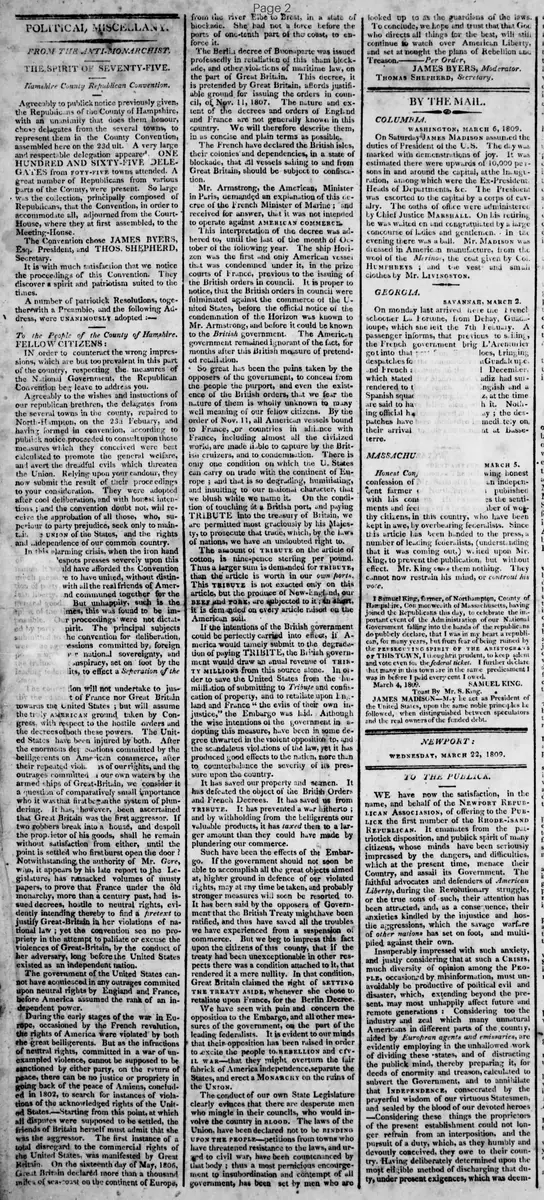
FROM THE ANTI-MONARCHIST
THE SPIRIT OF SEVENTY-FIVE.
Hampshire County Republican Convention.
Agreeably to publick notice previously given, the Republicans of the County of Hampshire, with an unanimity that does them honour, chose delegates from the several towns, to represent them in the County Convention, assembled here on the 23d ult. A very large and respectable delegation appeared. ONE HUNDRED AND SIXTY-FIVE DELEGATES from FORTY-FIVE towns attended. A great number of Republicans from various parts of the County, were present. So large was the collection, principally composed of Republicans, that the Convention, in order to accommodate all, adjourned from the Court-House, where they at first assembled, to the Meeting-House.
The Convention chose JAMES BYERS, Esq. President, and THOS. SHEPHERD, Secretary.
It is with much satisfaction that we notice the proceedings of this Convention. They discover a spirit and patriotism suited to the times.
A number of patriotick Resolutions, together with a Preamble, and the following Address, were UNANIMOUSLY adopted:--
To the People of the County of Hampshire.
FELLOW CITIZENS:
IN order to counteract the wrong impressions, which are but too prevalent in this part of the country, respecting the measures of the National Government, the Republican Convention beg leave to address you.
Agreeably to the wishes and instructions of our republican brethren, the delegates from the several towns in the county, repaired to North-Hampton, on the 23d February, and having formed in convention, according to publick notice, proceeded to consult upon those measures which they conceived were best calculated to promote the general welfare, and avert the dreadful evils which threaten the Union. Relying upon your candour, they now submit the result of their proceedings to your consideration. They were adopted after cool deliberation, and with honest intentions: and the convention doubt not, will receive the approbation of all those, who, superior to party prejudice, seek only to maintain union of the States, and the rights and independence of our common country.
In this alarming crisis, when the iron hand of despotism presses severely upon this land, it would have afforded the Convention much pleasure to have united, without distinction of party, with all the real friends of American liberty, and communed together on the federal good. But unhappily, such is the spirit of the times, this was found to be impossible.
Our proceedings were not dictated by party spirit. The principal subjects submitted to the convention for deliberation, were the aggressions committed by foreign powers upon our national sovereignty, and the treasonable conspiracy, set on foot by the leading federalists, to effect a Separation of the Union.
The convention will not undertake to justify the conduct of France nor Great Britain towards the United States; but will assume the truly American ground taken by Congress, with respect to the hostile orders and the decrees of both these powers. The United States have been injured by both. After the enormous depredations committed by the belligerents on American commerce, after their repeated violations of our rights, and the outrages committed in our own waters by the armed ships of Great-Britain, we consider it a question of comparatively small importance who it was that first began the system of plundering. It has, however, been ascertained that Great Britain was the first aggressor. If two robbers break into a house, and despoil the proprietor of his goods, shall he remain without satisfaction from either, until the point is settled who first burst open the door?
Notwithstanding the authority of Mr. Gore, who, it appears by his late report to the Legislature, has ransacked volumes of musty papers, to prove that France under the old monarchy, more than a century past, had issued decrees, hostile to neutral rights, evidently intending thereby to find a pretext to justify Great-Britain in her violations of national law; yet the convention see no propriety in the attempt to palliate or excuse the violences of Great-Britain, by the conduct of her adversary, long before the United States existed as an independent nation.
The government of the United States cannot have acquiesced in any outrages committed upon neutral rights by England and France, before America assumed the rank of an independent power.
During the early stages of the war in Europe, occasioned by the French revolution, the rights of America were violated by both the great belligerents. But as the infractions of neutral rights, committed in a war of unexampled violence, cannot be supposed to be sanctioned by either party, on the return of peace, there can be no justice or propriety in going back of the peace of Amiens, concluded in 1802, to search for instances of violations of the acknowledged rights of the United States.--Starting from this point, at which all disputes were supposed to be settled, the friends of Britain herself must admit that she was the aggressor. The first instance of a total disregard to the commercial rights of the United States, was manifested by Great Britain. On the sixteenth day of May, 1806, Great Britain declared more than a thousand miles of sea coast on the continent of Europe,
from the river Elbe to Brest, in a state of blockade. She had not a force before the ports of one-tenth part of the coast, to enforce it.
The Berlin decree of Buonaparte was issued professedly in retaliation of this sham blockade, and other violations of maritime law, on the part of Great Britain. This decree, it is pretended by Great Britain, affords justifiable ground for issuing the orders in council, of Nov. 11, 1807. The nature and extent of the decrees and orders of England and France are not generally known in this country. We will therefore describe them, in as concise and plain terms as possible.
The French have declared the British isles, their colonies and dependencies, in a state of blockade, that all vessels sailing to and from Great Britain, should be subject to confiscation.
Mr. Armstrong, the American Minister in Paris, demanded an explanation of this decree of the French Minister of Marine; and received for answer, that it was not intended to operate against AMERICAN COMMERCE.
This interpretation of the decree was adhered to, until the last of the month of October of the following year. The ship Horizon was the first and only American vessel that was condemned under it, in the prize courts of France, previous to the issuing of the British orders in council. It is proper to notice, that the British orders in council were fulminated against the commerce of the United States, before the official notice of the condemnation of the Horizon was known to Mr. Armstrong, and before it could be known to the British government. The American government remained ignorant of the fact, for months after this British measure of pretended retaliation.
So great has been the pains taken by the opposers of the government, to conceal from the people the purport, and even the existence of the British orders, that we fear the nature of them is wholly unknown to many well meaning of our fellow citizens. By the order of Nov. 11, all American vessels bound to France, or countries in alliance with France, including almost all the civilized world, are made liable to capture by the British cruizers, and to condemnation. There is only one condition on which the U. States can carry on trade with the continent of Europe; and that is so degrading, humiliating, and insulting to our national character, that we blush while we name it. On the condition of touching at a British port, and paying TRIBUTE into the treasury of Britain, we are permitted most graciously by his Majesty, to prosecute that trade, which, by the laws of nations, we have an undoubted right to.
The amount of TRIBUTE on the article of cotton, is nine-pence sterling per pound. Thus a larger sum is demanded for TRIBUTE, than the article is worth in our own ports. This TRIBUTE is not exacted only on this article, but the produce of New-England, our BEEF and PORK, are subjected to it; in short, it is demanded on every article raised on the American soil.
If the intentions of the British government could be perfectly carried into effect, if America would tamely submit to the degradation of paying TRIBUTE, the British government would draw an annual revenue of THIRTY MILLIONS from this source alone. In order to save the United States from the humiliation of submitting to Tribute and confiscation of property, and to retaliate upon England and France the evils of their own injustice, the Embargo was laid. Although the wise intentions of the government in adopting this measure, have been in some degree thwarted in the violent opposition to, and the scandalous violations of the law, yet it has produced good effects to the nation, more than to counterbalance the severity of its pressure upon the country.
It has Saved our property and seamen. It has defeated the object of the British Orders and French Decrees. It has saved us from TRIBUTE. It has prevented a War hitherto; and by withholding from the belligerents our valuable products, it has taxed them to a larger amount than they could have made by plundering our commerce.
Such have been the effects of the Embargo. If the government should not soon be able to accomplish all the great objects aimed at, higher ground in defence of our violated rights, may at any time be taken, and probably stronger measures will soon be resorted to.
It has been said by the opposers of Government that the British Treaty might have been ratified, and thus have saved all the troubles we have experienced from a suspension of commerce. But we beg to impress this fact upon the citizens of this county, that if the treaty had been unexceptionable in other respects there was a condition attached to it, that rendered it a mere nullity. In that condition, Great Britain claimed the right of SETTING THE TREATY ASIDE, whenever she chose to retaliate upon France, for the Berlin Decree.
We have seen with pain and concern the opposition to the Embargo, and all other measures of the government, on the part of the leading federalists. It is evident to our minds that their opposition has been raised in order to excite the people to REBELLION and CIVIL WAR that they might overturn the fair fabrick of American independence, separate the States, and erect a Monarchy on the ruins of the UNION.
The conduct of our own State Legislature clearly evinces that there are desperate men who mingle in their councils, who would involve the country in Blood. The laws of the Union, have been declared not to be BINDING UPON THE PEOPLE--Petitions from towns who have threatened resistance to the laws, and urged to civil war, have been countenanced by that body; thus a most pernicious encouragement to insubordination and contempt of all government, has been set by men who are
looked up to as the guardians of the laws.
To conclude, we hope and trust that that God who directs all things for the best, will still continue to watch over American Liberty, and set at nought the plans of Rebellion and Treason.
-Per Order,
JAMES BYERS, Moderator.
THOMAS SHEPHERD, Secretary.
What sub-type of article is it?
What themes does it cover?
What keywords are associated?
What entities or persons were involved?
Where did it happen?
Story Details
Key Persons
Location
County Of Hampshire, North Hampton
Event Date
23d February
Story Details
The Republicans of Hampshire County held a convention on February 23, adopting resolutions and an address countering misconceptions about national government measures, defending U.S. policies against British and French aggressions, supporting the Embargo Act for protecting commerce and seamen, and accusing leading Federalists of treasonous efforts to separate the Union and incite rebellion.