Thank you for visiting SNEWPapers!
Sign up free
Editorial
February 20, 1815
Portland Gazette, And Maine Advertiser
Portland, Cumberland County, Maine
What is this article about?
Editorial rejoices at the 1815 peace ending the war with Britain, contrasts it with war's declaration, criticizes its Napoleonic origins, lack of gains, economic ruin, human costs, and blames Madison's administration, urging a change in rulers for lasting peace.
Clipping
OCR Quality
95%
Excellent
Full Text
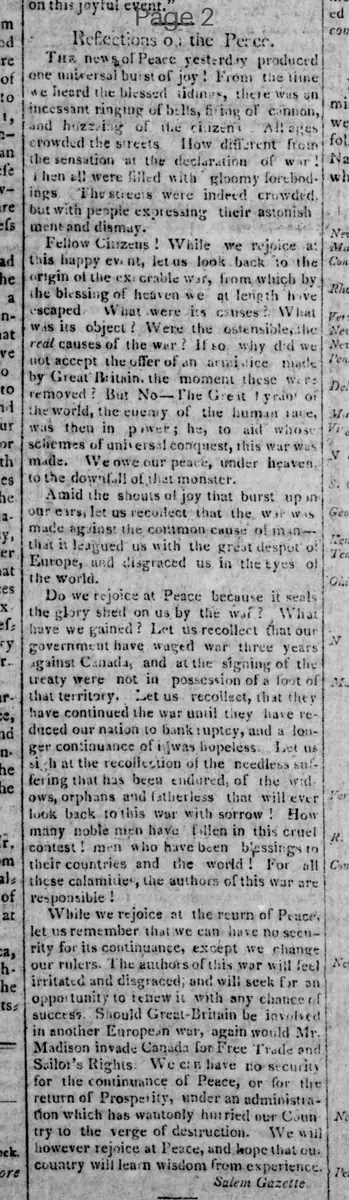
Reflections on the Peace.
The news of Peace yesterday produced one universal burst of joy: From the time we heard the blessed tidings, there was an incessant ringing of bells, firing of cannon, and huzzaing of the citizens All ages crowded the streets—how different from the sensation at the declaration of war! then all were filled with gloomy forebodings. The streets were indeed crowded, but with people expressing their astonishment and dismay.
Fellow Citizens! While we rejoice at this happy event, let us look back to the origin of the execrable war, from which by the blessing of heaven we at length have escaped. What were its causes? What was its object? Were the ostensible, the real causes of the war? If so why did we not accept the offer of an armistice made by Great Britain, the moment these were removed? But No—The Great Tyrant of the world, the enemy of the human race, was then in power; his, to aid whose schemes of universal conquest, this war was made. We owe our peace, under heaven, to the downfall of that monster.
Amid the shouts of joy that burst upon our ears, let us recollect that the war was made against the common cause of man—that it leagued us with the great despot of Europe, and disgraced us in the eyes of the world.
Do we rejoice at Peace because it seals the glory shed on us by the war? What have we gained? Let us recollect that our government have waged war three years against Canada, and at the signing of the treaty were not in possession of a foot of that territory. Let us recollect, that they have continued the war until they have reduced our nation to bankruptcy, and a longer continuance of it was hopeless. Let us sigh at the recollection of the needless suffering that has been endured, of the widows, orphans and fatherless that will ever look back to this war with sorrow! How many noble men have fallen in this cruel contest! men who have been blessings to their countries and the world! For all these calamities, the authors of this war are responsible!
While we rejoice at the return of Peace, let us remember that we can have no security for its continuance, except we change our rulers. The authors of this war will feel irritated and disgraced; and will seek for an opportunity to renew it with any chance of success. Should Great-Britain be involved in another European war, again would Mr. Madison invade Canada or Free Trade and Sailor's Rights. We can have no security for the continuance of Peace, or for the return of Prosperity, under an administration which has wantonly hurled our Country to the verge of destruction. We will however rejoice at Peace, and hope that our country will learn wisdom from experience.
The news of Peace yesterday produced one universal burst of joy: From the time we heard the blessed tidings, there was an incessant ringing of bells, firing of cannon, and huzzaing of the citizens All ages crowded the streets—how different from the sensation at the declaration of war! then all were filled with gloomy forebodings. The streets were indeed crowded, but with people expressing their astonishment and dismay.
Fellow Citizens! While we rejoice at this happy event, let us look back to the origin of the execrable war, from which by the blessing of heaven we at length have escaped. What were its causes? What was its object? Were the ostensible, the real causes of the war? If so why did we not accept the offer of an armistice made by Great Britain, the moment these were removed? But No—The Great Tyrant of the world, the enemy of the human race, was then in power; his, to aid whose schemes of universal conquest, this war was made. We owe our peace, under heaven, to the downfall of that monster.
Amid the shouts of joy that burst upon our ears, let us recollect that the war was made against the common cause of man—that it leagued us with the great despot of Europe, and disgraced us in the eyes of the world.
Do we rejoice at Peace because it seals the glory shed on us by the war? What have we gained? Let us recollect that our government have waged war three years against Canada, and at the signing of the treaty were not in possession of a foot of that territory. Let us recollect, that they have continued the war until they have reduced our nation to bankruptcy, and a longer continuance of it was hopeless. Let us sigh at the recollection of the needless suffering that has been endured, of the widows, orphans and fatherless that will ever look back to this war with sorrow! How many noble men have fallen in this cruel contest! men who have been blessings to their countries and the world! For all these calamities, the authors of this war are responsible!
While we rejoice at the return of Peace, let us remember that we can have no security for its continuance, except we change our rulers. The authors of this war will feel irritated and disgraced; and will seek for an opportunity to renew it with any chance of success. Should Great-Britain be involved in another European war, again would Mr. Madison invade Canada or Free Trade and Sailor's Rights. We can have no security for the continuance of Peace, or for the return of Prosperity, under an administration which has wantonly hurled our Country to the verge of destruction. We will however rejoice at Peace, and hope that our country will learn wisdom from experience.
What sub-type of article is it?
War Or Peace
Partisan Politics
What keywords are associated?
Peace Treaty
War Causes
Madison Administration
Canada Invasion
Napoleon Influence
National Bankruptcy
Political Change
What entities or persons were involved?
Mr. Madison
Great Britain
Canada
Editorial Details
Primary Topic
Reflections On The End Of The War And Criticism Of Its Causes
Stance / Tone
Rejoicing At Peace But Strongly Critical Of The War And Administration
Key Figures
Mr. Madison
Great Britain
Canada
Key Arguments
The War Originated From Schemes Of Universal Conquest By The Great Tyrant (Napoleon)
The War Leagued The Nation With The Despot Of Europe
No Territorial Gains From The War Against Canada
The War Reduced The Nation To Bankruptcy
Needless Suffering, Widows, Orphans, And Fallen Noble Men
Authors Of The War Are Responsible For Calamities
Security For Peace Requires Changing Rulers To Prevent Renewal