Thank you for visiting SNEWPapers!
Sign up free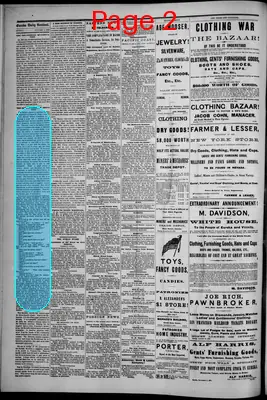
Story
January 4, 1880
Eureka Daily Sentinel
Eureka, Eureka County, Nevada
What is this article about?
James H. Slade describes the Quincy system of education, which emphasizes quickening children's senses through play, interactive exercises with toys and pictures, and stimulating perceptions to build familiarity and knowledge in a engaging manner.
Clipping

OCR Quality
98%
Excellent
Full Text
THE QUINCY SYSTEM OF EDUCATION.
The Quincy system of teaching children, as explained by James H. Slade, a member of the Quincy School Committee, is attracting a great deal of attention in the East, and more recently has been published at length in several papers in California. The first work in the Quincy schoolroom is to quicken the senses, to stimulate the perceptions, or in other words, to enlarge the ability to receive information. This is done in various ways; for instance, a hundred marbles, all sizes and variously colored and striped, are shown the children, one is selected and given to a child; he is allowed to play with it for a time, and then it is put with the others, the whole lot is put in a box, and the child asked to find the one he had. If the home training of the child has been such that his sense of sight is alert, his little fist will go into the box, and he quickly brushes aside the ninety-nine and finds his own, and no other will satisfy him. If he has had no training he reaches for the marble nearest at hand, and is just as well contented. When a pupil enters a Quincy school, says the writer, we first undertake to make him feel at home, to overcome his natural shyness and timidity, and let him get acquainted with his schoolmates. The obvious way to do this is to let him play with them. Put two children who have never seen each other before into a room and they stand in opposite corners and eye each other curiously. But, left to themselves, in fifteen minutes they become old and intimate acquaintances. Then follow a description of the school room and the further plan of instruction:
Our school rooms are equipped with toys, blocks and tables, arranged to afford facility for play, and the child very speedily becomes accustomed to the new surroundings, gets acquainted with teacher and schoolmates, and loses its diffidence. The next step is to begin the training of his senses. This is done at the outset by stimulating him to use them in connection with objects with which he is already familiar. The teacher, for instance, takes a picture, calls the class about her, and the exercise proceeds somewhat in this fashion:
"Now look at this picture and tell me what you see."
"A little girl;" "a kitten;" "a tree"
"some grass," answer the little ones.
"What is the little girl doing?"
"Holding the kitten in her arms."
"Have you a kitten?"
"I have."
"How many eyes has it?"
"Two."
"How many legs?"
"Four."
"How many hands have you got?"
"Two."
"Hold up one;" "hold up two."
"Which is your right hand?"
"All hold up your right hands."
"Now your left."
"What does the kitten drink?"
"Milk."
"Do you like milk?" "Why?"
"Because it's sweet," replies one.
"How do you know?"
"I taste it."
"Tell me something that isn't sweet."
"Lemon,"
"What do you call that?"
"Sour."
"What is the kitten covered with?"
"Fur."
"What is fur?" "What other animals have fur?"
"Rabbits has fur."
"Rabbits have fur," says the teacher.
"All say 'rabbits have fur.'"
This exercise is continued until each one of the elements of the picture is talked about, the teacher calling into play the knowledge, imagination and perception of the child, making suggestions as rarely as possible, and those in the form of questions, vigilantly watching to detect and correct errors; allowing the answers to be made now in concert, then individually, giving the greatest attention to the duller pupils, and by the frequent interpolation of anecdote and illustration, holding the interest of the child as in a game of hide-and-seek. An infinite variety of changes may be rung upon an ordinary picture, and with a skillful and fertile teacher an exercise like this becomes, unconsciously to the child, a lesson in number, in expression, in perception, in language and in natural history.
The Quincy system of teaching children, as explained by James H. Slade, a member of the Quincy School Committee, is attracting a great deal of attention in the East, and more recently has been published at length in several papers in California. The first work in the Quincy schoolroom is to quicken the senses, to stimulate the perceptions, or in other words, to enlarge the ability to receive information. This is done in various ways; for instance, a hundred marbles, all sizes and variously colored and striped, are shown the children, one is selected and given to a child; he is allowed to play with it for a time, and then it is put with the others, the whole lot is put in a box, and the child asked to find the one he had. If the home training of the child has been such that his sense of sight is alert, his little fist will go into the box, and he quickly brushes aside the ninety-nine and finds his own, and no other will satisfy him. If he has had no training he reaches for the marble nearest at hand, and is just as well contented. When a pupil enters a Quincy school, says the writer, we first undertake to make him feel at home, to overcome his natural shyness and timidity, and let him get acquainted with his schoolmates. The obvious way to do this is to let him play with them. Put two children who have never seen each other before into a room and they stand in opposite corners and eye each other curiously. But, left to themselves, in fifteen minutes they become old and intimate acquaintances. Then follow a description of the school room and the further plan of instruction:
Our school rooms are equipped with toys, blocks and tables, arranged to afford facility for play, and the child very speedily becomes accustomed to the new surroundings, gets acquainted with teacher and schoolmates, and loses its diffidence. The next step is to begin the training of his senses. This is done at the outset by stimulating him to use them in connection with objects with which he is already familiar. The teacher, for instance, takes a picture, calls the class about her, and the exercise proceeds somewhat in this fashion:
"Now look at this picture and tell me what you see."
"A little girl;" "a kitten;" "a tree"
"some grass," answer the little ones.
"What is the little girl doing?"
"Holding the kitten in her arms."
"Have you a kitten?"
"I have."
"How many eyes has it?"
"Two."
"How many legs?"
"Four."
"How many hands have you got?"
"Two."
"Hold up one;" "hold up two."
"Which is your right hand?"
"All hold up your right hands."
"Now your left."
"What does the kitten drink?"
"Milk."
"Do you like milk?" "Why?"
"Because it's sweet," replies one.
"How do you know?"
"I taste it."
"Tell me something that isn't sweet."
"Lemon,"
"What do you call that?"
"Sour."
"What is the kitten covered with?"
"Fur."
"What is fur?" "What other animals have fur?"
"Rabbits has fur."
"Rabbits have fur," says the teacher.
"All say 'rabbits have fur.'"
This exercise is continued until each one of the elements of the picture is talked about, the teacher calling into play the knowledge, imagination and perception of the child, making suggestions as rarely as possible, and those in the form of questions, vigilantly watching to detect and correct errors; allowing the answers to be made now in concert, then individually, giving the greatest attention to the duller pupils, and by the frequent interpolation of anecdote and illustration, holding the interest of the child as in a game of hide-and-seek. An infinite variety of changes may be rung upon an ordinary picture, and with a skillful and fertile teacher an exercise like this becomes, unconsciously to the child, a lesson in number, in expression, in perception, in language and in natural history.
What sub-type of article is it?
Curiosity
What keywords are associated?
Quincy System
Education
Children
Senses
Perception
Teaching Method
Schoolroom
Interactive Exercise
What entities or persons were involved?
James H. Slade
Where did it happen?
Quincy
Story Details
Key Persons
James H. Slade
Location
Quincy
Story Details
The Quincy system quickens children's senses through play with marbles and toys to build familiarity, then uses interactive questioning on familiar objects like pictures to stimulate perception, language, and knowledge without direct instruction.