Thank you for visiting SNEWPapers!
Sign up free
Editorial
March 20, 1767
The New Hampshire Gazette And Historical Chronicle
Portsmouth, Greenland, Rockingham County, New Hampshire
What is this article about?
An 18th-century editorial poem and essay addressed to New-England farmers critiques the proliferation of unqualified justices of the peace, warning that such appointments degrade the office, invite ridicule, and hinder effective law execution, drawing on English history and observations from New-York.
Clipping
OCR Quality
95%
Excellent
Full Text
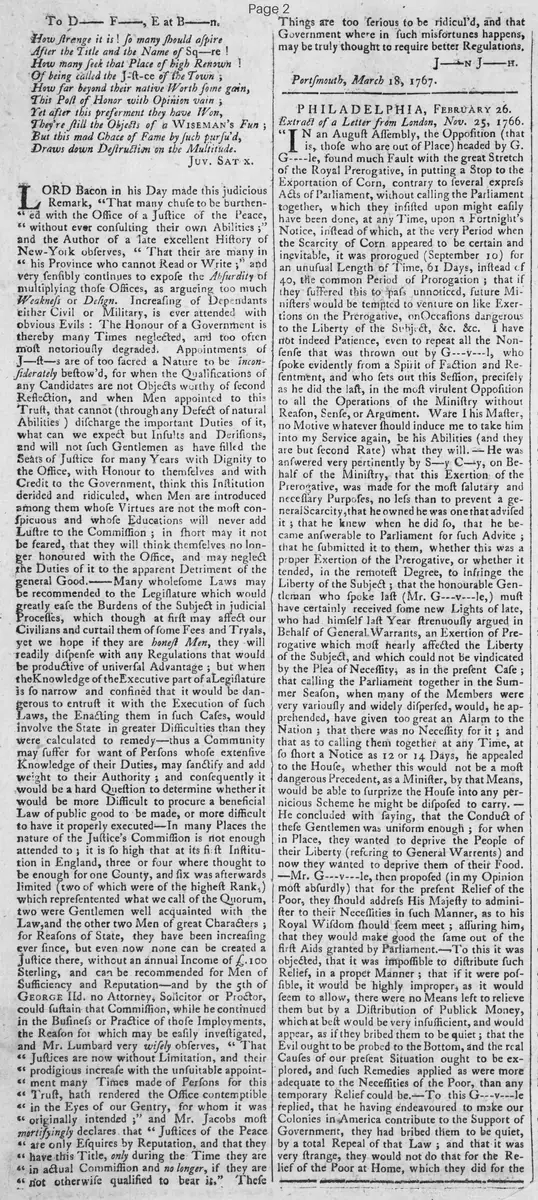
To the Farmers of New-England
How strange it is! so many should aspire
After the Title and the Name of Squire!
How many seek that Place of high Renown!
Of being called the Justice of the Town:
How far beyond their native Worth some gain,
This Post of Honor with Opinion vain;
Yet after this preferment they have Won,
They're still the Objects of a Wise Man's Fun;
But this mad Chace of Fame by such pursu'd,
Draws down Destruction on the Multitude.
Juv. Sat x.
LORD Bacon in his Day made this judicious
Remark, "That many chuse to be burthened
with the Office of a Justice of the Peace,
without ever consulting their own Abilities;"
and the Author of a late excellent History of
New-York observes, "That there are many in
his Province who cannot Read or Write;" and
very sensibly continues to expose the Absurdity of
multiplying those Offices, as arguing too much
Weaknes or Design. Increasing of Dependants
either Civil or Military, is ever attended with
obvious Evils: The Honour of a Government is
thereby many Times neglected, and too often
most notoriously degraded. Appointments of
J-t-s are of too sacred a Nature to be inconsiderately
bestow'd, for when the Qualifications of
any Candidates are not Objects worthy of second
Reflection, and when Men appointed to this
Trust, that cannot (through any Defect of natural
Abilities) discharge the important Duties of it,
what can we expect but Insults and Derisions,
and will not such Gentlemen as have filled the
Seats of Justice for many Years with Dignity to
the Office, with Honour to themselves and with
Credit to the Government, think this Institution
derided and ridiculed, when Men are introduced
among them whose Virtues are not the most conspicuous
and whose Educations will never add
Lustre to the Commission: in short may it not
be feared, that they will think themselves no longer
honoured with the Office, and may neglect
the Duties of it to the apparent Detriment of the
general Good.---Many wholesome Laws may
be recommended to the Legislature which would
greatly ease the Burdens of the Subject in judicial
Procees, which though at first may affect our
Civilians and curtail them of some Fees and Tryals,
yet we hope if they are honest Men, they will
readily dispense with any Regulations that would
be productive of universal Advantage; but when
the Knowledge of the Executive part of a Legislature
is so narrow and confined that it would be dangerous
to entrust it with the Execution of such
Laws, the Enacting them in such Cases, would
involve the State in greater Difficulties than they
were calculated to remedy--thus a Community
may suffer for want of Persons whose extensive
Knowledge of their Duties, may sanctify and add
weight to their Authority; and consequently it
would be a hard Question to determine whether it
would be more Difficult to procure a beneficial
Law of public good to be made, or more difficult
to have it properly executed--In many Places the
nature of the Justice's Commission is not enough
attended to; it is so high that at its first Institution
in England, three or four were thought to
be enough for one County, and six was afterwards
limited (two of which were of the highest Rank.)
which represented what we call of the Quorum,
two were Gentlemen well acquainted with the
Law, and the other two Men of great Characters:
for Reasons of State, they have been increasing
ever since, but even now none can be created a
Justice there, without an annual Income of £.100
Sterling, and can be recommended for Men of
Sufficiency and Reputation and by the 5th of
George II. no Attorney, Solicitor or Proctor,
could sustain that Commission, while he continued
in the Business or Practice of those Imployments,
the Reason for which may be easily investigated,
and Mr. Lumbard very wisely observes, "That
Justices are now without Limitation, and their
prodigious increase with the unsuitable appointment
many Times made of Persons for this
Trust, hath rendered the Office contemptible
in the Eyes of our Gentry, for whom it was
originally intended;" and Mr. Jacobs most
mortifyingly declares. that "Justices of the Peace
are only Esquires by Reputation, and that they
have this Title, only during the Time they are
in actual Commission and no longer, if they are
not otherwise qualified to bear it." These
How strange it is! so many should aspire
After the Title and the Name of Squire!
How many seek that Place of high Renown!
Of being called the Justice of the Town:
How far beyond their native Worth some gain,
This Post of Honor with Opinion vain;
Yet after this preferment they have Won,
They're still the Objects of a Wise Man's Fun;
But this mad Chace of Fame by such pursu'd,
Draws down Destruction on the Multitude.
Juv. Sat x.
LORD Bacon in his Day made this judicious
Remark, "That many chuse to be burthened
with the Office of a Justice of the Peace,
without ever consulting their own Abilities;"
and the Author of a late excellent History of
New-York observes, "That there are many in
his Province who cannot Read or Write;" and
very sensibly continues to expose the Absurdity of
multiplying those Offices, as arguing too much
Weaknes or Design. Increasing of Dependants
either Civil or Military, is ever attended with
obvious Evils: The Honour of a Government is
thereby many Times neglected, and too often
most notoriously degraded. Appointments of
J-t-s are of too sacred a Nature to be inconsiderately
bestow'd, for when the Qualifications of
any Candidates are not Objects worthy of second
Reflection, and when Men appointed to this
Trust, that cannot (through any Defect of natural
Abilities) discharge the important Duties of it,
what can we expect but Insults and Derisions,
and will not such Gentlemen as have filled the
Seats of Justice for many Years with Dignity to
the Office, with Honour to themselves and with
Credit to the Government, think this Institution
derided and ridiculed, when Men are introduced
among them whose Virtues are not the most conspicuous
and whose Educations will never add
Lustre to the Commission: in short may it not
be feared, that they will think themselves no longer
honoured with the Office, and may neglect
the Duties of it to the apparent Detriment of the
general Good.---Many wholesome Laws may
be recommended to the Legislature which would
greatly ease the Burdens of the Subject in judicial
Procees, which though at first may affect our
Civilians and curtail them of some Fees and Tryals,
yet we hope if they are honest Men, they will
readily dispense with any Regulations that would
be productive of universal Advantage; but when
the Knowledge of the Executive part of a Legislature
is so narrow and confined that it would be dangerous
to entrust it with the Execution of such
Laws, the Enacting them in such Cases, would
involve the State in greater Difficulties than they
were calculated to remedy--thus a Community
may suffer for want of Persons whose extensive
Knowledge of their Duties, may sanctify and add
weight to their Authority; and consequently it
would be a hard Question to determine whether it
would be more Difficult to procure a beneficial
Law of public good to be made, or more difficult
to have it properly executed--In many Places the
nature of the Justice's Commission is not enough
attended to; it is so high that at its first Institution
in England, three or four were thought to
be enough for one County, and six was afterwards
limited (two of which were of the highest Rank.)
which represented what we call of the Quorum,
two were Gentlemen well acquainted with the
Law, and the other two Men of great Characters:
for Reasons of State, they have been increasing
ever since, but even now none can be created a
Justice there, without an annual Income of £.100
Sterling, and can be recommended for Men of
Sufficiency and Reputation and by the 5th of
George II. no Attorney, Solicitor or Proctor,
could sustain that Commission, while he continued
in the Business or Practice of those Imployments,
the Reason for which may be easily investigated,
and Mr. Lumbard very wisely observes, "That
Justices are now without Limitation, and their
prodigious increase with the unsuitable appointment
many Times made of Persons for this
Trust, hath rendered the Office contemptible
in the Eyes of our Gentry, for whom it was
originally intended;" and Mr. Jacobs most
mortifyingly declares. that "Justices of the Peace
are only Esquires by Reputation, and that they
have this Title, only during the Time they are
in actual Commission and no longer, if they are
not otherwise qualified to bear it." These
What sub-type of article is it?
Legal Reform
What keywords are associated?
Justices Of The Peace
Judicial Appointments
Qualifications
Office Degradation
New England Farmers
English History
Legislative Reform
What entities or persons were involved?
Lord Bacon
Author Of A Late Excellent History Of New York
Mr. Lumbard
Mr. Jacobs
Justices Of The Peace
Legislature
Editorial Details
Primary Topic
Critique Of Unqualified Appointments To Justices Of The Peace
Stance / Tone
Critical And Cautionary
Key Figures
Lord Bacon
Author Of A Late Excellent History Of New York
Mr. Lumbard
Mr. Jacobs
Justices Of The Peace
Legislature
Key Arguments
Many Aspire To The Office Of Justice Without Sufficient Abilities, Leading To Ridicule And Degradation Of The Institution.
Multiplying Such Offices Argues Weakness Or Design And Brings Obvious Evils To Government Honor.
Unqualified Justices Cannot Properly Execute Laws, Causing Detriment To The General Good.
Historical English Practices Limited The Number And Required Qualifications Like Income And Reputation.
Proliferation Has Rendered The Office Contemptible, Originally Intended For Gentry.