Thank you for visiting SNEWPapers!
Sign up free
Daily National Intelligencer
Washington, District Of Columbia
What is this article about?
Editorial commentary on Gen. Harrison's departure from Pittsburgh to Detroit amid fears of renewed Indian hostility. Critiques U.S. policy of amnesty toward conquered tribes influenced by British, urges using them against the enemy, and condemns British barbarities like the burning of Buffalo.
Clipping
OCR Quality
Full Text
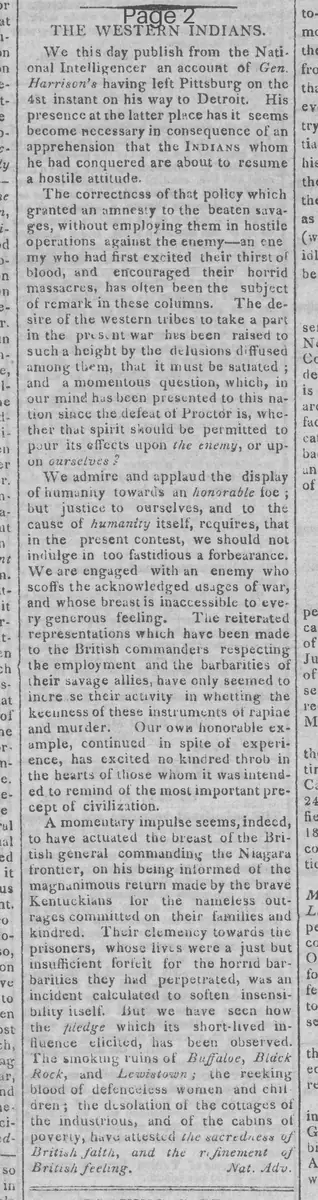
We this day publish from the National Intelligencer an account of Gen. Harrison's having left Pittsburgh on the 4th instant on his way to Detroit. His presence at the latter place has it seems become necessary in consequence of an apprehension that the Indians whom he had conquered are about to resume a hostile attitude.
The correctness of that policy which granted an amnesty to the beaten savages, without employing them in hostile operations against the enemy—an enemy who had first excited their thirst of blood, and encouraged their horrid massacres, has often been the subject of remark in these columns. The desire of the western tribes to take a part in the present war has been raised to such a height by the delusions diffused among them, that it must be satiated; and a momentous question, which, in our mind has been presented to this nation since the defeat of Proctor is, whether that spirit should be permitted to pour its effects upon the enemy, or upon ourselves?
We admire and applaud the display of humanity towards an honorable foe; but justice to ourselves, and to the cause of humanity itself, requires, that in the present contest, we should not indulge in too fastidious a forbearance. We are engaged with an enemy who scoffs the acknowledged usages of war, and whose breast is inaccessible to every generous feeling. The reiterated representations which have been made to the British commanders respecting the employment and the barbarities of their savage allies, have only seemed to increase their activity in whetting the keenness of these instruments of rapine and murder. Our own honorable example, continued in spite of experience, has excited no kindred throb in the hearts of those whom it was intended to remind of the most important precept of civilization.
A momentary impulse seems, indeed, to have actuated the breast of the British general commanding the Niagara frontier, on his being informed of the magnanimous return made by the brave Kentuckians for the nameless outrages committed on their families and kindred. Their clemency towards the prisoners, whose lives were a just but insufficient forfeit for the horrid barbarities they had perpetrated, was an incident calculated to soften insensibility itself. But we have seen how the pledge which its short-lived influence elicited, has been observed. The smoking ruins of Buffalo, Black Rock, and Lewistown; the reeking blood of defenceless women and children: the desolation of the cottages of the industrious, and of the cabins of poverty, have attested the sacredness of British faith, and the refinement of British feeling.
Nat. Ado.
What sub-type of article is it?
What themes does it cover?
What keywords are associated?
What entities or persons were involved?
Where did it happen?
Story Details
Key Persons
Location
Pittsburgh, Detroit, Niagara Frontier, Buffalo, Black Rock, Lewistown
Event Date
4th Instant
Story Details
Gen. Harrison departs Pittsburgh for Detroit due to fears of Indian resurgence. Editorial questions U.S. amnesty policy toward British-influenced tribes, advocates employing them against the enemy, praises Kentuckian clemency, and denounces British violations like the destruction of Buffalo.