Thank you for visiting SNEWPapers!
Sign up free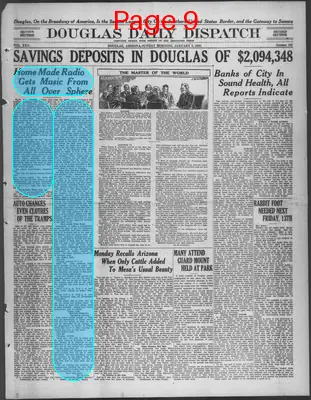
Story
January 8, 1928
Douglas Daily Dispatch
Douglas, Cochise County, Arizona
What is this article about?
In 1927, Gilbert Hale of Douglas, Arizona, builds a inexpensive three-tube radio set with a tall aerial, successfully receiving broadcasts from across North America and distant locations like Japan and Australia, earning confirmations from stations including JOBK in Osaka and Tokyo Broadcasting Station.
Clipping
OCR Quality
98%
Excellent
Full Text
Home Made Radio
Gets
Music
From
All
Over
Sphere
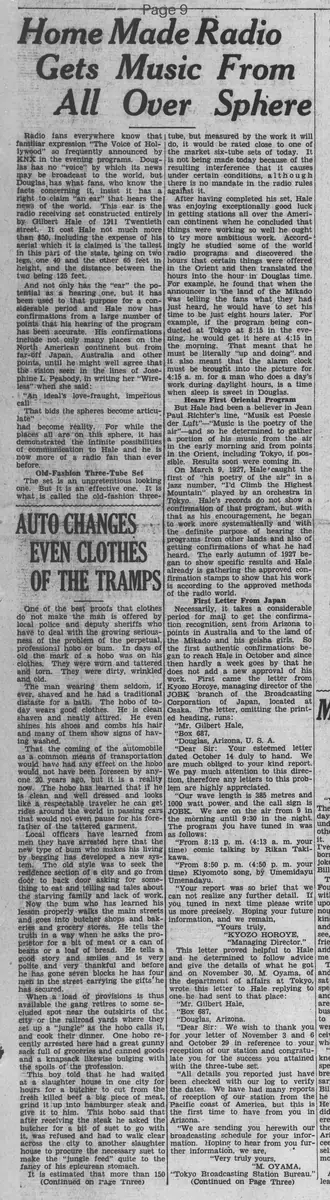
Radio fans everywhere know that familiar expression "The Voice of Hollywood" so frequently announced by KNX in the evening programs. Douglas has no "voice" by which its news may be broadcast to the world, but Douglas has what fans, who know the facts concerning it, insist it has a right to claim "an ear" that hears the news of the world. This ear is the radio receiving set constructed entirely by Gilbert Hale of 1211 Twentieth street. It cost Hale not much more than $50, including the expense of his aerial which it is claimed is the tallest in this part of the state, being on two legs, one 40 and the other 65 feet in height, and the distance between the two being 125 feet.
And not only has the "ear" the potential as a hearing one, but it has been used to that purpose for a considerable period and Hale now has confirmations from a large number of points that his hearing of the program has been accurate. His confirmations include not only many places on the North American continent but from far-off Japan, Australia and other points, until he might well agree that the vision seen in the lines of Josephine L. Peabody, in writing her "Wireless" when she said:
"An ideal's love-fraught, imperious call
That bids the spheres become articulate"
had become reality. For while the places all are on this sphere, it has demonstrated the infinite possibilities of communication to Hale and he is now more of a radio fan than ever before.
Old-Fashion Three-Tube Set
The set is an unpretentious looking one. But it is an effective one. It is what is called the old-fashion three-tube, but measured by the work it will do, it would be rated close to one of the market six-tube sets of today. It is not being made today because of the resulting interference that it causes under certain conditions, although there is no mandate in the radio rules against it.
After having completed his set, Hale was enjoying exceptionally good luck in getting stations all over the American continent when he concluded that things were working so well he ought to try more ambitious work. Accordingly he studied some of the world radio programs and discovered the hours that certain things were offered in the Orient and then translated the hours into the hour in Douglas time. For example, he found that when the announcer in the land of the Mikado was telling the fans what they had just heard, he would have to set his time to be just eight hours later. For example, if the program being conducted at Tokyo at 8:15 in the evening, he would get it here at 4:15 in the morning. That meant that he must be literally "up and doing", and it also meant that the alarm clock must be brought into the picture for 4:15 a. m. for a man who does a day's work during daylight hours, is a time when sleep is sweet in Douglas.
Hears First Oriental Program
But Hale had been a believer in Jean Paul Richter's line, "Musik est Poesie der Luft" "Music is the poetry of the air" and so he determined to gather a portion of his music, from the air in the early morning and from points in the Orient, including Tokyo, if possible. Results soon were coming in. On March 9, 1927, Hale caught the first of "his poetry of the air" in a jazz number, "I'd Climb the Highest Mountain" played by an orchestra in Tokyo. Hale's records do not show a confirmation of that program, but with that as his encouragement, he began to work more systematically and with the definite purpose of hearing the programs from other lands and also of getting confirmations of what he had heard. The early autumn of 1927 began to show specific results and Hale already is gathering the approved confirmation stamps to show that his work is according to the approved methods of the radio world.
First Letter From Japan
Necessarily, it takes a considerable period for mail to get the confirmation recognition, sent from Arizona to points in Australia and to the land of the Mikado and his geisha girls. So the first authentic confirmations began to reach Hale in October and since then hardly a week goes by that he does not add a new approval of his work. First came the letter from Kyozo Horoye, managing director of the JOBK branch of the Broadcasting Corporation of Japan, located at Osaka. The letter, omitting the printed heading, runs:
"Mr. Gilbert Hale
"Box 687
"Douglas, Arizona, U. S. A.
"Dear Sir: Your esteemed letter dated October 14. duly to hand. We are much obliged to your kind report. We pay much attention to this direction, therefore any letters to this problem are highly appreciated.
"Our wave length is 385 metres and 1000 watt power, and the call sign is JOBK. We are on the air from 9 in the morning until 9:30 in the night. The program you have tuned in was as follows:
"From 8:13 p. m. (4:13 a. m. your time) comic talking by Rikan Takikawa.
From 8:50 p. m. (4:50 p. m. your time) Kiyomoto song, by Umemidayu Umenadayu.
"Your report was so brief that we can not realize any further detail. If you tuned in next time please write us more precisely. Hoping your future information, and we remain,
"Yours truly,
"KYOZO HOROYE,
"Managing Director."
This letter proved helpful to Hale and he determined to follow advice and give the details of what he got and on November 30, M. Oyama, of the department of affairs at Tokyo, wrote this letter to Hale replying to one he had sent to that place:
"Mr. Gilbert Hale,
"Box 687
"Douglas, Arizona.
"Dear Sir: We wish to thank you for your letter of November 3 and 6 and October 29 in reference to your reception of our station and congratulate you for the success you attained with the three-tube set.
"All details you reported just have been checked with our log to verify the dates. We have had many reports of reception of our station from the Pacific coast of America, but this is the first time to have from you in Arizona.
"We are sending you herewith our broadcasting schedule for your information. Hoping to hear from you further information, we are,
"Very truly yours,
"M. OYAMA,
"Tokyo Broadcasting Station Bureau."
(Continued on Page Three)
Gets
Music
From
All
Over
Sphere
Radio fans everywhere know that familiar expression "The Voice of Hollywood" so frequently announced by KNX in the evening programs. Douglas has no "voice" by which its news may be broadcast to the world, but Douglas has what fans, who know the facts concerning it, insist it has a right to claim "an ear" that hears the news of the world. This ear is the radio receiving set constructed entirely by Gilbert Hale of 1211 Twentieth street. It cost Hale not much more than $50, including the expense of his aerial which it is claimed is the tallest in this part of the state, being on two legs, one 40 and the other 65 feet in height, and the distance between the two being 125 feet.
And not only has the "ear" the potential as a hearing one, but it has been used to that purpose for a considerable period and Hale now has confirmations from a large number of points that his hearing of the program has been accurate. His confirmations include not only many places on the North American continent but from far-off Japan, Australia and other points, until he might well agree that the vision seen in the lines of Josephine L. Peabody, in writing her "Wireless" when she said:
"An ideal's love-fraught, imperious call
That bids the spheres become articulate"
had become reality. For while the places all are on this sphere, it has demonstrated the infinite possibilities of communication to Hale and he is now more of a radio fan than ever before.
Old-Fashion Three-Tube Set
The set is an unpretentious looking one. But it is an effective one. It is what is called the old-fashion three-tube, but measured by the work it will do, it would be rated close to one of the market six-tube sets of today. It is not being made today because of the resulting interference that it causes under certain conditions, although there is no mandate in the radio rules against it.
After having completed his set, Hale was enjoying exceptionally good luck in getting stations all over the American continent when he concluded that things were working so well he ought to try more ambitious work. Accordingly he studied some of the world radio programs and discovered the hours that certain things were offered in the Orient and then translated the hours into the hour in Douglas time. For example, he found that when the announcer in the land of the Mikado was telling the fans what they had just heard, he would have to set his time to be just eight hours later. For example, if the program being conducted at Tokyo at 8:15 in the evening, he would get it here at 4:15 in the morning. That meant that he must be literally "up and doing", and it also meant that the alarm clock must be brought into the picture for 4:15 a. m. for a man who does a day's work during daylight hours, is a time when sleep is sweet in Douglas.
Hears First Oriental Program
But Hale had been a believer in Jean Paul Richter's line, "Musik est Poesie der Luft" "Music is the poetry of the air" and so he determined to gather a portion of his music, from the air in the early morning and from points in the Orient, including Tokyo, if possible. Results soon were coming in. On March 9, 1927, Hale caught the first of "his poetry of the air" in a jazz number, "I'd Climb the Highest Mountain" played by an orchestra in Tokyo. Hale's records do not show a confirmation of that program, but with that as his encouragement, he began to work more systematically and with the definite purpose of hearing the programs from other lands and also of getting confirmations of what he had heard. The early autumn of 1927 began to show specific results and Hale already is gathering the approved confirmation stamps to show that his work is according to the approved methods of the radio world.
First Letter From Japan
Necessarily, it takes a considerable period for mail to get the confirmation recognition, sent from Arizona to points in Australia and to the land of the Mikado and his geisha girls. So the first authentic confirmations began to reach Hale in October and since then hardly a week goes by that he does not add a new approval of his work. First came the letter from Kyozo Horoye, managing director of the JOBK branch of the Broadcasting Corporation of Japan, located at Osaka. The letter, omitting the printed heading, runs:
"Mr. Gilbert Hale
"Box 687
"Douglas, Arizona, U. S. A.
"Dear Sir: Your esteemed letter dated October 14. duly to hand. We are much obliged to your kind report. We pay much attention to this direction, therefore any letters to this problem are highly appreciated.
"Our wave length is 385 metres and 1000 watt power, and the call sign is JOBK. We are on the air from 9 in the morning until 9:30 in the night. The program you have tuned in was as follows:
"From 8:13 p. m. (4:13 a. m. your time) comic talking by Rikan Takikawa.
From 8:50 p. m. (4:50 p. m. your time) Kiyomoto song, by Umemidayu Umenadayu.
"Your report was so brief that we can not realize any further detail. If you tuned in next time please write us more precisely. Hoping your future information, and we remain,
"Yours truly,
"KYOZO HOROYE,
"Managing Director."
This letter proved helpful to Hale and he determined to follow advice and give the details of what he got and on November 30, M. Oyama, of the department of affairs at Tokyo, wrote this letter to Hale replying to one he had sent to that place:
"Mr. Gilbert Hale,
"Box 687
"Douglas, Arizona.
"Dear Sir: We wish to thank you for your letter of November 3 and 6 and October 29 in reference to your reception of our station and congratulate you for the success you attained with the three-tube set.
"All details you reported just have been checked with our log to verify the dates. We have had many reports of reception of our station from the Pacific coast of America, but this is the first time to have from you in Arizona.
"We are sending you herewith our broadcasting schedule for your information. Hoping to hear from you further information, we are,
"Very truly yours,
"M. OYAMA,
"Tokyo Broadcasting Station Bureau."
(Continued on Page Three)
What sub-type of article is it?
Personal Triumph
Curiosity
What themes does it cover?
Triumph
Exploration
What keywords are associated?
Homemade Radio
Distant Reception
Japan Broadcast
Radio Confirmation
Three Tube Set
Tokyo Program
What entities or persons were involved?
Gilbert Hale
Kyozo Horoye
M. Oyama
Where did it happen?
Douglas, Arizona
Story Details
Key Persons
Gilbert Hale
Kyozo Horoye
M. Oyama
Location
Douglas, Arizona
Event Date
1927
Story Details
Gilbert Hale constructs a low-cost three-tube radio set and tall aerial in Douglas, Arizona, receiving broadcasts from North America, Japan, Australia, and other distant points, obtaining confirmations from stations like JOBK in Osaka and Tokyo Broadcasting Station starting in March 1927.