Thank you for visiting SNEWPapers!
Sign up free
The North Carolina Standard
Raleigh, Wake County, North Carolina
What is this article about?
In 1839, Peter Scales writes to the North Carolina Standard, enclosing a refused letter to the Greensboro Patriot refuting 'A Citizen of Stokes'' accusations of corrupt conduct in secretly arranging a battalion muster at Madison, NC, to undermine Solomon Hill's election. He criticizes Whig editors for injustice and libel.
Clipping
OCR Quality
Full Text
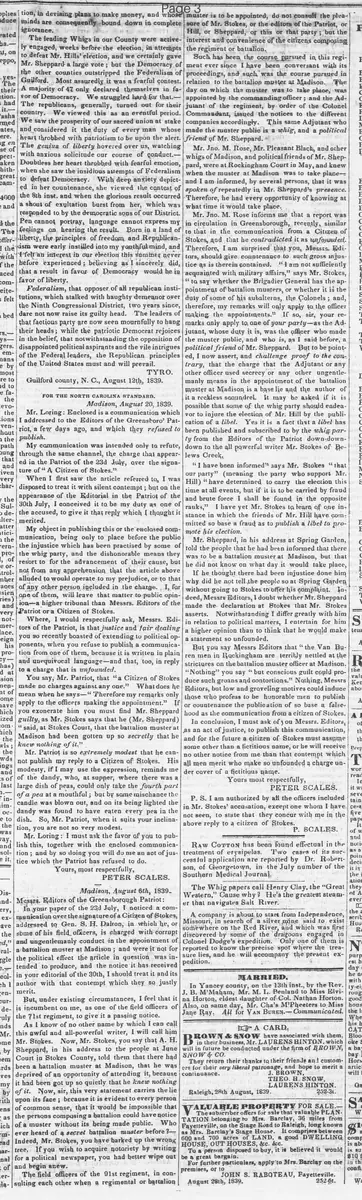
Madison, August 20, 1839.
Mr. Loring: Enclosed is a communication which I addressed to the Editors of the Greensboro' Patriot, a few days ago, and which they refused to publish.
My communication was intended only to refute, through the same channel, the charge that appeared in the Patriot of the 23d July, over the signature of "A Citizen of Stokes."
When I first saw the article referred to, I was disposed to treat it with silent contempt; but on the appearance of the Editorial in the Patriot of the 30th July, I conceived it to be my duty as one of the accused, to give it that reply which I thought it merited.
My object in publishing this or the enclosed communication, being only to place before the public the injustice which has been practised by some of the whig party, and the dishonorable means they resort to for the advancement of their cause, but not from any apprehension that the article above alluded to would operate to my prejudice, or to that of any other person included in the charge. I, or one of them, will leave that matter to public opinion--a higher tribunal than Messrs. Editors of the Patriot or a Citizen of Stokes.
Where, I would respectfully ask, Messrs. Editors of the Patriot, is that justice and fair dealing you so recently boasted of extending to political opponents, when you refuse to publish a communication from one of them, because it is written in plain and unequivocal language-and that, too, in reply to a charge that is unfounded.
You say, Mr. Patriot, that "a Citizen of Stokes made no charges against any one." What does he mean when he says—"Therefore my remarks only apply to the officers making the appointment." If you exonerate him you must find Mr. Sheppard guilty, as Mr. Stokes says that he (Mr. Sheppard) "said at Stokes Court, that the battalion muster at Madison had been gotten up so secretly that he knew nothing of it."
Mr. Patriot is so extremely modest that he cannot publish my reply to a Citizen of Stokes. His modesty, if I may use the expression, reminds me of the dandy, who, at supper, where there was a large dish of peas, could only take the fourth part of a pea at a mouthful; but by some mischance the candle was blown out, and on its being lighted the dandy was found to have eaten every pea in the dish. So, Mr. Patriot, when it suits your inclination, you are not so very modest.
Mr. Loring: I must ask the favor of you to publish this, together with the enclosed communication; and by so doing you will do me an act of justice which the Patriot has refused to do.
Yours, most respectfully,
PETER SCALES.
Madison, August 6th, 1839.
Messrs. Editors of the Greensboro Patriot:
In your paper of the 23d July, I noticed a communication over the signature of a Citizen of Stokes, addressed to Gen. S. H. Dalton, in which he, or some of his field officers, is charged with corrupt and ungentlemanly conduct in the appointment of a battalion muster at Madison; and were it not for the political effect the article in question was intended to produce, and the notice it has received in your editorial of the 30th, I should treat it and its author with that contempt which they so justly merit.
But, under existing circumstances, I feel that it is incumbent on me, as one of the field officers of the 71st regiment, to give it a passing notice.
As I know of no other name by which I can call this awful and all-powerful writer, I will call him Mr. Stokes. Now, Mr. Stokes, you say that A. H. Sheppard, in his address to the people at June Court in Stokes County, told them that there had been a battalion muster at Madison, that he was deprived of an opportunity of attending it, because it had been got up so quietly that he knew nothing of it. Now, sir, this very statement carries the lie upon its face; because it is evident to every person of common sense, that it would be impossible that the persons composing a battalion could have notice of a muster without its being made public. Who ever heard of a secret battalion muster before? Indeed, Mr. Stokes, you have barked up the wrong tree. If you wish to acquire notoriety by writing for a political newspaper, you had better wipe out and begin anew.
The field officers of the 91st regiment, in consulting each other when a regimental or battalion muster is to be appointed, do not consult the pleasure of Mr. Stokes, or the editors of the Patriot, or Hill, or Sheppard, or this or that party; but the interest and convenience of the citizens composing the regiment or battalion.
Such has been the course pursued in this regiment ever since I have been conversant with its proceedings, and such was the course pursued in relation to the battalion muster at Madison. The day on which the muster was to take place, was appointed by the commanding officer; and the Adjutant of the regiment, by order of the Colonel Commandant, issued the notices to the different companies accordingly. This same Adjutant who made the muster public is a whig, and a political friend of Mr. Sheppard.
Mr. Jno. M. Rose, Mr. Pleasant Black, and other whigs of Madison, and political friends of Mr. Sheppard, were at Rockingham Court in May, and knew when the muster at Madison was to take place- and I am informed, by several persons, that it was spoken of repeatedly in Mr. Sheppard's presence. Therefore, he had every opportunity of knowing at what time it would take place.
Mr. Jno. M. Rose informs me that a report was in circulation in Greensboro, recently, similar to that in the communication from a Citizen of Stokes, and that he contradicted it as unfounded. Therefore, I am surprised that you, Messrs. Editors, should give countenance to such gross injustice as is therein contained. "I am not sufficiently acquainted with military affairs," says Mr. Stokes, "to say whether the Brigadier General has the appointment of battalion musters, or whether it is the duty of some of his subalterns, the Colonels; and, therefore, my remarks will only apply to the officer making the appointments." If so, sir, your remarks only apply to one of your party-as the Adjutant, whose duty it is, was the officer who made the muster public, and who is, as I said before, a political friend of Mr. Sheppard. But to be pointed, I now assert, and challenge proof to the contrary, that the charge that the Adjutant or any other officer used secrecy or any other ungentlemanly means in the appointment of the battalion muster at Madison is a base lie and the author of it a reckless scoundrel. It may be asked if it is possible that some of the whig party should endeavor to injure the election of Mr. Hill by the publication of a libel. Yes it is a fact that a libel has been published and subscribed to by the whig party from the Editors of the Patriot down-down-down to the all powerful writer Mr. Stokes of Belew's Creek.
"I have been informed" says Mr. Stokes "that our party" (meaning the party who support Mr. Hill) "have determined to carry the election this time at all events, but if it is to be carried by fraud and brute force I shall be found in the opposite ranks," I have yet Mr. Stokes to learn of one instance in which the friends of Mr. Hill have committed so base a fraud as to publish a libel to promote his election.
Mr. Sheppard, in his address at Spring Garden, told the people that he had been informed that there was to be a battalion muster at Madison, but that he did not know on what day it would take place. If he thought there had been injustice done him why did he not tell the people so at Spring Garden without going to Stokes to offer his complaint. Indeed, Messrs Editors, I doubt whether Mr. Sheppard made the declaration at Stokes that Mr. Stokes asserts. Notwithstanding I differ greatly with him in relation to political matters, I entertain for him a higher opinion than to think that he would make a statement so unfounded.
But you say Messrs Editors that "the Van Buren men in Rockingham are terribly nettled at the strictures on the battalion muster officer at Madison." "Nothing" you say "but conscious guilt could produce such groans and contortions." Nothing, Messrs Editors, but low and groveling motives could induce those who profess to be honorable men to publish or countenance the publication of so base a falsehood as the communication from a citizen of Stokes.
In conclusion, I must ask of you Messrs. Editors, as an act of justice, to publish this communication, and for the future a citizen of Stokes must assume some other than a fictitious name, or he will receive no other notice from me than that contempt which all men merit who make so unfounded a charge under cover of a fictitious name.
Yours most respectfully,
PETER SCALES.
P. S. I am authorized by all the officers included in Mr. Stokes' accusation, except one whom I have not seen, to state that they concur with me in the above reply to a citizen of Stokes.
P. SCALES.
What sub-type of article is it?
What themes does it cover?
What keywords are associated?
What entities or persons were involved?
Letter to Editor Details
Author
Peter Scales
Recipient
Mr. Loring
Main Argument
peter scales refutes accusations by 'a citizen of stokes' of secret and corrupt arrangement of a battalion muster at madison to politically disadvantage opponents, calling it a libel by whigs to harm solomon hill's election, and criticizes the greensboro patriot for refusing to publish his reply.
Notable Details