Thank you for visiting SNEWPapers!
Sign up free
West Virginia Freeman
Parkersburg, Wood County, West Virginia
What is this article about?
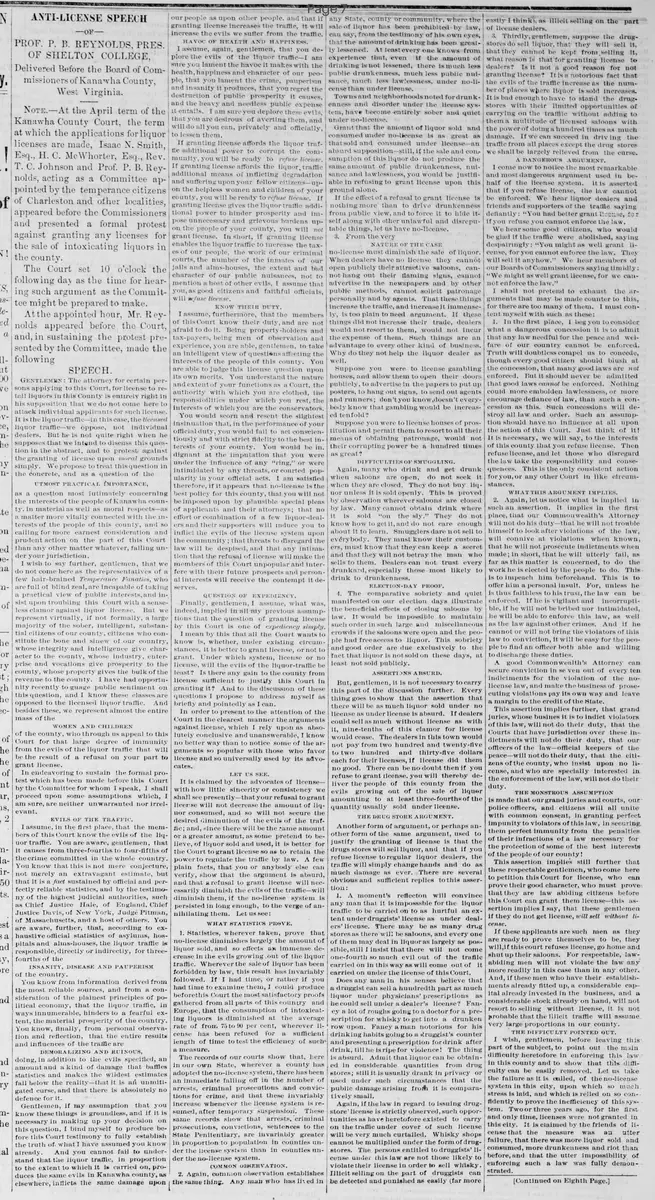
Prof. P. B. Reynolds, president of Shelton College, delivers a passionate speech before the Kanawha County Commissioners in West Virginia, protesting liquor licenses. He argues the liquor traffic causes immense crime, insanity, pauperism, and economic harm, advocating no-license to reduce evils and protect the community.
Merged-components note: These components are the continuation of Prof. P. B. Reynolds' Anti-License Speech, split across pages with a '[Continued from Seventh Page.]' indicator.
Clippings
1 of 2
OCR Quality
Full Text
PROF. P. B. REYNOLDS, PRES.
OF SHELTON COLLEGE,
Delivered Before the Board of Com-
missioners of Kanawha County,
West Virginia.
NOTE.-At the April term of the
Kanawha County Court, the term
at which the applications for liquor
licenses are made, Isaac N. Smith,
Esq., H. C. McWhorter, Esq., Rev.
T. C. Johnson and Prof. P. B. Rey-
nolds, acting as a Committee ap-
pointed by the temperance citizens
of Charleston and other localities
appeared before the Commissioners
and presented a formal protest
against granting any licenses for
the sale of intoxicating liquors in
the county.
The Court set 10 o'clock the
following day as the time for hear-
ing such argument as the Commit-
tee might be prepared to make.
At the appointed hour, Mr. Rey-
nolds appeared before the Court,
and, in sustaining the protest pre-
sented by the Committee, made the
following
SPEECH.
Gentlemen: The attorney for certain per-
sons applying to this Court, for license to re-
tail liquors in this County is entirely right in
his supposition that we do not come here to
attack individual applicants for such license.
It is the liquor traffic-in this case, the licensed
liquor traffic-we oppose, not individual
dealers. But he is not quite right when he
supposes that we intend to discuss this ques-
tion in the abstract, and to protest against
the granting of license upon moral grounds
simply. We propose to treat this question in
the concrete, and as a question of the
UTMOST PRACTICAL IMPORTANCE,
as a question most intimately concerning
the interests of the people of Kanawha coun-
ty, in material as well as moral respects-as
a matter more vitally connected with the in-
terests of the people of this county, and so
calling for more earnest consideration and
prudent action on the part of this Court
than any other matter whatever. falling un-
der your jurisdiction.
I wish to say further, gentlemen, that we
do not come here as the representatives of a
few hair-brained Temperance Fanatics, who
are full of blind zeal, are incapable of taking
a practical view of public interests, and in-
sist upon troubling this Court with a sense-
less clamor against liquor license. But we
represent virtually, if not formally, a large
majority of the sober, intelligent, substan-
tial citizens of our county, citizens who con-
stitute the bone and sinew of our country,
whose integrity and intelligence give char-
acter to the county, whose industry, enter-
prise and vocations give prosperity to the
county, whose property gives the bulk of the
revenue to the county. I have had opportu-
nity recently to gauge public sentiment on
this question, and I know these classes are
opposed to the licensed liquor traffic. And
besides these, we represent almost the entire mass of the
WOMEN AND CHILDREN
of the county, who through us appeal to this
Court for that large degree of immunity
from the evils of the liquor traffic that will
be the result of a refusal on your part to
grant license.
In endeavoring to sustain the formal pro-
test which has been made before this Court
by the Committee for whom I speak, I shall
proceed upon some assumptions which, I
am sure, are neither unwarranted nor irrel-
evant.
EVILS OF THE TRAFFIC.
I assume, in the first place, that the mem-
bers of this Court know the evils of the liq-
uor traffic. You are aware, gentlemen, that
it causes from three-fourths to four-fifths of
the crime committed in the whole country.
You know that this is not mere conjecture,
not merely an extravagant estimate. but
that it is a fact sustained by official and per-
fectly reliable statistics, and by the testimo-
ny of the highest judicial authorities, such
as Chief Justice Hale, of England, Chief
Justice Davis, of New York, Judge Pitman,
of Massachusetts, and a host of others. You
are aware, further, that, according to ex-
haustive official statistics of asylums, hos-
pitals and alms-houses, the liquor traffic is
responsible, directly or indirectly, for three-
fourths of the
INSANITY. DISEASE AND PAUPERISM
of the country.
You know from information derived from
the most reliable sources, and from a con-
sideration of the plainest principles of po-
litical economy, that the liquor traffic, in
ways innumerable, hinders to a fearful ex-
tent, the material prosperity of the country.
You know, finally, from personal observa-
tion and reflection, that the entire results
and influences of the traffic are
DEMORALIZING AND RUINOUS.
doing, in addition to the evils specified, an
amount and a kind of damage that baffles
statistics and makes the wildest estimates
fall below the reality-that it is an unmiti-
gated curse, and that there is absolutely no
defence for it.
Gentlemen, if my assumption that you
know these things is groundless, and if it is
necessary in making up your decision on
this question, I bind myself to produce be-
fore this Court testimony to fully establish
the truth of. what I have assumed you know
already. And you cannot fail to under-
stand that the liquor traffic, in proportion
to the extent to which it is carried on, pro-
duces the same evils in Kanawha county, as
elsewhere, inflicts the same damage upon
our people as upon other people. and that if
granting license increases the traffic, it will
increase the evils we suffer from the traffic.
HAVOC OF HEALTH AND HAPPINESS.
I assume, again, gentlemen, that you de-
plore the evils of the liquor traffic-I am
sure you lament the havoc it makes with the
health, happiness and character of our peo-
ple, that you lament the crime, pauperism
and insanity it produces, that you regret the
destruction of public prosperity it causes,
and the heavy and needless public expense
it entails. I am sure you deplore these evils,
that you are desirous of averting them, and
will do all you can, privately and officially.
to lessen them,
If granting license affords the liquor traf-
fic additional power to corrupt the com-
munity, you will be ready to refuse license.
If granting license affords the liquor, traffic
additional means of inflicting degradation
and suffering upon your fellow citizens—up-
on the helpless women and children of your
county, you will be ready to refuse license, If
granting license gives the liquor traffic addi-
tional power to hinder prosperity and im-
pose unnecessary and grievous burdens up-
on the people of your county, you will not
grant license. In short, if granting license
enables the liquor traffic to increase the tax-
es of our people, the work of our criminal
courts, the number of the inmates of our
jails and alms-houses, the extent and bad
character of our public nuisances, not to
mention a host of other evils, I assume that
you, as good citizens and faithful officials,
will refuse license.
KNOW THEIR DUTY.
I assume, furthermore, that the members
of this Court know their duty, and are not
afraid to do it. Being property-holders and
tax-payers, being men of observation and
experience, you are able. gentlemen, to take
an intelligent view of questions affecting the
interests of the people of this county. You
are able to judge this license question upon
its own merits. You understand the nature
and extent of your functions as a Court, the
authority with which you are clothed, the
responsibilities under which you rest, the
interests of which you are the conservators.
You would scorn and resent the slightest
insinuation that, in the performance of your
official duty, you would fail to act conscien-
tiously and with strict fidelity to the best in-
terests of your county. You would be in.
dignant at the imputation that you were
under the influence of any "ring," or were
intimidated by any threats, or courted pop-
ularity in your official acts. I am satisfied
therefore, if it appears that no-license is the
best policy for this county, that you will not
be imposed upon by plausible special pleas
of applicants and their attorneys; that no
effort or combination of a few liquor-deal-
ers and their supporters will induce you to
inflict the evils of the license system upon
the community: that threats to disregard the
law will be despised, and that any intima-
tion that the refusal of license will make the
members of this Court unpopular and inter-
fere with their future prospects and person-
al interests will receive the contempt it de-
serves.
QUESTION OF EXPEDIENCY.
Finally, gentlemen, I assume, what was.
indeed. implied in all my previous assump-
tions that the question of granting license
by this Court is one of expediency simply.
I mean by this that all the Court wants to
know is, whether, under existing circum-
stances. it is better to grant license, or not to
grant. Under which system, license or no
license, will the evils of the liquor-traffic be
least? Is there any gain to the county from
license sufficient to justify this Court in
granting it? And to the discussion of these
questions I propose to address myself as
briefly and pointedly as I can.
In order to present to the attention of the
Court in the clearest manner the arguments
against license, which I rely upon as abso-
lutely conclusive and unanswerable, I know
no better way than to notice some of the ar-
guments so popular with those who favor
license and so universally used by its advo-
cates.
LET US SEE.
It is claimed by the advocates of license-
with how little sincerity or consistency we
shall see presently—that your refusal to grant
license will not decrease the amount of liq-
uor consumed, and so will not secure the
desired diminution of the evils of the traf-
fic; and, since there will be the same amount
or a greater amount, as some pretend to be-
lieve, of liquor sold and used, it is better for
the Court to grant license so as to retain the
power to regulate the traffic by law. A few
plain facts, that you or anybody else can
verify, show that the argument is absurd.
and that a refusal to grant license will nec-
essarily diminish the evils of the traffic-will
diminish them, if the no-license system is
persisted in long enough, to the verge of an-
nihilating them. Let us see:
WHAT STATISTICS PROVE.
1. Statistics, wherever taken, prove that
no-license diminishes largely the amount of
liquor sold, and so effects an immense de-
crease in the evils growing out of the liquor
traffic. Wherever the sale of liquor has been
forbidden by law, this result has invariably
followed. If I had time, or rather if you
had time to examine them, I could produce
before this Court the most satisfactory proofs
gathered from all parts of this country and
Europe, that the consumption of intoxicat-
ing liquors is diminished at the average
rate of from 75 to 90 per cent, wherever li-
license has been refused for a sufficient
length of time to test the efficiency of such
a measure.
The records of our courts show that, here
in our own State, wherever a county has
adopted the no-license system, there has been
an immediate falling off in the number of
arrests, criminal prosecutions and convic-
tions for crime. and that these invariably
increase whenever the license system is re-
sumed, after temporary suspension. These
same records show that arrests, criminal
prosecutions, convictions, sentences to the
State Penitentiary, are invariably greater
in proportion to population in counties un-
der the license system than in counties un-
der the no-license system.
COMMON OBSERVATION.
2. Again, common observation establishes
the same thing. Any man who has lived in
any State, county or community, where the
sale of liquor has been prohibited by law,
can say, from the testimony of his own eyes,
that the amount of drinking has been great-
ly lessened. At least every one knows from
experience that, even if the amount of
drinking is not lessened, there is much less
public drunkenness, much less public nui-
sance, much less lawlessness, under no-li-
license than under license.
Towns and neighborhoods noted for drunk-
enness and disorder under the license sys-
tem, have become entirely sober and quiet
under no-license.
Grant that the amount of liquor sold and
consumed under no-license is as great as
that sold and consumed under license-an
absurd supposition-still, if the sale and con-
sumption of this liquor do not produce the
same amount of public drunkenness. nui-
sance and lawlessness, you would be justifi-
able in refusing to grant license upon this
ground alone.
If the effect of a refusal to grant license is
nothing more than to drive drunkenness
from public view, and to force it to hide it-
self along with other unlawful and disrepu-
table things, let us have no-license.
3. From the very
NATURE OF THE CASE
no-license must diminish the sale of liquor.
When dealers have no license they cannot
open publicly their attractive saloons, can-
not hang out their flaming signs, cannot
advertise in the newspapers and by other
public methods, cannot solicit patronage
personally and by agents. That these things
increase the traffic, and increase it immense-
ly, is too plain to need argument. If these
things did not increase their trade. dealers
would not resort to them, would not incur
the expense of them. Such things are an
advantage to every other kind of business.
Why do they not help the liquor dealer as
well.
Suppose you
were to license gambling
houses, and allow them to open their doors
publicly, to advertise in the papers to put up
posters, to hang out signs, to send out agents
and runners; don't you know, doesn't every-
body know that gambling would be increas-
ed tenfold?
Suppose you were to license houses of pros-
titution and permit them to resort to all their
means of obtaining patronage, would not
their corrupting power be a hundred times
as great?
DIFFICULTIES OF SMUGGLING.
Again, many who drink and get drunk
when saloons are open, do not seek it
when they are closed. They do not buy liq-
uor unless it is sold openly. This is proved
by observation wherever saloons are closed
by law. Many cannot obtain drink where
it is sold "on the sly." They do not
know how to get it, and do not care enough
about it to learn. Smugglers dare not sell te
everybody. They must know their custom-
ers, must know that they can keep a secret
and that they will not betray the man who
sells to them. Dealers can not trust every
drunkard, especially those most likely to
drink to drunkenness.
ELECTION-DAY PROOF.
4. The comparative sobriety and quiet
manifested on our election days illustrate
the beneficial effects of closing saloons by
law. It would be impossible to maintain
such order in such large and miscellaneous
crowds if the saloons were open and the peo-
ple had free access to liquor. This sobriety
and good order are due exclusively to the
fact that liquor is not sold on these days, at
least not sold publicly.
ASSERTIONS ABSURD.
But, gentlemen, it is not necessary to carry
this part of the discussion further. Every
thing goes to show that the assertion that
there will be as much liquor sold under no
license as under license is absurd. If dealers
could sell as much without license as with
it. nine-tenths of this clamor for license
would cease. The dealers in this town would
not pay from two hundred and twenty-five
to two hundred and thirty-five dollars
each for their licenses, if license did them
no good. There can be no doubt then if you
refuse to grant license, you will thereby de-
liver the people of this county from the
evil growing out of the sale of liquor
amounting to at least three-fourths of the
quantity usually sold under license.
THE DRUG STORE ARGUMENT.
Another form of argument, or perhaps an-
other form of the same argument, used to
justify the granting of license is that the
drugs stores will sell liquor, and that if you
refuse license to regular liquor dealers, the
traffic will simply change hands and do as
much damage as ever. There are several
obvious and sufficient replies to this asser-
tion:
1. A moment's reflection will convince
any man that it is impossible for the liquor
traffic to be carried on to as hurtful an ex-
tent under druggists' license as under deal-
ers' license. There may be as many drug
stores as there will. be saloons, and every one
of them may deal in liquor as largely as pos-
sible. still I insist that there will not come
one-fourth so much evil out of the traffic
carried on in this way as will come out of it
carried on under the license of this Court.
Does any man in his senses believe that
a druggist can sell a hundredth part as much
liquor under physicians' prescriptions as
he could sell under a dealer's license? Fan-
ey a lot of roughs going to a doctor for a pre-
scription for whisky to get into a drunken
row upon. Fancy a man notorious for his
drinking habits going to a druggist's counter
and presenting a prescription for drink after
drink, till he is ripe for violence! The thing
is absurd. Admit that liquor can be obtain-
ed in considerable quantities from drug
stores; still it is usually drank in privacy or
used under such circumstances that the
public damage arising from it is compara-
tively small.
Again. if the law in regard to issuing drug:
store' license is strictly observed, such oppor:
tunities as have heretofore existed to carry
on the traffic under cover of such license
will be very much curtailed. Whisky shops
cannot be multiplied under the form of drug
stores. The persons entitled to druggists' li-
cense under this law are not those likely to
violate their license in order to sell whisky.
Illicit selling on the part of druggists can
easily I think), as illicit selling on the part
of license dealers.
3. Thirdly, gentlemen, suppose the drug-
stores do sell liquor, that they will sell it,
that they cannot be kept from selling it,
what reason is that for granting license to
dealers? Is it not a good reason for not
granting license? It is a notorious fact that
the evils of the traffic increase as the num-
ber of places where liquor is sold increases.
It is bad enough to have to stand the drug
stores with their limited opportunities of
carrying on the traffic without adding to
them a multitude of licensed saloons with
the power of doing a hundred times as much
damage. If we can succeed in driving the
traffic from all places except the drug stores
we shall be largely relieved from the curse.
A DANGEROUS ARGUMENT
I come now to notice the most remarkable
and most dangerous argument used in be-
half of the license system. It is asserted
that if you refuse license, the law cannot
be enforced. We hear liquor dealers and
their friends and supporters of the traffic saying
defiantly: "You had better grant license, for
if you refuse you cannot enforce the law.
We hear some good citizens, who would
be glad if the traffic were abolished, saying
despairingly: "You might as well grant li-
license, for you cannot enforce the law. They
will sell It anyhow." We hear members of
our Boards of Commissioners saying timidly:
"We might as well grant license, for we can-
not enforce the law."
I shall not pretend to exhaust the ar-
guments that may be made counter to this,
for there are too many of them. I must con-
tent myself with such as these:
1. In the first place, I beg you to consider
what a dangerous concession it is to admit
that any law needful for the peace and wel-
fare of our country cannot be enforced.
Truth will doubtless compel us to concede,
though every good citizen should blush at
the concession, that many good laws are not
enforced. But it should never be admitted
that good laws cannot be enforced. Nothing
could more embolden lawlessness, or more
encourage defiance of law, than such a con-
cession as this. Such concessions will de-
story all law and order. Such an assump-
tion should have no influence at all upon
the action of this Court. Just think of it!
It is necessary. we will say, to the interests
of this county that you refuse license. Then
refuse license, and let those who disregard
the law take the responsibility and conse-
quences. This is the only consistent action
for you, or any other Court in like circum-
stances.
WHAT THIS ARGUMENT IMPLIES
2. Again, let us notice what is implied in
such an assertion. It implies in the first
place, that our Commonwealth's Attorney
will not do his duty-that he will not trouble
himself to look after violations of the law,
will connive at violations when known,
that he will not prosecute indictments when
made; in short, that he will utterly fail, as
far as this matter is concerned. to do the
work he is elected by the people to do. This
is to impeach him beforehand. This is to
offer him a personal insult. For. unless he
is thus faithless to his trust, the law can be
enforced. If he is vigilant and incorrupti-
ble, if he will not be bribed nor intimidated,
he will be able to enforce this law, as well
as the law against other crimes. And if he
cannot or will not bring the violators of this
law to conviction, it will be easy for the peo-
ple to find an officer both able and willing
to discharge these duties
A good Commonwealth's Attorney can
secure conviction in seven out of every ten
indictments for the violation of the no-
license law, and make the business of prose-
cuting violations pay its own way and leave
a margin to the credit of the State,
This assertion implies further. that grand
juries, whose business it is to indict violators
of this law, will not do their duty, that the
Courts that have jurisdiction over these in-
dictments will not do their duty, that our
officers of the law-official keepers of the
peace-will not do their duty, that the citi-
zens of the county, who insist upon no li-
license, and who are specially interested in
the enforcement of the law, will not do their
duty.
THE MONSTROUS ASSUMPTION
is made that our grand juries and courts, our
police officers, and citizens will all unite
with common consent, in granting perfect
impunity to violators of this law, in securing.
them perfect immunity from the penalties
of their infractions of a law necessary for
the protection of some of the best interests
of the people of our county!
This assertion implies still further that
these respectable gentlemen, who come here
to petition this Court for license, who can
prove their good character, who must prove
that they are law abiding citizens before
this Court can grant them license-this as-
sertion implies I say, that these gentlemen
if they do not get license, will sell without li-
license.
If these applicants are such men as they
are ready to prove themselves to be, they
will, if this court refuses license, go home and
shut up their saloons. For respectable, law-
abiding men will not violate the law any
more readily in this case than in any other.
And, if these men who have their establish-
ments already fitted up, a considerable cap-
ital already invested in the business. and a
considerable stock already on hand. will not
resort to selling without license, it is not
probable that the illicit traffic will assume
very large proportions in our county.
THE DIFFICULTY POINTED OUT.
I wish, gentlemen, before leaving this
part of the subject, to point out the main
difficulty heretofore in enforcing this law
in this county and to show that this difi-
culty can be easily removed. Let us take
the failure as it is called, of the no-license
system in this city, upon which so much
stress is laid, and which is relied on so con-.
fidently to prove the inefficiency of this sys-
tem. Two or three years ago, for the first
and only time, licenses were not granted in
this city. It is claimed by the friends of li-
license that the measure
was
an utter
failure, that there was more liquor sold and
consumed, more drunkenness and riot than
before, and that the utter impossibility of
enforcing such a law was fully demon-
strated.
[Continued on Eighth Page.]
[Continued from Seventh Page.]
Now, admitting that there was as much liquor sold and drank as before, which I am assured by many of the most respectable citizens of the town was not the case, still it proves nothing against the benefits of the no-license system or the possibility of enforcing the law, for, from the very nature of the case, it was no test.
The measure was understood to be temporary. Nobody expected it would be permanent. Therefore, the saloon keepers and friends of license determined to defy the law. They made extraordinary exertions to keep up the traffic to its former extent.
Those interested in enforcing the law had no time to take efficient measures. In fact, they had no heart to exert themselves, for they saw from the complexion of the Court, and from measures used, that licenses would in all probability be granted soon again. It turned out so, and the result was that this temporary suspension of license did little good—perhaps did harm.
TEST OF TIME,
Now, gentlemen, I insist that the difficulty in this case was a want of time. The experiment was not fairly made. Let this Court decide, as you can decide, that there shall be no more licenses granted in this county for, at least, four years. The dealers will see that they cannot afford to defy the law so long, and will abandon the tactics that gave them success in a month's contest.
The friends of the law will have time to prosecute efficient measures against violators. The friends of no-license will be encouraged and the friends of license will be discouraged. There will be no fear that the Court will next year undo all that may be done to enforce the law permanently.
Depend upon it, results will be quite different. I honestly believe, if this Court shall, here and now, refuse to grant license, and announce that this matter is fixed for four years, Kanawha county will never return to the license system. By that time the traffic will be so crippled, the blessings of no-license so demonstrated, public sentiment so modified, that there will never be another application for license, and such a scene as this will never be re-enacted on this floor.
VIOLATIONS UNDER LICENSE.
I must not omit, in this connection, to call your attention to another point. It is altogether as easy to enforce the law under no-license as to punish violations of law under license. In fact, it is easier. Under no-license, we know that the whole traffic is illegal, while under license it is almost impossible for an outsider, at least, to discover the existence and extent of many violations of the law, or to discriminate between legal and illegal selling.
The fact is, many dealers take out license simply as a
CLOAK FOR ILLICIT TRAFFIC.
The protection given them in violating the law more than pays the cost of the license. They know, and you know, that if they abide by the law strictly, they cannot afford to carry on the business at all, much less pay for license to carry it on.
I undertake to say, therefore, that the illicit traffic under license is as great as the traffic would be under no-license. The consequence is, that when you grant license, we suffer all the evils from the illicit traffic under license that we would suffer from the traffic under no-license, plus the evils of such part of the traffic as is legalized by license.
BURLESQUE AND IRONY.
There is another argument for license almost as remarkable, though in quite a different way, as the one first noticed. It is this: License ought to be granted, so as to keep the business in the hands of respectable, honest men.
Really, when we consider the essential badness of the traffic itself—the character of the commodity dealt in, the kind of fruit the business bears, the character of the major part of the customers that support it, the character of the greater part of the men who carry it on, the ends for which dealers engage in it and patrons sustain it—it seems like burlesque and irony to propose to keep it in respectable, responsible hands by licensing it.
Still, in spite of its glaring fallaciousness, this argument is very plausible to some minds. Let us examine it and we shall see that there is nothing in it to warrant the granting of license, if the object of granting license is to curtail to any extent the evils of the liquor traffic.
RESULTS THE SAME, SOLD BY CHRISTIAN OR HEATHEN.
1. In the first place, granting that you can restrict the business to strictly respectable and responsible men, it is plain that it would tend very little to lessen the evils of the traffic. The respectability of the dealer would not change the effect of the liquor sold to his customers and drank by them.
The same amount of the same kind of liquor drank by the same class of men would have precisely the same effect, would create precisely the same amount of evil, if sold by a Christian that it would if sold by a heathen.
The respectability of the dealers, at least that degree of respectability that it is possible to secure in dealers, never has prevented and never will prevent liquor from being sold indiscriminately to all who want it.
It is notorious that anybody—minors, habitual drunkards, or anybody else, can obtain liquor in any quantity from any "respectable" saloon in the country. If he cannot get it in person—and refusals are very scarce—he can get it by proxy.
RESPECTABLE AND UNRESPECTABLE.
2. Licensing respectable men will not keep unrespectable men from selling without license. The unlicensed dealer can sell liquor for a less price than the licensed dealers, and will have his customers.
I believe, gentlemen, if you grant license, there will be as much unlicensed selling as there will be if you refuse license. The result of granting license, therefore, so far from restricting the business to respectable dealers, will be to give us both the respectable and the unrespectable dealers.
I know it is claimed that the men who take out license will watch those who attempt to sell without license. But it is notorious that they cannot break up unlicensed selling any more thoroughly than it can be broken up under the no-license system.
REGULATION DONT REGULATE.
3. But, gentlemen, I make bold to say that you will find it impossible to restrict the business to respectable hands. You cannot confine it to men who will abide strictly by the letter and spirit of the regulations of their license.
Men who are so respectable as to do this, cannot possibly make the business profitable. The sole purpose in engaging in this business is to make money; and nine out of ten men who take out license will not, provided they can escape prosecution, hesitate a moment to transgress the regulations of their license, if by so doing more money can be made out of the business.
If a dealer should insist upon sticking to the regulations of his license, his trade would soon be taken away from him by some rival who was not so scrupulous.
NOTHING GAINED—MUCH LOST.
4. Finally, to show that all this talk about protection from the evils of the liquor traffic by confining the business by license to respectable, responsible men is pure humbug, it is only necessary to note these two things:
First. Any man who is too respectable to violate a license, will not sell without license. So you do not gain, but lose by granting him license.
Secondly. Any man who would sell without license, if refused license, would violate his license if you granted it to him. So you gain nothing by licensing him.
REVENUE ARGUMENT.
I must hasten to the last argument for license that I shall have time to notice. It is the revenue argument. It is claimed by some that the county cannot do without the revenue that license brings. It is said by others that, since we cannot abolish the liquor traffic entirely, we may as well license it, and thus save that much revenue.
I presume this is the most plausible argument used by the advocates of license. I am sure it is by far the most fallacious and dangerous. It has, to use a slang phrase, "pulled the wool" over the eyes of more men than any other plea. It has oftener imposed upon Courts, has oftener reconciled men to the curse of the licensed liquor traffic, than any other argument that has ever been made.
Let us see why it is
UTTERLY FALLACIOUS.
1. I find that a levy of an additional five cents on the $100 worth of taxable property in the county will make up the revenue that the county will be deprived of by a refusal to grant license.
Now, it seems to me that any man ought to see plainly that it would be much better for the people of the county to pay this small additional levy than to bear the burdens and evils of the licensed liquor traffic.
I believe a large majority of the tax-payers of the county would be willing to pay it, if it would rid the county of license.
2. That the revenue derived from license is poor compensation for the damage that license will inflict, is plain from a few facts:
In the first place the increased crime and pauperism, due directly to license, will increase the expenses of the county by an amount that will overrun the amount of revenue received from license.
Statistics show that everywhere else no license lessens crime, pauperism, &c., more than enough to save this amount of expense. This would evidently be the effect in Kanawha county also.
In the second place, the indirect damage financially that license will inflict upon the county will offset this amount of revenue many times.
The idleness and vice, the interference with business, the consumption of property, the general hindrance to public prosperity, that the licensed liquor traffic must produce in excess of that produced by the unlicensed traffic will rob the county indirectly of many times more revenue than the license system will ever bring in.
Men with the slightest acquaintance with the workings of the license system, with the most rudimentary knowledge of the elements of public prosperity ought to know this.
In the first place the moral damage inflicted upon our people by the licensed liquor traffic offsets a million times the revenue coming from license. Money cannot compensate for such damage.
Gentlemen, I commend this fact to your most earnest consideration. Just think of the enormity of selling to thirty or forty men for the paltry sum of three or four thousand dollars, the privilege of corrupting the people to so fearful an extent as the licensed liquor traffic must corrupt them.
TEMPTATION TO OUR YOUTH
to become drunkards will be increased tenfold by license; the suffering and degradation of women and children with drunken husbands and fathers will be increased tenfold, a hundredfold, by license; the demoralizing, brutalizing influences of public debauchery will be increased a thousand fold by license.
Yet for all this, three or four thousand dollars of revenue is considered sufficient compensation! This is penny wisdom and pound foolishness with a vengeance. No county can afford to raise revenue in this way.
TWO OR THREE PROPOSITIONS.
3. Before leaving the revenue argument, gentlemen, let me submit to you two or three propositions to illustrate its fallaciousness.
Gambling is an evil that we have never been able to entirely prevent. Men will gamble more or less in spite of all the laws against it. Let us license gambling and get revenue from it. Why not? The liquor traffic is an evil. It cannot be entirely suppressed. Yet you are asked to license it for the sake of revenue.
Gambling houses have as good a right, as good a claim to license as saloons.
Prostitution is an evil that we have not been able to suppress entirely by law. Let us license prostitutes to ply their trade publicly unmolested and get revenue from it. Why not?
It is said that because saloons will be kept without license, you ought to license them for revenue. Houses of ill-fame will be kept without license. Therefore you ought to license them for the revenue.
Lying, theft, adultery, a hundred and one other things, are evils that cannot be suppressed by law. Therefore, you should license them and get revenue from them!
Such monstrous propositions as these show the utter untenableness and abominableness of the argument that you should, for the sake of revenue, license the liquor traffic because a refusal to grant license will not entirely suppress it.
STEWED DOWN TO ITS ESSENCE.
But I must not detain the court longer. This question, when stewed down to its essence, is found to be this and only this:
Shall a few liquor dealers have license to ply a trade, to make a living at the expense of the rest of the people of the county?
Their business serves no interest, and antagonizes every interest. All they make out of their trade will be at the expense of the peace, morality and prosperity of the county.
No good, but great evil, will inevitably come from granting them license. No good will be done the dealers themselves by granting them license. With the capital, industry and attention they give to the liquor business, they can make a living, can make money, at some legitimate business.
THE RESPONSIBILITY.
In conclusion, I beg you gentlemen, to remember that if our county is plagued with license, it will be because you fix it upon us. All the damage, of every kind, that the county may suffer from the licensed liquor traffic above that which it would suffer from the unlicensed traffic will be directly charged to this Court.
For the law of our State says that we may protect ourselves from the evils of the licensed traffic, if we can induce you to allow us this protection.
If I sat where you sit, clothed with your authority, resting under your responsibilities, confronted by the evils of the license system as you are, sustained by the sanction of law and public sentiment as you are, I would for no fortune under the sun forego the high, almost
SACRED PRIVILEGE
of saying that my county should never be cursed with liquor license during my term of office.
No mother should point to drunken son, no wife should point to drunken husband, and say he was ruined by liquor sold under license granted by me. No criminal should ever come here and plead that he was maddened to his crime by liquor sold under license granted by me.
Men should not point to riot and debauchery and say that liquor sold under my license was responsible for it. No man should ever point to the squalor and misery of a drunkard's home and say that this squalor and misery had been produced or increased, by liquor sold under license granted by me.
Gentlemen, I thank you for the privilege you have granted me. Consider the arguments that have been advanced, and allow them whatever weight they may be entitled to in making up your decision on this question.
ERRATA.—In 3rd column of speech, 54th line from top, for "their" read these. Same column, 11 lines from bottom, for "drank" read "drunk."
What sub-type of article is it?
What themes does it cover?
What keywords are associated?
What entities or persons were involved?
Where did it happen?
Story Details
Key Persons
Location
Kanawha County, West Virginia
Event Date
April Term Of The Kanawha County Court
Story Details
Prof. Reynolds argues against granting liquor licenses, citing statistics on crime, insanity, pauperism, and economic harm caused by the liquor traffic; refutes pro-license arguments on consumption, enforcement, respectability, and revenue; urges no-license to protect community morals and prosperity.