Thank you for visiting SNEWPapers!
Sign up free
The Cheyenne Daily Leader
Cheyenne, Laramie County, Wyoming
What is this article about?
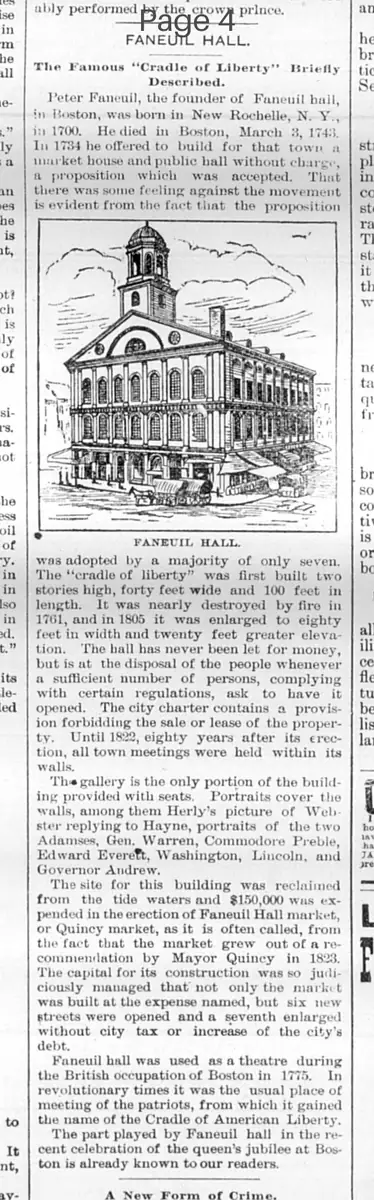
Historical description of Faneuil Hall in Boston, founded by Peter Faneuil in 1740 as a free market and public hall, known as the 'Cradle of Liberty' for revolutionary meetings. Details its construction, expansions, portraits, and management without public cost.
Merged-components note: Image is an illustration of Faneuil Hall, overlapping spatially with the story text.
Clipping
OCR Quality
Full Text
The Famous
"Cradle of Liberty"
Briefly
Described.
Peter Faneuil, the founder of Faneuil Hall, in Boston, was born in New Rochelle, N. Y., in 1700. He died in Boston, March 3, 1743. In 1740 he offered to build for that town a market house and public hall without charge, a proposition which was accepted. That there was some feeling against the movement is evident from the fact that the proposition was adopted by a majority of only seven.
The "cradle of liberty" was first built two stories high, forty feet wide and 100 feet in length. It was nearly destroyed by fire in 1761, and in 1805 it was enlarged to eighty feet in width and twenty feet greater elevation. The hall has never been let for money, but is at the disposal of the people whenever a sufficient number of persons, complying with certain regulations, ask to have it opened. The city charter contains a provision forbidding the sale or lease of the property. Until 1822, eighty years after its erection, all town meetings were held within its walls.
The gallery is the only portion of the building provided with seats. Portraits cover the walls, among them Healy's picture of Webster replying to Hayne, portraits of the two Adamses, Gen. Warren, Commodore Preble, Edward Everett, Washington, Lincoln, and Governor Andrew.
The site for this building was reclaimed from the tide waters and $150,000 was expended in the erection of Faneuil Hall market, or Quincy market, as it is often called, from the fact that the market grew out of a recommendation by Mayor Quincy in 1823. The capital for its construction was so judiciously managed that not only the market was built at the expense named, but six new streets were opened and a seventh enlarged without city tax or increase of the city's debt.
Faneuil Hall was used as a theatre during the British occupation of Boston in 1775. In revolutionary times it was the usual place of meeting of the patriots, from which it gained the name of the Cradle of American Liberty.
The part played by Faneuil Hall in the recent celebration of the queen's jubilee at Boston is already known to our readers.
What sub-type of article is it?
What themes does it cover?
What keywords are associated?
What entities or persons were involved?
Where did it happen?
Story Details
Key Persons
Location
Boston
Event Date
1700 1823
Story Details
Peter Faneuil builds Faneuil Hall as a free public market and hall in 1740; structure expands after 1761 fire; serves as revolutionary meeting place, earning 'Cradle of Liberty' name; managed without cost to city, features notable portraits.