Thank you for visiting SNEWPapers!
Sign up free
The New Hampshire Gazette
Portsmouth, Rockingham County, New Hampshire
What is this article about?
An extract from 'The Monitor' praises Prussian and British military successes against France by comparing them to historical English victories at Crecy (1346), Poitiers (1356), and Agincourt (1415), emphasizing that disciplined smaller forces can triumph over larger ones.
Clipping
OCR Quality
Full Text
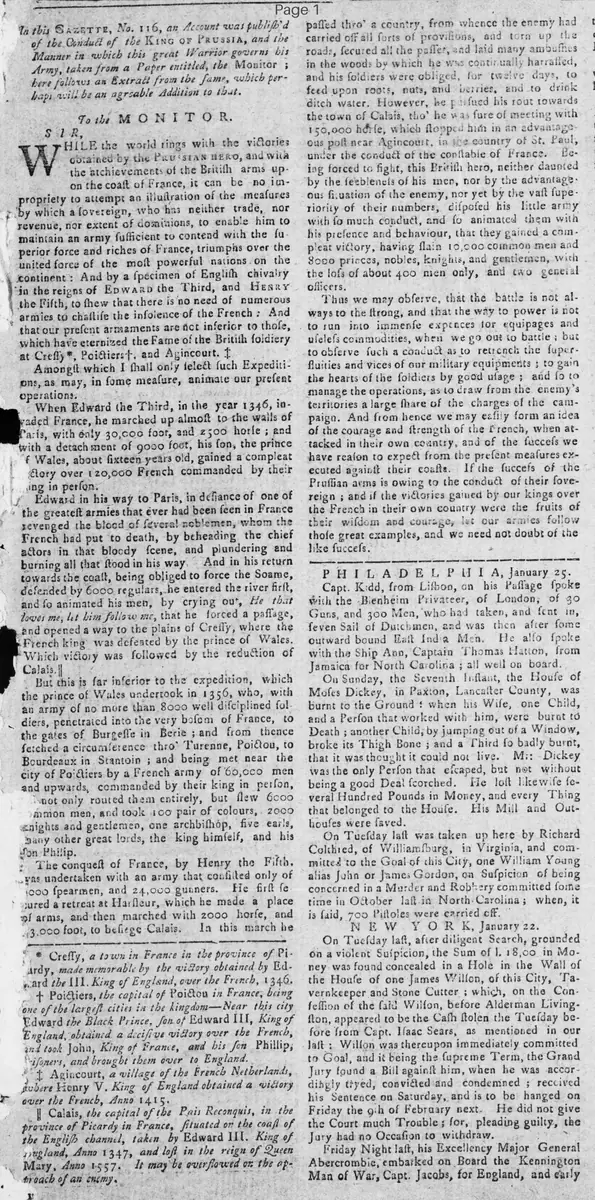
To the M O N I T O R.
SIR,
WHILE the world rings with the victories obtained by the Prussian armies, and with the atchievements of the British arms upon the coast of France, it can be no impropriety to attempt an illustration of the measures by which a sovereign, who has neither trade, nor revenue, nor extent of dominions, to enable him to maintain an army sufficient to contend with the superior force and riches of France, triumphs over the united force of the most powerful nations on the continent: And by a specimen of English chivalry in the reigns of Edward the Third, and Henry the Fifth, to shew that there is no need of numerous armies to chastise the insolence of the French: And that our present armaments are not inferior to those which have eternized the Fame of the British soldiery at Crey*, Poictiers†, and Agincourt.‡
Amongst which I shall only select such Expeditions, as may, in some measure, animate our present operations:
When Edward the Third, in the year 1346, invaded France, he marched up almost to the walls of Paris, with only 30,000 foot, and 2500 horse; and with a detachment of 8000 foot, his son, the prince of Wales, about sixteen years old, gained a compleat Victory over 20,000 French commanded by their King in person.
Edward in his way to Paris, in defiance of one of the greatest armies that ever had been seen in France, avenged the blood of several noblemen, whom the French had put to death, by beheading the chief actors in that bloody scene, and plundering and burning all that stood in his way. And in his return towards the coast, being obliged to force the Somme, defended by 8000 regulars, he entered the river first, and so animated his men, by crying out, He that loves me, let him follow me, that he forced a passage, and opened a way to the plains of Crefy, where the French king was defeated by the prince of Wales.
Which victory was followed by the reduction of Calais.
But this is far inferior to the expedition, which the prince of Wales undertook in 1356, who, with an army of no more than 8000 well disciplined soldiers, penetrated into the very boom of France, to the gates of Bourges in Berri; and from thence stretched a circumference thro' Turenne, Poictou, to Bourdeaux in Xaintion; and being met near the city of Poictiers by a French army of 60,000 men and upwards, commanded by their king in person, not only routed them entirely, but flew 6000 common men, and took 110 pair of colours, 2000 knights and gentlemen, one archbishop, five earls, many other great lords, the king himself, and his son Philip.
The conquest of France, by Henry the Fifth, was undertaken with an army that consisted only of 900 pearmen, and 24,000 gunners. He first secured a retreat at Harleur, which he made a place of arms, and then marched with 2000 horse, and 3000 foot, to besiege Calais. In this march he passed thro' a country, from whence the enemy had carried off all sorts of provisions, and torn up the roads, secured all the passes, and laid many ambushes in the woods by which he was continually harassed, and his soldiers were obliged, for twelve days, to feed upon roots, nuts, and berries, and to drink ditch water. However, he pursued his rout towards the town of Calais, tho' he was sure of meeting with 120,000 horse, which stopped him in an advantageous post near Agincourt, in the country of St. Paul, under the conduct of the constable of France. Being forced to fight, this British hero, neither daunted by the feebleness of his men, nor by the advantageous situation of the enemy, nor yet by the vast superiority of their numbers, disposed his little army with so much conduct, and so animated them with his presence and behaviour, that they gained a compleat victory, having flain 10,000 common men and 5000 princes, nobles, knights, and gentlemen, with the loss of about 400 men only, and two general officers.
Thus we may observe, that the battle is not always to the strong, and that the way to power is not to run into immense expences for equipages and useless commodities, when we go out to battle; but to observe such a conduct as to retrench the superfluities and vices of our military equipments; to gain the hearts of the soldiers by good usage; and so to manage the operations, as to draw from the enemy's territories a large share of the charges of the campaign. And from hence we may easily form an idea of the courage and strength of the French, when attacked in their own country, and of the success we have reason to expect from the present measures executed against their coasts. If the success of the Prussian arms is owing to the conduct of their sovereign; and if the victories gained by our kings over the French in their own country were the fruits of their wisdom and courage, let our armies follow those great examples, and we need not doubt of the like success.
* Crey, a town in France in the province of Picardy, made memorable by the victory obtained by Ed. ward the III. King of England, over the French, in 1346.
† Poictiers, the capital of Poictou in France; being one of the largest cities in the kingdom. Near this city Edward the Black Prince, son of Edward III, King of England, obtained a decisive victory over the French, and took John, King of France, and his son Phillip Prisoners, and brought them over to England.
‡ Agincourt, a village of the French Netherlands, where Henry V. King of England obtained a victory over the French, Anno. 1415.
Calais, the capital of the Pays Reconquis, in the province of Picardy in France, situated on the coast of the English channel, taken by Edward III. King of England, Anno 1347, and lost in the reign of Queen Mary, Anno 1557: It may be overflowed on the approach of an enemy.
What sub-type of article is it?
What keywords are associated?
What entities or persons were involved?
Where did it happen?
Foreign News Details
Primary Location
France
Event Date
1346, 1356, 1415
Key Persons
Outcome
at poictiers: 6000 french common men slain, 110 pair of colours taken, 2000 knights and gentlemen captured, one archbishop, five earls, many lords, king john and son philip captured. at agincourt: 10,000 french common men and 5000 nobles slain, british loss of 400 men and two officers. crecy victory followed by reduction of calais.
Event Details
Extract from 'The Monitor' illustrates Prussian triumphs over continental powers and British coastal actions against France by recounting Edward III's 1346 invasion with 30,000 foot and 2500 horse, leading to victory at Crecy by Prince of Wales over 20,000 French; 1356 Poictiers campaign with 8000 soldiers routing 60,000 French; and Henry V's 1415 Agincourt victory with small force over 120,000 French despite hardships, emphasizing disciplined leadership over numbers.