Thank you for visiting SNEWPapers!
Sign up free
Literary
July 7, 1829
Constitutional Whig
Richmond, Virginia
What is this article about?
Rev. George Croly recounts a feverish night in St. Heliers, Isle of Jersey, marked by medical uncertainty, delirium-induced hallucinations of death, the French Revolution, global adventures, supernatural visions, and eventual recovery, blending personal reflection with vivid dream sequences.
Clipping
OCR Quality
95%
Excellent
Full Text
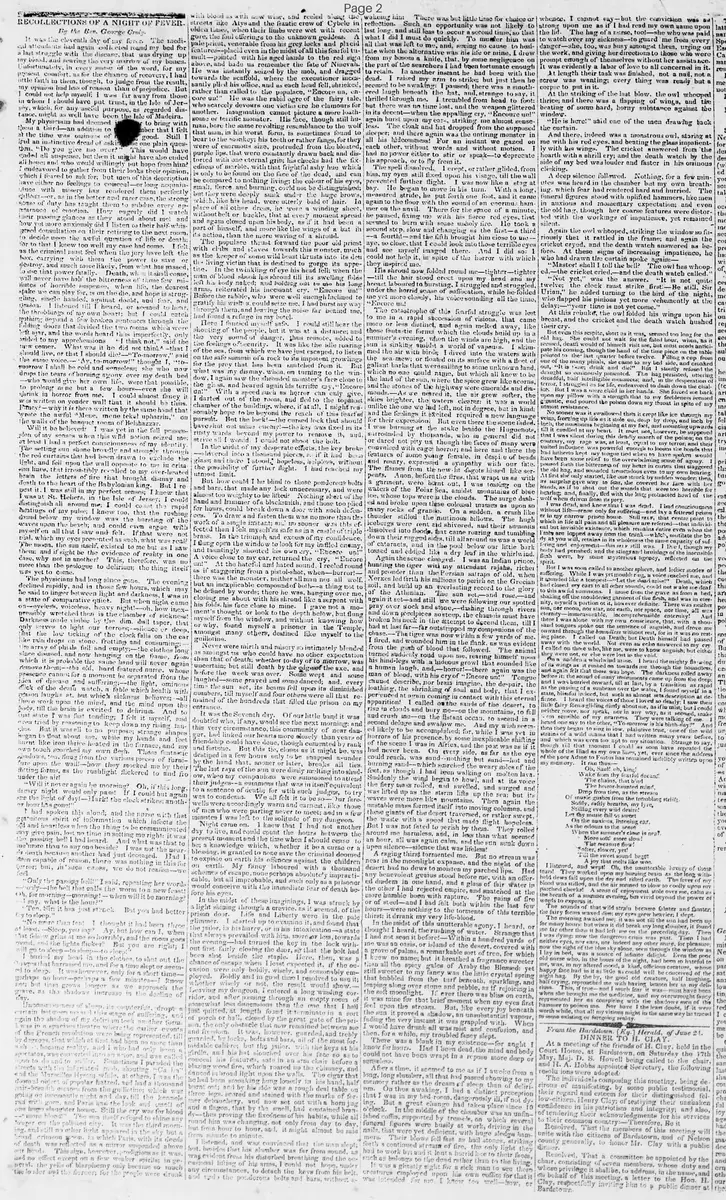
RECOLLECTIONS OF A NIGHT OF FEVER.
By the Rev. George Croly.
It was the eleventh day of my fever. The medical attendants had again collected round my bed for a last struggle with the disease, that was drying up my blood, and searing the very marrow of my bones. Unfortunately, in every sense of the word, for my present comfort, as for the chance of recovery, I had little faith in them, though, to judge from the result, my opinion had less of reason than of prejudice. But I could not help myself; I was far away from those in whom I should have put trust, in the Isle of Jersey, which, for any useful purpose, as regarded distance, might as well have been the Isle of Madeira. My physicians had deemed to bring with them a third—an addition to their number that I felt at the time was ominous of good. Still I had an instinctive dread of asking one plain question, "Do you give me over?"
This would have ended all suspense, but then it might have also ended all hope; and who would willingly put hope from him? I endeavored to gather from their looks their opinion, which I feared to ask for; but men of this description have either no feelings to conceal—or long acquaintance with misery has rendered them perfectly callous—or, as in the better and rarer case, the strong sense of duty has taught them to subdue every appearance of emotion. How eagerly did I watch their passing glances as they stood about me! and how yet more anxiously did I listen to their half-whispered consultation on their retiring to the next room, to decide upon the awful question of life or death: for to that I knew too well my case had come. I felt as the criminal must feel when the jury have left the box, carrying with them the power to save or destroy, and much more likely, from what has passed, to use that power fatally. Death, when it shall come, will never have half the bitterness of those few minutes of horrible suspense, when life, the dearest stake we can play for, is on the die, and hope is struggling, single-handed, against doubt, and fear, and reason. I listened till I heard, or seemed to hear, the throbbings of my own heart; but I could catch nothing beyond a few broken sentences through the folding doors that divided the two rooms which were left ajar, and the words heard thus imperfectly, only added to my apprehensions. "I think not," said the new comer. What was it he did not think—that I should live, or that I should die? "To-morrow," said the same voice.—"Ay, to-morrow!" thought I, "to-morrow I shall be cold and senseless; she who now drops the tears of burning agony over my death-bed—who would give her own life, were that possible, to prolong mine but a few hours—even she will shrink in horror from me. I could almost fancy it was written on yonder wall that it should be thus. Mercy!—why it is there written by the same hand that wrote the awful 'Mene, mene, tekel upharsin,' on the walls of the banquet room of Belshazzar."
Will it be believed? I was yet in the full possession of my senses when this wild notion seized me: at least I had a perfect consciousness of my identity. The setting sun shone broadly and strongly through the red curtains that had been drawn to exclude the light, and fell upon the wall opposite to me in crimson lines, that irresistibly recalled to my over-heated brain the letters of fire that brought dismay and death to the heart of the Babylonian king. But I repeat it, I was still in my perfect senses; I knew that I was at St. Heliers, in the Isle of Jersey: I could distinguish all around me; I could count the rapid beatings of my pulse; I knew too, that the rushing sound below my window was the bursting of the waves upon the beach; and could even argue with myself on all that I saw and felt. If that were not real, which my eyes presented as such, what was real? The moon, the sun itself, existed to me but as I saw them: and if sight be the evidence of reality in one case, why not in another? This, therefore, was no more than the prologue to delirium; the thing itself was yet to come.
The physicians had long since gone. The evening declined rapidly, and in those few hours, which may be said to linger between light and darkness, I was in a state of comparative quiet. But when night came on—eyeless, voiceless, heavy night!—oh, how inexpressibly wretched then is the chamber of sickness! Darkness made visible by the dim, dull taper, that only serves to light our terrors;—silence or deep, that the low ticking of the clock falls on the ear like rain drops on stone, fretting and consuming;—the array of phials full and empty;—the clothes long since disused, and now hanging on the frame, from which it is probable the same hand will never again remove them;—the old, hard-featured nurse, whose presence cannot for a moment be separated from the idea of disease and suffering;—the light, ominous click of the death watch, a fable which health with reason laughs at, but which sickness believes;—all these work upon the mind, and the mind upon the body, till the brain is excited to delirium. And to that state I was fast tending; I felt it myself, and even tried by reasoning to keep down my rising fancies. But it was all to no purpose; strange shapes began to float about me, while my hands and feet burnt like iron thrice heated in the furnace, and my own touch scorched my own flesh. Those fantastic shadows, too, flung from the various pieces of furniture upon the wall!—how they mocked me by their flitting forms, as the rushlight flickered to and fro under the air!
"Will it never again be morning? Oh, if this long, dreary night would only pass! If I could but again see the light of day!—hark! the clock strikes; another hour has gone!"
I had spoken this aloud; and the nurse with that gratuitous spirit of information which infects the cold and heartless when the thing to be communicated may give pain, lost no time in setting me right: it was the passing bell I had heard. And what was that to me more than to any one beside? I was not the nearer death because another had just deceased. Had I been capable of reason, there was nothing in this for terror; but, in such cases, we do not reason—we feel.
"Only the passing bell!" I said, repeating her words—"only—the bell that calls the worm to a new feast! Oh, for morning—morning!—when will it be morning? I say, what is the hour?"
"Ten, Sir: it has just struck. But you had better try to sleep."
"No more than ten! I thought it had been three at least.—Sleep, you say? Ay, but how can I, when that fellow grins at me so horribly, and the room goes round, and the lights flicker? But you are right; I will go to sleep—to sleep—to sleep!"
I buried my head in the clothes, to shut out the jagrs that harassed me, and for a time slept or seemed to sleep. It was however, only for a short time—perhaps an hour—perhaps a few minutes—I know not; but time grows longer as we approach the grave, as the shadows increase in the declining of day.
Unconscious need of sleep, it counterfeit, dropped a curtain between me and this stage of suffering, and again the shadow of my delirium took another form. I was in a spacious theatre where the darker events of the French revolution were being represented, till by degrees, that which at first had been no more than a shadow, became reality, and I who had only been a spectator, was converted into an actor, and was called on to do and to suffer. Sometimes I paraded the streets with the infuriated mob, shouting "Ca ira" and the Marseilles Hymn; while, at others, I was the doomed object of popular hatred, and had a thousand angry eyes fixed upon me from the guillotine: which was going on incessantly night and day, till the kennels ran with gore, and Paris had the look and smell of one huge slaughter house. Still the cry was for blood—"more blood!" This sun itself refused to shine any longer on the polluted city. It was the third morning, and still no other light appeared in the sky but a broad crimson glow, in which Paris, with its deeds of death was reflected as a mirror suspended above our heads. This sign, however, prodigious as it was, had no effect except on a few weaker spirits; in general, the yells of blasphemy only became so much the louder and the fiercer; for the people were drunk with blood as with new wine, and reeled along the streets like Bacchus and the frantic crew of Cybele in olden times, when their limbs were wet with recent gore, the foul offerings to the unknown goddess. A pale priest, venerable from his grey locks and placid features—placidity even in the midst of all this fearful tumult—pointed with his aged hands to the red sign above, and bade us remember the fate of Nineveh. He was instantly seized by the mob, and dragged towards the scaffold, where the executioner incessantly plied his office, and as each head fell, shrieked, rather than called to the populace, "Encore un, encore un!" He was the rabid ogre of the fairy tale, who scarcely devours one victim ere he clamours for another. Imagination cannot picture a more loathsome or terrific monster. His face, though still human, bore the same revolting resemblance to the wolf that man, in his worst form, is sometimes found to bear to the monkey: his teeth—or rather fangs, for they were of enormous size, protruded from the bloated, purple lips, that were constantly drawn back and distorted with one eternal grin; his cheeks had the fixedness of marble, with that frightful ashy hue which is only to be found on the face of the dead, and can be compared to nothing living; the colour of his eyes, small, fierce and burning, could not be distinguished; but they were deeply sunk under the huge brows, which, like his head, were utterly bald of hair. In place of all other dress, he wore a winding sheet, without belt or buckle, that at every moment spread and again closed upon his body, as if it had been a part of himself, and more like the wings of a bat in its action, than the mere waving of a shroud.
The populace thrust forward the poor old priest with clubs and staves towards this monster, much as the keeper of some wild beast thrusts into its den the living victim that is destined to gorge its appetite. In the twinkling of an eye his head fell: when the man of blood shook his shroud till its swelling folds left his body naked; and holding out to me his long arms, reiterated his incessant cry, "Encore un!" Before the rabble, who were well enough inclined to gratify his wish, could seize me, I had burst my way through them, and leaving the noise far behind me, had found a refuge in my hotel.
Here I fancied myself safe. I could still hear the shouting of the people, but it was at a distance; and the very sound of danger, thus remote, added to the feelings of security. "It was like the idle roaring of the sea, from which we have just escaped, to listen on the safe summit of a rock to its impotent growlings for the prey that has been snatched from it. But what was my dismay, when, on turning to the window, I again saw the shroud-headed monster's face close to the glass, and heard again his terrible cry, 'Encore un!' With a speed such as horror can only give, I darted out of the room, and fled to the topmost chamber of the building, where, if at all, I might reasonably hope to be beyond the reach of this fearful pursuit. But the lock!—the cursed lock that should have shut out mine enemy!—the key was fixed in its rusty wards beyond my power to remove it, and, strive all I would, I could not shoot the bolt. In the midst of my desperate efforts, the key broke—shivered into a thousand pieces, as if it had been glass: and there I stood, hopeless, helpless, without the possibility of further flight. I had reached my utmost limit.
But how could I be blind to those ponderous bolts and bars, that made any lock unnecessary, and were almost too weighty to be lifted? Nothing short of the hand and hammer of a blacksmith, and those too plied for hours, could break down a door with such defences. To draw and fasten them was not more than the work of a single instant; and no sooner was this effected than I felt myself as safe as in a castle of triple brass. In the triumph and excess of my confidence, I flung open the window to look for my baffled enemy, and tauntingly shouted his own cry, "Encore un!" A voice close to my ear, returned the cry, "Encore un!" At the hateful and hated sound, I reeled round as if staggering from a pistol-shot, when—horror!—there was the monster, neither all man nor all wolf, but an inexplicable compound of both—a thing not to be defined by words; there he was, hanging over me, closing me about with his shroud like a serpent with his folds, his face close to mine. I gave not a moment's thought or look to the depth below, but flung myself from the window, and without knowing how or why, found myself a prisoner in the Temple, amongst many others, destined like myself to the guillotine.
Never were mirth and misery so intimately blended as amongst us who could have no other expectation than that of death; whether to-day or to-morrow, was uncertain; but still death by the edge of the axe, and before the week was over. Some wept and some laughed—some prayed and some danced; and, every time the sun set, its beams fell upon its diminished numbers, till myself and four others were all that remained of the hundreds that filled the prison on my entrance.
It was the seventh day. Of our little band it was doubtful who, if any, would see the next morning: and this very circumstance, this community of near danger, had linked our hearts more closely than years of friendship could have done, though cemented by rank and fortune. But this tie, close as it might be, was destined in a few hours only to be snapped asunder by the hand that, sooner or later, breaks all ties. The last rays of the sun were dimly melting into shadow, when my companions were summoned to attend their judges—a summons that was in itself equivalent to a sentence of death; for with such judges, to try was to condemn. We all felt it to be so—our farewells were accordingly warm and earnest, like those of men who were parting never to meet; and in a few minutes I was left to the solitude of my dungeon.
Night came on. I knew that I had not another day to live, and could count the hours between the present moment and the time when I should cease to be; a knowledge which, whether it be a curse or a blessing, is granted to none save the criminal doomed to expiate on earth his offences against the children of earth. My fancy laboured with a thousand schemes of escape, none perhaps absolutely impracticable, but all improbable, and such only as a prisoner would conceive with the immediate fear of death before his eyes.
In the midst of these imaginings, I was struck by a light shining through a crevice, as it seemed, of the prison door. "Life and Liberty were in the pale glimmer. I started up to examine it, and found that the jailor, in his hurry, or in his intoxication—a state that always prevailed with him, more or less, towards the evening—had turned the key in the lock without first fairly closing the door, so that the bolt had been shot beside the staple. Here, then, was a chance of escape when I least expected it, if the occasion were only boldly, wisely, and seasonably employed. Boldly and in good time I resolved to use it; whether wisely or not, the result would show.— Leaving my dungeon, I entered a long winding corridor, and after passing through an empty room of somewhat less dimensions than the one that I had just quitted, at length found it terminate in a sort of porch or hall, closed by the great gate of the prison, the only obstacle that now remained between me and freedom. It was, however, guarded, and trebly guarded, by locks, bolts and bars, all of the most formidable calibre but the jailor, with the keys at his girdle, and his hat slouched over his face so as to conceal his features, sat in an arm chair before a blazing wood fire, which roared up the chimney, and danced in broad light upon the walls. The cigar that he had been smoking hung loosely in his hand, half burnt out; and by his side was a rough deal table on three legs, scored and stained with the marks of former debauchery, and now set out with a horn jug and a flagon, that by the smell, had contained brandy—thus proving the fixedness of his habits, while all around him was changing, not only from day to day, but from hour to hour, and, it might almost be said from minute to minute.
I listened, and was convinced that this man slept; but, besides that his slumber was far from sound, as was evident from his disturbed breathing and the occasional lifting of his arms, I could not hope, under any circumstances, to detach the keys from his belt, and to draw the ponderous bolts and bars, without awakening him. There was but little time for choice or reflection. Such an opportunity was not likely to last long, and still less to occur a second time, so that what I did I must do quickly. To murder him was all that was left to me, and, seeing no cause to hesitate when the alternative was his life or mine, I drew from my bosom a knife, that, by some negligence on the part of the searchers I had been fortunate enough to retain. In another instant he had been with the dead. I raised my arm to strike; but just then he seemed to be awakening: I paused; there was a smothered laugh beneath the hat, and, strange to say, it thrilled through me. I trembled from head to foot: but there was no time lost, and the weapon glittered in its descent—when the appalling cry, "Encore un!" again burst upon my ears, striking me almost senseless. The cloak and hat dropped from the supposed sleeper; and there again was the untiring monster in all his hideousness! For an instant we gazed on each other, without words and without motion. I had no power either to stir or speak—to deprecate his approach, or to fly from it.
The spell dissolved. I crept, or rather glided, from him, my eyes still fixed upon his visage, till the wall prevented further flight. I was now like a stag at bay. He began to move in his turn. With a long, measured stride, he put forth one foot, and it came again to the floor with the sound of an enormous hammer on the anvil. There for the space of a minute, he paused, fixing me with his fierce red eyes, that seemed to burn with some unholy fire. He took a second step, slow and changing as the first—a third—a fourth!—and the fifth brought him close to me—aye, so close, that I could look into those terrible eyes and see myself imaged there. And I did so: I could not help it, in spite of the horror with which they inspired me.
His shroud now folded round me—tighter—tighter—till the hair stood erect upon my head and my breast laboured to bursting, I struggled and struggled, under the horrid sense of suffocation, while he folded me yet more closely, his voice sounding all the time, "Encore un!"
The catastrophe of this fearful struggle was lost to me in a rapid succession of visions, that came more or less distinct, and again melted away, like those fantastic forms which the clouds build up in a summer's evening, when the winds are high, and the sun is sinking amidst a world of vapours. I skimmed the air with birds; I dived into the waters with the sea-mew; or floated on its surface with a fleet of gallant barks that were sailing to some unknown land, which no one could name, but which all knew to be the land of the sun, where the spice grew like acorns, and the stones of the highway were emeralds and diamonds.—As we neared it, the air grew softer, the skies brighter, the waters clearer: it was a world unlike the one we had left, not in degree, but in kind: and the feelings it excited required a new language for their expression. But even there the scene faded. I was burning at the stake beside the Huguenots, surrounded by thousands, who in general did not or dared not pity us, though the faces of many were convulsed with eager horror; and here and there the features of some young female, in despite of beads and rosary, expressed a sympathy with our fate. The flames from the new-lit fagots hissed like serpents. Anon, before the fires, that wrapt us as with a garment, were burnt out, I was tossing on the waters of the Polar Sea, amidst mountains of blue ice, whose tops were in the clouds. The surge dashed and broke upon these colossal masses as upon so many rocks of granite. On a sudden, a crash like thunder stilled the mutinous billows. The huge icebergs were rent and shivered, and their summits dissolved into floods, that came roaring and tumbling down their rugged sides, till all around us was a world of cataracts, and in the pool below our little bark tossed and eddied like a dry leaf in the whirlwind. Again the scene changed. I was an Indian prince, hunting the tiger with my attendant rajahs, richer and prouder than the Persian satraps of old, when Xerxes led forth his millions to perish on the Grecian soil, and build up an everlasting record to the glory of the Athenian. The sun set,—and rose,—and again it set—and still we were following our spotted prey over stock and stone,—dashing through rivers and down precipices so steep, the chamois must have broken his neck in the attempt to descend them, till I had at last far—far outstripped my companions of the chase.—The tiger was now within a few yards of me. I fired, and wounded him in the flank, as was evident from the gush of blood that followed. The animal turned suddenly round upon me, rearing himself upon his hind-legs with a hideous growl that sounded like a human laugh, and,—horror!—there again was the man of blood, with his cry of "Encore un!" Tongue cannot describe, nor brain imagine, the despair, the loathing, the shrinking of soul and body, that I experienced at again coming in contact with this eternal apparition! I called on the sands of the desert, to rise in clouds and bury me—on the mountains, to fall and crush me—on the distant ocean, to ascend in a second deluge and swallow me. And my wish seemed likely to be accomplished; for, while I was yet in the horrors of his presence, by some inexplicable shifting of the scene I was in Africa, and the past was as if it had never been. On every side, as far as the eye could reach, was sand—nothing but sand—hot and burning sand—which scorched the weary soles of the feet, as though I had been walking on molten lava.
Suddenly the wind began to howl, and at its voice the fiery mass rolled, and swelled, and surged and was lifted up as the storm lifts up the sea; but its waves were more like mountains. Then again the unstable mass formed itself into moving columns, and these giants of the desert traversed, or rather swept, the waste with a speed that made flight hopeless. But I was not fated to perish by them. They rolled around me harmless, and, in less than what seemed an hour, all was again calm, and the sun sunk down upon silence—silence that was lifeless!
A raging thirst tormented me. But no stream was near in the moonlight expanse, and the night of the desert had no dews to moisten my parched lips. Had any benevolent genius stood before me, with an offered diadem in one hand, and a glass of fair water in the other I had rejected empire, and snatched at the more humble boon with rapture. The pains of fire or of steel—and I had felt both within the last few hours—were nothing to the torments of this terrible thirst; it drank my very life-blood.
In the midst of this unutterable agony, I heard, or thought I heard, the rushing of water. Strange that I had not seen it before!—Within a hundred yards of me was an oasis, or island of the desert, covered with a grove of palms, a remarkable sort of tree, for which I knew no name; but it breathed a fragrance sweeter than all the spicy gales of Araby the Blessed: yet still sweeter to my fancy was the little crystal spring that bubbled from the turf beneath, sparkling, and leaping along over stone and pebble, as if rejoicing in the soft moonlight. If ever there was bliss on earth, it was mine for that brief moment when my eyes first fell upon the stream. But, like every joy beneath the sun it proved a shadow, an unsubstantial vapour, fading the very instant it was grappled with. When I would have drunk all was mist and confusion, and then, for a while, my troubled fancy slept.
There was a blank in my existence—for aught I know for hours. Had I been dead, the mind and body could not have been wrapt in a repose more deep or senseless.
After a time, it seemed to me as if I awoke from a long, long slumber, all that had passed showing to my memory rather as the dream of sleep than of delirium. On thus awaking, I had a distinct perception that I was in my bed room, dangerously ill, if not dying. But a great change had taken place since ten o'clock. In the middle of the chamber was an unfinished coffin, supported by trestles, on which several funeral figures were busily at work, driving in the nails, that were yet deficient, with huge sledge hammers. Their blows fell fast as hail stones, striking forth a continued stream of fire, the only light they had to work by; and it lent a horrid hue to their faces, such as belongs to the dead rather than to the living: It was a ghastly sight for a sick man to see those creatures employed upon his own coffin; for that it was intended for me, I knew too well—how, or whence, I cannot say—but the conviction was as strong upon me as if I had read my own name upon the lid. The hag of a nurse, too!—she who was paid to watch over my sickness—to guard me from every danger—she, too, was busy amongst them, urging on the work, and giving her directions to those who were prompt enough of themselves without her assistance. It was evidently a labor of love to all concerned in it.
At length their task was finished, not a nail, not a screw was wanting; every thing was ready but a corpse to put in it. At the striking of the last blow, the owl whooped thrice; and there was a flapping of wings, and the beating of some hard, horny substance against the window.
"He is here!" said one of the men drawing back the curtain.
And there, indeed was a monstrous owl, staring at me with his red eyes, and beating the glass impatiently with his wings. The cricket answered from the hearth with a shrill cry; and the death watch by the side of my bed was louder and faster in his ominous clicking.
A deep silence followed. Nothing, for a few minutes was heard in the chamber but my own breathing, which fear had rendered hard and hurried. The funeral figures stood with uplifted hammers, like men in anxious and momentary expectation; and even the old hag, though her coarse features were distorted with the workings of impatience, yet remained silent.
Again the owl whooped, striking the window so furiously that it rattled in the frame; and again the cricket cried, and the death watch answered as before. At these signs of increasing impatience, he who had drawn the curtain spoke again:-
"Master! shall I toll the bell? The owl has whooped.—the cricket cried,—and the death watch called."
"Not yet," was the answer. "It is not quite twelve; the clock must strike first:- Be still, Sir Urian," he added turning to the bird of the night, who flapped his pinions yet more vehemently at the delay;—"your time is not yet come."
At this rebuke, the owl folded his wings upon his breast, and the cricket and the death watch hushed their cry.
But even this respite, short as it was, seemed too long for the old hag. She could not wait for the fated hour, when, as it seemed, death would of himself visit me, but must needs anticipate his coming, though the hand of the time piece on the table pointed to the last quarter before twelve. Filling a cup from one of the many phials, she came to my bed side, and croaked out, "It is time; drink and die!" But I stoutly refused the draught so ominously presented. The hag persisted, uttering dreadful, half intelligible menaces; and, in the desperation of terror, I struggled as for life, endeavored to dash down the chalice. But I was a mere child in her hands. She forced me back upon my pillow with a strength that to my feebleness seemed gigantic, and poured the poison down my throat in spite of my utmost resistance.
No sooner was it swallowed than it crept like ice through my veins, freezing up life as it stole on, drop by drop, and inch by inch, the numbness beginning at my feet, and mounting upwards till it curdled at my heart. it must not, however, be supposed that I was silent during this deadly march of the poison; on the contrary, my rage was, at least, equal to my terror; and their united influence was powerful enough to loosen the bonds that had hitherto kept my tongue tied when to have spoken would have been some relief to the overwhelming sense of agony. I poured forth the bitterness of my heart in curses that staggered the old hag, and sounded tremendous even to my own hearing. At first she only started, like one struck by sudden wonder; then, as surprise gave way to fear, she covered her face with her hands, as if to shut out the sounds that were too horrible for hearing: and, finally, fled with the long protracted howl of the wolf when driven from its prey.
I was dead, and knew that I was dead. I had consciousness without life—sense only for suffering—and lay a fettered prisoner in my narrow prison house. Still self, that centre point to which in life all pain and all pleasure are referred—that individual but invisible existence, which remains entire even when the limbs are lapped away from the trunk—which mutilate the body as you will, retains in its wholeness the same capacity of suffering and enjoyment—this soul still was. I felt, though my body had perished: and the stings and bruises of the insensible flesh were, by some mysterious agency, reflected on the spirit.
But I was soon called to another sphere, and loftier mode of suffering. While I was yet mouldering, a voice reached me, and it sounded like a tempest—"Let the dead arise!" Death, which had closed my ears to all other sounds, could not make me deaf to this awful summons. I arose from the grave as from a bed, shaking off the mouldering garment of the flesh, and was in eternity, myself a portion of it, however definite. There was neither sun, nor moon, nor star, nor earth, nor space, nor time, all was eternity—immeasurable, incomprehensible eternity! There I was alone with my own conscience, that, with a thousand tongues spoke out the sentence of anguish, and drove me onward through the boundless without rest, for in it was no resting place. I called on Death; but Death himself had passed away with the world. Not even an echo answered to my cry. I called on those who, like me, were to know anguish; but either they were not, or else were lost in the void.
On a sudden a whirlwind arose. I heard the mighty flapping of its wings as it rushed on towards me through the boundless, and again felt that there was hope. The darkness rolled away before it: the sound of many instruments came up from the deep: and I was hurried onward, till at last, by a transition as rapid as the passing of a sunbeam over the water, I found myself in a state, blissful indeed, but such as almost sets description at defiance. I heard the voices of those I loved so dearly; I saw their little fairy forms gliding dimly about me, as if in mist; but I could neither move, nor speak, nor in any way, as it seemed, make them sensible of my nearness. They were talking of me. I heard one say to the other, "To-morrow is his birthday!" And then they began to sing in low, plaintive tone, one of the wild strains of a wild drama that I had written many years before, and which was even too apt to my situation. Strange to say, though till that moment I could as soon have repeated the whole of the Iliad as my own lines, yet, ever since the address of the poor Adine to Faustus has remained indelibly written upon my memory.
It ran thus:-
Oh, Saul! oh, king!
Wake from thy fearful dream?
The chains, that bind
The horror-haunted mind.
Drop from thee, as the stream
Of music gushes from the trembling string
Softly, softly breathe, my lyre
Stilling every wild desire!
Let thy music fall as sweet
On the anxious, listening ear,
As the odours to the sense
When the summer's close is near
More soft! more slow!
The measure flow!
Softer, slower, yet!
'Till the sweet sound beget
A joy that melts like woe.
I listened, and wept! Oh, the unutterable luxury of those tears! They worked upon my burning brain as the long withheld dews fall upon the dry and rifted earth. The fever of my blood was stilled, and the air seemed to blow so coolly upon my parched cheeks! A sense of enjoyment stole over me, calm as the breath of a summer evening, but vivid beyond the power of words to express it.
The sounds of that wild strain became fainter and fainter the fairy forms waxed dim; my eyes grew heavier; I slept.
The morning awaked me; it was not till the sun had been up for many hours but when it did break my long slumber, it found me far other than it had left me on the preceding day. Then I was dying: now the dangerous crisis was past. Then I had neither eyes, nor ears, nor indeed any other sense, for pleasure; now the sight of the blue sky alone, seen through the window as I lay in bed, was a source of infinite delight. Even the poor old nurse who, in the hours of the night, had been so hateful to me, was, in my altered mood, a kind, officious creature, whose happy face had in it as little as could well be conceived of the night hag. By the by, the good old creature, half laughing, half crying, reproached me with having beaten her in my delirium. This, if true—and I much fear it was—must have been when she brought me the medicine, and my overwrought fancy represented her as conspiring with the shadowy men of the hammer to poison me. Nor have I the least doubt, if it were worth while, that all my visions might in the same way be traced to some existing or foregoing reality.
By the Rev. George Croly.
It was the eleventh day of my fever. The medical attendants had again collected round my bed for a last struggle with the disease, that was drying up my blood, and searing the very marrow of my bones. Unfortunately, in every sense of the word, for my present comfort, as for the chance of recovery, I had little faith in them, though, to judge from the result, my opinion had less of reason than of prejudice. But I could not help myself; I was far away from those in whom I should have put trust, in the Isle of Jersey, which, for any useful purpose, as regarded distance, might as well have been the Isle of Madeira. My physicians had deemed to bring with them a third—an addition to their number that I felt at the time was ominous of good. Still I had an instinctive dread of asking one plain question, "Do you give me over?"
This would have ended all suspense, but then it might have also ended all hope; and who would willingly put hope from him? I endeavored to gather from their looks their opinion, which I feared to ask for; but men of this description have either no feelings to conceal—or long acquaintance with misery has rendered them perfectly callous—or, as in the better and rarer case, the strong sense of duty has taught them to subdue every appearance of emotion. How eagerly did I watch their passing glances as they stood about me! and how yet more anxiously did I listen to their half-whispered consultation on their retiring to the next room, to decide upon the awful question of life or death: for to that I knew too well my case had come. I felt as the criminal must feel when the jury have left the box, carrying with them the power to save or destroy, and much more likely, from what has passed, to use that power fatally. Death, when it shall come, will never have half the bitterness of those few minutes of horrible suspense, when life, the dearest stake we can play for, is on the die, and hope is struggling, single-handed, against doubt, and fear, and reason. I listened till I heard, or seemed to hear, the throbbings of my own heart; but I could catch nothing beyond a few broken sentences through the folding doors that divided the two rooms which were left ajar, and the words heard thus imperfectly, only added to my apprehensions. "I think not," said the new comer. What was it he did not think—that I should live, or that I should die? "To-morrow," said the same voice.—"Ay, to-morrow!" thought I, "to-morrow I shall be cold and senseless; she who now drops the tears of burning agony over my death-bed—who would give her own life, were that possible, to prolong mine but a few hours—even she will shrink in horror from me. I could almost fancy it was written on yonder wall that it should be thus. Mercy!—why it is there written by the same hand that wrote the awful 'Mene, mene, tekel upharsin,' on the walls of the banquet room of Belshazzar."
Will it be believed? I was yet in the full possession of my senses when this wild notion seized me: at least I had a perfect consciousness of my identity. The setting sun shone broadly and strongly through the red curtains that had been drawn to exclude the light, and fell upon the wall opposite to me in crimson lines, that irresistibly recalled to my over-heated brain the letters of fire that brought dismay and death to the heart of the Babylonian king. But I repeat it, I was still in my perfect senses; I knew that I was at St. Heliers, in the Isle of Jersey: I could distinguish all around me; I could count the rapid beatings of my pulse; I knew too, that the rushing sound below my window was the bursting of the waves upon the beach; and could even argue with myself on all that I saw and felt. If that were not real, which my eyes presented as such, what was real? The moon, the sun itself, existed to me but as I saw them: and if sight be the evidence of reality in one case, why not in another? This, therefore, was no more than the prologue to delirium; the thing itself was yet to come.
The physicians had long since gone. The evening declined rapidly, and in those few hours, which may be said to linger between light and darkness, I was in a state of comparative quiet. But when night came on—eyeless, voiceless, heavy night!—oh, how inexpressibly wretched then is the chamber of sickness! Darkness made visible by the dim, dull taper, that only serves to light our terrors;—silence or deep, that the low ticking of the clock falls on the ear like rain drops on stone, fretting and consuming;—the array of phials full and empty;—the clothes long since disused, and now hanging on the frame, from which it is probable the same hand will never again remove them;—the old, hard-featured nurse, whose presence cannot for a moment be separated from the idea of disease and suffering;—the light, ominous click of the death watch, a fable which health with reason laughs at, but which sickness believes;—all these work upon the mind, and the mind upon the body, till the brain is excited to delirium. And to that state I was fast tending; I felt it myself, and even tried by reasoning to keep down my rising fancies. But it was all to no purpose; strange shapes began to float about me, while my hands and feet burnt like iron thrice heated in the furnace, and my own touch scorched my own flesh. Those fantastic shadows, too, flung from the various pieces of furniture upon the wall!—how they mocked me by their flitting forms, as the rushlight flickered to and fro under the air!
"Will it never again be morning? Oh, if this long, dreary night would only pass! If I could but again see the light of day!—hark! the clock strikes; another hour has gone!"
I had spoken this aloud; and the nurse with that gratuitous spirit of information which infects the cold and heartless when the thing to be communicated may give pain, lost no time in setting me right: it was the passing bell I had heard. And what was that to me more than to any one beside? I was not the nearer death because another had just deceased. Had I been capable of reason, there was nothing in this for terror; but, in such cases, we do not reason—we feel.
"Only the passing bell!" I said, repeating her words—"only—the bell that calls the worm to a new feast! Oh, for morning—morning!—when will it be morning? I say, what is the hour?"
"Ten, Sir: it has just struck. But you had better try to sleep."
"No more than ten! I thought it had been three at least.—Sleep, you say? Ay, but how can I, when that fellow grins at me so horribly, and the room goes round, and the lights flicker? But you are right; I will go to sleep—to sleep—to sleep!"
I buried my head in the clothes, to shut out the jagrs that harassed me, and for a time slept or seemed to sleep. It was however, only for a short time—perhaps an hour—perhaps a few minutes—I know not; but time grows longer as we approach the grave, as the shadows increase in the declining of day.
Unconscious need of sleep, it counterfeit, dropped a curtain between me and this stage of suffering, and again the shadow of my delirium took another form. I was in a spacious theatre where the darker events of the French revolution were being represented, till by degrees, that which at first had been no more than a shadow, became reality, and I who had only been a spectator, was converted into an actor, and was called on to do and to suffer. Sometimes I paraded the streets with the infuriated mob, shouting "Ca ira" and the Marseilles Hymn; while, at others, I was the doomed object of popular hatred, and had a thousand angry eyes fixed upon me from the guillotine: which was going on incessantly night and day, till the kennels ran with gore, and Paris had the look and smell of one huge slaughter house. Still the cry was for blood—"more blood!" This sun itself refused to shine any longer on the polluted city. It was the third morning, and still no other light appeared in the sky but a broad crimson glow, in which Paris, with its deeds of death was reflected as a mirror suspended above our heads. This sign, however, prodigious as it was, had no effect except on a few weaker spirits; in general, the yells of blasphemy only became so much the louder and the fiercer; for the people were drunk with blood as with new wine, and reeled along the streets like Bacchus and the frantic crew of Cybele in olden times, when their limbs were wet with recent gore, the foul offerings to the unknown goddess. A pale priest, venerable from his grey locks and placid features—placidity even in the midst of all this fearful tumult—pointed with his aged hands to the red sign above, and bade us remember the fate of Nineveh. He was instantly seized by the mob, and dragged towards the scaffold, where the executioner incessantly plied his office, and as each head fell, shrieked, rather than called to the populace, "Encore un, encore un!" He was the rabid ogre of the fairy tale, who scarcely devours one victim ere he clamours for another. Imagination cannot picture a more loathsome or terrific monster. His face, though still human, bore the same revolting resemblance to the wolf that man, in his worst form, is sometimes found to bear to the monkey: his teeth—or rather fangs, for they were of enormous size, protruded from the bloated, purple lips, that were constantly drawn back and distorted with one eternal grin; his cheeks had the fixedness of marble, with that frightful ashy hue which is only to be found on the face of the dead, and can be compared to nothing living; the colour of his eyes, small, fierce and burning, could not be distinguished; but they were deeply sunk under the huge brows, which, like his head, were utterly bald of hair. In place of all other dress, he wore a winding sheet, without belt or buckle, that at every moment spread and again closed upon his body, as if it had been a part of himself, and more like the wings of a bat in its action, than the mere waving of a shroud.
The populace thrust forward the poor old priest with clubs and staves towards this monster, much as the keeper of some wild beast thrusts into its den the living victim that is destined to gorge its appetite. In the twinkling of an eye his head fell: when the man of blood shook his shroud till its swelling folds left his body naked; and holding out to me his long arms, reiterated his incessant cry, "Encore un!" Before the rabble, who were well enough inclined to gratify his wish, could seize me, I had burst my way through them, and leaving the noise far behind me, had found a refuge in my hotel.
Here I fancied myself safe. I could still hear the shouting of the people, but it was at a distance; and the very sound of danger, thus remote, added to the feelings of security. "It was like the idle roaring of the sea, from which we have just escaped, to listen on the safe summit of a rock to its impotent growlings for the prey that has been snatched from it. But what was my dismay, when, on turning to the window, I again saw the shroud-headed monster's face close to the glass, and heard again his terrible cry, 'Encore un!' With a speed such as horror can only give, I darted out of the room, and fled to the topmost chamber of the building, where, if at all, I might reasonably hope to be beyond the reach of this fearful pursuit. But the lock!—the cursed lock that should have shut out mine enemy!—the key was fixed in its rusty wards beyond my power to remove it, and, strive all I would, I could not shoot the bolt. In the midst of my desperate efforts, the key broke—shivered into a thousand pieces, as if it had been glass: and there I stood, hopeless, helpless, without the possibility of further flight. I had reached my utmost limit.
But how could I be blind to those ponderous bolts and bars, that made any lock unnecessary, and were almost too weighty to be lifted? Nothing short of the hand and hammer of a blacksmith, and those too plied for hours, could break down a door with such defences. To draw and fasten them was not more than the work of a single instant; and no sooner was this effected than I felt myself as safe as in a castle of triple brass. In the triumph and excess of my confidence, I flung open the window to look for my baffled enemy, and tauntingly shouted his own cry, "Encore un!" A voice close to my ear, returned the cry, "Encore un!" At the hateful and hated sound, I reeled round as if staggering from a pistol-shot, when—horror!—there was the monster, neither all man nor all wolf, but an inexplicable compound of both—a thing not to be defined by words; there he was, hanging over me, closing me about with his shroud like a serpent with his folds, his face close to mine. I gave not a moment's thought or look to the depth below, but flung myself from the window, and without knowing how or why, found myself a prisoner in the Temple, amongst many others, destined like myself to the guillotine.
Never were mirth and misery so intimately blended as amongst us who could have no other expectation than that of death; whether to-day or to-morrow, was uncertain; but still death by the edge of the axe, and before the week was over. Some wept and some laughed—some prayed and some danced; and, every time the sun set, its beams fell upon its diminished numbers, till myself and four others were all that remained of the hundreds that filled the prison on my entrance.
It was the seventh day. Of our little band it was doubtful who, if any, would see the next morning: and this very circumstance, this community of near danger, had linked our hearts more closely than years of friendship could have done, though cemented by rank and fortune. But this tie, close as it might be, was destined in a few hours only to be snapped asunder by the hand that, sooner or later, breaks all ties. The last rays of the sun were dimly melting into shadow, when my companions were summoned to attend their judges—a summons that was in itself equivalent to a sentence of death; for with such judges, to try was to condemn. We all felt it to be so—our farewells were accordingly warm and earnest, like those of men who were parting never to meet; and in a few minutes I was left to the solitude of my dungeon.
Night came on. I knew that I had not another day to live, and could count the hours between the present moment and the time when I should cease to be; a knowledge which, whether it be a curse or a blessing, is granted to none save the criminal doomed to expiate on earth his offences against the children of earth. My fancy laboured with a thousand schemes of escape, none perhaps absolutely impracticable, but all improbable, and such only as a prisoner would conceive with the immediate fear of death before his eyes.
In the midst of these imaginings, I was struck by a light shining through a crevice, as it seemed, of the prison door. "Life and Liberty were in the pale glimmer. I started up to examine it, and found that the jailor, in his hurry, or in his intoxication—a state that always prevailed with him, more or less, towards the evening—had turned the key in the lock without first fairly closing the door, so that the bolt had been shot beside the staple. Here, then, was a chance of escape when I least expected it, if the occasion were only boldly, wisely, and seasonably employed. Boldly and in good time I resolved to use it; whether wisely or not, the result would show.— Leaving my dungeon, I entered a long winding corridor, and after passing through an empty room of somewhat less dimensions than the one that I had just quitted, at length found it terminate in a sort of porch or hall, closed by the great gate of the prison, the only obstacle that now remained between me and freedom. It was, however, guarded, and trebly guarded, by locks, bolts and bars, all of the most formidable calibre but the jailor, with the keys at his girdle, and his hat slouched over his face so as to conceal his features, sat in an arm chair before a blazing wood fire, which roared up the chimney, and danced in broad light upon the walls. The cigar that he had been smoking hung loosely in his hand, half burnt out; and by his side was a rough deal table on three legs, scored and stained with the marks of former debauchery, and now set out with a horn jug and a flagon, that by the smell, had contained brandy—thus proving the fixedness of his habits, while all around him was changing, not only from day to day, but from hour to hour, and, it might almost be said from minute to minute.
I listened, and was convinced that this man slept; but, besides that his slumber was far from sound, as was evident from his disturbed breathing and the occasional lifting of his arms, I could not hope, under any circumstances, to detach the keys from his belt, and to draw the ponderous bolts and bars, without awakening him. There was but little time for choice or reflection. Such an opportunity was not likely to last long, and still less to occur a second time, so that what I did I must do quickly. To murder him was all that was left to me, and, seeing no cause to hesitate when the alternative was his life or mine, I drew from my bosom a knife, that, by some negligence on the part of the searchers I had been fortunate enough to retain. In another instant he had been with the dead. I raised my arm to strike; but just then he seemed to be awakening: I paused; there was a smothered laugh beneath the hat, and, strange to say, it thrilled through me. I trembled from head to foot: but there was no time lost, and the weapon glittered in its descent—when the appalling cry, "Encore un!" again burst upon my ears, striking me almost senseless. The cloak and hat dropped from the supposed sleeper; and there again was the untiring monster in all his hideousness! For an instant we gazed on each other, without words and without motion. I had no power either to stir or speak—to deprecate his approach, or to fly from it.
The spell dissolved. I crept, or rather glided, from him, my eyes still fixed upon his visage, till the wall prevented further flight. I was now like a stag at bay. He began to move in his turn. With a long, measured stride, he put forth one foot, and it came again to the floor with the sound of an enormous hammer on the anvil. There for the space of a minute, he paused, fixing me with his fierce red eyes, that seemed to burn with some unholy fire. He took a second step, slow and changing as the first—a third—a fourth!—and the fifth brought him close to me—aye, so close, that I could look into those terrible eyes and see myself imaged there. And I did so: I could not help it, in spite of the horror with which they inspired me.
His shroud now folded round me—tighter—tighter—till the hair stood erect upon my head and my breast laboured to bursting, I struggled and struggled, under the horrid sense of suffocation, while he folded me yet more closely, his voice sounding all the time, "Encore un!"
The catastrophe of this fearful struggle was lost to me in a rapid succession of visions, that came more or less distinct, and again melted away, like those fantastic forms which the clouds build up in a summer's evening, when the winds are high, and the sun is sinking amidst a world of vapours. I skimmed the air with birds; I dived into the waters with the sea-mew; or floated on its surface with a fleet of gallant barks that were sailing to some unknown land, which no one could name, but which all knew to be the land of the sun, where the spice grew like acorns, and the stones of the highway were emeralds and diamonds.—As we neared it, the air grew softer, the skies brighter, the waters clearer: it was a world unlike the one we had left, not in degree, but in kind: and the feelings it excited required a new language for their expression. But even there the scene faded. I was burning at the stake beside the Huguenots, surrounded by thousands, who in general did not or dared not pity us, though the faces of many were convulsed with eager horror; and here and there the features of some young female, in despite of beads and rosary, expressed a sympathy with our fate. The flames from the new-lit fagots hissed like serpents. Anon, before the fires, that wrapt us as with a garment, were burnt out, I was tossing on the waters of the Polar Sea, amidst mountains of blue ice, whose tops were in the clouds. The surge dashed and broke upon these colossal masses as upon so many rocks of granite. On a sudden, a crash like thunder stilled the mutinous billows. The huge icebergs were rent and shivered, and their summits dissolved into floods, that came roaring and tumbling down their rugged sides, till all around us was a world of cataracts, and in the pool below our little bark tossed and eddied like a dry leaf in the whirlwind. Again the scene changed. I was an Indian prince, hunting the tiger with my attendant rajahs, richer and prouder than the Persian satraps of old, when Xerxes led forth his millions to perish on the Grecian soil, and build up an everlasting record to the glory of the Athenian. The sun set,—and rose,—and again it set—and still we were following our spotted prey over stock and stone,—dashing through rivers and down precipices so steep, the chamois must have broken his neck in the attempt to descend them, till I had at last far—far outstripped my companions of the chase.—The tiger was now within a few yards of me. I fired, and wounded him in the flank, as was evident from the gush of blood that followed. The animal turned suddenly round upon me, rearing himself upon his hind-legs with a hideous growl that sounded like a human laugh, and,—horror!—there again was the man of blood, with his cry of "Encore un!" Tongue cannot describe, nor brain imagine, the despair, the loathing, the shrinking of soul and body, that I experienced at again coming in contact with this eternal apparition! I called on the sands of the desert, to rise in clouds and bury me—on the mountains, to fall and crush me—on the distant ocean, to ascend in a second deluge and swallow me. And my wish seemed likely to be accomplished; for, while I was yet in the horrors of his presence, by some inexplicable shifting of the scene I was in Africa, and the past was as if it had never been. On every side, as far as the eye could reach, was sand—nothing but sand—hot and burning sand—which scorched the weary soles of the feet, as though I had been walking on molten lava.
Suddenly the wind began to howl, and at its voice the fiery mass rolled, and swelled, and surged and was lifted up as the storm lifts up the sea; but its waves were more like mountains. Then again the unstable mass formed itself into moving columns, and these giants of the desert traversed, or rather swept, the waste with a speed that made flight hopeless. But I was not fated to perish by them. They rolled around me harmless, and, in less than what seemed an hour, all was again calm, and the sun sunk down upon silence—silence that was lifeless!
A raging thirst tormented me. But no stream was near in the moonlight expanse, and the night of the desert had no dews to moisten my parched lips. Had any benevolent genius stood before me, with an offered diadem in one hand, and a glass of fair water in the other I had rejected empire, and snatched at the more humble boon with rapture. The pains of fire or of steel—and I had felt both within the last few hours—were nothing to the torments of this terrible thirst; it drank my very life-blood.
In the midst of this unutterable agony, I heard, or thought I heard, the rushing of water. Strange that I had not seen it before!—Within a hundred yards of me was an oasis, or island of the desert, covered with a grove of palms, a remarkable sort of tree, for which I knew no name; but it breathed a fragrance sweeter than all the spicy gales of Araby the Blessed: yet still sweeter to my fancy was the little crystal spring that bubbled from the turf beneath, sparkling, and leaping along over stone and pebble, as if rejoicing in the soft moonlight. If ever there was bliss on earth, it was mine for that brief moment when my eyes first fell upon the stream. But, like every joy beneath the sun it proved a shadow, an unsubstantial vapour, fading the very instant it was grappled with. When I would have drunk all was mist and confusion, and then, for a while, my troubled fancy slept.
There was a blank in my existence—for aught I know for hours. Had I been dead, the mind and body could not have been wrapt in a repose more deep or senseless.
After a time, it seemed to me as if I awoke from a long, long slumber, all that had passed showing to my memory rather as the dream of sleep than of delirium. On thus awaking, I had a distinct perception that I was in my bed room, dangerously ill, if not dying. But a great change had taken place since ten o'clock. In the middle of the chamber was an unfinished coffin, supported by trestles, on which several funeral figures were busily at work, driving in the nails, that were yet deficient, with huge sledge hammers. Their blows fell fast as hail stones, striking forth a continued stream of fire, the only light they had to work by; and it lent a horrid hue to their faces, such as belongs to the dead rather than to the living: It was a ghastly sight for a sick man to see those creatures employed upon his own coffin; for that it was intended for me, I knew too well—how, or whence, I cannot say—but the conviction was as strong upon me as if I had read my own name upon the lid. The hag of a nurse, too!—she who was paid to watch over my sickness—to guard me from every danger—she, too, was busy amongst them, urging on the work, and giving her directions to those who were prompt enough of themselves without her assistance. It was evidently a labor of love to all concerned in it.
At length their task was finished, not a nail, not a screw was wanting; every thing was ready but a corpse to put in it. At the striking of the last blow, the owl whooped thrice; and there was a flapping of wings, and the beating of some hard, horny substance against the window.
"He is here!" said one of the men drawing back the curtain.
And there, indeed was a monstrous owl, staring at me with his red eyes, and beating the glass impatiently with his wings. The cricket answered from the hearth with a shrill cry; and the death watch by the side of my bed was louder and faster in his ominous clicking.
A deep silence followed. Nothing, for a few minutes was heard in the chamber but my own breathing, which fear had rendered hard and hurried. The funeral figures stood with uplifted hammers, like men in anxious and momentary expectation; and even the old hag, though her coarse features were distorted with the workings of impatience, yet remained silent.
Again the owl whooped, striking the window so furiously that it rattled in the frame; and again the cricket cried, and the death watch answered as before. At these signs of increasing impatience, he who had drawn the curtain spoke again:-
"Master! shall I toll the bell? The owl has whooped.—the cricket cried,—and the death watch called."
"Not yet," was the answer. "It is not quite twelve; the clock must strike first:- Be still, Sir Urian," he added turning to the bird of the night, who flapped his pinions yet more vehemently at the delay;—"your time is not yet come."
At this rebuke, the owl folded his wings upon his breast, and the cricket and the death watch hushed their cry.
But even this respite, short as it was, seemed too long for the old hag. She could not wait for the fated hour, when, as it seemed, death would of himself visit me, but must needs anticipate his coming, though the hand of the time piece on the table pointed to the last quarter before twelve. Filling a cup from one of the many phials, she came to my bed side, and croaked out, "It is time; drink and die!" But I stoutly refused the draught so ominously presented. The hag persisted, uttering dreadful, half intelligible menaces; and, in the desperation of terror, I struggled as for life, endeavored to dash down the chalice. But I was a mere child in her hands. She forced me back upon my pillow with a strength that to my feebleness seemed gigantic, and poured the poison down my throat in spite of my utmost resistance.
No sooner was it swallowed than it crept like ice through my veins, freezing up life as it stole on, drop by drop, and inch by inch, the numbness beginning at my feet, and mounting upwards till it curdled at my heart. it must not, however, be supposed that I was silent during this deadly march of the poison; on the contrary, my rage was, at least, equal to my terror; and their united influence was powerful enough to loosen the bonds that had hitherto kept my tongue tied when to have spoken would have been some relief to the overwhelming sense of agony. I poured forth the bitterness of my heart in curses that staggered the old hag, and sounded tremendous even to my own hearing. At first she only started, like one struck by sudden wonder; then, as surprise gave way to fear, she covered her face with her hands, as if to shut out the sounds that were too horrible for hearing: and, finally, fled with the long protracted howl of the wolf when driven from its prey.
I was dead, and knew that I was dead. I had consciousness without life—sense only for suffering—and lay a fettered prisoner in my narrow prison house. Still self, that centre point to which in life all pain and all pleasure are referred—that individual but invisible existence, which remains entire even when the limbs are lapped away from the trunk—which mutilate the body as you will, retains in its wholeness the same capacity of suffering and enjoyment—this soul still was. I felt, though my body had perished: and the stings and bruises of the insensible flesh were, by some mysterious agency, reflected on the spirit.
But I was soon called to another sphere, and loftier mode of suffering. While I was yet mouldering, a voice reached me, and it sounded like a tempest—"Let the dead arise!" Death, which had closed my ears to all other sounds, could not make me deaf to this awful summons. I arose from the grave as from a bed, shaking off the mouldering garment of the flesh, and was in eternity, myself a portion of it, however definite. There was neither sun, nor moon, nor star, nor earth, nor space, nor time, all was eternity—immeasurable, incomprehensible eternity! There I was alone with my own conscience, that, with a thousand tongues spoke out the sentence of anguish, and drove me onward through the boundless without rest, for in it was no resting place. I called on Death; but Death himself had passed away with the world. Not even an echo answered to my cry. I called on those who, like me, were to know anguish; but either they were not, or else were lost in the void.
On a sudden a whirlwind arose. I heard the mighty flapping of its wings as it rushed on towards me through the boundless, and again felt that there was hope. The darkness rolled away before it: the sound of many instruments came up from the deep: and I was hurried onward, till at last, by a transition as rapid as the passing of a sunbeam over the water, I found myself in a state, blissful indeed, but such as almost sets description at defiance. I heard the voices of those I loved so dearly; I saw their little fairy forms gliding dimly about me, as if in mist; but I could neither move, nor speak, nor in any way, as it seemed, make them sensible of my nearness. They were talking of me. I heard one say to the other, "To-morrow is his birthday!" And then they began to sing in low, plaintive tone, one of the wild strains of a wild drama that I had written many years before, and which was even too apt to my situation. Strange to say, though till that moment I could as soon have repeated the whole of the Iliad as my own lines, yet, ever since the address of the poor Adine to Faustus has remained indelibly written upon my memory.
It ran thus:-
Oh, Saul! oh, king!
Wake from thy fearful dream?
The chains, that bind
The horror-haunted mind.
Drop from thee, as the stream
Of music gushes from the trembling string
Softly, softly breathe, my lyre
Stilling every wild desire!
Let thy music fall as sweet
On the anxious, listening ear,
As the odours to the sense
When the summer's close is near
More soft! more slow!
The measure flow!
Softer, slower, yet!
'Till the sweet sound beget
A joy that melts like woe.
I listened, and wept! Oh, the unutterable luxury of those tears! They worked upon my burning brain as the long withheld dews fall upon the dry and rifted earth. The fever of my blood was stilled, and the air seemed to blow so coolly upon my parched cheeks! A sense of enjoyment stole over me, calm as the breath of a summer evening, but vivid beyond the power of words to express it.
The sounds of that wild strain became fainter and fainter the fairy forms waxed dim; my eyes grew heavier; I slept.
The morning awaked me; it was not till the sun had been up for many hours but when it did break my long slumber, it found me far other than it had left me on the preceding day. Then I was dying: now the dangerous crisis was past. Then I had neither eyes, nor ears, nor indeed any other sense, for pleasure; now the sight of the blue sky alone, seen through the window as I lay in bed, was a source of infinite delight. Even the poor old nurse who, in the hours of the night, had been so hateful to me, was, in my altered mood, a kind, officious creature, whose happy face had in it as little as could well be conceived of the night hag. By the by, the good old creature, half laughing, half crying, reproached me with having beaten her in my delirium. This, if true—and I much fear it was—must have been when she brought me the medicine, and my overwrought fancy represented her as conspiring with the shadowy men of the hammer to poison me. Nor have I the least doubt, if it were worth while, that all my visions might in the same way be traced to some existing or foregoing reality.
What sub-type of article is it?
Prose Fiction
Vision Or Dream
Essay
What themes does it cover?
Death Mortality
Religious
What keywords are associated?
Fever Delirium
Death Visions
French Revolution
Eternity Conscience
Recovery
Hallucinations
Guillotine Monster
Desert Thirst
Coffin Scene
Fairy Song
What entities or persons were involved?
By The Rev. George Croly.
Literary Details
Title
Recollections Of A Night Of Fever.
Author
By The Rev. George Croly.
Subject
Recollections Of A Feverish Delirium
Key Lines
"Encore Un!"
Oh, Saul! Oh, King!
Wake From Thy Fearful Dream?
The Chains, That Bind
The Horror Haunted Mind.
Drop From Thee, As The Stream
Of Music Gushes From The Trembling String
I Was Dead, And Knew That I Was Dead. I Had Consciousness Without Life—Sense Only For Suffering—And Lay A Fettered Prisoner In My Narrow Prison House.
There Was Neither Sun, Nor Moon, Nor Star, Nor Earth, Nor Space, Nor Time, All Was Eternity—Immeasurable, Incomprehensible Eternity!
The Morning Awaked Me; It Was Not Till The Sun Had Been Up For Many Hours But When It Did Break My Long Slumber, It Found Me Far Other Than It Had Left Me On The Preceding Day.