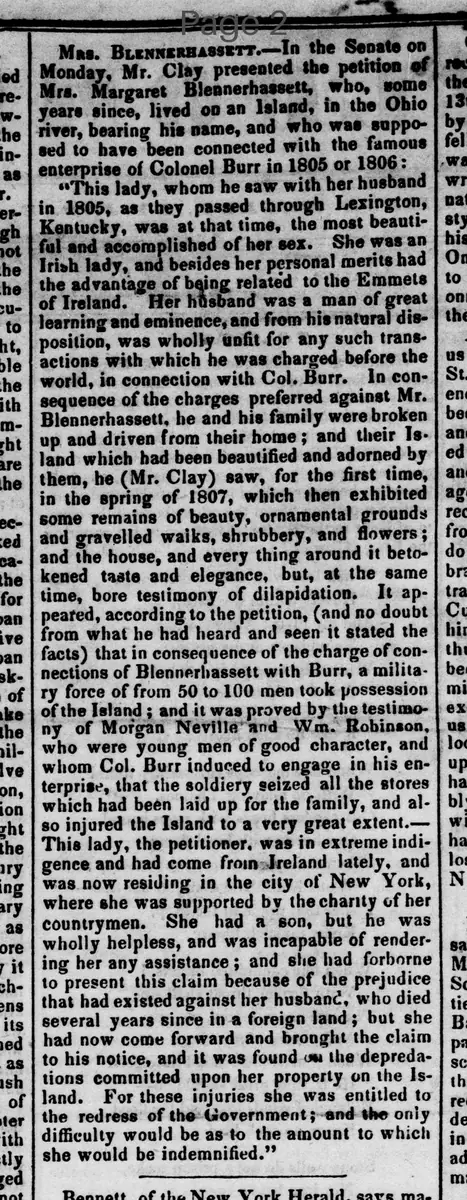
Mrs. Blennerhassett.-- In the Senate on Monday, Mr. Clay presented the petition of Mrs. Margaret Blennerhassett, who, some years since, lived on an Island, in the Ohio river, bearing his name, and who was supposed to have been connected with the famous enterprise of Colonel Burr in 1805 or 1806: "This lady, whom he saw with her husband in 1805, as they passed through Lexington, Kentucky, was at that time, the most beautiful and accomplished of her sex. She was an Irish lady, and besides her personal merits had the advantage of being related to the Emmets of Ireland. Her husband was a man of great learning and eminence, and from his natural disposition, was wholly unfit for any such transactions with which he was charged before the world, in connection with Col. Burr. In consequence of the charges preferred against Mr. Blennerhassett, he and his family were broken up and driven from their home; and their Island which had been beautified and adorned by them, he (Mr. Clay) saw, for the first time, in the spring of 1807, which then exhibited some remains of beauty, ornamental grounds and gravelled walks, shrubbery, and flowers; and the house, and every thing around it betokened taste and elegance, but, at the same time, bore testimony of dilapidation. It appeared, according to the petition, (and no doubt from what he had heard and seen it stated the facts) that in consequence of the charge of connections of Blennerhassett with Burr, a military force of from 50 to 100 men took possession of the Island; and it was proved by the testimony of Morgan Neville and Wm. Robinson, who were young men of good character, and whom Col. Burr induced to engage in his enterprise, that the soldiery seized all the stores which had been laid up for the family, and also injured the Island to a very great extent.— This lady, the petitioner, was in extreme indigence and had come from Ireland lately, and was now residing in the city of New York, where she was supported by the charity of her countrymen. She had a son, but he was wholly helpless, and was incapable of rendering her any assistance; and she had forborne to present this claim because of the prejudice that had existed against her husband, who died several years since in a foreign land; but she had now come forward and brought the claim to his notice, and it was found on the depredations committed upon her property on the Island. For these injuries she was entitled to the redress of the Government; and the only difficulty would be as to the amount to which she would be indemnified."