Thank you for visiting SNEWPapers!
Sign up free
Story
June 26, 1811
Alexandria Daily Gazette, Commercial & Political
Alexandria, Virginia
What is this article about?
An article critiques a purported confidential French state paper from Duke of Cadore (October 30, 1810) published in the Boston Patriot, which blames Britain for Europe's woes and proposes isolating her. The author suspects it's a forgery designed for sinister purposes.
Clipping
OCR Quality
96%
Excellent
Full Text
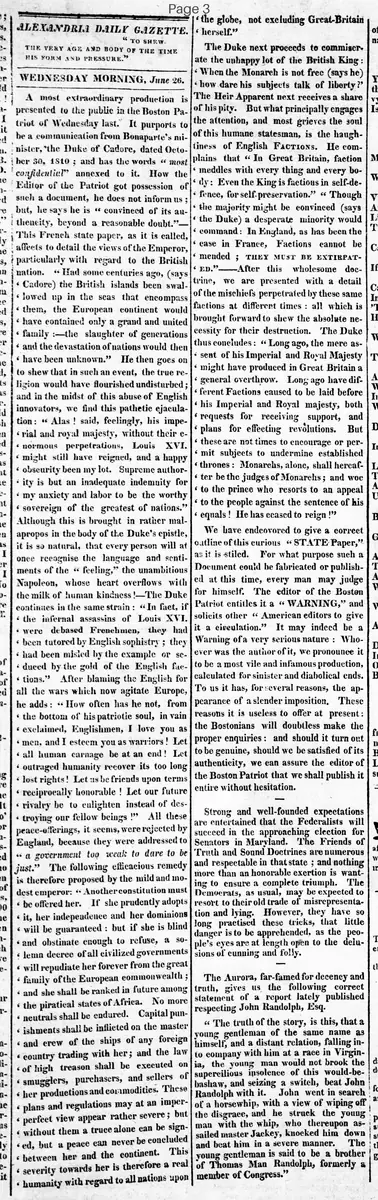
A most extraordinary production is presented to the public in the Boston Patriot of Wednesday last. It purports to be a communication from Bonaparte's minister, the Duke of Cadore, dated October 30, 1810; and has the words "most confidentiel" annexed to it. How the Editor of the Patriot got possession of such a document, he does not inform us; but, he says he is "convinced of its authenticity, beyond a reasonable doubt."
This French state paper, as it is called, affects to detail the views of the Emperor, particularly with regard to the British nation. "Had some centuries ago, (says Cadore) the British islands been swallowed up in the seas that encompass them, the European continent would have contained only a grand and united family:—this slaughter of generations and the devastation of nations would then have been unknown." He then goes on to show that in such an event, the true religion would have flourished undisturbed; and in the midst of this abuse of English innovators, we find this pathetic ejaculation: "Alas! said, feelingly, his imperial and royal majesty, without their enormous perpetrations, Louis XVI. might still have reigned, and a happy obscurity been my lot. Supreme authority is but an inadequate indemnity for my anxiety and labor to be the worthy sovereign of the greatest of nations."
Although this is brought in rather mal apropos in the body of the Duke's epistle, it is so natural, that every person will at once recognise the language and sentiments of the "feeling," the unambitious Napoleon, whose heart overflows with the milk of human kindness! The Duke continues in the same strain: "In fact, if the infernal assassins of Louis XVI. were debased Frenchmen, they had been tutored by English sophistry; they had been misguided by the example or seduced by the gold of the English factions." After blaming the English for all the wars which now agitate Europe, he adds: How often has he not, from the bottom of his patriotic soul, in vain exclaimed, Englishmen, I love you as men, and I esteem you as warriors! Let all human carnage be at an end! Let outraged humanity recover its too long lost rights! Let us be friends upon terms reciprocally honorable! Let our future rivalry be to enlighten instead of destroying our fellow beings!
All these peace-offerings, it seems, were rejected by England, because they were addressed to "a government too weak to dare to be just." The following efficacious remedy is therefore proposed by the mild and modest emperor: "Another constitution must be offered her. If she prudently adopts it, her independence and her dominions will be guaranteed: but if she is blind and obstinate enough to refuse, a solemn decree of all civilized governments will repudiate her forever from the great family of the European commonwealth; and she shall be ranked in future among the piratical states of Africa. No more neutrals shall be endured. Capital punishments shall be inflicted on the master and crew of the ships of any foreign country trading with her; and the law of high treason shall be executed on smugglers, purchasers, and sellers of her productions and commodities. These plans and regulations may at an imperfect view appear rather severe; but without them a truce alone can be signed between her and the continent. This humanity with regard to all nations upon the globe, not excluding Great-Britain herself."
The Duke next proceeds to commiserate the unhappy lot of the British King: When the Monarch is not free (says he) how dare his subjects talk of liberty? The Heir Apparent next receives a share of his pity. But what principally engages the attention, and most grieves the soul of this humane statesman, is the haughtiness of English Factions. He complains that "In Great Britain, faction meddles with every thing and every body: Even the King is factious in self-defence, for self-preservation." "Though the majority might be convinced (says the Duke) a desperate minority would command: In England, as has been the case in France, Factions cannot be mended; THEY MUST BE EXTIRPATED."—After this wholesome doctrine, we are presented with a detail of the mischiefs perpetrated by these same factions at different times: all which is brought forward to show the absolute necessity for their destruction. The Duke thus concludes: "Long ago, the mere assent of his Imperial and Royal Majesty might have produced in Great Britain a general overthrow. Long ago have different Factions caused to be laid before his Imperial and Royal majesty, both requests for receiving support, and plans for effecting revolutions. But these are not times to encourage or permit subjects to undermine established thrones: Monarchs, alone, shall hereafter be the judges of Monarchs; and woe to the prince who resorts to an appeal to the people against the sentence of his equals! He has ceased to reign!"
We have endeavored to give a correct outline of this curious "STATE Paper," as it is styled. For what purpose such a Document could be fabricated or published at this time, every man may judge for himself. The editor of the Boston Patriot entitles it a "WARNING," and solicits other "American editors to give it a circulation." It may indeed be a Warning of a very serious nature: Whoever was the author of it, we pronounce it to be a most vile and infamous production, calculated for sinister and diabolical ends. To us it has, for several reasons, the appearance of a slender imposition. These reasons it is useless to offer at present: the Bostonians will doubtless make the proper enquiries: and should it turn out to be genuine, should we be satisfied of its authenticity, we can assure the editor of the Boston Patriot that we shall publish it entire without hesitation.
This French state paper, as it is called, affects to detail the views of the Emperor, particularly with regard to the British nation. "Had some centuries ago, (says Cadore) the British islands been swallowed up in the seas that encompass them, the European continent would have contained only a grand and united family:—this slaughter of generations and the devastation of nations would then have been unknown." He then goes on to show that in such an event, the true religion would have flourished undisturbed; and in the midst of this abuse of English innovators, we find this pathetic ejaculation: "Alas! said, feelingly, his imperial and royal majesty, without their enormous perpetrations, Louis XVI. might still have reigned, and a happy obscurity been my lot. Supreme authority is but an inadequate indemnity for my anxiety and labor to be the worthy sovereign of the greatest of nations."
Although this is brought in rather mal apropos in the body of the Duke's epistle, it is so natural, that every person will at once recognise the language and sentiments of the "feeling," the unambitious Napoleon, whose heart overflows with the milk of human kindness! The Duke continues in the same strain: "In fact, if the infernal assassins of Louis XVI. were debased Frenchmen, they had been tutored by English sophistry; they had been misguided by the example or seduced by the gold of the English factions." After blaming the English for all the wars which now agitate Europe, he adds: How often has he not, from the bottom of his patriotic soul, in vain exclaimed, Englishmen, I love you as men, and I esteem you as warriors! Let all human carnage be at an end! Let outraged humanity recover its too long lost rights! Let us be friends upon terms reciprocally honorable! Let our future rivalry be to enlighten instead of destroying our fellow beings!
All these peace-offerings, it seems, were rejected by England, because they were addressed to "a government too weak to dare to be just." The following efficacious remedy is therefore proposed by the mild and modest emperor: "Another constitution must be offered her. If she prudently adopts it, her independence and her dominions will be guaranteed: but if she is blind and obstinate enough to refuse, a solemn decree of all civilized governments will repudiate her forever from the great family of the European commonwealth; and she shall be ranked in future among the piratical states of Africa. No more neutrals shall be endured. Capital punishments shall be inflicted on the master and crew of the ships of any foreign country trading with her; and the law of high treason shall be executed on smugglers, purchasers, and sellers of her productions and commodities. These plans and regulations may at an imperfect view appear rather severe; but without them a truce alone can be signed between her and the continent. This humanity with regard to all nations upon the globe, not excluding Great-Britain herself."
The Duke next proceeds to commiserate the unhappy lot of the British King: When the Monarch is not free (says he) how dare his subjects talk of liberty? The Heir Apparent next receives a share of his pity. But what principally engages the attention, and most grieves the soul of this humane statesman, is the haughtiness of English Factions. He complains that "In Great Britain, faction meddles with every thing and every body: Even the King is factious in self-defence, for self-preservation." "Though the majority might be convinced (says the Duke) a desperate minority would command: In England, as has been the case in France, Factions cannot be mended; THEY MUST BE EXTIRPATED."—After this wholesome doctrine, we are presented with a detail of the mischiefs perpetrated by these same factions at different times: all which is brought forward to show the absolute necessity for their destruction. The Duke thus concludes: "Long ago, the mere assent of his Imperial and Royal Majesty might have produced in Great Britain a general overthrow. Long ago have different Factions caused to be laid before his Imperial and Royal majesty, both requests for receiving support, and plans for effecting revolutions. But these are not times to encourage or permit subjects to undermine established thrones: Monarchs, alone, shall hereafter be the judges of Monarchs; and woe to the prince who resorts to an appeal to the people against the sentence of his equals! He has ceased to reign!"
We have endeavored to give a correct outline of this curious "STATE Paper," as it is styled. For what purpose such a Document could be fabricated or published at this time, every man may judge for himself. The editor of the Boston Patriot entitles it a "WARNING," and solicits other "American editors to give it a circulation." It may indeed be a Warning of a very serious nature: Whoever was the author of it, we pronounce it to be a most vile and infamous production, calculated for sinister and diabolical ends. To us it has, for several reasons, the appearance of a slender imposition. These reasons it is useless to offer at present: the Bostonians will doubtless make the proper enquiries: and should it turn out to be genuine, should we be satisfied of its authenticity, we can assure the editor of the Boston Patriot that we shall publish it entire without hesitation.
What sub-type of article is it?
Deception Fraud
Curiosity
Historical Event
What themes does it cover?
Deception
What keywords are associated?
Napoleon
Duke Of Cadore
Bonaparte
British Factions
French State Paper
Forgery
Boston Patriot
European Wars
What entities or persons were involved?
Duke Of Cadore
Bonaparte
Napoleon
Louis Xvi
British King
Heir Apparent
Editor Of The Boston Patriot
Where did it happen?
Boston
Story Details
Key Persons
Duke Of Cadore
Bonaparte
Napoleon
Louis Xvi
British King
Heir Apparent
Editor Of The Boston Patriot
Location
Boston
Event Date
October 30, 1810
Story Details
A supposed confidential French document from Duke of Cadore details Napoleon's views blaming Britain for Europe's conflicts, proposes isolating Britain if she refuses a new constitution, and calls for extirpating British factions; the publishing newspaper suspects it as a forgery for sinister ends.