Thank you for visiting SNEWPapers!
Sign up free
The Daily Advertiser
New York, New York County, New York
What is this article about?
An 1787 essay excerpt critiques Britain's economic reliance on paper currency and bank notes, arguing it masks a lack of real wealth in gold and silver, unchanged since the 1770s, and warns of ruinous consequences similar to America's Continental Money.
Clipping
OCR Quality
Full Text
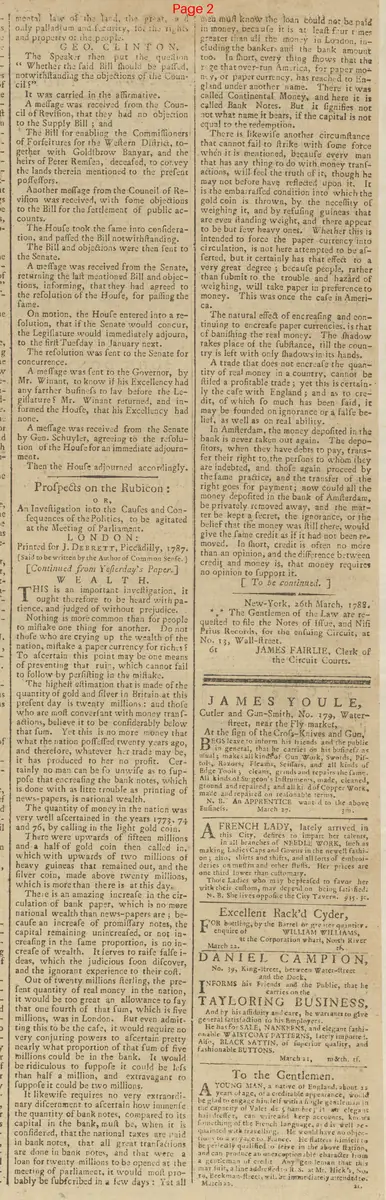
OR,
An Investigation into the Causes and Consequences of the Politics, to be agitated at the Meeting of Parliament.
LONDON:
Printed for J. Debrett, Piccadilly, 1787.
[Said to be written by the Author of Common Sense.]
Continued from Yesterday's Paper.
WEALTH.
This is an important investigation, it ought therefore to be heard with patience, and judged of without prejudice.
Nothing is more common than for people to mistake one thing for another. Do not those who are crying up the wealth of the nation, mistake a paper currency for riches?
To ascertain this point may be one means of preventing that ruin, which cannot fail to follow by persisting in the mistake.
The highest estimation that is made of the quantity of gold and silver in Britain at this present day is twenty millions: and those who are most conversant with money transactions, believe it to be considerably below that sum. Yet this is no more money than what the nation possessed twenty years ago, and therefore, whatever her trade may be, it has produced to her no profit. Certainly no man can be so unwise as to suppose that increasing the bank notes, which is done with as little trouble as printing of news-papers, is national wealth.
The quantity of money in the nation was very well ascertained in the years 1773, 74 and 76, by calling in the light gold coin.
There were upwards of fifteen millions and a half of gold coin then called in, which with upwards of two millions of heavy guineas that remained out, and the silver coin, made above twenty millions, which is more than there is at this day.
There is an amazing increase in the circulation of bank paper, which is no more national wealth than news-papers are; because an increase of promissory notes, the capital remaining unincreased, or not increasing in the same proportion, is no increase of wealth. It serves to raise false ideas, which the judicious soon discover, and the ignorant experience to their cost.
Out of twenty millions sterling, the present quantity of real money in the nation, it would be too great an allowance to say that one fourth of that sum, which is five millions, was in London. But even admitting this to be the case, it would require no very conjuring powers to ascertain pretty nearly what proportion of that sum of five millions could be in the bank. It would be ridiculous to suppose it could be less than half a million, and extravagant to suppose it could be two millions.
It likewise requires no very extraordinary discernment to ascertain how immense the quantity of bank notes, compared to its capital in the bank, must be, when it is considered, that the national taxes are paid in bank notes, that all great transactions are done in bank notes, and that were a loan for twenty millions to be opened at the meeting of parliament, it would most probably be subscribed in a few days: Yet all men must know the loan could not be paid in money, because it is at least four times greater than all the money in London, including the bankers and the bank amount to. In short, every thing shows that the rage that over-ran America, for paper money, or paper currency, has reached to England under another name. There it was called Continental Money, and here it is called Bank Notes. But it signifies not what name it bears, if the capital is not equal to the redemption.
There is likewise another circumstance that cannot fail to strike with some force when it is mentioned, because every man that has any thing to do with money transactions, will feel the truth of it, though he may not before have reflected upon it. It is the embarrassed condition into which the gold coin is thrown, by the necessity of weighing it, and by refusing guineas that are even standard weight, and there appear to be but few heavy ones. Whether this is intended to force the paper currency into circulation, is not here attempted to be asserted, but it certainly has that effect to a very great degree; because people, rather than submit to the trouble and hazard of weighing, will take paper in preference to money. This was once the case in America.
The natural effect of increasing and continuing to increase paper currencies, is that of banishing the real money. The shadow takes place of the substance, till the country is left with only shadows in its hands.
A trade that does not increase the quantity of real money in a country, cannot be called a profitable trade; yet this is certainly the case with England; and as to credit, of which so much has been said, it may be founded on ignorance or a false belief, as well as on real ability.
In Amsterdam, the money deposited in the bank is never taken out again. The depositors, when they have debts to pay, transfer their right to the persons to whom they are indebted, and those again proceed by the same practice, and the transfer of the right goes for payment; now could all the money deposited in the bank of Amsterdam, be privately removed away, and the matter be kept a secret, the ignorance, or the belief that the money was still there, would give the same credit as if it had not been removed. In short, credit is often no more than an opinion, and the difference between credit and money is, that money requires no opinion to support it.
[To be continued.]
What sub-type of article is it?
What keywords are associated?
Where did it happen?
Foreign News Details
Primary Location
London
Event Date
1787
Event Details
The essay investigates national wealth, asserting that Britain's gold and silver remain at about twenty millions, unchanged from twenty years prior, while bank notes proliferate without increasing real capital. It compares this to America's failed paper money and notes the embarrassment of gold coin circulation, predicting ruin if the mistake persists. Amsterdam's banking practices are cited as an example of credit based on opinion rather than substance.