Thank you for visiting SNEWPapers!
Sign up free
The Frontier
O'neill, O'neill City, Holt County, Nebraska
What is this article about?
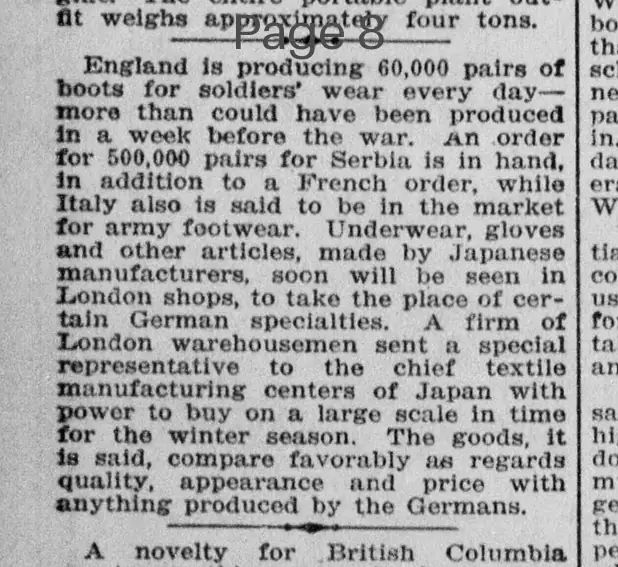
England's boot production for soldiers has increased dramatically to 60,000 pairs daily amid war, with large orders from Serbia, France, and Italy. Japanese underwear and gloves will replace German goods in London shops, bought in bulk for winter.
Clipping
OCR Quality
Full Text
What sub-type of article is it?
What keywords are associated?
Where did it happen?
Foreign News Details
Primary Location
England
Outcome
england producing 60,000 pairs of boots daily; orders for 500,000 pairs for serbia, plus french and italian orders; japanese goods replacing german specialties in london shops
Event Details
England is producing 60,000 pairs of boots for soldiers' wear every day—more than could have been produced in a week before the war. An order for 500,000 pairs for Serbia is in hand, in addition to a French order, while Italy also is said to be in the market for army footwear. Underwear, gloves and other articles, made by Japanese manufacturers, soon will be seen in London shops, to take the place of certain German specialties. A firm of London warehousemen sent a special representative to the chief textile manufacturing centers of Japan with power to buy on a large scale in time for the winter season. The goods, it is said, compare favorably as regards quality, appearance and price with anything produced by the Germans.