Thank you for visiting SNEWPapers!
Sign up free
The National Intelligencer And Washington Advertiser
Washington, District Of Columbia
What is this article about?
London reports from July 11-12 detail Austrian successes against Napoleon, including insurrections in Hanover, Hesse, and southern Germany; supply shortages in Vienna; Archduke Charles's reinforcements and positions; and the official Austrian account of the Battles of Aspern (May 21-22, 1809), with heavy casualties and French defeat. Calls for British aid subscription.
Merged-components note: Continuation of the same foreign intelligence article from London across multiple components and pages, sequential reading order and text flows directly.
Clippings
1 of 2
OCR Quality
Full Text
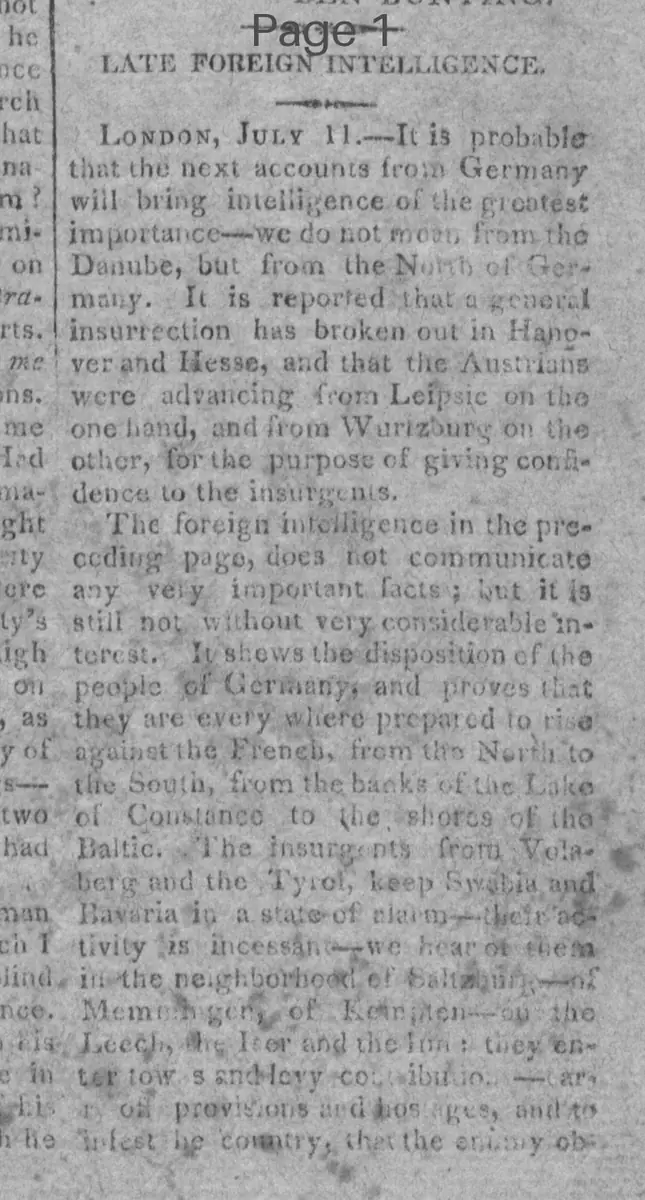
London, July 11.—It is probable that the next accounts from Germany will bring intelligence of the greatest importance—we do not mean from the Danube, but from the North of Germany. It is reported that a general insurrection has broken out in Hanover and Hesse, and that the Austrians were advancing from Leipsic on the one hand, and from Wurzburg on the other, for the purpose of giving confidence to the insurgents.
The foreign intelligence in the preceding page, does not communicate any very important facts; but it is still not without very considerable interest. It shows the disposition of the people of Germany, and proves that they are every where prepared to rise against the French, from the North to the South, from the banks of the Lake of Constance to the shores of the Baltic. The insurgents from Volaberg and the Tyrol, keep Swabia and Bavaria in a state of alarm—their activity is incessant—we hear of them in the neighborhood of Salzburg—a Member of Keirgen—on the Leech, the Iser and the Inn: they enter towns and levy contributions.—and provisions and hostages, and as they infest the country, that the enemy obtains
certain supplies with the greatest difficulty.
This must naturally increase the scarcity which is acknowledged to be felt at Vienna, and which is so great that the populace besiege the bakers, and butchers shops day and night, just as they did in Paris during the early part of the revolution. Hungary was the source from whence Vienna usually drew supplies—but that source is no longer open, and to an application in behalf of the capital, made by Bonaparte to the Archduke Charles, a positive refusal is said to have been returned.
Whilst these events are passing in the southern parts of Germany, the sovereign is not more disposed to remain quiet under the French yoke. The progress, of the Austrians in Franconia and Saxony is already known. In Westphalia and Hesse the spirit of insurrection has shewn itself, and the "insurgent peasantry" as they are called, lately broke into the town of Marburg on the Lahn. These peasants are not raw troops unused to arms; they are men who by the ancient constitution of the country were enrolled and exercised during a certain part of the year. Thus rapidly and vigorously is the spirit of insurrection spreading itself every where round the enemy. Meanwhile the archduke Charles is reinforcing himself by the landwehr (militia) of Moravia and Bohemia, and so strong does he feel himself, that he has sent a part of the Hungarian insurrection, that had arrived at Brunn to join the archduke John at Comorn. This reinforcement is said to have enabled him to advance again and to resume his position at Raab. The two great Austrian armies under the archduke Charles and John occupy an almost straight line from Warkerederf to Comorn. Presburg is the centre of it.—Hence the French have made the greatest efforts to take Presburg; they would then have interposed between the two armies—But all these efforts have been ineffectual, and marshal Davoust has been constantly repulsed in his attempt to make himself master of the Tete de Pont near Wollsthal.
We have authority to state that the Austrian official account of the battle of Aspern will appear in a supplement to the Gazette of this evening. It consists of three sheets, and takes up the events of the war at the period of the battle of Abersburg and the capture of Ratisbon by the Austrians—gives an account of the capture of Vienna, & follows the march of the archduke to the position where the battle was fought. It then gives the archduke's plan of the attack—states the Austrian force at 75,000 men—gives a detail of the battle of the 21st May, which it closes in the following manner—“For the first time Napoleon has sustained a defeat in Germany. The charm of his invincibility was dissolved. No longer the spoiled Child of Fortune; by posterity he will be characterised as the earl of the fickle Goddess.”
It then proceeds to give a narrative of the battle of the 22d May—17,000 French muskets and 3000 cuirasses were taken.—The Austrians had 87 superior officers and 4190 subalterns and privates killed—663 officers, and 15,657 privates wounded—On the part of the French, 7000 were buried in the field of battle, and 5000 are wounded in the Austrian hospitals—In Vienna and the suburbs there are 29,263 wounded—2300 were taken; hundreds of corpses have floated down the Danube.
The account of the second battle closes in the following terms—“Thus terminated a conflict of two daysIt was decisive of the glory of the Austrian arms, of the preservation of the monarchy, and of the correction of public opinion.”
The prisoner taken on board a Dutch prize, sent into Dover by the Tiger revenue cutter, states that it was universally believed at Flushing, when they sailed, that another great battle had been fought upon the Danube on the 26th. which terminated in the defeat of the French army, with the loss of 50,000 men, 10,000 of whom belonged to Bonaparte's guards. The same person also states that there were lying at Flushing three men of war, full of troops, waiting for a favorable opportunity to put to sea, in consequence of which, a squadron sailed immediately from Deal for that part of the Dutch coast; that it was understood 20,000 Prussians were on their march to co-operate with the Austrian army; and that the greatest possible discontent prevailed in Holland, in consequence of the severity of the conscription law. Reports are also stated to have been circulated at Flushing of the assassination of Ferdinand VII. We know not what degree of credit to attach to those statements,
July 12.—We this day lay before
our readers one of the most interesting and important documents that was ever offered to the public eye; the history of the campaign from the battle of Abensburg to that glorious victory of Aspern, which “has dissolved the charm of Bonaparte's invincibility, and reduced him to the rank of bold and successful generals, who, like himself, after a few series of destructive achievements, have experienced the vicissitudes of fortune.” A clearer, a more spirited, a more eloquent narrative never came from the hand of man—it is such a narrative as such an achievement deserves, and there is not a human being, at least there is not a Briton who reads it, who will not feel the deepest joy, admiration, gratitude, and enthusiasm for the cause of Austria. Men who can sustain such a cause in such a manner—who, after an unbroken series of disaster and defeat of calamity and distress, can display such constancy and courage, such loyalty and patriotism cannot (no! it were treason to suppose they could) be subdued, and we have no more doubt that Austria will establish her independence and security, than we have that a British fleet will beat a French one whenever it is fortunate enough to meet with it. How fade the bulletins of Bonaparte before this manly and noble document! How contemptible & disgusting do they look when placed beside it! Here is none of the braggadism and insolence which distinguished and degrade those labors of the Corsican. Here are no claims to a victory gained with ease, and almost without effort. Every line pays tribute to the mightiness and difficulty of the conflict. We have the field of battle depicted to us in the clearest manner; we trace the march of each army—we follow the movements of the different columns; we see where the battle raged with the greatest fury, where the struggle was the most tremendous—we appreciate the talents of the different generals, and we behold, towering above them all, the two commanders in chief bringing into the conflict all the resources and energies of their mighty minds, and fighting for glory and for victory, for fame and for life.—How every thing was foreseen and provided against by the Archduke Charles! With a kind of prophetic wisdom he knew where the greatest efforts of the enemy would be directed, and there the enemy always found that preparations had been made to receive them. All the tactics and manoeuvres of Bonaparte, his furious attempts to pierce the centre, and thus cut off the right wing from the left—his repeated efforts to turn the Austrian flanks, and thus come in their rear, were rendered unavailing by the admirable dispositions of the Austrian commander. After two days, the most sanguinary days that Europe ever saw, Bonaparte was at length compelled to yield the palm of pre-eminence, to descend from his towering height, to lose his character of invincible, and to resign the rank of being the first captain of the age.
It would be difficult to say which part of the conduct of the Archduke Charles deserves the most praise—that firmness of mind which made him not despair of stopping the progress of the enemy after the battle of Echmuhl—that confidence in his own talents which rendered him anxious to hazard a battle with the French, flushed though they were with uninterrupted success, and led on by Bonaparte in person—that astonishing presence of mind which rendered him equal to every emergency—or that consummate knowledge of the art of war which enabled him to beat the man who had arrogated to himself the title of invincible.
Yet, it is such an army under such a general, such a power making such exertions, that the late ministry would not assist with a liberal hand; they would help her but sparingly with the treasures of England, whilst she is lavishing her blood in a cause which they will not deny to be as much British as Austrian—they would treat her with suspicion and distrust, and we well remember the efforts they made at first to damp our satisfaction by throwing doubts upon this great victory.—They would not even see “the symptoms of a defeat of the French.”
A grateful task remains to be performed, and we dare say our readers anticipate us in what we are going to say. The Gazette shews by what sacrifices the late victory was gained. The killed and wounded of the Austrian army amount to twenty thousand. We can abate the grief of those who have lost their relatives—we can assuage the pain of those who are suffering under their wounds, by raising a subscription for their wives and families. It will be worthy of the exalted character of the British nation, and we hope to see it carried into execution without loss of time.
What sub-type of article is it?
What keywords are associated?
What entities or persons were involved?
Where did it happen?
Foreign News Details
Primary Location
Germany And Austria
Event Date
As Of July 11, With Events From May 21 22
Key Persons
Outcome
austrians: 87 superior officers and 4190 subalterns/privates killed, 663 officers and 15,657 privates wounded. french: 7000 buried on field, 5000 wounded in austrian hospitals, 29,263 wounded in vienna/suburbs, 2300 taken prisoner, hundreds of corpses floated down danube. 17,000 french muskets and 3000 cuirasses captured. austrian victory at aspern, dissolving napoleon's invincibility.
Event Details
Reports of insurrections in Hanover, Hesse, Westphalia, and southern Germany against French; Austrian advances and reinforcements by Archduke Charles using Moravian, Bohemian, and Hungarian forces; failed French attempts on Presburg; official Austrian account details Battles of Aspern on May 21-22, with 75,000 Austrian troops defeating Napoleon; rumors from Flushing of further French defeat on May 26 and Prussian cooperation; British praise and call for subscription aid to Austrians.