Thank you for visiting SNEWPapers!
Sign up free
The Topeka State Journal
Topeka, Shawnee County, Kansas
What is this article about?
Topeka City Council passes ordinances annexing Heery and Norton additions amid rivalry with Oakland, which had previously claimed the territory, sparking a legal battle. Other business includes resolutions on city attorney, paving streets, reducing depository bonds, and regulating bees.
Clipping
OCR Quality
Full Text
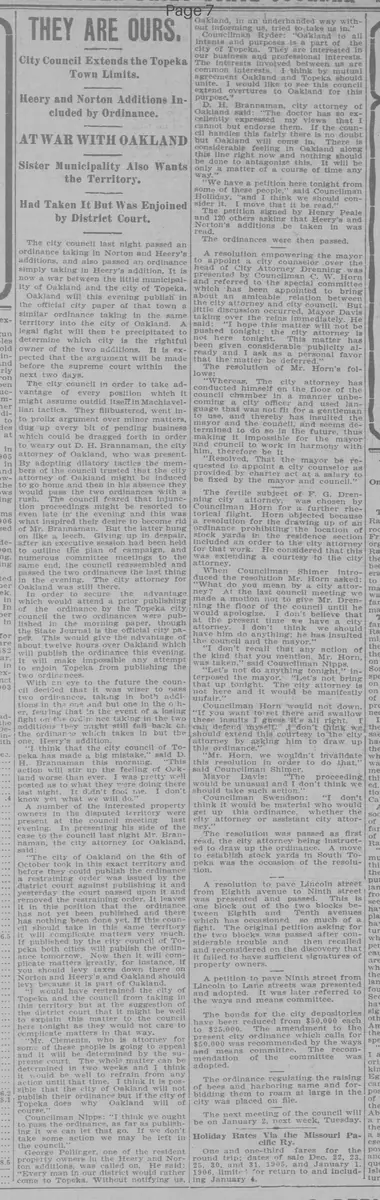
City Council Extends the Topeka Town Limits.
Heery and Norton Additions Included by Ordinance.
AT WAR WITH OAKLAND
Sister Municipality Also Wants the Territory.
Had Taken It But Was Enjoined by District Court.
The city council last night passed an ordinance taking in Norton and Heery's additions, and also passed an ordinance simply taking in Heery's addition. It is now a war between the little municipality of Oakland and the city of Topeka. Oakland will this evening publish in the official city paper of that town a similar ordinance taking in the same territory into the city of Oakland. A legal fight will then be precipitated to determine which city is the rightful owner of the two additions. It is expected that the argument will be made before the supreme court within the next two days.
The city council in order to take advantage of every position which it might assume outdid itself in Machiavellian tactics. They filibustered, went into prolix argument over minor matters, dug up every bit of pending business which could be dragged forth in order to weary out D. H. Brannaman, the city attorney of Oakland, who was present. By adopting dilatory tactics the members of the council trusted that the city attorney of Oakland might be induced to go home and then in his absence they would pass the two ordinances with a rush. The council feared that injunction proceedings might be resorted to even late in the evening and this was what inspired their desire to become rid of Mr. Brannaman. But the latter hung on like a leech. Giving up in despair, after an executive session had been held to outline the plan of campaign, and numerous committee meetings to the same end, the council reassembled and passed the two ordinances the last thing in the evening. The city attorney for Oakland was still there.
In order to secure the advantage which would attend a prior publishing of the ordinance by the Topeka city council the two ordinances were published in the morning paper, though the State Journal is the official city paper. This would give the advantage of about twelve hours over Oakland which will publish the ordinance this evening. It will make impossible any attempt to enjoin Topeka from publishing the two ordinances.
With an eye to the future the council decided that it was wiser to pass two ordinances, taking in both additions in the one and but one in the other, fearing that in the event of a losing fight on the ordinance taking in the two additions they might still fall back on the ordinance which takes in but the one, Heery's addition.
"I think that the city council of Topeka has made a big mistake," said D. H. Brannaman this morning. "This action will stir up the feeling of Oakland worse than ever. I was pretty well posted as to what they were doing there last night. It didn't fool me. I don't know yet what we will do."
A number of the interested property owners in the disputed territory were present at the council meeting last evening. In presenting his side of the case to the council last night Mr. Brannaman, the city attorney for Oakland, said:
"The city of Oakland on the 6th of October took in this exact territory and before they could publish the ordinance a restraining order was issued by the district court against publishing it and yesterday the court passed upon it and removed the restraining order. It leaves it in this position that the ordinance has not yet been published and there has nothing been done yet. If this council should take in this same territory it will complicate matters very much. If published by the city council of Topeka both cities will publish the ordinance tomorrow. Now then it will complicate matters greatly, for instance, if you should levy taxes down there on Norton and Heery's and Oakland should levy because it is part of Oakland.
"I would have restrained the city of Topeka and the council from taking in this territory but at the suggestion of the district court that it might be well to explain this matter to the council here tonight as they would not care to complicate matters in that way.
"Mr. Clements, who is attorney for some of these people is going to appeal and it will be determined by the supreme court. The whole matter can be determined in two weeks and I think it would be well to refrain from any action until that time. I think it is possible that the city of Oakland will not publish their ordinance but if the city of Topeka does why Oakland will of course."
Councilman Nipps: "I think we ought to pass the ordinance, as far as publishing it we can let that go. If we don't take some action we may be left in the council."
George Polligner, one of the resident property owners in the Heery and Norton additions, was called on. He said:
"Every man in our district would rather come to Topeka. Without notifying us, Oakland, in an underhanded way without informing us, tried to take us in."
Councilman Ryder: "Oakland to all intents and purposes is a part of the city of Topeka. They are interested in our business and professional interests. The interests involved between us are common interests. I think by mutual agreement Oakland and Topeka should unite. I would like to see this council extend overtures to Oakland for this purpose."
D. H. Brannaman, city attorney of Oakland said: "The doctor has so excellently expressed my views that I cannot but endorse them. If the council handles this fairly there is no doubt but Oakland will come in. There is considerable feeling in Oakland along this line right now and nothing should be done to antagonize this. It will be only a matter of a course of time any way."
"We have a petition here tonight from some of these people," said Councilman Holliday, "and I think we should consider it. I move that it be read."
The petition signed by Henry Peale and 120 others asking that Heery's and Norton's additions be taken in was read.
The ordinances were then passed.
A resolution empowering the mayor to appoint a city counselor over the head of City Attorney Drenning was presented by Councilman C. W. Horn and referred to the special committee which has been appointed to bring about an amicable relation between the city attorney and city council. But little discussion occurred. Mayor Davis taking over the reins immediately. He said: "I hope this matter will not be pushed tonight; the city attorney is not here tonight. This matter has been given considerable publicity already and I ask as a personal favor that the matter be deferred."
The resolution of Mr. Horn's follows:
"Whereas, The city attorney has conducted himself on the floor of the council chamber in a manner unbecoming a city officer and used language that was not fit for a gentleman to use, and thereby has insulted the mayor and the council, and seems determined to do so in the future, thus making it impossible for the mayor and council to work in harmony with him, therefore be it
"Resolved, That the mayor be requested to appoint a city counselor as provided by charter act at a salary to be fixed by the mayor and council."
The fertile subject of F. G. Drenning city attorney, was chosen by Councilman Horn for a further rhetorical flight. Horn objected because a resolution for the drawing up of an ordinance prohibiting the location of stock yards in the residence section included an order to the city attorney for that work. He considered that this was extending a courtesy to the city attorney.
When Councilman Shimer introduced the resolution Mr. Horn asked: "What do you mean by a city attorney? At the last council meeting we made a motion not to give Mr. Drenning the floor of the council until he would apologize. I don't believe that at the present time we have a city attorney. I don't think we should have him do anything; he has insulted the council and the mayor."
"I don't recall that any action of the kind that you mention, Mr. Horn, was taken," said Councilman Nipps.
"Let's not do anything tonight," interposed the mayor. "Let's not bring that up tonight. The city attorney is not here and it would be manifestly unfair."
Councilman Horn would not down.
"If you want to sit there and swallow these insults I guess it's all right. I can defend myself. I don't think we should extend this courtesy to the city attorney by asking him to draw up this ordinance."
"Mr. Horn, we wouldn't invalidate this resolution in order to do that," said Councilman Shimer.
Mayor Davis: "The proceeding would be unusual and I don't think we should take such action."
Councilman Swendson: "I don't think it would be material who would get up this ordinance, whether the city attorney or assistant city attorney."
The resolution was passed as first read, the city attorney being instructed to draw up the ordinance. A move to establish stock yards in South Topeka was the occasion of the resolution.
A resolution to pave Lincoln street from Eighth avenue to Ninth street was presented and passed. This is one block out of the two blocks between Eighth and Tenth avenues which has occasioned so much of a fight. The original petition asking for the two blocks was passed after considerable trouble and then recalled and reconsidered on the discovery that it failed to have sufficient signatures of property owners.
A petition to pave Ninth street from Lincoln to Lane streets was presented and adopted. It was later referred to the ways and means committee.
The bonds for the city depositories have been reduced from $50,000 each to $25,000. The amendment to the present city ordinance which calls for $50,000 was recommended by the ways and means committee. The recommendation of the committee was adopted.
The ordinance regulating the raising of bees and harboring same and forbidding them to roam at large in the city was placed on file.
The next meeting of the council will be on January 2, next week, Tuesday.
What sub-type of article is it?
What themes does it cover?
What keywords are associated?
What entities or persons were involved?
Where did it happen?
Story Details
Key Persons
Location
Topeka, Oakland
Event Date
Last Night; 6th Of October
Story Details
Topeka City Council passes two ordinances to annex Heery and Norton additions despite Oakland's prior claim, using tactics to outmaneuver Oakland's attorney, leading to a supreme court battle over territorial rights. Other council actions include deferring a resolution against City Attorney Drenning, passing paving resolutions, reducing depository bonds, and filing a bee ordinance.