Thank you for visiting SNEWPapers!
Sign up free
Letter to Editor
November 3, 1863
Semi Weekly Standard
Raleigh, Wake County, North Carolina
What is this article about?
W. Dunn, Jr. writes to the North Carolina Standard opposing military overreach and suspension of habeas corpus in the Confederacy, emphasizing civil supremacy. He details his resignation as 1st Lt. in Co. F, 10th NC Heavy Artillery due to unjust transfer and treatment by Brig. Gen. Martin near Kinston in 1863.
Clipping
OCR Quality
80%
Good
Full Text
THE NORTH CAROLINA STANDARD:
[...duct, has already caused thou- come before Congress to restrain these inalienable rights I shall promptly oppose them..]
Supremacy of the Civil over the Military
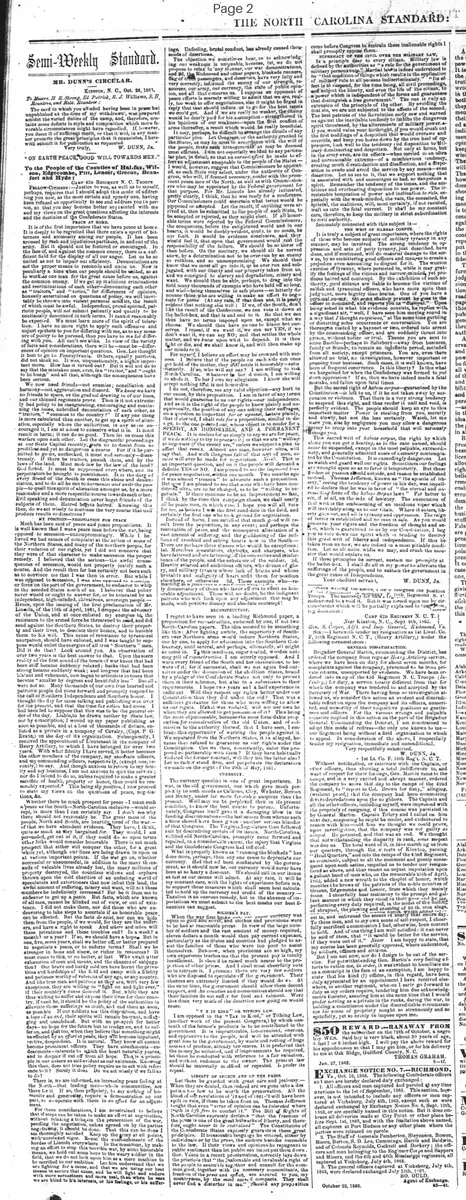
[A principle dear to every citizen. Military law is defined by the authorities as "a rule for the government of military persons only." Martial law is indeed understood to be "that condition of things which results in the application of military rule to all persons indiscriminately." Its effect is to suspend, for the time being, all civil proceedings, and subject the liberty, and even the life of the citizen, to a power which is independent of the forms and guarantees that distinguish a free government. The one is only an extension of the principle of the other. By avoiding the first sin, we are not subjected to the effects of the second. The best patriots of the Revolution early saw and warned us against the inevitable tendency to imbibe the dangerous spirit threatened, by the allurements of military power. If you would value your birthright, if you would crush out the first buddings of a despotism that would overawe and override, and keep you borne down by the iron heel of oppression, look well to the tendency and disposition to Military domineering and despotism. Not only at home, but in the army even, are its effects—when carried to an ultra and unreasonable extreme—of a mischievous tendency, creating much dissatisfaction and disaffection, and a disposition to evade and avoid the service by any means—even desertion. Let us see to it, that we support nothing that is associated with and encourages so bad, so dangerous a spirit. Remember the tendency of the times, and the ambitious and overbearing disposition to use power. The especially with the weak-minded, the vain, the conceited, the spiteful, the malicious, will, most certainly, if not resisted, waft us into the fatal current. It shall be my constant care, therefore, to keep the military in strict subordination to civil authority.
The Writ of Habeas Corpus
It is truly a subject of great importance, where the rights of those who become subjects of military tyranny in any manner, may be involved. The strong tendency to oppression and acts of petty tyranny, just described, have done, and if continued, will do material damage to the service, by so embittering good officers and men, as to create a prejudice even amounting to disgust for it. The wanton exercise of tyranny, where persisted in, while it may gratify the feelings of the vicious and narrow-minded, yet produces hatred and contempt. By the exhibition of such authority, good citizens are liable to become the victims of selfish and tyrannical officers, who have more spite than judgment, more bigotry than brains. One of you have a personal enemy. On some shallow pretext he goes to the officer in command, and reports you as "disloyal." Upon being asked in what his evidence consists, he replies with an insignificant air, "well, I have seen him moving round in a way that I thought suspicious," at the same time garbling or distorting some occurrence or conversation. You are thereupon visited by a bayonet or two, ordered into arrest by the commanding officer, and are suddenly thrust into prison, without notice or trial. Thence you are sent to some Bastile—perhaps to Salisbury—away from business, family or friends, to remain an indefinite period, secluded from all society, except prisoners. You are, even there allowed no trial, no investigation, however important or pressing your business. Such cases, it is well known, have been of frequent occurrence. Is this liberty? Is this what we bargained for when the Confederacy was formed to put down oppression? If so, then we have indeed made a fatal mistake, and fallen upon fatal times. But the sacred right of habeas corpus—guaranteed by the Constitution—is left to us, if it be not taken away by suspension or violence. That there is a very strong tendency to suspend this right, and thus render it null and void, is perfectly evident. The people should keep an eye to this important matter. Power is stealing from you, secretly and slowly, but not the less certainly. Watch, let me warn you, else by negligence you may allow a dangerous enemy to creep into your household that will seriously damage you. This sacred writ of habeas corpus, the right by which alone you can get a hearing, as in the case named, should never be suspended, except in the most palpable, extraordinary, and generally admitted cases of necessity contemplated by the Constitution. It is exceedingly dangerous. Let us watch and guard well our rights. Sometimes our feelings are wrought upon so as to favor it temporarily. But these dashes of passion should subside, and reason be established instead. Thomas Jefferson, known as "the apostle of liberty," seeing the tendency of power in his day, was impelled to declare that he was in favor of "the eternal and unremitting force of the habeas corpus laws." Far better to err, if at all, on the side of leniency. The suspension of this writ is the embosoming of an insidious viper which will inevitably sting us to our vitals. Where it enters, liberty goes out, and all is tyranny and oppression. The reign of terror is established and no man is safe. As you would preserve your rights and the freedom of thought and action, which is guaranteed to us by our Constitution, I beg you to vote down the spirit which is tending to destroy this great writ of liberty and independence. If this be taken from us now, we are indeed in a most pitiable condition. Let us all unite, while we may, and crush the monster that would enslave us. If these principles be correct, sustain me promptly at the ballot-box. I shall do all in my power to alleviate the sufferings of the people, and to sustain the government in the great cause of Independence.
Your obedient servant,
W. DUNN, JR.
Since writing the above, I have resigned the position of Lieutenant in Co. F, 10th Regiment N. C. Heavy Artillery Troops. The necessity was imperative. I endeavored to avoid it. But it was forced upon me by circumstances which will be partially explained in accompanying document:
Camp 42d Regiment N. C. T.
Near Kinston, N. C., Sept 9th, 1863.
Gen. S. Cooper, Adj't. and Insp. General, Richmond, Va.
SIR:—I herewith tender my resignation as 1st Lieut. Co. F, 10th Regiment N. C. T., (Heavy Artillery,) under the following circumstances:
General Dissatisfaction.
Brigadier General Martin, commanding the District, has ordered the company from regular Heavy Artillery service where we have been on duty for about seven months, for complaints against the company, presumed to be from private citizens, unsupported by evidence. We have been ordered into camp of the 42d Regiment N. C. Troops. (Infantry.) for duty, a service totally different from that for which the company was tendered to and accepted by the Secretary of War. There having been no investigation allowed us, we consider this action an evident and discreditable reflection upon the company and its officers, unmerited, and unworthy of their respective positions as gentlemen and officers. For the various wrongs and palpable injustice implied in this action on the part of the Brigadier General Commanding the District, I am constrained to adopt this mode of redress—the only one known to me—our Regiment being without a field organization to which to appeal. In consideration of the above, I respectfully tender my resignation, immediate and unconditional.
Very respectfully submitted,
W. DUNN, JR.
1st Lt. Co. F, 10th Reg't. N. C. T.
Without notification, or interview with the Captain, or other officers, thus showing a total indifference to, and want of respect for their feelings, Gen. Martin came to the camps, and in a very excited and abrupt manner, ordered the company to move that day to the camps of the 42nd Regiment, to "report to Col. Brown for duty," alleging, (without proof,) that the company had been committing divers depredations upon the neighbors. The Captain and all the other officers, including myself, were impressed with the propriety of resigning, if this course was persisted in by General Martin. Captain Tillery and I called on him next day, supposing he might be cooler, and endeavored to reason with him—told him we thought we could prove, upon investigation, that the company was not guilty as alleged. He persisted, and that was an end. We thought that notwithstanding the disparity in rank, some respect was due us. The total want of it, in thus marching us from our quarters, through the streets of Kinston, passing Head Quarters, and into the camps of the 42nd Regiment, as criminals, subject to all the comment and gossip consequent upon such action, impelled us to tender our resignations as above, and thus resent an unjust imputation upon a gallant band of men who, on the memorable 25th of April, 1862, added a new wreath to the chaplet of honor, which mantles the brows of the patriots of the noble counties of Greene, Edgecombe and Lenoir, from which they mainly come. I cheerfully bear testimony to the prompt and gallant manner in which they stood to their guns under fire, performing every duty required, in the midst of the hailing of shrapnel, the plowing and crashing of so much iron slugs, and enlivened the scenes of nearly that entire day. To these men, and to my own sense of self-respect, I cheerfully sacrificed a commission I had, otherwise, been content to hold. And of one thing I am well satisfied: it can never be said of them, that "it would be better for the service, if they were out of it." Never I am happy to state, that my course has been generally approved, where understood, by soldiers, officers and citizens. But I am not now, nor do I design to be out of the service. For notwithstanding Gen. Martin's very feeling efforts to retain me, in order, it was evident to humiliate me further, as a conscript in the face of an exemption, I am happy to state that his kind (?) offices, in this regard, have been duly appreciated by an appointment I have received elsewhere, in another regiment, whence I early go forward to duty as my orders require, tendering him due acknowledgments therefor, assuring him at the same time that I would prefer serving as a private in the ranks, during the war, to holding a commission under the discreditable circumstances his sense of propriety sought so strenuously and so spitefully, yet so vainly to impose upon me.
[...duct, has already caused thou- come before Congress to restrain these inalienable rights I shall promptly oppose them..]
Supremacy of the Civil over the Military
[A principle dear to every citizen. Military law is defined by the authorities as "a rule for the government of military persons only." Martial law is indeed understood to be "that condition of things which results in the application of military rule to all persons indiscriminately." Its effect is to suspend, for the time being, all civil proceedings, and subject the liberty, and even the life of the citizen, to a power which is independent of the forms and guarantees that distinguish a free government. The one is only an extension of the principle of the other. By avoiding the first sin, we are not subjected to the effects of the second. The best patriots of the Revolution early saw and warned us against the inevitable tendency to imbibe the dangerous spirit threatened, by the allurements of military power. If you would value your birthright, if you would crush out the first buddings of a despotism that would overawe and override, and keep you borne down by the iron heel of oppression, look well to the tendency and disposition to Military domineering and despotism. Not only at home, but in the army even, are its effects—when carried to an ultra and unreasonable extreme—of a mischievous tendency, creating much dissatisfaction and disaffection, and a disposition to evade and avoid the service by any means—even desertion. Let us see to it, that we support nothing that is associated with and encourages so bad, so dangerous a spirit. Remember the tendency of the times, and the ambitious and overbearing disposition to use power. The especially with the weak-minded, the vain, the conceited, the spiteful, the malicious, will, most certainly, if not resisted, waft us into the fatal current. It shall be my constant care, therefore, to keep the military in strict subordination to civil authority.
The Writ of Habeas Corpus
It is truly a subject of great importance, where the rights of those who become subjects of military tyranny in any manner, may be involved. The strong tendency to oppression and acts of petty tyranny, just described, have done, and if continued, will do material damage to the service, by so embittering good officers and men, as to create a prejudice even amounting to disgust for it. The wanton exercise of tyranny, where persisted in, while it may gratify the feelings of the vicious and narrow-minded, yet produces hatred and contempt. By the exhibition of such authority, good citizens are liable to become the victims of selfish and tyrannical officers, who have more spite than judgment, more bigotry than brains. One of you have a personal enemy. On some shallow pretext he goes to the officer in command, and reports you as "disloyal." Upon being asked in what his evidence consists, he replies with an insignificant air, "well, I have seen him moving round in a way that I thought suspicious," at the same time garbling or distorting some occurrence or conversation. You are thereupon visited by a bayonet or two, ordered into arrest by the commanding officer, and are suddenly thrust into prison, without notice or trial. Thence you are sent to some Bastile—perhaps to Salisbury—away from business, family or friends, to remain an indefinite period, secluded from all society, except prisoners. You are, even there allowed no trial, no investigation, however important or pressing your business. Such cases, it is well known, have been of frequent occurrence. Is this liberty? Is this what we bargained for when the Confederacy was formed to put down oppression? If so, then we have indeed made a fatal mistake, and fallen upon fatal times. But the sacred right of habeas corpus—guaranteed by the Constitution—is left to us, if it be not taken away by suspension or violence. That there is a very strong tendency to suspend this right, and thus render it null and void, is perfectly evident. The people should keep an eye to this important matter. Power is stealing from you, secretly and slowly, but not the less certainly. Watch, let me warn you, else by negligence you may allow a dangerous enemy to creep into your household that will seriously damage you. This sacred writ of habeas corpus, the right by which alone you can get a hearing, as in the case named, should never be suspended, except in the most palpable, extraordinary, and generally admitted cases of necessity contemplated by the Constitution. It is exceedingly dangerous. Let us watch and guard well our rights. Sometimes our feelings are wrought upon so as to favor it temporarily. But these dashes of passion should subside, and reason be established instead. Thomas Jefferson, known as "the apostle of liberty," seeing the tendency of power in his day, was impelled to declare that he was in favor of "the eternal and unremitting force of the habeas corpus laws." Far better to err, if at all, on the side of leniency. The suspension of this writ is the embosoming of an insidious viper which will inevitably sting us to our vitals. Where it enters, liberty goes out, and all is tyranny and oppression. The reign of terror is established and no man is safe. As you would preserve your rights and the freedom of thought and action, which is guaranteed to us by our Constitution, I beg you to vote down the spirit which is tending to destroy this great writ of liberty and independence. If this be taken from us now, we are indeed in a most pitiable condition. Let us all unite, while we may, and crush the monster that would enslave us. If these principles be correct, sustain me promptly at the ballot-box. I shall do all in my power to alleviate the sufferings of the people, and to sustain the government in the great cause of Independence.
Your obedient servant,
W. DUNN, JR.
Since writing the above, I have resigned the position of Lieutenant in Co. F, 10th Regiment N. C. Heavy Artillery Troops. The necessity was imperative. I endeavored to avoid it. But it was forced upon me by circumstances which will be partially explained in accompanying document:
Camp 42d Regiment N. C. T.
Near Kinston, N. C., Sept 9th, 1863.
Gen. S. Cooper, Adj't. and Insp. General, Richmond, Va.
SIR:—I herewith tender my resignation as 1st Lieut. Co. F, 10th Regiment N. C. T., (Heavy Artillery,) under the following circumstances:
General Dissatisfaction.
Brigadier General Martin, commanding the District, has ordered the company from regular Heavy Artillery service where we have been on duty for about seven months, for complaints against the company, presumed to be from private citizens, unsupported by evidence. We have been ordered into camp of the 42d Regiment N. C. Troops. (Infantry.) for duty, a service totally different from that for which the company was tendered to and accepted by the Secretary of War. There having been no investigation allowed us, we consider this action an evident and discreditable reflection upon the company and its officers, unmerited, and unworthy of their respective positions as gentlemen and officers. For the various wrongs and palpable injustice implied in this action on the part of the Brigadier General Commanding the District, I am constrained to adopt this mode of redress—the only one known to me—our Regiment being without a field organization to which to appeal. In consideration of the above, I respectfully tender my resignation, immediate and unconditional.
Very respectfully submitted,
W. DUNN, JR.
1st Lt. Co. F, 10th Reg't. N. C. T.
Without notification, or interview with the Captain, or other officers, thus showing a total indifference to, and want of respect for their feelings, Gen. Martin came to the camps, and in a very excited and abrupt manner, ordered the company to move that day to the camps of the 42nd Regiment, to "report to Col. Brown for duty," alleging, (without proof,) that the company had been committing divers depredations upon the neighbors. The Captain and all the other officers, including myself, were impressed with the propriety of resigning, if this course was persisted in by General Martin. Captain Tillery and I called on him next day, supposing he might be cooler, and endeavored to reason with him—told him we thought we could prove, upon investigation, that the company was not guilty as alleged. He persisted, and that was an end. We thought that notwithstanding the disparity in rank, some respect was due us. The total want of it, in thus marching us from our quarters, through the streets of Kinston, passing Head Quarters, and into the camps of the 42nd Regiment, as criminals, subject to all the comment and gossip consequent upon such action, impelled us to tender our resignations as above, and thus resent an unjust imputation upon a gallant band of men who, on the memorable 25th of April, 1862, added a new wreath to the chaplet of honor, which mantles the brows of the patriots of the noble counties of Greene, Edgecombe and Lenoir, from which they mainly come. I cheerfully bear testimony to the prompt and gallant manner in which they stood to their guns under fire, performing every duty required, in the midst of the hailing of shrapnel, the plowing and crashing of so much iron slugs, and enlivened the scenes of nearly that entire day. To these men, and to my own sense of self-respect, I cheerfully sacrificed a commission I had, otherwise, been content to hold. And of one thing I am well satisfied: it can never be said of them, that "it would be better for the service, if they were out of it." Never I am happy to state, that my course has been generally approved, where understood, by soldiers, officers and citizens. But I am not now, nor do I design to be out of the service. For notwithstanding Gen. Martin's very feeling efforts to retain me, in order, it was evident to humiliate me further, as a conscript in the face of an exemption, I am happy to state that his kind (?) offices, in this regard, have been duly appreciated by an appointment I have received elsewhere, in another regiment, whence I early go forward to duty as my orders require, tendering him due acknowledgments therefor, assuring him at the same time that I would prefer serving as a private in the ranks, during the war, to holding a commission under the discreditable circumstances his sense of propriety sought so strenuously and so spitefully, yet so vainly to impose upon me.
What sub-type of article is it?
Persuasive
Political
Ethical Moral
What themes does it cover?
Constitutional Rights
Military War
Politics
What keywords are associated?
Military Tyranny
Habeas Corpus
Civil Authority
Resignation
Confederate Army
North Carolina
Kinston
Martial Law
What entities or persons were involved?
W. Dunn, Jr.
The North Carolina Standard
Letter to Editor Details
Author
W. Dunn, Jr.
Recipient
The North Carolina Standard
Main Argument
advocates for supremacy of civil over military authority and protection of habeas corpus to prevent tyranny in the confederacy; details resignation due to unjust treatment by brig. gen. martin, emphasizing the need to resist military overreach.
Notable Details
References Thomas Jefferson On Habeas Corpus
Mentions Battle On April 25, 1862
Resignation Dated Sept 9th, 1863, Near Kinston, N.C.
Criticizes Brig. Gen. Martin For Lack Of Investigation And Respect