Thank you for visiting SNEWPapers!
Sign up free
Story
May 12, 1953
The Farmville Herald And Farmer Leader
Farmville, Prince Edward County, Virginia
What is this article about?
Quinacrine hydrochloride (Atabrine), a WWII antimalarial, effectively treated tapeworm in 11 patients at Tulane University, as reported by Drs. Sodeman and Jung. Doses of 0.6-1.2 grams were administered, with success in all cases.
Clipping
OCR Quality
98%
Excellent
Full Text
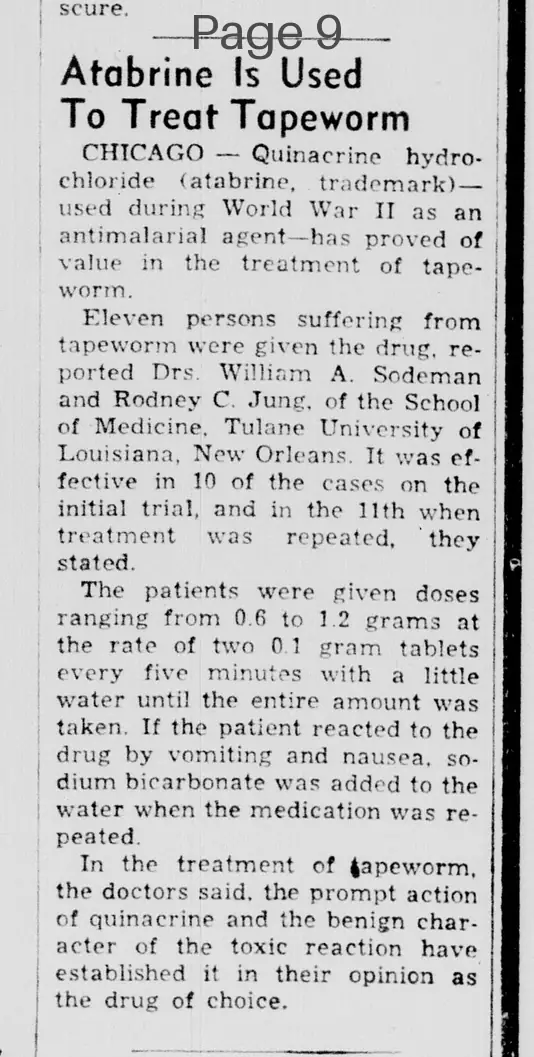
Atabrine Is Used
To Treat Tapeworm
CHICAGO - Quinacrine hydrochloride (atabrine, trademark)-
used during World War II as an antimalarial agent-has proved of value in the treatment of tapeworm.
Eleven persons suffering from tapeworm were given the drug, reported Drs. William A. Sodeman and Rodney C. Jung, of the School of Medicine, Tulane University of Louisiana, New Orleans. It was effective in 10 of the cases on the initial trial, and in the 11th when treatment was repeated, they stated.
The patients were given doses ranging from 0.6 to 1.2 grams at the rate of two 0.1 gram tablets every five minutes with a little water until the entire amount was taken. If the patient reacted to the drug by vomiting and nausea, sodium bicarbonate was added to the water when the medication was repeated.
In the treatment of tapeworm, the doctors said, the prompt action of quinacrine and the benign character of the toxic reaction have established it in their opinion as the drug of choice.
To Treat Tapeworm
CHICAGO - Quinacrine hydrochloride (atabrine, trademark)-
used during World War II as an antimalarial agent-has proved of value in the treatment of tapeworm.
Eleven persons suffering from tapeworm were given the drug, reported Drs. William A. Sodeman and Rodney C. Jung, of the School of Medicine, Tulane University of Louisiana, New Orleans. It was effective in 10 of the cases on the initial trial, and in the 11th when treatment was repeated, they stated.
The patients were given doses ranging from 0.6 to 1.2 grams at the rate of two 0.1 gram tablets every five minutes with a little water until the entire amount was taken. If the patient reacted to the drug by vomiting and nausea, sodium bicarbonate was added to the water when the medication was repeated.
In the treatment of tapeworm, the doctors said, the prompt action of quinacrine and the benign character of the toxic reaction have established it in their opinion as the drug of choice.
What sub-type of article is it?
Medical Curiosity
What themes does it cover?
Recovery
What keywords are associated?
Atabrine
Tapeworm Treatment
Quinacrine Hydrochloride
Tulane University
What entities or persons were involved?
William A. Sodeman
Rodney C. Jung
Where did it happen?
New Orleans
Story Details
Key Persons
William A. Sodeman
Rodney C. Jung
Location
New Orleans
Story Details
Quinacrine hydrochloride (atabrine) proved effective in treating tapeworm in 11 patients, successful in all cases with initial or repeated doses.