Thank you for visiting SNEWPapers!
Sign up free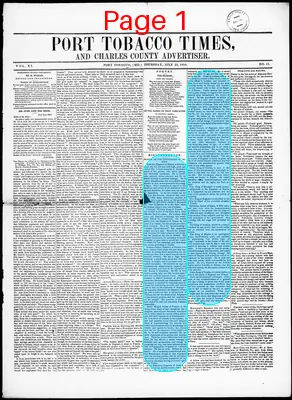
Foreign News
July 13, 1854
Port Tobacco Times, And Charles County Advertiser
Port Tobacco, Charles County, Maryland
What is this article about?
Biographical sketches of major European sovereigns, including their ages, physical descriptions, personal traits, and stances on the emerging general war involving Russia, Turkey, and western powers.
Clipping
OCR Quality
98%
Excellent
Full Text
MISCELLANEOUS.
SKETCH OF THE SOVEREIGNS OF EUROPE.
Nicholas, Emperor of Russia, is fifty-nine years old, six feet one inch high, erect and soldier-like in form, haughty in demeanor, proud of his person, and, when young, was decidedly handsome. He is intelligent, shrewd, stern, resolute, and by no means wanting in personal courage. He is a good disciplinarian, but not a skilful commander in war, as was proved in his younger days. His information in regard to the condition and policy of all nations is minute and extensive, his plans vast, his ambition boundless. In the last respect he resembles the Russian character and sentiment. The same disposition prevails in him to pour down on the more fair and sunny realms of the south and west of Europe, as in the days when the Roman Empire was overwhelmed.
Frederick William, King of Prussia, is the brother-in-law of the Czar, but a very different kind of a man. He is about fifty years old, despotic in feelings, but somewhat liberal by compulsion. He would gladly join the Emperor of Russia in his plans if he dared; but his people are otherwise inclined. He is a "good-looking," tolerable "good-natured," and somewhat stupid sort of a man. Should the present war continue for some years he will probably be found on the side of Russia. His present declaration for neutrality is merely designed to gain time to watch the course of events for one campaign, and then shape his course according to results.
Francis Joseph, Emperor of Austria, is about twenty-three years old, and has succeeded in raising small mustachios for his handsome face, and a small loan for his exhausted treasury. He has a high broad forehead, a good form, about five feet ten inches in height, and is an expert and excellent horseman. He exhibits no sign of extraordinary administrative capacity, and will probably add little to the reputation of the House of Hapsburg. He fell in love with a young lady, last fall, "at first sight," and was recently married to her. His government is almost bankrupt in pecuniary resources, his people are discontented, and his empire is exposed to desperate peril between the contending interests and nations now at war on the continent of Europe. He is greatly indebted to the Emperor of Russia, and would join him in the partition of Turkey, but for the dread of the vengeance of the western powers, and the opposition of his people. His position is perilous, turn where he will and neutrality is almost impossible.
Abdul Medjid, Sultan of Turkey, is but thirty-three years of age, though he has a daughter married and two more betrothed. He is rather small in stature, with a sallow, sad, and mild expression of countenance. He is in favor of reforms in his empire; is just and merciful in his rule, and delights more in superintending his schools and public improvements than in marshaling his armies and navies for battle; but, forced into war for the existence of his empire, as he is, he will doubtless maintain the ancient reputation of his gallant and warlike race. Thus far, in his difficulties with the Czar, he has shown a moral courage, a firmness and moderation, and energy in preparing for war, that have enlisted on his side the sympathies of nearly all civilized nations. He has no wife. Sultans do not marry. He is evidently a sincere and zealous Mahomedan, though he has stipulated with the western powers that he will place the Greek and Christian population of his empire on the same footing as to civil rights as the Turk.
Louis Napoleon, Emperor of France, is rather below the middle stature; has a dull and drowsy eye, and a countenance that ordinarily expresses but little. He is about forty-five years of age, and has had an adventurous life. From an artillery officer in Switzerland, a rowdy in New York, a special police officer in London, and prisoner at Ham, he is now firmly seated on the most dazzling throne of Europe, and wields a power second only to that of the Emperor of Russia. Public opinion has undergone a great change in regard to his mental capacity since he ascended the throne of France. He has manifested an ability of high order as a ruler and statesman; and at this moment, exercises a greater influence over the affairs of Europe than any other sovereign, not even excepting the Emperor of Russia. And this influence he has wielded wisely for his own interests, and thus far, for the honor and interests of France. He enters on the conflict with his great antagonist of Russia with a dauntless spirit and an energy of preparation that shows much of the true metal of his uncle "of glorious memory."
Queen Victoria of England, rules over the most populous, wealthy and powerful empire on the globe. On her dominions the sun never sets; and under her government the people of England and Scotland at least, enjoy more freedom than under any other monarchy. Victoria is now thirty-five years of age; of a mild and amiable disposition, and is an exemplary wife and mother. But as a ruler, she exercises little real authority. Her Cabinet Councilors and Parliament are the actual rulers of the British Empire. The naval power of England is nearly as great as that of all other nations combined and her commerce and manufactures greater than those of any other nation.
Oscar, King of Sweden, is now in the prime of life, and personally is strongly inclined to side with the Czar in the present war. But his people, almost unanimously are hostile to Russia. An armed neutrality is his declared position, and to this position and its rights the Czar accedes.
The King of Denmark is under personal obligations to the Emperor of Russia, but is compelled by his position and the voice of his people, to adopt the policy of neutrality.
The King of Belgium is controlled in his policy by dread of his powerful neighbor of France.
Christina, Queen of Spain, is fully occupied just now with the insurrectionary movements of her people, who are disgusted with her open profligacy, her disregard of the welfare of her subjects, and the arbitrary principles of her government. She is young, but her reign will probably be short.
The King of Sardinia would be a liberal, if backed by any power that would enable him to contend with the myrmidons of Austria.
The King of Naples is an unmitigated tyrant, blood-thirsty, cruel, and resolved on maintaining "the divine right of kings;" and such is the temper of his subjects towards him, that he has a very fair chance of meeting a sudden and violent death. A few years ago he was an accomplished horseman and charioteer, and might be seen almost daily driving through the streets of Naples, with a frequent nod of recognition to his people. He is now seldom seen, except when surrounded by his guards. He is a Bourbon of the French family, and is friendly to Russia; but his influence among the European nations is of little account.
Otho, King of Greece, is a mere cipher, a tool in the hands of England and France.
Such are the principal sovereigns of Europe, at the commencement of a general war that is likely to prove one of the most sanguinary and momentous conflicts that has ever occurred on that continent, and cannot fail to result in the end in many changes in its condition. What these changes may be, time alone can reveal; but there is little doubt that despotism will suffer more than the cause of freedom. The people will gain what the despots lose.
—Petersburgh Post.
SKETCH OF THE SOVEREIGNS OF EUROPE.
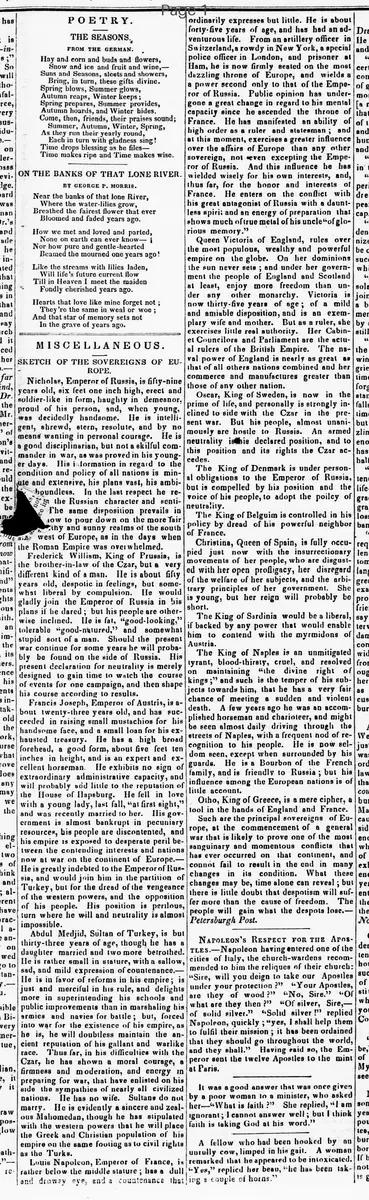
Nicholas, Emperor of Russia, is fifty-nine years old, six feet one inch high, erect and soldier-like in form, haughty in demeanor, proud of his person, and, when young, was decidedly handsome. He is intelligent, shrewd, stern, resolute, and by no means wanting in personal courage. He is a good disciplinarian, but not a skilful commander in war, as was proved in his younger days. His information in regard to the condition and policy of all nations is minute and extensive, his plans vast, his ambition boundless. In the last respect he resembles the Russian character and sentiment. The same disposition prevails in him to pour down on the more fair and sunny realms of the south and west of Europe, as in the days when the Roman Empire was overwhelmed.
Frederick William, King of Prussia, is the brother-in-law of the Czar, but a very different kind of a man. He is about fifty years old, despotic in feelings, but somewhat liberal by compulsion. He would gladly join the Emperor of Russia in his plans if he dared; but his people are otherwise inclined. He is a "good-looking," tolerable "good-natured," and somewhat stupid sort of a man. Should the present war continue for some years he will probably be found on the side of Russia. His present declaration for neutrality is merely designed to gain time to watch the course of events for one campaign, and then shape his course according to results.
Francis Joseph, Emperor of Austria, is about twenty-three years old, and has succeeded in raising small mustachios for his handsome face, and a small loan for his exhausted treasury. He has a high broad forehead, a good form, about five feet ten inches in height, and is an expert and excellent horseman. He exhibits no sign of extraordinary administrative capacity, and will probably add little to the reputation of the House of Hapsburg. He fell in love with a young lady, last fall, "at first sight," and was recently married to her. His government is almost bankrupt in pecuniary resources, his people are discontented, and his empire is exposed to desperate peril between the contending interests and nations now at war on the continent of Europe. He is greatly indebted to the Emperor of Russia, and would join him in the partition of Turkey, but for the dread of the vengeance of the western powers, and the opposition of his people. His position is perilous, turn where he will and neutrality is almost impossible.
Abdul Medjid, Sultan of Turkey, is but thirty-three years of age, though he has a daughter married and two more betrothed. He is rather small in stature, with a sallow, sad, and mild expression of countenance. He is in favor of reforms in his empire; is just and merciful in his rule, and delights more in superintending his schools and public improvements than in marshaling his armies and navies for battle; but, forced into war for the existence of his empire, as he is, he will doubtless maintain the ancient reputation of his gallant and warlike race. Thus far, in his difficulties with the Czar, he has shown a moral courage, a firmness and moderation, and energy in preparing for war, that have enlisted on his side the sympathies of nearly all civilized nations. He has no wife. Sultans do not marry. He is evidently a sincere and zealous Mahomedan, though he has stipulated with the western powers that he will place the Greek and Christian population of his empire on the same footing as to civil rights as the Turk.
Louis Napoleon, Emperor of France, is rather below the middle stature; has a dull and drowsy eye, and a countenance that ordinarily expresses but little. He is about forty-five years of age, and has had an adventurous life. From an artillery officer in Switzerland, a rowdy in New York, a special police officer in London, and prisoner at Ham, he is now firmly seated on the most dazzling throne of Europe, and wields a power second only to that of the Emperor of Russia. Public opinion has undergone a great change in regard to his mental capacity since he ascended the throne of France. He has manifested an ability of high order as a ruler and statesman; and at this moment, exercises a greater influence over the affairs of Europe than any other sovereign, not even excepting the Emperor of Russia. And this influence he has wielded wisely for his own interests, and thus far, for the honor and interests of France. He enters on the conflict with his great antagonist of Russia with a dauntless spirit and an energy of preparation that shows much of the true metal of his uncle "of glorious memory."
Queen Victoria of England, rules over the most populous, wealthy and powerful empire on the globe. On her dominions the sun never sets; and under her government the people of England and Scotland at least, enjoy more freedom than under any other monarchy. Victoria is now thirty-five years of age; of a mild and amiable disposition, and is an exemplary wife and mother. But as a ruler, she exercises little real authority. Her Cabinet Councilors and Parliament are the actual rulers of the British Empire. The naval power of England is nearly as great as that of all other nations combined and her commerce and manufactures greater than those of any other nation.
Oscar, King of Sweden, is now in the prime of life, and personally is strongly inclined to side with the Czar in the present war. But his people, almost unanimously are hostile to Russia. An armed neutrality is his declared position, and to this position and its rights the Czar accedes.
The King of Denmark is under personal obligations to the Emperor of Russia, but is compelled by his position and the voice of his people, to adopt the policy of neutrality.
The King of Belgium is controlled in his policy by dread of his powerful neighbor of France.
Christina, Queen of Spain, is fully occupied just now with the insurrectionary movements of her people, who are disgusted with her open profligacy, her disregard of the welfare of her subjects, and the arbitrary principles of her government. She is young, but her reign will probably be short.
The King of Sardinia would be a liberal, if backed by any power that would enable him to contend with the myrmidons of Austria.
The King of Naples is an unmitigated tyrant, blood-thirsty, cruel, and resolved on maintaining "the divine right of kings;" and such is the temper of his subjects towards him, that he has a very fair chance of meeting a sudden and violent death. A few years ago he was an accomplished horseman and charioteer, and might be seen almost daily driving through the streets of Naples, with a frequent nod of recognition to his people. He is now seldom seen, except when surrounded by his guards. He is a Bourbon of the French family, and is friendly to Russia; but his influence among the European nations is of little account.
Otho, King of Greece, is a mere cipher, a tool in the hands of England and France.
Such are the principal sovereigns of Europe, at the commencement of a general war that is likely to prove one of the most sanguinary and momentous conflicts that has ever occurred on that continent, and cannot fail to result in the end in many changes in its condition. What these changes may be, time alone can reveal; but there is little doubt that despotism will suffer more than the cause of freedom. The people will gain what the despots lose.
—Petersburgh Post.
What sub-type of article is it?
Court News
Political
War Report
What keywords are associated?
European Sovereigns
Russian War
Neutrality Policies
Royal Profiles
Crimean Conflict
Despotic Rulers
Western Powers
What entities or persons were involved?
Nicholas Emperor Of Russia
Frederick William King Of Prussia
Francis Joseph Emperor Of Austria
Abdul Medjid Sultan Of Turkey
Louis Napoleon Emperor Of France
Queen Victoria Of England
Oscar King Of Sweden
King Of Denmark
King Of Belgium
Christina Queen Of Spain
King Of Sardinia
King Of Naples
Otho King Of Greece
Where did it happen?
Europe
Foreign News Details
Primary Location
Europe
Key Persons
Nicholas Emperor Of Russia
Frederick William King Of Prussia
Francis Joseph Emperor Of Austria
Abdul Medjid Sultan Of Turkey
Louis Napoleon Emperor Of France
Queen Victoria Of England
Oscar King Of Sweden
King Of Denmark
King Of Belgium
Christina Queen Of Spain
King Of Sardinia
King Of Naples
Otho King Of Greece
Event Details
Sketches of European sovereigns detailing their ages, appearances, characters, and positions regarding the ongoing war with Russia, including personal inclinations towards alliances, neutrality, or opposition, and domestic challenges.