Thank you for visiting SNEWPapers!
Sign up free
The Portland Daily Press
Portland, Cumberland County, Maine
What is this article about?
In Washington on August 18, a large enthusiastic demonstration honored released Union officers including Col. Michael Corcoran, Col. Wilcox, and others. Speeches by Hon. Alfred Ely, Corcoran, Wilcox, and additional speakers praised their service and urged continued effort against the rebellion.
Clipping
OCR Quality
Full Text
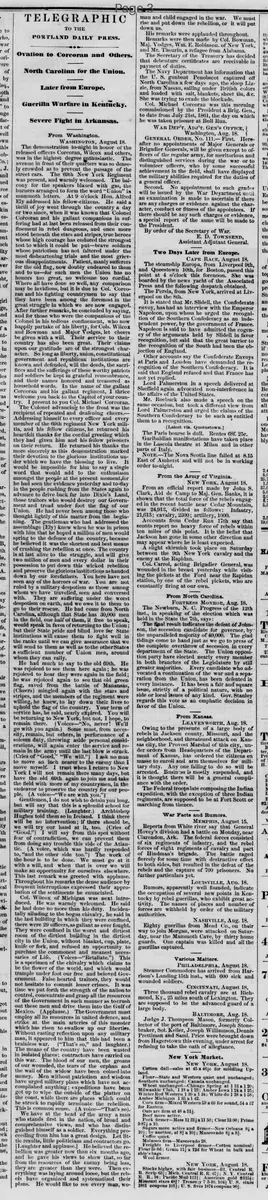
TO THE PORTLAND DAILY PRESS.
Ovation to Corcoran and Others.
North Carolina for the Union.
Later from Europe.
Guerilla Warfare in Kentucky.
Severe Fight in Arkansas.
From Washington.
WASHINGTON, August 18.
The demonstration to-night in honor of the released officers Corcoran, Wilcox and others, was in the highest degree enthusiastic. The avenue in front of their quarters was so densely crowded as to prevent the passage of the street cars. The 69th New York Regiment was present, and warmly welcomed. The balcony for the speakers blazed with gas, the burners arranged to form the word "Union" in mammoth letters. At 9 o'clock Hon. Alfred Ely addressed his fellow-citizens. He said a thrill of joy went through the country a day or two since, when it was known that Colonel Corcoran and his gallant companions in suffering had at last been released from their confinement in rebel dungeons, and once more stood beneath the stars and stripes, true heroes whose high courage has endured the strongest test to which it could be put—brave soldiers whose patriotism has not faltered under the most disheartening trials and the most grievous disappointments. Patient, manly sufferers for the old flag, now doubly endeared to them and to us—for such men the Union has no honors too great, no welcome too cordial. Where all have done so well, any comparison may be invidious, but it is due to Col. Corcoran and his fighting countrymen to say that they have been among the foremost in the great struggle in which we are now engaged. After further remarks, he concluded by saying, and for those who were the companions of the Colonel in his tedious confinement, who now happily partake of his liberty, for Cols. Wilcox and Bowman and Major Vodges, let cheers be given with a will. Their service to their country has also been great. Their claims upon our gratitude are of the strongest character. So long as liberty, union, constitutional government and republican institutions are known and defended, will the deeds, the sacrifices and the sufferings of these worthy patriots and soldiers be kept in grateful remembrance, and their names honored and treasured as household words. In the name of the gallant Corcoran and his gallant regiment, I thrice welcome you back to the Capitol of your country. I present to you Col. Michael Corcoran.
[A tremendous applause followed the presentation of Col. Corcoran, who was loudly cheered. He responded as follows:]
Fellow Citizens:—I thank you for this cordial welcome. [Cheers.] I have never been among those who thought lightly of this matter from the beginning. The gentleman who has addressed the assemblage [Ely] knew when he was in prison with him that he hoped a million of men would spring to the defence of the country, because he believed it was the shortest and best means of crushing the rebellion at once. The country is at last alive to the struggle, and will give two million of men and every dollar in their possession to put down this wicked rebellion and preserve the glorious institutions as handed down by our forefathers. You here have not seen any of the horrors of war. You are not ruled by a military despotism as those among whom we have travelled, stayed and conversed with. They are suffering under the worst despotism on earth, and we owe it to them to go to their rescue. He had come from North Carolina, although that State has 30,000 men in the field, one half of them, if free to speak, would speak in favor of returning to the Union; but their State pride and blind love for State institutions will cause them to fight well in the ranks until we can give assurance that we will send to them as well as to the other States a sufficient number of Union men, around whom they can rally.
He had much to say to the old 69th. He was rejoiced to see them here again; he was rejoiced to hear they were again in the field; he was rejoiced again to see that old green flag, scarred from the battle of Manassas, [Cheers] mingled again with the stars and stripes, and the members of the regiment were willing, he knew, to lay down their lives to uphold the flag of the country. Your term of service has, he said, nearly expired. You will be returning to New York, but not, I hope, to remain there. [Voices—"No, never! We'll go with you again."] Some must, from necessity, remain, but others, in performance of a solemn duty, throwing aside personal considerations, will again enter the service and remain in the army until the last blow is struck. [Cries of "Good," "We will."] I ask no man to move an inch nearer to the enemy than I move myself. I trust when I return to New York I will not remain there many days, but have the old 69th again to join me and take the field with more of my countrymen, in the endeavor to preserve the country for our people. [A voice—"We are with you."]
Gentlemen, I do not wish to detain you long, but will say that this is a splendid school for military training. [Laughter.] Archbishop Hughes told them so in Ireland. I think there will be no intervention: if there should be, we will try our hand at it, too. [Cries of "Good."] I will say from this spot without fear of contradiction, we can prevent them from doing any trouble this side of the Atlantic. [A voice, which was hardly responded to, "and the other side too."] The work of the hour is to be done. We must go at it with a will, and when that is over we will make an opportunity for ourselves elsewhere.
This last remark was greeted with applause. Throughout his remarks the dense audience by frequent interruptions expressed their approbation of the sentiments he enunciated.
Col. Wilcox of Michigan was next introduced. He was warmly welcomed. He said he had done no more than his duty. Incidentally alluding to the bogus chivalry, he said in the last building in which they were confined, there were 29 officers, as gallant as ever fought. They were confined in the worst and dirtiest room of the dirtiest building in the dirtiest city in the Union, without blanket, cup, plate, knife or fork, and refused an opportunity to purchase the commonest and meanest necessaries of life. [Voices—"Retaliate."] This is a specimen of the chivalry which claims to be the flower of the world, and which would trample under foot our free and beloved Government. False hearted traitors, they would not hesitate to commit lesser crimes. It was time we put forth the strength of the nation to control, concentrate and grasp all the resources of the Government in such manner as to crush out these men and drive them into the Gulf of Mexico. [Applause.] The Government must employ all its resources in united defence, and strike at the main arteries of this monster which has risen to swallow up our liberties. Without casting reflection upon any military man, it appeared to him that this had been a brainless war. ["That's so," and laughter.] The means of the country have been wasted in isolated places; contractors have carried on this war. The blood of our men, the groans of our wounded, the tears of the orphan and the wail of the widow have been coined into money. Men without patriotism and wisdom have urged military plans which have not accomplished anything; expeditions have been got up to wipe the outside of the platter on the coast, while there are places which could be struck to rapidly terminate the rebellion. This is common sense. [A voice—"That's so."] We have at the head of the army a man who stands first in the nation, of broad and comprehensive views, and who has distinguished himself as a soldier. Everything proceeding from him has a great design. Let little results, little politicians and contractors go. [Laughter and applause.] He believed the rebellion was greater now than six months ago, and he gave his views to show that, so far from the resources of the enemy being less, they are greater than they were. Then everything was laying around loose, but the rebels have organized and systematized their plans. He would like to see every man, woman and child engaged in the war. We must rise and put down the rebellion, or it will put down us.
His remarks were applauded throughout.
Remarks were then made by Col. Bowman, Maj. Vodges, Wm. E. Robinson, of New York, and Mr. Thourin, a refugee from Alabama.
What sub-type of article is it?
What keywords are associated?
What entities or persons were involved?
Where did it happen?
Domestic News Details
Primary Location
Washington
Event Date
August 18
Key Persons
Outcome
enthusiastic public welcome and speeches praising the officers' service and calling for continued union effort against the rebellion.
Event Details
A large demonstration in front of the released officers' quarters featured speeches by Hon. Alfred Ely introducing Col. Corcoran, who thanked the crowd and urged support for the war; Col. Wilcox criticized rebel treatment and war conduct; additional remarks by Col. Bowman, Maj. Vodges, Wm. E. Robinson, and Mr. Thourin. The 69th New York Regiment attended, and the event included cheers and applause.