Thank you for visiting SNEWPapers!
Sign up free
Editorial
February 19, 1943
The East Hartford Gazette
New Britain, Hartford County, Connecticut
What is this article about?
Editorial criticizes U.S. administration's expanded WWII draft policy drafting married men and requiring war work, predicting catastrophic manpower shortages, collapse of small businesses, and unsustainable civilian economy despite demands for more production and aid to allies.
Clipping
OCR Quality
98%
Excellent
Full Text
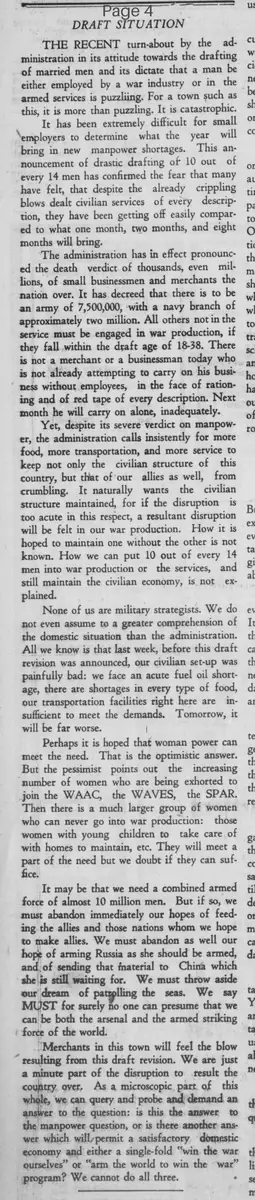
DRAFT SITUATION
THE RECENT turn-about by the administration in its attitude towards the drafting
of married men and its dictate that a man be
either employed by a war industry or in the
armed services is puzzling. For a town such as
this, it is more than puzzling. It is catastrophic.
It has been extremely difficult for small
employers to determine what the year will
bring in new manpower shortages. This announcement of drastic drafting of 10 out of
every 14 men has confirmed the fear that many
have felt, that despite the already crippling
blows dealt civilian services of every description, they have been getting off easily compared
to what one month, two months, and eight
months will bring.
The administration has in effect pronounced
the death verdict of thousands, even millions, of small businessmen and merchants the
nation over. It has decreed that there is to be
an army of 7,500,000, with a navy branch of
approximately two million. All others not in the
service must be engaged in war production, if
they fall within the draft age of 18-38. There
is not a merchant or a businessman today who
is not already attempting to carry on his business without employees, in the face of rationing and of red tape of every description. Next
month he will carry on alone, inadequately.
Yet, despite its severe verdict on manpower,
the administration calls insistently for more
food, more transportation, and more service to
keep not only the civilian structure of this
country, but that of our allies as well, from
crumbling. It naturally wants the civilian
structure maintained, for if the disruption is
too acute in this respect, a resultant disruption
will be felt in our war production. How it is
hoped to maintain one without the other is not
known. How we can put 10 out of every 14
men into war production or the services, and
still maintain the civilian economy, is not explained.
None of us are military strategists. We do
not even assume to a greater comprehension of
the domestic situation than the administration.
All we know is that last week, before this draft
revision was announced, our civilian set-up was
painfully bad: we face an acute fuel oil shortage, there are shortages in every type of food,
our transportation facilities right here are insufficient to meet the demands. Tomorrow, it
will be far worse.
Perhaps it is hoped that woman power can
meet the need. That is the optimistic answer.
But the pessimist points out the increasing
number of women who are being exhorted to
join the WAAC, the WAVES, the SPAR.
Then there is a much larger group of women
who can never go into war production: those
women with young children to take care of
with homes to maintain, etc. They will meet a
part of the need but we doubt if they can suffice.
It may be that we need a combined armed
force of almost 10 million men. But if so, we
must abandon immediately our hopes of feeding the allies and those nations whom we hope
to make allies. We must abandon as well our
hope of arming Russia as she should be armed,
and of sending that material to China which
she is still waiting for. We must throw aside
our dream of patrolling the seas. We say
MUST for surely no one can presume that we
can be both the arsenal and the armed striking
force of the world.
Merchants in this town will feel the blow
resulting from this draft revision. We are just
a minute part of the disruption to result the
country over. As a microscopic part of this
whole, we can query and probe and demand an
answer to the question: is this the answer to
the manpower question, or is there another answer which will permit a satisfactory domestic
economy and either a single-fold "win the war
ourselves" or "arm the world to win the war"
program? We cannot do all three.
THE RECENT turn-about by the administration in its attitude towards the drafting
of married men and its dictate that a man be
either employed by a war industry or in the
armed services is puzzling. For a town such as
this, it is more than puzzling. It is catastrophic.
It has been extremely difficult for small
employers to determine what the year will
bring in new manpower shortages. This announcement of drastic drafting of 10 out of
every 14 men has confirmed the fear that many
have felt, that despite the already crippling
blows dealt civilian services of every description, they have been getting off easily compared
to what one month, two months, and eight
months will bring.
The administration has in effect pronounced
the death verdict of thousands, even millions, of small businessmen and merchants the
nation over. It has decreed that there is to be
an army of 7,500,000, with a navy branch of
approximately two million. All others not in the
service must be engaged in war production, if
they fall within the draft age of 18-38. There
is not a merchant or a businessman today who
is not already attempting to carry on his business without employees, in the face of rationing and of red tape of every description. Next
month he will carry on alone, inadequately.
Yet, despite its severe verdict on manpower,
the administration calls insistently for more
food, more transportation, and more service to
keep not only the civilian structure of this
country, but that of our allies as well, from
crumbling. It naturally wants the civilian
structure maintained, for if the disruption is
too acute in this respect, a resultant disruption
will be felt in our war production. How it is
hoped to maintain one without the other is not
known. How we can put 10 out of every 14
men into war production or the services, and
still maintain the civilian economy, is not explained.
None of us are military strategists. We do
not even assume to a greater comprehension of
the domestic situation than the administration.
All we know is that last week, before this draft
revision was announced, our civilian set-up was
painfully bad: we face an acute fuel oil shortage, there are shortages in every type of food,
our transportation facilities right here are insufficient to meet the demands. Tomorrow, it
will be far worse.
Perhaps it is hoped that woman power can
meet the need. That is the optimistic answer.
But the pessimist points out the increasing
number of women who are being exhorted to
join the WAAC, the WAVES, the SPAR.
Then there is a much larger group of women
who can never go into war production: those
women with young children to take care of
with homes to maintain, etc. They will meet a
part of the need but we doubt if they can suffice.
It may be that we need a combined armed
force of almost 10 million men. But if so, we
must abandon immediately our hopes of feeding the allies and those nations whom we hope
to make allies. We must abandon as well our
hope of arming Russia as she should be armed,
and of sending that material to China which
she is still waiting for. We must throw aside
our dream of patrolling the seas. We say
MUST for surely no one can presume that we
can be both the arsenal and the armed striking
force of the world.
Merchants in this town will feel the blow
resulting from this draft revision. We are just
a minute part of the disruption to result the
country over. As a microscopic part of this
whole, we can query and probe and demand an
answer to the question: is this the answer to
the manpower question, or is there another answer which will permit a satisfactory domestic
economy and either a single-fold "win the war
ourselves" or "arm the world to win the war"
program? We cannot do all three.
What sub-type of article is it?
Military Affairs
Economic Policy
Labor
What keywords are associated?
Draft Policy
Manpower Shortages
Small Business Impact
Civilian Economy
War Production
Administration Policy
Woman Power
Armed Forces Expansion
What entities or persons were involved?
Administration
Editorial Details
Primary Topic
Critique Of Expanded Draft Policy Impacting Civilian Economy And Small Businesses
Stance / Tone
Critical And Puzzled
Key Figures
Administration
Key Arguments
Expanded Draft Of Married Men And Requirement For War Industry Employment Or Service Is Puzzling And Catastrophic For Small Towns
Drastic Drafting Of 10 Out Of Every 14 Men Confirms Fears Of Worsening Manpower Shortages For Civilian Services
Administration Decrees Army Of 7,500,000 And Navy Of Two Million, Forcing All Draft Age Men Into Service Or War Production
Small Businessmen Already Struggling Without Employees Amid Rationing And Red Tape Will Be Left Alone
Administration Demands More Food, Transportation, And Service To Maintain Civilian And Allied Structures Despite Manpower Verdict
Unclear How To Maintain Civilian Economy While Putting 10 Out Of 14 Men Into War Production Or Services
Civilian Setup Already Bad With Shortages; Will Worsen
Woman Power Insufficient Due To Military Recruitment And Women With Young Children
Must Abandon Hopes Of Feeding Allies, Arming Russia And China, And Patrolling Seas If Needing 10 Million Armed Forces
Questions If This Draft Is The Answer Or If Another Allows Satisfactory Domestic Economy And War Program